Research and Innovation Bulletin

The Research and Innovation Bulletin is distributed weekly every Tuesday by the Office of Research Services and includes information on research funding opportunities, events and workshops and updates from our funding partners. 

Check out the latest version of our Bulletin, by clicking here.

Research and innovation bulletin

Celebrating National Nursing Week 2025

Andrea OltsherThe School of Nursing is pleased to celebrate National Nursing Week from May 12-18. This special week honours and celebrates the hard work and dedication of all nurses across Canada. This year’s theme is “The Power of Nurses to Transform Health.” This is a fitting theme as our healthcare services and systems are led by nurses and other valued members of multi-disciplinary team into transformational, post-COVID changes.
This acknowledgement of Canadian nurses is actually launched on May 8th with the celebration of National Indigenous Nurses' day. May 8th specifically honours the important contributions and achievements of all Indigenous nurses, including First Nations, Inuit, and Metis nurses in Canada.

Nurses work across many sectors and in many diverse and challenging roles, including roles in acute care, chronic care, long-term care, public health, community care, education, research, policy, administration, and more! The School of Nursing is proud to have many amazing alumni across the world. Together, with our colleagues, workplaces, and communities we celebrate this week to honour all nurses. The School is so proud of all that Lakehead’s nursing graduates accomplish as leaders and as valued care providers with the knowledge, skills, and abilities to truly make a difference in the lives of individuals, families, and communities.

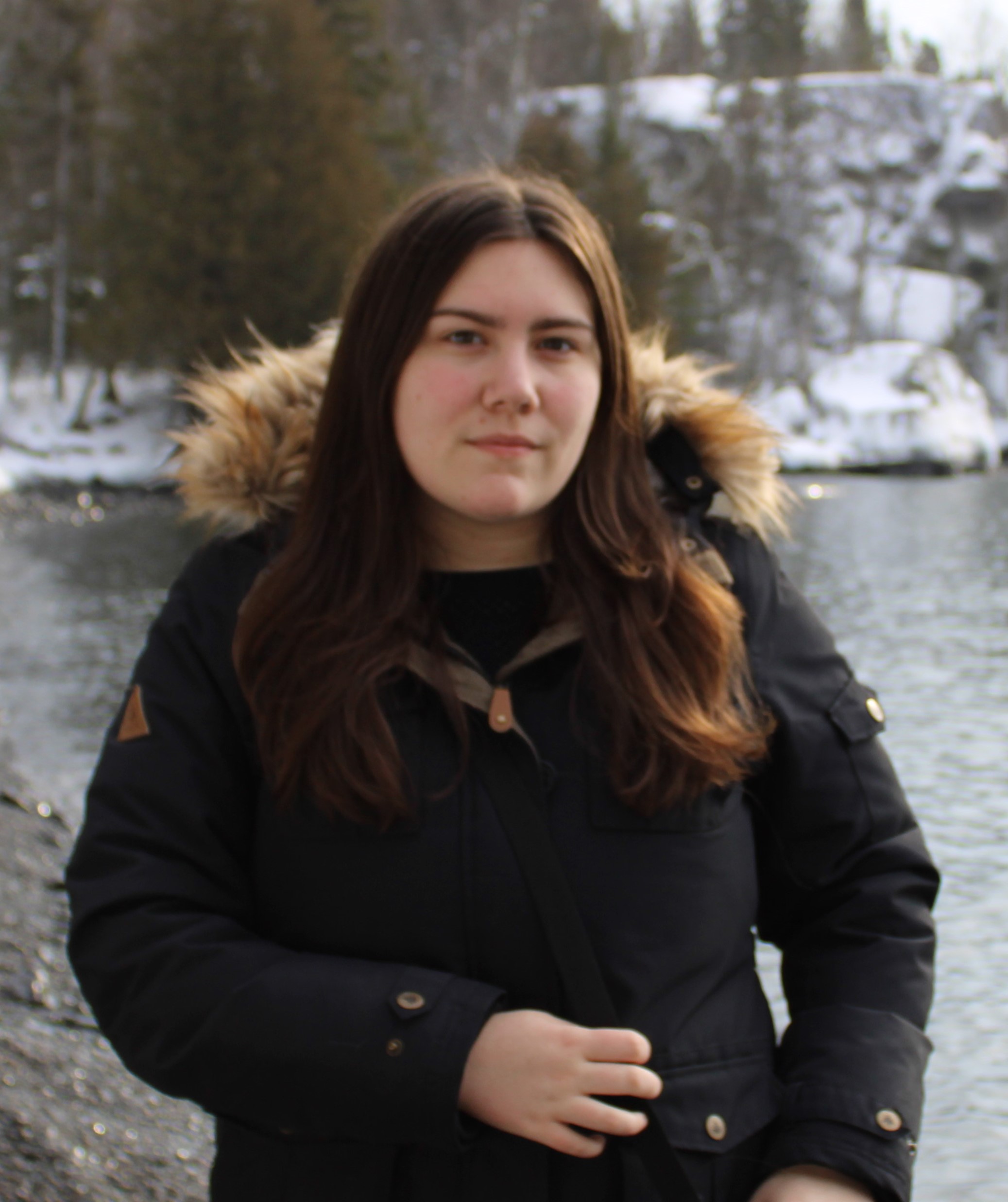
The School of Nursing is very proud to acknowledge one of our Master of Nursing- Advanced Nursing students, Andrea Oltsher. Andrea was nominated for and won the prestigious SE H.O.P.E. Award by the Registered Nurses’ Foundation of Ontario (RNFOO). With a value of $2,500, this scholarship is one of highest valued awards offered by RNFOO's academic awards program. The judging for the awards was rigorously conducted by 43 judges on the RNFOO Awards & Scholarship Review Panel. Andrea (see photo attached) attended the Hybrid Gala to receive her award on May 7th, along with current and future leaders of the nursing profession. Recipients of this award must show that their career path is dedicated to the principles of the H.O.P.E. Model® (Home, Opportunity, People, Empowerment) in Community Nursing. Congratulations Andrea!

Life is an Adventure for Holly Gray

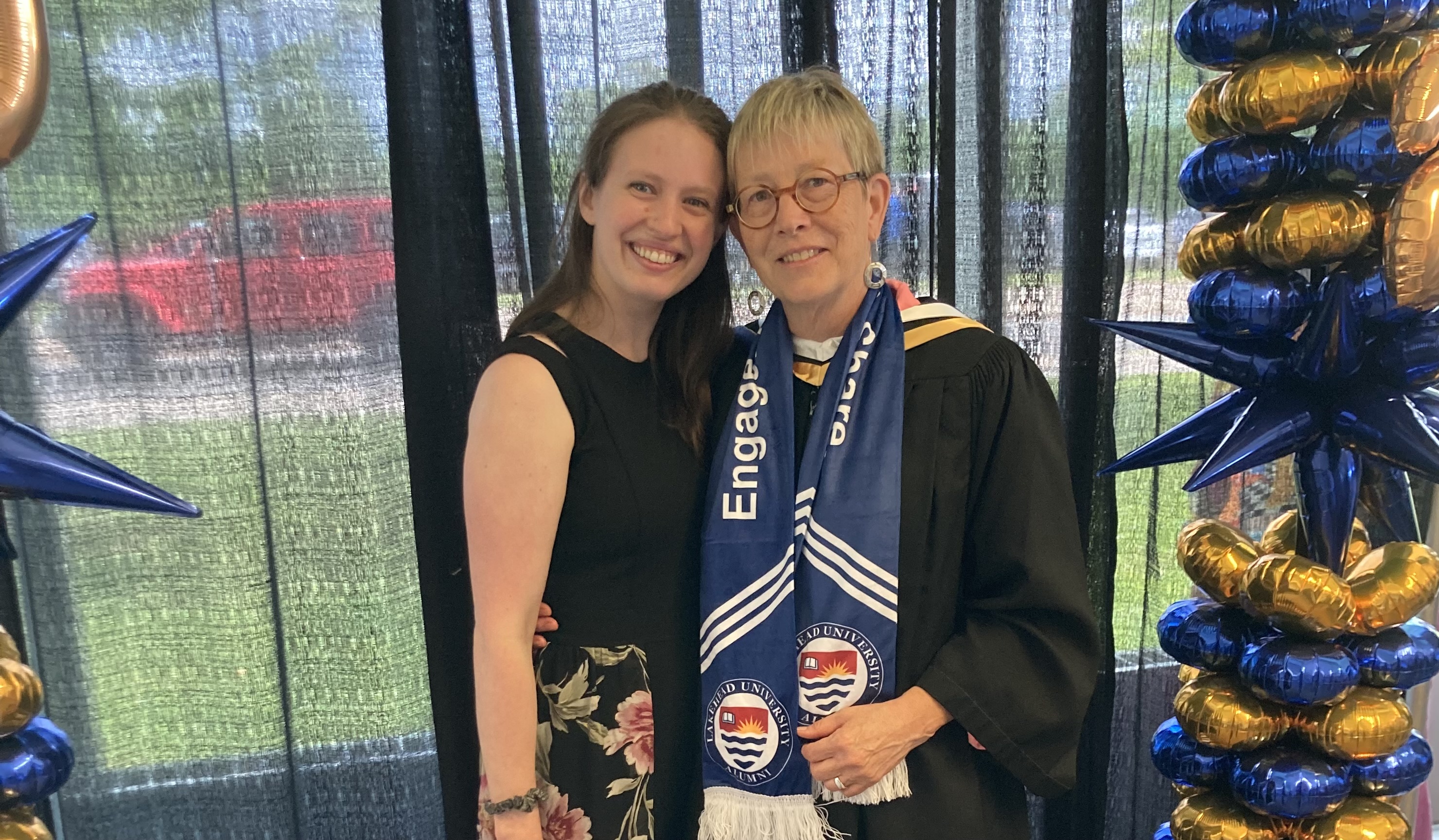
Holly Gray wearing a convocation robe stands beside her daughter Alexandria at her 2024 convocation

"Lakehead has not only pushed me to be the best I can be academically, but also the best person I can be," says Holly Gray, who received an Honours Bachelor of Arts and Science in Anthropology in 2024. Above, Holly and her daughter Alexandria celebrate Holly's graduation.

"In the fall of 2016, I was bemoaning to my husband and my daughter that although I'd been exercising my body, my mind was in the parking lot," says recent Lakehead grad Holly Gray.

"My daughter said, 'Oh, mom! Just take a course.' I said, 'Great idea, but what course?' and she replied, 'Anthropology.'"

That was the start of a new chapter for Holly, whose curious mind and independent streak was apparent even as a child.

She grew up in the small village of Victoria Harbour on Georgian Bay where she spent her time swimming, skiing, and tobogganing. Holly also earned pocket money by babysitting for 25 cents an hour. Her favourite early jobs, though, were more unconventional. "I worked on horse farms and in a mechanics shop repairing bicycles, lawnmowers, and chainsaws," Holly says. "I just loved it, my poor mother, however, was mortified because I was the only girl at my high school graduation with grease under her fingernails."

Holly then earned a Bachelor of Arts at the University of Guelph. She'd hoped to pursue her postsecondary education further, but life and its challenges got in the way—that is until several decades later when she drove to Lakehead Orillia to sign up for an anthropology course.

As fate would have it, Professor Tim Kaiser was running a mock archaeological dig on campus that day. Holly went over to talk to him and "Dr. Kaiser, who's a wonderful gentleman, said, 'Why don't you join my class?'

The course was called Ancient People and Places," Holly continues, "so I thought that's good, since I'm ancient—but I was scared because it was a second-year course."

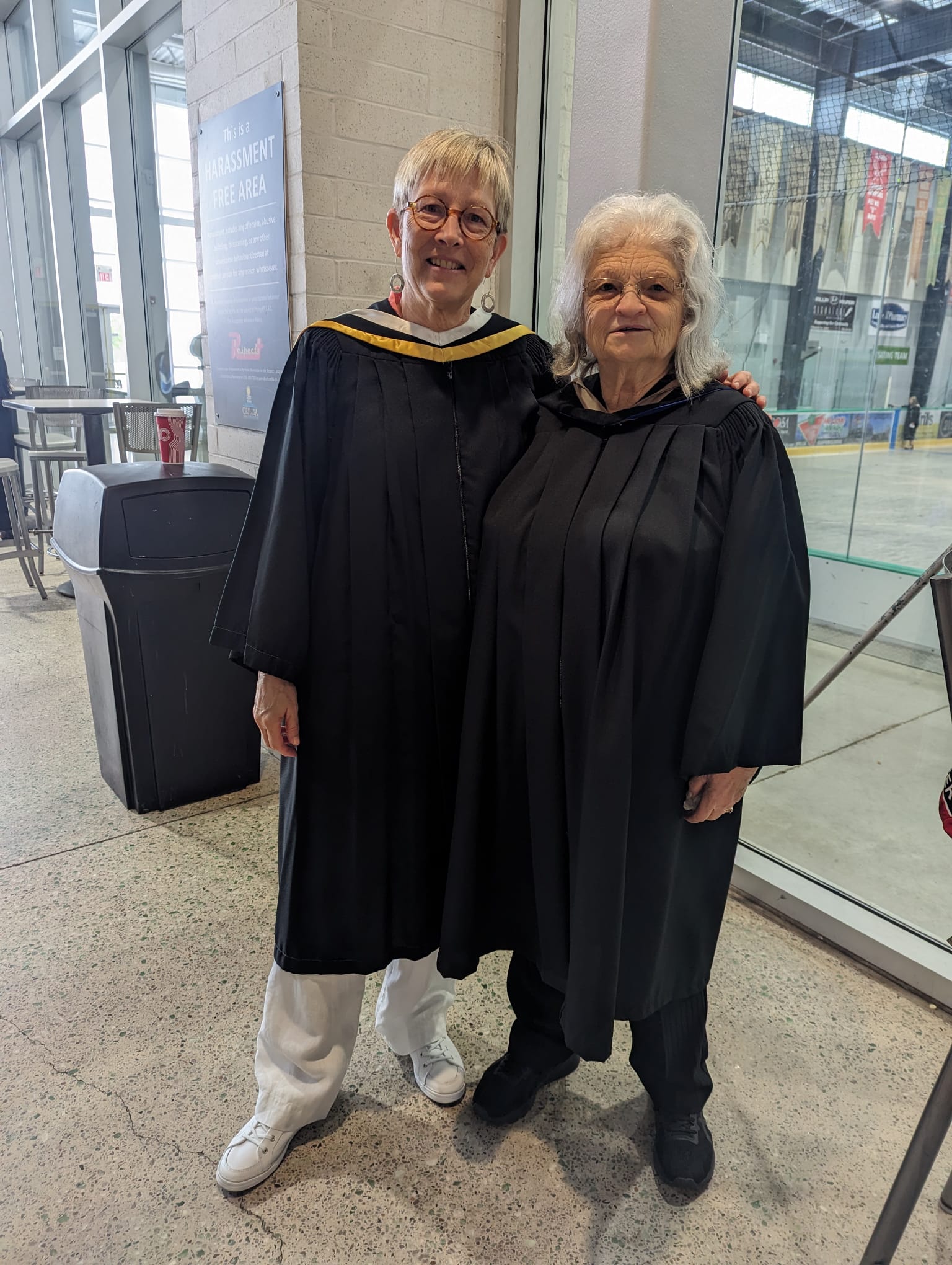
Holly Gray and Ginny Majury stand next to each other wearing convocation robes

“Lakehead’s instructors have been outstanding—Dr. Frederico Oliveira is a gem of a man—and it’s a gift to be able to meet the kids and be accepted by them,” Holly says. “Everyone from the cafeteria and library staff to security, students, and professors have treated me with kindness and respect. It’s been an incredible joy.” Left, Holly and her friend Ginny Majury on their graduation day.

Her fears were eased after she spotted two other seniors in the class. One of them, Ginny Majury, became her study buddy. Soon, Holly was taking more courses, with the goal of earning a degree, and she and Ginny were forming study groups and providing tea and cookies for the students who came. Off-campus experiences were equally important to Holly. "I went on a life-altering dig led by Dr. Scott Hamilton and Dr. Frederico Oliveira at the Indigenous community of Slate Falls north of Sioux Lookout, Ontario. We were looking at the site of the original community of Slate Falls before they were forced to move from their island to the mainland."

As graduation day drew nearer, Holly applied to be the Voice of the Class speaker at Lakehead's June 2024 convocation ceremonies, not expecting to be selected.

"I felt that being a senior and a part-time student disqualified me from speaking, then I found out I'd been chosen. I was absolutely honoured and thrilled—I was also absolutely terrified."

Holly has now embarked on a Master of Environmental Studies degree specializing in anthropology, and she's even considering doing a PhD. "I'd like to investigate the social, political, and legal ramifications of so many things."

As Holly said in her Voice of the Class speech, "None of us are too young, nor too old to be agents of change in the world around us. Just try to do things, live through the fear of it, and you'll be amazed at what a different person you'll be."

Brandon Rhéal Amyot Uplifts Students and Communities

"I love to bake—it's my escape and one of the ways that I express caring," says Brandon Rhéal Amyot, a soon-to-be graduate of Lakehead Orillia's Bachelor of Arts and Science in Interdisciplinary Studies program. "When I was a kid, my mom and I would bring trays of baked goods to our neighbours during the holidays."

In elementary school, Brandon's baking abilities helped take them in a new direction after a teacher recommended they attend an Ontario Educational Leadership Centre (OELC) summer camp. "I'm from a working-class family," Brandon explains, "so I spent months baking cookies and selling them at recess to raise money to attend OELC—my mum would find me baking at midnight."

Brandon Rheal Amyot talks with three other members of the 2024 LUSU executive team

Brandon (second from left) attended Georgian College and Carleton University before coming to Lakehead. They will be graduating with a Bachelor of Arts and Science in Interdisciplinary Studies in June 2025. This unique degree gave them the opportunity to study political science, media, film, and communications.

Brandon's sense of civic engagement is a thread that runs throughout their life. Today, they are an inspiring intersectional activist focused on youth, postsecondary education, media, and the 2SLGBTQ+ and Indigenous communities. They spent 10 years volunteering with Fierté Simcoe Pride—a grassroots organization that advocates for the 2SLGBTQ+ community—before becoming the VP Orillia of the Lakehead University Student Union (LUSU).

"I always ask myself, 'How can I fight for students, for Lakehead, and for equity?' I had to fight to open the door to postsecondary education for myself, and I want to leave it open for others. Although I'm the first person in my family to go to college or university, I hope I won't be the last."

Brandon enrolled at Lakehead Orillia because "it's an interdisciplinary campus by design. I didn't want to go to school simply to get a job. I wanted to become a lifelong learner and build skills to uplift communities, and interdisciplinary studies lend themselves to that." Brandon believes there's real power in students working together. "It's what enabled us to open LUSU Orillia's Food Pantry—an emergency food resource for students in need that's served over 2,200 students since opening in October 2022. The Food Pantry is one of my proudest achievements because I've struggled with food security at certain points.

Brandon Rhéal Amyot walks across a rainbow crosswalk on a summer day

"After Lakehead, I feel much more prepared to be part of the world and to take on the world," Brandon says. "I owe that to my family, friends, and instructors who've encouraged me to stay the path." Photo credit: Jessica Owen

With the increasing wealth inequality and the social and political challenges gripping us, we need to step up in any way we can," adds Brandon, who recently joined the City of Orillia's Poverty Reduction Working Group. They have also officially launched their career, even though they are still a month away from graduation.

"I've been hired as LUSU's first governance and advocacy officer, supporting student leaders, the union, and our university community. I'm also working part-time with the Paapiiwaaniimaan Grassy Narrows Mercury Care Home as an executive assistant with their Operational Planning Committee. These roles are both close to my heart and offer me a way to give back.

We have to take bold risks as students, faculty, staff, and community members, and do it with grit and with love. That's the whole purpose of higher education—Lakehead instilled in me that a rising tide lifts all boats."

Award-Winning Scholar Dr. Michel S. Beaulieu Explores Northwestern Ontario’s Overlooked History

OHS Executive Director Daniel Dishaw and Dr. Michel Beaulieu at the Cruikshank Gold Medal Ceremony on February 7, 2025

Dr. Michel S. Beaulieu (right) received the Cruikshank Gold Medal for Outstanding Service to the Ontario Historical Society in February 2025. In addition to his 2025 Cruikshank Gold Medal, Dr. Beaulieu received a King Charles III Coronation Medal in March 2025 for his contributions as educator, volunteer, and philanthropist.

"I'm very curious, if you dangle something in front of me that I don't know anything about, I'll latch onto it," Dr. Michel S. Beaulieu says.

That's plainly evident from Dr. Beaulieu's diverse body of work. He's a history professor specializing in northern Ontario, as well as Lakehead University's Associate Vice-Provost (Academic) and a Lakehead alum. Dr. Beaulieu has written about everything from labour and politics to resource development, including Second World War German POWs and the pioneering northwestern Ontario filmmaker Dorothea Mitchell—"the Lady Lumberjack" who also ran a sawmill.

His love of history extends beyond his roles as professor and researcher to encompass more than two decades spent volunteering with heritage and historical organizations such as the Ontario Historical Society (OHS), the Multicultural History Society of Ontario, the Northwestern Ontario Archivists' Association, and the Thunder Bay Historical Museum Society. Behind his efforts is a commitment to bring to light history that challenges prevailing views.

"There are certain grand narratives of Canadian history that overlook those who live in regions like northwestern Ontario," Dr. Beaulieu explains, "and it's not just that our story or region needs to be included, it's about countering narratives that are, at times, exclusionary, inaccurate, and that don't reflect the experiences of many geographic and ethnic communities in Canada."

It's because of the high standard of his scholarship, his mentoring of students, his philanthropic work, and his time serving on boards, associations, and societies that Dr. Beaulieu was recently awarded the Ontario Historical Society's highest honour—the Cruikshank Gold Medal.

The medal, which is only rarely given out, recognizes individuals who've gone above and beyond to preserve, promote, and protect the history of Ontario and, in doing so, for their service for the OHS.

"I was overwhelmed when I found out," Dr. Beaulieu says. "Past award recipients are people that I've looked up to and admired."

In the presentation of the award, the OHS also drew special attention to Dr. Beaulieu's leadership in transitioning the journal Ontario History into an online publication and, as a result, bringing "Ontario's foremost history journal to readers on a global scale."

Ontario Historical Society Cruikshank Gold Medal placed on top of an Ontario Historical Society Bulletin

"I first came to Lakehead as an undergraduate student," Dr. Beaulieu says. "I chose Lakehead because of the interest that the faculty took in me as an individual, the volunteer opportunities, and the financial support—I was the first person in my family to go to university and that wouldn't have been possible without awards and scholarships." He's also grateful for the funding he's received from SSHRC and other organizations for his research.

"If we don't preserve and promote the histories and experiences of northwestern Ontario, who will?" Dr. Beaulieu asks. "Knowledge of our history shapes how we talk about the province and the nation, and I want to contribute to that."

"In many ways, I was drawn to history because of my mom and dad," adds Dr. Beaulieu, who grew up in Brampton, Ontario. "It was their suggestion that I volunteer with the Region of Peel Museum while I was in high school that sparked my life-long passion for volunteerism. The staff, particularly Bill Barber and Janice Calvert, introduced me to the good, the bad, and the fascinating in Ontario's history. It was a vastly different history from what I was taught previously."

He believes that some of the problems facing democracies today stem from a devaluing of history and historical education. "It's frustrating when decision makers are ignorant of the past or create skepticism about historical events. It's alarming and, frankly, dangerous, when individuals, organizations, and politicians, dispute, for example, the trauma caused by residential schools, the role racism has played in our society, or argue that the Holocaust never occurred."

Despite these hurdles, Dr. Beaulieu takes great joy in engaging people in our region's history. "History is meant to be shared. It's not meant to stay behind closed doors."

Can a Tiny Shrimp Reverse an Environmental Disaster? Biologist Dr. Michael Rennie has the answer.

Michael Rennie standing beside a boat filled with equipment at the shore of a lake

The general public and policymakers at all levels of government use Dr. Rennie's stellar research work for the sustainable resource management of aquatic ecosystems.

Acid rain fell unrelentingly on Canada's lakes from the Industrial Revolution until the 1980s when modern environmental regulations came into effect.

The effects of this rain, generated by manufacturing and coal-burning industries belching pollutants into the atmosphere, were catastrophic. Many pristine northern Ontario lakes were acidified and the plants, fish, and other aquatic life native to them died off. But for several years, Lakehead University's Dr. Michael Rennie and his team of students have been researching how to reverse this environmental devastation.

"The lakes were greatly helped by bi-lateral agreements between Canada and the United States that dramatically reduced the levels of sulfur dioxide and nitrogen oxides that cause acid rain," explains Dr. Rennie—a Lakehead University biology professor and the head of the Community Ecology and Energetics Lab.

"By the 2000s, the pH levels of many lakes had returned to normal, but the diversity of fish, zooplankton, and invertebrate communities were very low, indicating that these lakes had not recovered biologically."

To restore these fragile ecosystems, Dr. Rennie focused on Lake 223 in northwestern Ontario, one of 58 lakes that are part of the International Institute for Sustainable Development's Experimental Lakes Area (IISD-ELA)—the world's largest freshwater laboratory.

An Unassuming Crustacean Becomes a Mighty Hero

A Mysis Shrimp resting on a human's thumbnail

"The IISD-ELA purposely acidified Lake 223 in the 1970s to study acid rain," Dr. Rennie says. "They discovered that lake trout populations declined during the experiment, starving as the animals they ate were decimated by acidification."

It's not only humans who love shrimp. Mysis diluviana is a high-protein food that's a favourite of lake trout.

This included Mysis diluviana—a googly-eyed crustacean about the size of your thumbnail commonly known as opossum shrimp—which turned out to be a keystone animal species that many aquatic creatures rely upon for food. "Although the pH of the lake recovered, the remaining lake trout population was smaller in size, fewer in number, and had higher mercury concentrations after the shrimp were extirpated."

Dr. Rennie's team developed a new scientific method to extract Mysis DNA from sediment cores in Lake 223. The lake itself was important in developing the method because the extirpation date of Mysis was known. "The disappearance of the DNA from the dated core corresponded exactly to the date we knew they were no longer found in the lake—1979."

The implications go far beyond this single lake. "Lake 223 is proof of concept that analyzing DNA in sediment cores enables us to identify the aquatic organisms that previously lived in disturbed lakes, allowing managers to use this information to guide biological restoration."

His team has also shown that reintroduction can work. From 2018 to 2021, they reintroduced small numbers of opossum shrimp into the lake and there's now an abundance of them. "It's the first time ever that these shrimp have been successfully re-established in a lake where they were extirpated."

Dr. Rennie and his team continue to track the lake's recovery. "It'll be a few years for us to tell if the lake trout population will recover, but things are looking good so far." Dr. Rennie is currently collaborating with government, industry, and researchers to apply the same technology to reveal historical biological communities in lake sediments in the Sudbury area to guide the restoration of lakes damaged by former nickel smelting operations.

His hope is that future Earth Days will be times for celebrating healthy lakes that sustain all of us.

Dr. Rennie received an NSERC Discovery Grant and a Government of Ontario Early Career Researcher Award for his ecosystem restoration work. He currently has an NSERC Alliance Grant for his work to restore lakes in the Sudbury area.

Tashie Broadbent Harnesses the Power of Art to Heal

Northwestern Ontario community members made the decision to be part of Canada's journey to reconciliation by creating the stunning painting Maamawi, which now hangs in the Agora on the Thunder Bay campus.

"Maamawi refers to the action of coming together," says Tashie Broadbent, an Anishinaabekwe artist and Lakehead visual arts student who led this powerful community-based art project in September 2024.

Maamawi painting featuring a turtle and a jingle dress dancer

Lakehead's Office of Indigenous Initiatives reached out to Tashie about leading this unique art project. "Maamawi was a community effort," Tashie says, "and the process of creating the piece was the main point. I'm very grateful that I got to be the carrier of the community's ideas."

Reconciliation has a strong personal resonance for Tashie.

"My father is a Sixties Scoop survivor who began searching for his mother as an adult," Tashie says. After finding her, Tashie's family moved from London, Ontario, to his home community of Manitou Rapids in northwestern Ontario where his mother was living. "This allowed me to absorb cultural influences, especially at powwows," Tashie says. It was in Manitou Rapids that she became familiar with the Woodland style of art that was used to create Maamawi.

"Woodland art employs bold lines, colours, and symbolism to illustrate Indigenous stories and teachings that I take inspiration from," Tashie explains. "There are times when Indigenous knowledge and perspectives should be at the forefront and, for this initiative, painting in the Woodland style made sense."

The Maamawi project was open to the general public, and more than 40 people took part in a brainstorming session to conceptualize the artwork and to talk about how they were fostering reconciliation. Along with community members, grade 7 and grade 8 students from Bishop EQ Jennings school, Lakehead University Indigenous Transition Year students, and Lakehead University Indigenous Learning students engaged in the artistic process.

"The imagery I chose to symbolize reconciliation—and to design the sketch that formed the basis of the painting—came from the participants' thoughts and intentions," Tashie says. "Many of the Indigenous participants said they were advancing reconciliation through practices like singing and dancing to keep their culture alive. Many of the settler participants said it was by educating themselves about the injustices faced by Indigenous Peoples in Canada and by acknowledging the damage this has caused. This is the significance of the turtle in the artwork—in the Anishinaabe Seven Grandfather teachings, the turtle is an embodiment of both the truth and the land. The jingle dress dancer that appears on the turtle is dancing to heal the land and its inhabitants."

Tashie Broadbent holds a strawberry tart in front of a building

Tashie has loved art since she was a child, but she only began thinking of it as a vocation after her parents began reconnecting with their culture. "My mom motivated me to pursue visual arts and she's given me little lessons over the years about my connection to art."

In the painting's upper left corner, a circle containing a drum represents the Indigenous community, which is joined by a line of connection to a circle in the bottom right corner containing a tree. "The tree represents the settler community and the learning and growth that's transforming it. The line of connection is wavy to signify the detours that reconciliation will take."

The actual painting process, guided by Tashie, happened in a second session. Afterward, Tashie worked nonstop to fix up the line work and the details in the circles and the turtle's shell, not finishing until the night before the artwork's unveiling. She was incredibly nervous about whether people would like it, but she arrived at the ceremony to find her family, friends, and professors there to support her. "It was so special to have people I look up to congratulating me," she says.

Tashie believes that projects like hers are important to reconciliation because "art is medicine and art can bridge cultures. Maamawi wouldn't have come together without people coming together."

Meet Tashie and get a behind-the-scenes look at the making of Maamawi.

The Answers are Blowing in the Wind

Three wind turbines in an open field on a cloudy day

Wind power will slow climate change by replacing conventional fossil fuels with renewable energy.
Photo Credit: Pexels/Sam Forson

Making wind turbines more efficient and helping Canada make the shift to green energy has become Dr. Mohammed Nasir Uddin life's work. This Lakehead engineering professor is the director of the Renewable Energy, Power Systems and Drive Research Lab in Barrie, Ontario, as well as the coordinator of the Lakehead University-Georgian College Electrical Engineering program.

Even though Dr. Uddin completed his PhD at Memorial University in St. John's Newfoundland—famous as the windiest city in Canada—his initial research focused on the motor drives of electric vehicles.

"Slowly, I began studying renewable energy, specifically wind turbines, which uses the same technology as electric motor drives," Dr. Uddin says. "The main reason I switched areas is because in 2019, Canada committed to having net zero greenhouse gas emissions by 2050." Dr. Uddin's work also supports the United Nations Sustainable Development Goal 7—a call for countries around the world to develop affordable and clean energy for a healthier planet.

Head-and shoulders image of Dr. Mohammad Nasir Uddin wearing a suit and tie

Wind-generated energy is crucial to achieving Canada's net zero commitment because it can replace fossil fuel-based power like oil, gas, and coal, which are notorious producers of greenhouse gases. Wind energy, in contrast, doesn't generate any pollution or waste. According to the Canadian Renewable Energy Association: "Wind energy is now the lowest-cost source of new electricity generation in Canada. There has been more wind-energy capacity installed in Canada over the last decade than any other form."

Dr. Uddin is a Fellow of the Institute of Electrical and Electronics Engineers (IEEE) and a Fellow of the Engineering Institute of Canada (EIC).

Dr. Uddin was also influenced by his students' interest in protecting the environment from global warming and climate change. These young people work alongside him in his lab designing wind-energy conversion systems that extract the maximum amount of power from the wind.

Their research is possible because wind energy has evolved from quaint windmills into sophisticated wind turbines—colossal giants that can reach over 300 feet into the air. "The speed of the wind becomes the mechanical energy that rotates the wind turbine blades," Dr. Uddin explains. "The wind turbine generator then converts the mechanical energy into electrical energy."

But there's one big problem that wind energy producers must contend with.

"Wind turbine output varies because wind speed varies depending upon weather conditions. This, in turn, means that the wind generator's electrical output is variable and can only be connected to the power supply grid if the turbines have power converters," Dr. Uddin says.

The Power of Algorithms

Dr. Uddin and his team have concentrated their attention on making wind turbine power converters more efficient by creating AI algorithms that these power converters can use to regulate wind turbines' power output. "We're applying mathematical logic—the algorithm runs through a microprocessor that sends a signal to the power converter."

The algorithms are designed to reduce the loss of energy and improve wind turbines' dynamic performance. "Whenever wind speed varies, the turbine should adjust to the new wind speed as quickly as possible for better performance," Dr. Uddin says. "One of the algorithms our lab developed was able to reduce the lag time by three to four per cent."

These algorithms respond the way humans do when they face unexpected events. "If you're driving your car and there's a roadblock, you'll find an alternate route to your destination," Dr. Uddin says. "That's how algorithms work."

It takes one to four years for Dr. Uddin's lab to develop an algorithm. Once an algorithm has been released, any company or energy producer is free to use it. Mercedes Benz, Rockwell Automation, and Texas Instruments, for instance, have adopted some of Dr. Uddin's algorithms for their variable-speed motor drives.

Dr. Uddin says that the success of his Renewable Energy, Power Systems and Drive Research Lab hinges upon his students. "They dedicate huge amounts of time to wind-energy conversion research. Without them, I couldn't do my work."

A five-year NSERC Discovery Grant of $210,000 is helping make possible Dr. Mohammed Nasir Uddin's research project "Power Conversion, Fault Protection, and Power Management Schemes for Wind Energy Conversion Systems."

Lakehead University is ranked in the top 10 per cent globally for universities making an impact through a commitment to sustainability and positive societal change, and was named the top-ranked university with under 10,000 students in Canada and North America in the Times Higher Education Impact Rankings. These prestigious rankings assess universities' success in delivering on the United Nations 17 Sustainable Development Goals (SDGs) to solve our planet's most pressing social, economic, and environmental challenges.

New project will increase pathways for Indigenous youth to enter engineering programs at Lakehead University

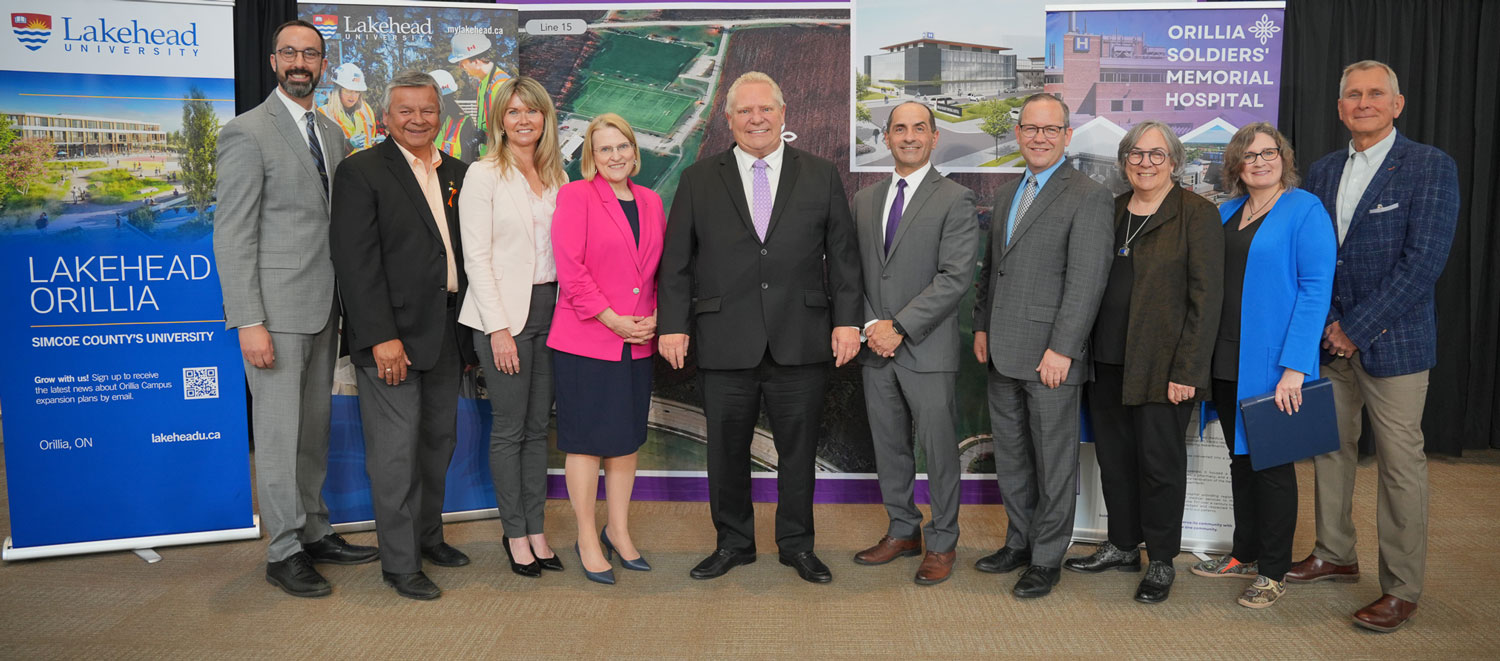
Thunder Bay, Ont. – Lakehead University has received $540,000 from the Natural Sciences and Engineering Research Council of Canada (NSERC) PromoScience program to address the underrepresentation of Indigenous perspectives and knowledge in Canada’s engineering profession.

Janusz KozinskiLed by Lakehead’s Faculty of Engineering, the project, ‘Sustainable Engineering for Indigenous Communities,’ will develop outreach programming for primary and secondary school students in northwestern Ontario, Manitoba, and Saskatchewan, with an emphasis on engaging Indigenous youth and their communities to promote sustainable engineering.

“Our shared intention with our partners is to provide Indigenous youth with more opportunities and more pathways to become engineers, enabling them to apply their talent and perspectives to help address challenges facing communities across Canada, including sustainable land development, ecosystem restoration, and access to clean water, energy, and housing,” said Faculty of Engineering dean Dr. Janusz Kozinski.

Dr. Kozinski says that less than one per cent of undergraduate students enrolled in accredited engineering programs in Canada identify as Indigenous. “We want to send a strong, compelling message to students throughout their educational journey that engineering is for everyone and there is a pathway for every student to become an engineer.”

Alongside partners PSI Analytics Inc., a Saskatoon-based pavement, materials, and mining engineering firm, and Civiconnect, an Ontario-based organization with expertise in developing work-integrated learning experiences for young people, the outreach program aims to engage 2,000 Indigenous youth each year, and an additional 5,000 through digital resources and platforms. Educators, including Elders, Knowledge Keepers, and cultural advisors, will support the development and delivery of these initiatives.

“PSI believes in knowledge sharing with youngsters in our community,” stated Dr. Curtis Berthelot, President and Chief Technical Officer, PSI Analytics Inc. “We are aware of the necessity of developing outreach programs and educational pathways that are designed in a collaborative partnership with Indigenous leaders and educators, with the long-term goal of bringing more Indigenous students into engineering, and to help build the next generation of infrastructure that Canada needs.”

“Through initiatives like this, Lakehead University can create balanced and effective engineering solutions that genuinely benefit Indigenous communities,” said Nour Hage, President & CEO of Civiconnect. “By partnering on this initiative, we strive to further Civiconnect’s mission of fostering career readiness among Canada's youth, notably by expanding opportunities for Indigenous communities, thereby enhancing our efforts to bridge educational and employment gaps in underrepresented groups.”

The proposal also received strong support from the Fort William First Nation, the Ontario Society of Professional Engineers, Gambler First Nation in Manitoba, and Lakehead’s Office of Indigenous Initiatives.

The project is set to begin later in 2025 and will take place initially over the next three years.

NSERC's PromoScience program offers financial support for organizations working with young Canadians to promote an understanding of science and engineering (including mathematics and technology). PromoScience supports hands-on learning experiences for young students and their science teachers.

Lakehead Celebrates King Charles III Coronation Medal Recipients

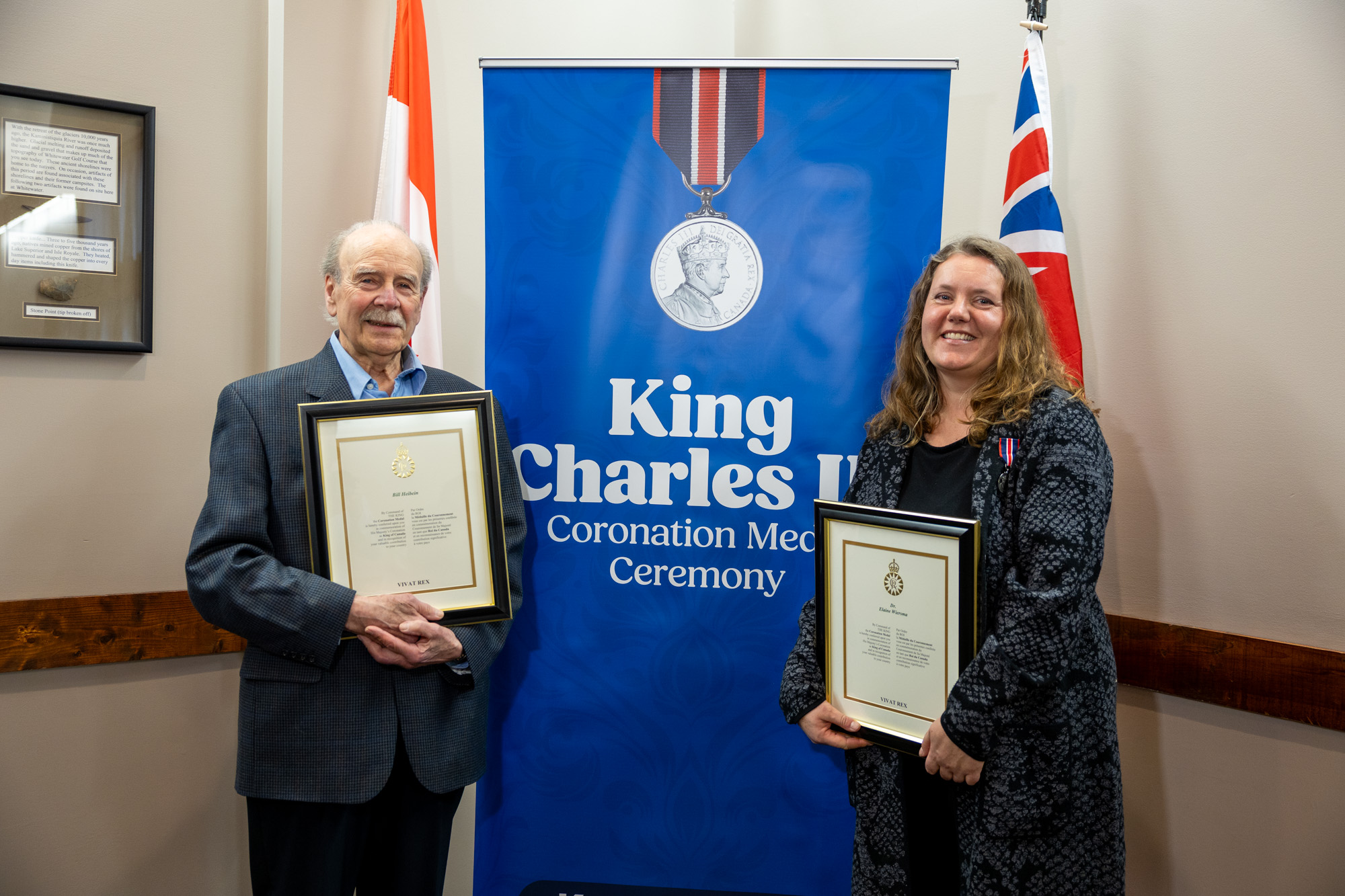
It's an exciting time to be at Lakehead! Several members of the university community have joined a select group of Canadians who've been awarded a King Charles III Coronation Medal. This honour was created to recognize individuals who've demonstrated outstanding service and excellence within their communities, and it is the first Canadian commemorative medal to mark a coronation.

Pipe Major Lorne Clifford, Dr. Christopher Mushquash, Dr. Roopa Rakshit, Dr. Alla Reznik, and Dr. Michel S. Beaulieu, along with several Lakehead alumni, were presented with this medal by Thunder Bay—Superior North MP Patty Hajdu at a special ceremony in March. Their contributions span diverse fields and encompass developing better breast cancer detection, improving access to mental health and addictions treatment in the region, fostering stronger community relationships through music, increasing our understanding of northern Ontario history, and making Thunder Bay a welcoming and inclusive place for newcomers from across the globe.

"With numerous inspiring nominations from across our community, the selection process was challenging," MP Hajdu noted in her letters to northwestern Ontario recipients. "Being chosen as one of only 35 medalists is a remarkable achievement and a testament to your dedication and contributions."

Pipe Major Lorne Clifford


Pipe Major Lorne Clifford in a parade playing the bagpipes

"I've been piping since I was 11 years old and I've competed in North American championships, but what I love most about the bagpipes is the camaraderie it fosters and the opportunity to bring members of the community together. It is awe inspiring to receive the King Charles III Coronation Medal and to be in the company of such wonderful representatives of our region."

Community Contributions:
Pipe Major Lorne Clifford is the founder and musical director of the Thunder Bay Police Pipe Band and a member of the Lake Superior Regiment Pipes and Drums who is being honoured for his more than four decades of volunteer service through music. He is also Lakehead University's Director of Security Services, a vital member of the Lakehead campus, and a Lakehead alum who holds a Bachelor of Arts in Political Science degree. Under his leadership of the Thunder Bay Police Pipe Band, he has fostered greater understanding between the police and the community and created a robust musical organization that performs at countless ceremonial and memorial events in addition to raising funds for diverse causes and social issues. Pipe Major Clifford's commitment to cultural diplomacy has seen him represent Canada internationally at performances in Australia as well as performances in Kenya, Sudan, and Palestine while serving as a Canadian Peacekeeper—harnessing the power of music to foster cultural exchange and community building. In addition, he's passing along the piping tradition as a teacher and mentor.

Dr. Christopher Mushquash


Dr. Christopher Musquash stands outside in a forested area in the winter

"Being from northwestern Ontario motivated me to work to help improve health outcomes for rural, northern, and Indigenous communities by reducing disparities in access to treatment for mental health and addiction services. For me, this medal is a shared recognition with my community partners, colleagues, trainees, and students, and an acknowledgement of the importance of Indigenous-led research and clinical care."

Community Contributions:
Dr. Christopher Mushquash, an Anishinaabe clinical psychologist and member of Pays Plat First Nation, is being honoured for his contributions to Indigenous mental health and addiction services. He is a psychology professor at Lakehead University and the Northern Ontario School of Medicine, Director of Lakehead's Centre for Rural & Northern Health Research, Vice President Research at the Thunder Bay Regional Health Sciences Centre and Chief Scientist at the Thunder Bay Regional Health Research Institute, and a Canada Research Chair in Indigenous Mental Health and Addiction. He is also a Lakehead alum who earned both his MA and Honours Bachelor of Science degrees at the Thunder Bay campus. His integration of traditional Indigenous knowledge with evidence-based practices has received numerous accolades, including the Canada Gairdner Momentum Award and a Champions of Mental Health award. He is known for his integrity and compassion, which is evident through his mentoring of the next generation of health professionals and his reshaping of the Canadian mental health field to overcome systemic problems.

Dr. Roopa Rakshit


Dr. Roopa Rakshit sits in a room with a houseplant and a small statue of Buddha in the background

"It was overwhelming to receive this honour—it was like the feeling I had when I received my PhD from Lakehead. Many people helped me when I arrived in Thunder Bay by providing me with support and opportunities to grow. Now I give back by welcoming newcomer women, helping international students thrive, and fostering cross-cultural understanding."

Community Contributions:
Dr. Roopa Rakshit empowers international students as the Manager of Agency Relations & Pathways with Lakehead University International and is an inspirational volunteer. She is being honoured for her contributions to international partnership relations and enrolments, research administration, and sustainable community development. She earned a PhD in Forestry from Lakehead focused on energy transition strategies for remote First Nation communities and has been a strong environmental advocate, working with organizations like Eco Superior. Dr. Rakshit has taken important strides in making Thunder Bay a more inclusive and vibrant city, including co-founding the International Tapestry Women's Network, coordinating the One City, Many Voices newspaper column, hosting the Asian Vibes TV show, and serving as a member of Thunder Bay's Anti-Racism & Equity Advisory Committee. She has received multiple awards, including the 2020 Respect Award and the 2017 Lakehead Luminary Award for her many worthy initiatives.

Dr. Alla Reznik


Dr. Alla Reznik sits in a office with a bookcase in the background

"My students are really the recipients of this medal, and I'd like to share the award with my trainees at all levels. Together, we are advancing breast cancer detection through the development of innovative medical imaging technologies, designed and developed in Canada. Our work improves patient outcomes and decreases the cost of breast cancer detection—I believe that this country can be a pioneer in health innovation."

Community Contributions:
Dr. Alla Reznik is a renowned physicist and researcher specializing in medical imaging technologies who is being honoured for her health-care breakthroughs. She is a Lakehead University physics professor, a Senior Scientist at the Thunder Bay Regional Health Research Institute and a Canada Research Chair in the Physics of Radiation Medical Imaging. Dr. Reznik and her team developed the groundbreaking Positron Emission Mammography (PEM) device. This life-saving technology enhances breast cancer detection by using molecular imaging to distinguish between cancerous and normal cells. Specifically, PEM uses a radiotracer to detect small masses and early breast cancer in younger high-risk women, women with dense breast tissue, and women with inconclusive mammography results. This innovation led to the founding of Radialis, a company that's commercializing PEM technology for use in hospitals and clinics. In addition to advancing cancer diagnosis techniques, Dr. Reznik gives back as a community educator, sharing her expertise at regional forums.

Dr. Michel S. Beaulieu


Dr. Michel S. Beaulieu stands with the Canadian flag in the background

"Being recognized as an educator and for my passion for history and volunteerism is an honor. I've had the privilege of working alongside some truly remarkable individuals at the regional, provincial, and national levels. This recognition is as much a reflection of what I've learned from them and what we've achieved together as it is about my own contributions."

Community Contributions:
Dr. Michel S. Beaulieu is an outstanding volunteer and distinguished educator who's being honoured for his contributions to his community, province, and country through decades of volunteerism. He has dedicated countless hours to preserving and promoting the history of northern Ontario, including as a member of the board of directors of the Multicultural History Society of Ontario and the Northwestern Ontario Archivists' Association and as a past president of the Thunder Bay Historical Museum Society, the Champlain Society, and the Ontario Historical Society. He is Lakehead University's Associate Vice-Provost (Academic), a history professor, and a Lakehead alum who holds MA, HBA, and BEd degrees. Dr. Beaulieu has helped shape the lives of students, especially from rural communities, and is a philanthropist who has established student awards and scholarships. He serves as Honorary Colonel of the Lake Superior Scottish Regiment and recently received the Cruikshank Gold Medal from the Ontario Historical Society.

Our congratulations to each of the King Charles III Coronation Medal recipients—you've demonstrated what can be achieved when individuals pledge themselves to the greater good of others and to society. We are proud to count you as members of the Lakehead community.

Pages