

Students

Brandon Rhéal Amyot Uplifts Students and Communities

"I love to bake—it's my escape and one of the ways that I express caring," says Brandon Rhéal Amyot, a soon-to-be graduate of Lakehead Orillia's Bachelor of Arts and Science in Interdisciplinary Studies program. "When I was a kid, my mom and I would bring trays of baked goods to our neighbours during the holidays."

In elementary school, Brandon's baking abilities helped take them in a new direction after a teacher recommended they attend an Ontario Educational Leadership Centre (OELC) summer camp. "I'm from a working-class family," Brandon explains, "so I spent months baking cookies and selling them at recess to raise money to attend OELC—my mum would find me baking at midnight."
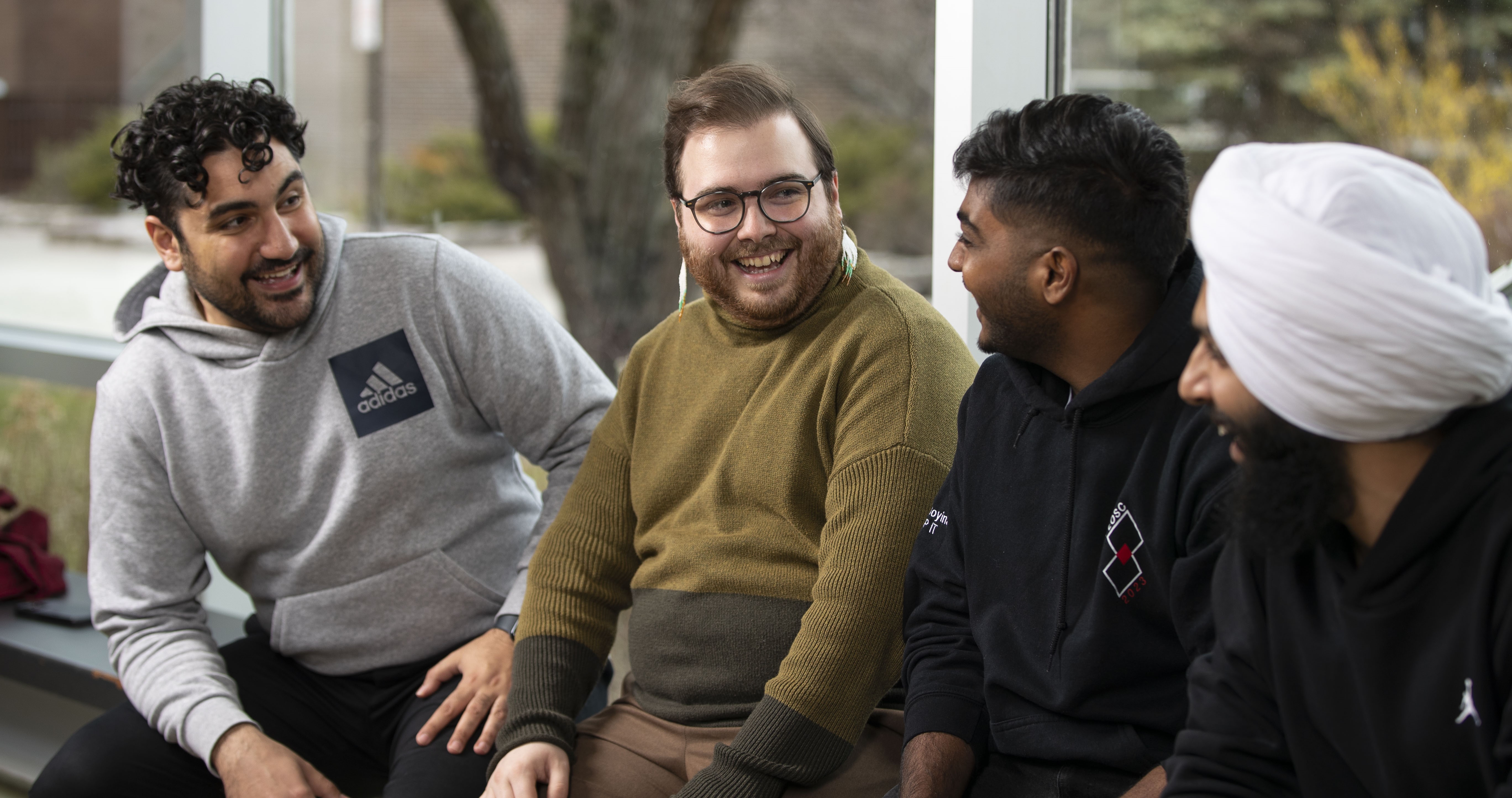
Brandon Rheal Amyot talks with three other members of the 2024 LUSU executive team

Brandon (second from left) attended Georgian College and Carleton University before coming to Lakehead. They will be graduating with a Bachelor of Arts and Science in Interdisciplinary Studies in June 2025. This unique degree gave them the opportunity to study political science, media, film, and communications.

Brandon's sense of civic engagement is a thread that runs throughout their life. Today, they are an inspiring intersectional activist focused on youth, postsecondary education, media, and the 2SLGBTQ+ and Indigenous communities. They spent 10 years volunteering with Fierté Simcoe Pride—a grassroots organization that advocates for the 2SLGBTQ+ community—before becoming the VP Orillia of the Lakehead University Student Union (LUSU).

"I always ask myself, 'How can I fight for students, for Lakehead, and for equity?' I had to fight to open the door to postsecondary education for myself, and I want to leave it open for others. Although I'm the first person in my family to go to college or university, I hope I won't be the last."

Brandon enrolled at Lakehead Orillia because "it's an interdisciplinary campus by design. I didn't want to go to school simply to get a job. I wanted to become a lifelong learner and build skills to uplift communities, and interdisciplinary studies lend themselves to that." Brandon believes there's real power in students working together. "It's what enabled us to open LUSU Orillia's Food Pantry—an emergency food resource for students in need that's served over 2,200 students since opening in October 2022. The Food Pantry is one of my proudest achievements because I've struggled with food security at certain points.

Brandon Rhéal Amyot walks across a rainbow crosswalk on a summer day

"After Lakehead, I feel much more prepared to be part of the world and to take on the world," Brandon says. "I owe that to my family, friends, and instructors who've encouraged me to stay the path." Photo credit: Jessica Owen

With the increasing wealth inequality and the social and political challenges gripping us, we need to step up in any way we can," adds Brandon, who recently joined the City of Orillia's Poverty Reduction Working Group. They have also officially launched their career, even though they are still a month away from graduation.

"I've been hired as LUSU's first governance and advocacy officer, supporting student leaders, the union, and our university community. I'm also working part-time with the Paapiiwaaniimaan Grassy Narrows Mercury Care Home as an executive assistant with their Operational Planning Committee. These roles are both close to my heart and offer me a way to give back.

We have to take bold risks as students, faculty, staff, and community members, and do it with grit and with love. That's the whole purpose of higher education—Lakehead instilled in me that a rising tide lifts all boats."

Fees

Understanding the various fees associated with your education is essential for effective budgeting. These pages provide  information on the different fees you may encounter, such as incidental and ancillary fees, helping you plan your finances accurately throughout your journey here at Lakehead University.

Indigenous Nursing Entry Program

The Indigenous Nursing Entry Program (INEP) is an eight month program intended for students of First Nations (status or non-status), Métis, or Inuit people who do not meet the regular or mature student entry requirements for the Bachelor of Science, Nursing (BScN) program at Lakehead University. The INEP is designed to provide the necessary skills and academic preparation for successful transition into Nursing studies.  Successful completion of  INEP (with a minimum 70% average) will ensure your eligibility for admission to the Bachelor of Science Nursing degree program at Lakehead University. INEP students who attain an overall average of 80% or higher will be eligible for the 3 year compressed BScN program.

You can realize your dreams to become a qualified nurse by beginning your studies with the INEP here at Lakehead University.

 Our innovative programming honours and celebrates Indigenous heritage while providing culturally appropriate supports and services. Academic advising and tutoring are available, as well as other supports, such as Elder visits, cultural activities, personal counselling, and assistance with community connections for services such as housing and child care.


Our mission is clear:

"To improve the health care of Indigenous people by increasing the number of Indigenous Nurses who would provide culturally appropriate care. The Indigenous Nursing Entry Program provides access to a Baccalaureate Nursing Education for those of Aboriginal ancestry who do not meet the regular University entrance requirements."

Admission Requirements & Application Details for the Indigenous Nursing Entry Program

The Indigenous Nursing Entry Program (INEP) is designed to provide First Nations (status or non-status), Métis, or Inuit students with the necessary skills and academic preparation to transition into the BScN program. You must be fluent in English to participate in this program.

Admission Requirements

Applicants to the INEP must be First Nations (status or non-status), Métis, or Inuit and be:
  1. Recent high school graduates NOT meeting the School of Nursing BScN required admission criteria (see Admission Requirements, Requirements for Admission to Undergraduate Degree Programs)
  2. Mature students, extraordinary students, or college/transfer students NOT meeting the School of Nursing BScN required admission criteria (see Admission Requirements, Requirements for Admission to Undergraduate Degree Programs)

The INEP is a rigorous science-based program. Senior Chemistry and Math courses are strongly recommended prior to attending this program.


Important Deadline Dates

Status of Application

Open (currently accepting application for next academic year)

Deadline to Submit Copies of Transcripts

Two weeks after Application (Upgrading may be “in progress”)


How to Apply

Please complete and submit the application package. There is no cost to apply! 

Download Application Package

With the application package, you will submit:

  • application form
  • personal statement
  • two personal references
  • resume
  • transcripts from high school and post-secondary institutions attended

Please submit your application package directly to the Indigenous Acces Programs Coordinator by email or fax, as directed in the package. Applicants may submit a partial application, while awaiting personal references.

Copies of your official transcripts from all high schools, colleges, and universities that you have attended, if applicable, are required. You can upload copies using your myInfo student portal. You gain access to myInfo shortly after applying. We will send you your username and temporary password in our acknowledgement email. If you encounter issues with accessing myInfo, try to recover your account

Alternatively, you can mail your application and copies of your official transcripts to Lakehead University. Our mailing address is:

Lakehead University
Enrolment Services - Undergraduate Admissions
955 Oliver Road
Thunder Bay, ON
P7B 5E1 

If you need assistance with getting copies of your transcripts from your previous institutions, please contact Lisa Primavesi, the Indigenous Access Programs Coordinator, at coordinator.iap@lakeheadu.ca.

What Happens After I Apply?

Applicants gain access to myInfo, which is Lakehead University’s student portal, shortly after applying. Your username and temporary password are included in our acknowledgement email. 

Contact Us

If you have any questions regarding the program or your application, please contact Lisa Primavesi, the Indigenous Access Programs Coordinator, at coordinator.iap@lakeheadu.ca.

The program includes four academic preparation courses:

  • English                                   ENGL 1012, ENGL 1015
  • Chemistry                              CHEM 1050, CHEM 1070
  • Mathematics                         MATH 0212
  • Biology                                   NURS 1120


In addition, four skills-based courses are also included:

  • Communications                                NURS 1110
  • Professional Orientation                   NURS 1130
  • Study Skills and Critical Thinking     UNIV 1016

For descriptions of these courses, please visit the Course Calendar.

The INEP Program combines traditional and western medical practices

The program is based on two semesters of twelve weeks each.

With the support of faculty, staff, peers, and the community, your successful completion of the program (with a minimum 70% average) will ensure your eligibility for admission to the Bachelor of Science Nursing degree program at Lakehead University.


More information about Payment Methods, and Payment Due Dates can be found here: Student Fees Information


All fees are displayed in Canadian Dollars ($CAD)

Arts (Includes, but is not limited to: ISTEM, ILIP, HB Mus, HBFA, Palliative Care, Dementia Studies, etc.)
Thunder Bay
YearTuitionAncillary FeesTotal1st Installment2nd Installment1.0 FCE Tuition1.0 FCE Total0.5 FCE Tuition0.5 FCE Total
1
$5,984.51
$1,473.19
$7,457.70
$3,728.85
$3,728.85
$1,196.90
$1,331.31
$598.45
$665.66
2
$5,955.86
$1,389.06
$7,344.92
$3,672.46
$3,672.46
$1,191.17
$1,325.58
$595.59
$662.79
3
$5,915.30
$1,389.06
$7,304.36
$3,652.18
$3,652.18
$1,183.06
$1,317.47
$591.53
$658.74
4
$5,398.29
$1,389.06
$6,787.35
$3,393.68
$3,393.67
$1,079.66
$1,214.07
$539.83
$607.03
YearTuitionAncillary FeesTotal1st Installment2nd Installment1.0 FCE Tuition1.0 FCE Total0.5 FCE Tuition0.5 FCE Total
1
$6,597.93
$1,473.19
$8,071.12
$4,035.56
$4,035.56
$1,319.59
$1,454.00
$659.79
$727.00
2
$5,955.86
$1,389.06
$7,344.92
$3,672.46
$3,672.46
$1,191.17
$1,325.58
$595.59
$662.79
3
$5,915.30
$1,389.06
$7,304.36
$3,652.18
$3,652.18
$1,183.06
$1,317.47
$591.53
$658.74
4
$5,398.29
$1,389.06
$6,787.35
$3,393.68
$3,393.67
$1,079.66
$1,214.07
$539.83
$607.03
YearTuitionAncillary FeesTotal1st Installment2nd Installment1.0 FCE Tuition1.0 FCE Total0.5 FCE Tuition0.5 FCE Total
1
$30,236.00
$1,473.19
$31,709.19
$15,854.60
$15,854.59
$6,047.20
$6,181.61
$3,023.60
$3,090.81
2
$30,235.65
$1,389.06
$31,624.71
$15,812.36
$15,812.35
$6,047.13
$6,181.54
$3,023.57
$3,090.77
3
$30,235.65
$1,389.06
$31,624.71
$15,812.36
$15,812.35
$6,047.13
$6,181.54
$3,023.57
$3,090.77
4
$29,825.98
$1,389.06
$31,215.04
$15,607.52
$15,607.52
$5,965.20
$6,099.61
$2,982.60
$3,049.80
In addition to the above, International Students must pay the mandatory University Health Insurance Plan (UHIP) which is payable in full with your first installment. Please click here for more information about UHIP
Nursing, INEP
Thunder Bay
YearTuitionAncillary FeesTotal1st Installment2nd Installment1.0 FCE Tuition1.0 FCE Total0.5 FCE Tuition0.5 FCE Total
1
$5,984.51
$1,499.19
$7,483.70
$3,741.85
$3,741.85
$1,196.90
$1,422.44
$598.45
$711.22
2
$5,955.86
$1,415.06
$7,370.92
$3,685.46
$3,685.46
$1,191.17
$1,349.51
$595.59
$674.76
3
$5,915.30
$1,415.06
$7,330.36
$3,665.18
$3,665.18
$1,183.06
$1,341.40
$591.53
$670.70
4
$5,398.29
$1,415.06
$6,813.35
$3,406.68
$3,406.67
$1,079.66
$1,238.00
$539.83
$619.00
YearTuitionAncillary FeesTotal1st Installment2nd Installment1.0 FCE Tuition1.0 FCE Total0.5 FCE Tuition0.5 FCE Total
1
$6,597.93
$1,499.19
$8,097.12
$4,048.56
$4,048.56
$1,319.59
$1,545.13
$659.79
$772.56
2
$5,955.86
$1,415.06
$7,370.92
$3,685.46
$3,685.46
$1,191.17
$1,332.58
$595.59
$666.29
3
$5,915.30
$1,415.06
$7,330.36
$3,665.18
$3,665.18
$1,183.06
$1,324.47
$591.53
$662.24
4
$5,398.29
$1,415.06
$6,813.35
$3,406.68
$3,406.67
$1,079.66
$1,221.07
$539.83
$610.53
YearTuitionAncillary FeesTotal1st Installment2nd Installment1.0 FCE Tuition1.0 FCE Total0.5 FCE Tuition0.5 FCE Total
1
$30,236.00
$1,499.19
$31,735.19
$15,867.60
$15,867.59
$6,047.20
$6,272.74
$3,023.60
$3,136.37
2
$30,235.65
$1,415.06
$31,650.71
$15,825.36
$15,825.35
$6,047.13
$6,188.54
$3,023.57
$3,094.27
3
$30,235.65
$1,415.06
$31,650.71
$15,825.36
$15,825.35
$6,047.13
$6,188.54
$3,023.57
$3,094.27
4
$29,825.98
$1,415.06
$31,241.04
$15,620.52
$15,620.52
$5,965.20
$6,106.61
$2,982.60
$3,053.30
In addition to the above, International Students must pay the mandatory University Health Insurance Plan (UHIP) which is payable in full with your first installment. Please click here for more information about UHIP

Click to display ancillary fee breakdown
2025-26 Compulsory Ancillary Fees for Full-Time Undergraduate Nursing Students (Thunder Bay)CodeAmount
Lakehead University Services & Nursing Fees  
Athletic Building Fee (Wolf Den)SABWF99.00
Student Recreation and WellnessSATHF141.80
Computer Enhancement (Technology) FeeSCOMF25.00
Health Services Support FeeSHEAF96.76
Capital Improvements C.J. Sanders BuildingSCISF30.00
Canadian Nursing Student Association SNURA11.00
 LU Services & Nursing Fees Subtotal: 403.56
Lakehead University Student Union (LUSU) Fees  
LUSU Capital Fund Fee SBLDF62.00
LUSU Medical/Dental* SMEDF435.00
LUSU Bus Pass** SLBUS282.00
LUSU Activity FeeSLUSF164.00
Aboriginal ProgrammingSLRAB2.00
AFCASA African Caribbean Student Association FeeSLRAF0.50
Nanabijou FeeSLRNA5.00
Social Action FeeSLRSA2.00
Sustainability FeeSLRSU6.00
WUSC - World University Service of Canada (Sponsor Refugee Students)SLRWU7.00
CFS - Canadian Federation of Students FeeSLCFS21.00
LU Radio FeeSRADF10.00
Lakehead University Nursing Association Membership FeeSLUNM15.00
LUSU Fees Subtotal: 1011.50
TOTAL NURSING Student Ancillary Fee (Upper Years): 1415.06

First Year Students Only:

2025-26 Compulsory Ancillary Fees for First Year Full-Time Nursing Students (Thunder Bay)CodeAmount
Orientation & First Year Experience FeeSORIE84.13
TOTAL NURSING Student Ancillary Fee (Thunder Bay): 1415.06
TOTAL First Year Nursing Student Ancillary Fee (Thunder Bay): 1499.19

 * The LUSU Medical/Dental Insurance (SMEDF) policy is effective September 1, for the 12 months ending August 31. All full-time undergraduate students who have registered in 3.75 or more FCEs by the last day to register in September are automatically assessed this mandatory fee. Should a student have comparable coverage, and choose to opt-out, they may do so by going to the LUSU Website at www.lusu.ca and clicking on opt-out to proceed. No exceptions or extensions. Opting out does not remove the fee from your student account. For additional information regarding LUSU services including Medical and Dental please go to www.lusu.ca or contact LUSU directly by phone (807) 343-8259

 Co-op, Part-Time, Senior, and Graduate students are not covered but may purchase the Plan.

** 
The LUSU Bus Pass Fee (SLBUS):  All full-time undergraduate students who have registered in 3.75 or more FCEs by the last day to register in September are automatically assessed this mandatory fee.


2025-26 Compulsory Ancillary Fees - Undergraduate Full-Time (Thunder Bay)CodeAmount
Lakehead University Services Fees  
Athletic Building Fee (Wolf Den) SABWF  99.00
Student Recreation and WellnessSATHF141.80
Computer Enhancement (Technology) FeeSCOMF25.00
Health Services Support FeeSHEAF96.76
Capital Improvements C.J. Sanders BuildingSCISF30.00
Lakehead Services Subtotal: 392.56
Lakehead University Student Union (LUSU) Fees   
LUSU Capital FundSBLDF62.00
LUSU Medical/DentalSMEDF *435.00
LUSU Bus PassSLBUS **282.00
LUSU Activity FeeSLUSF164.00
Aboriginal Programming FeeSLRAB2.00
AFCASA African Caribbean Student Association FeeSLRAF 0.50
Nanabijou FeeSLRNA5.00
Social Action FeeSLRSA2.00
SustainabilitySLRSU6.00
WUSC - World University Service of Canada (Sponsor Refugee Students)SLRWU7.00
Canadian Federation of Students (CFS) FeeSLCFS21.00
LU Radio FeeSRADF10.00
LUSU Fees Subtotal: 996.50
TOTAL Compulsory Ancillary Fees - Undergraduate Full-Time (Thunder Bay) 1389.06

* The LUSU Medical/Dental Insurance (SMEDF) policy is effective September 1, for the 12 months ending August 31. All full-time undergraduate students who have registered in 3.75 or more FCEs by the last day to register in September are automatically assessed this mandatory fee. Should a student have comparable coverage and choose to opt-out they may do so by going to the LUSU Website at www.lusu.ca and clicking on opt-out to proceed. No exceptions or extensions. Opting out does not remove the fee from your student account. For additional information regarding LUSU services including Medical and Dental please go to www.lusu.ca or contact LUSU directly by phone (807) 343-8259

 Co-op, Part-Time, Senior, and Graduate students are not covered, but may purchase the Plan.

**
The LUSU Bus Pass Fee (SLBUS):  All full-time undergraduate students who have registered in 3.75 or more FCEs by the last day to register in September are automatically assessed this mandatory fee.


2025-26 Compulsory Ancillary Fees for First Year
- Undergraduate Full-Time  Students (Thunder Bay)
 Code Amount
Orientation & First Year Experience Fee SORIE84.13
Total Compulsory Ancillary Fees - Undergraduate Full-Time (Thunder Bay): 1389.06
 TOTAL Compulsory Ancillary Fees for First Year Students - Undergraduate Full-Time (Thunder Bay):
  1473.19
2025-26 Ancillary Fees for Part-Time Undergraduate Students - Per Course (Thunder Bay)CodeAmount (1.0FCE)
Amount (0.5FCE)
Lakehead University Services Fees   
Athletic Building Fee (Wolf Den)SABWF19.80 9.90
Student Recreation and WellnessSATHF28.3614.18
Computer Enhancement (Technology) FeeSCOMF5.002.50
Health Services Support FeeSHEAF19.359.68
Capital Improvements C.J. Sanders BuildingSCISF6.003.00
Lakehead University Services Subtotal: 78.5139.26
Lakehead University Student Union (LUSU) Fees   
LUSU Capital FundSBLDF12.406.20
LUSU Activity FeeSLUSF 32.8016.40
Aboriginal Programming Fee SLRAB0.400.20
AFCASA African Caribbean Student Association FeeSLRAF0.100.05
 Nanabijou Fee SLRNA1.00  0.50
Social Action FeeSLRSA0.400.20
Sustainability FeeSLRSU1.200.60
WUSC World University Service of Canada (Sponsor Refugee Student) FeeSLRWU1.400.70
CFS (Canadian Federation of Students) FeeSLCFS4.202.10
LU Radio FeeSRADF2.001.00
LUSU fees Subtotal: 55.9027.95
TOTAL Part-Time Per Course Ancillary Fees (Thunder Bay): 134.4167.21
    
2025-26 Compulsory Ancillary Fees For Part-Time Undergraduate First Year Students: Amount (1.0FCE)Amount (0.5FCE)
Orientation and First Year Experience Fee (Flat Fee - not per course)SORIE84.1384.13
Part-Time Per Course Ancillary Fees (Thunder Bay): 134.4167.21
TOTAL Part-Time Per Course Ancillary Fees - Undergraduate First Year/First Course (Thunder Bay): 218.54151.34
2025-26 Compulsory Ancillary Fees - Undergraduate Full-Time (Orillia) Code Amount
Lakehead University Services Fees  
Student Recreation and WellnessSATHO113.46
Computer Enhancement (Technology) FeeSCOMO25.00
Health Services Support FeeSHEAO96.76
Lakehead Services Subtotal 235.22
Lakehead University Student Union (LUSU) Fees  
LUSU Capital FundSBLDO62.00
LUSU U-Pass Fee SLBUO160.00
LUSU Medical/Dental Insurance *SMEDO435.00
LUSU Activity FeeSLUSO164.00
WUSC World University Service of Canada (Sponsor Refugee Students)SWUSO7.00
CFS (Canadian Federation of Student) FeeSCFSO21.00
LUSU Fees (Orillia) Subtotal 849.00
TOTAL Compulsory Ancillary Fees - Undergraduate Full-Time (Orillia) 1084.22

* The LUSU Medical/Dental Insurance (SMEDF) policy is effective September 1, for the 12 months ending August 31. All full-time undergraduate students who have registered in 3.75 or more FCEs by the last day to register in September are automatically assessed this mandatory fee. Should a student have comparable coverage and choose to opt-out they may do so by going to the LUSU Website at www.lusu.ca and clicking on opt-out to proceed. No exceptions or extensions. Opting out does not remove the fee from your student account. For additional information regarding LUSU services including Medical and Dental please go to www.lusu.ca or contact LUSU directly by phone (807) 343-8259

 Co-op, Part-Time, Seniors, and Graduate students are not covered but may purchase the Plan.

** The LUSU Bus Pass Fee (SLBUO):  All full-time undergraduate students who have registered in 3.75 or more FCEs by the last day to register in September are automatically assessed this mandatory fee.


 First Year Students

2025-26 Compulsory Ancillary Fees for First Year Full-Time Students (Orillia) Code Amount
Orientation & First Year Experience FeeSORIO84.13
LUSU and LU Services Fees Total 1084.22
Total 1168.35
2025-26 Compulsory Ancillary Fees for Part-Time Undergraduate Students (Orillia)CodeAmount Per Course (1.0FCE)Amount Per Half Course (0.5FCE)
Lakehead University Services Fees
   
Student Recreation and WellnessSATHO22.6911.35
Computer Enhancement (Technology) FeeSCOMO5.002.50
Health Services Support FeeSHEAO19.359.68
Lakehead Services Fees Subtotal: 47.0423.52
Lakehead University Student Union Fees   
LUSU Capital FundSBLDO12.406.20
LUSU Activity FeeSLUSO32.8016.40
WUSC World University Service of Canada (Sponsor Refugee Students)SWUSO1.400.70
CFS (Canadian Federation of Students) FeeSCFSO4.202.10
LUSU Fees Subtotal: 50.8025.40
TOTAL Part-Time Per Course Ancillary Fee (Orillia): 97.8448.92
    
First Year Part-Time Orillia Students:   
Orientation & First Year Experience Fee (Flat fee - Not per course)SORIO84.1384.13
Part-Time Per Course Ancillary Fee (Orillia) 97.8448.92
TOTAL Part-Time Per Course/First Course, First Year (Orillia) 181.97133.05
2025-26 Compulsory Ancillary Fees for Full-Time Undergraduate Lakehead-Georgian Students (Barrie) - all programs except Engineering
 Code Amount
Lakehead University Services Fees  
Student Recreation and WellnessSATHG113.46
Computer Enhancement (Technology) FeeSCOMG25.00
Health Services Support FeeSHEAG96.76
Lakehead Services Subtotal: 235.22
Lakehead University Student Union (LUSU) Fees  
LUSU Medical/Dental Insurance *SMEDG435.00
LUSU Activity FeeSLUSG164.00
LUSU Capital FundSBLDG62.00
WUSC World University Service of Canada (Sponsor Refugee Students)SWUSG7.00
CFS (Canadian Federation of Student) FeeSCFSG21.00
LUSU Fees Subtotal: 689.00
Georgian/Barrie U-Pass Fee **SLBUB199.04
TOTAL Compulsory Ancillary Fees for Full-Time Undergraduate Lakehead-Georgian Students (Barrie) - all programs except Engineering:
 1123.26

* The LUSU Medical/Dental Insurance (SMEDG) policy is effective September 1, for the 12 months ending August 31. All full-time undergraduate students who have registered in 3.75 or more FCEs by the last day to register in September are automatically assessed this mandatory fee. Should a student have comparable coverage and choose to opt-out they may do so by going to the LUSU Website at www.lusu.ca and clicking on opt-out to proceed. No exceptions or extensions. Opting out does not remove the fee from your student account. For additional information regarding LUSU services including Medical and Dental please go to www.lusu.ca or contact LUSU directly by phone (807) 343-8259

 Co-op students, Part-Time Students, Seniors, and Graduate students are not covered but may purchase the Plan.

** The Georgian/Barrie Bus Pass Fee (SLBUB):  All full-time undergraduate students who have registered in 3.75 or more FCEs by the last day to register in September are automatically assessed this mandatory fee.


2025-26 Compulsory Ancillary Fees for First Year Full-Time Lakehead-Georgian (Barrie) - Non-Engineering
 Code Amount
Orientation & First Year Experience FeeSORIB84.13
LUSU and LU Services and Bus Pass Subtotal 1123.26
Total 1207.39


2025-26  Compulsory Ancillary Fees for Part-Time Undergraduate Lakehead-Georgian Students (Barrie) All Programs
 Code Amount Per Course (1.0 FCE)
Amount Per Half Course (0.5 FCE)
Lakehead University Services Fees   
Student Recreation and Wellness 
SATHG22.6911.35
Computer Enhancement (Technology) FeeSCOMG5.002.50
Health Services Support FeeSHEAG19.359.68
Lakehead Services Subtotal: 47.0423.52
Lakehead University Student Union (LUSU) Fees   
LUSU Activity FeeSLUSG32.8016.40
LUSU Capital FundSBLDG11.805.90
WUSC World University Service of Canada (Sponsor Refugee Students)SWUSG1.400.70
CFS (Canadian Federation of Student) FeeSCFSG4.202.10
LUSU Fees Subtotal: 50.8025.40
TOTAL Compulsory Ancillary Fees for Part-Time (Per Course) Undergraduate Lakehead-Georgian Students (Barrie) - all programs:
 97.8448.92
 

Indigenous Transition Year Program (ITYP)

Our Indigenous Transition Year Program (ITYP) is intended for First Nations (status or non-status), Métis, or Inuit people who do not meet the regular or mature student university entry requirements, or who require academic preparation to become eligible for admission to Lakehead University. 

Our innovative programming honours and celebrates Indigenous heritage while providing culturally appropriate support services. Academic advising and tutoring are also available, contributing to an environment conducive to success and support.

Over eight months you will complete core courses in English, Study Skills, Science and an elective of limited choice. You will develop:

  • Essential research, study, and communication skills
  • Knowledge about Indigenous history, traditions, and culture
  • Critical thinking and problem solving skills
  • University program planning abilities
  • Applied Science skills

With the support of faculty, peers and the community, your successful completion of the program will ensure your eligibility for admission to a Lakehead University program of your choosing*.

*Prerequisites apply for some programs. Check the Admissions page for more details or contact the Office of Admissions & Recruitment.

Lakehead Advantage

As a graduate of the Indigenous Transition Year Program, you will be academically prepared for admission to a Lakehead University program, and you will also earn three university credits. Depending on your program of choice, these credits may be applied toward the completion of your degree. This gives you a head start on your undergraduate degree and will allow you to take a partial course load as you move into upper years of study.

The program size ranges from 15-30 students, all of whom take the same classes together. This is to ensure you, as a student, will experience your education in a stable and comfortable setting with strong peer support. Many students are from rural communities and bring their families and children with them as they work through the program. 


Admission Requirements & Application Details for the Indigenous Transition Year Program

The Indigenous Transition Year Program (ITYP) is an eight-month full-time preparatory program which has been designed to provide First Nations (status or non-status), Métis, or Inuit people who did not meet the regular or mature student admission criteria, the opportunity to pursue a university education in an academically, socially, and culturally supportive environment. You must be fluent in English. Learn more about the ITYP

Admission Requirements 

Applicants considered for admission to the ITYP must be First Nations (status or non-status), Métis, or Inuit:

  1. Recent high school graduates NOT meeting the required admission criteria for programs in the Social Sciences and Humanities (see Admission Requirements, Requirements for Admission to Undergraduate Degree Programs)
  2. Mature students, extraordinary students, college/transfer students NOT meeting the required admission criteria for programs in the Social Sciences and Humanities (see Admission Requirements, Requirements for Admission to Undergraduate Degree Programs)

Important Deadline Dates

Status of Application

Open  (Currently Accepting Applications for the Next Academic Year)

Deadline to Submit Copies of Your Transcripts 

Two (2) weeks after you apply

How to Apply

Please complete and submit the application package. There is no cost to apply! 

Application Package

In addition, you must submit copies of your official transcripts from all high schools, colleges, and universities that you have attended, if applicable. You can upload copies using your myInfo student portal. You gain access to myInfo shortly after applying. We will send you your username and temporary password in our acknowledgement email. If you encounter issues with accessing myInfo, try to recover your account.  

Alternatively, you can mail copies of your official transcripts to Lakehead University. Our mailing address is:

Lakehead University
Enrolment Services - Undergraduate Admissions
955 Oliver Road
Thunder Bay, ON
P7B 5E1

Contact Us

If you need assistance getting your transcripts, or have any questions regarding the program, please contact Fionna Farquhar, the Indigenous Transition Year Program Coordinator, at coordinator.ityp@lakeheadu.ca.

The program consists of a minimum of three and one-half full course equivalents (3.5 FCEs) and 1.5 FCEs of non-credit courses.

(a) Indigenous Transition Year Program 1191/1192 (non-credit)
(b) English 1012 and 1015
(c) General Science 0261
(d) University Seminar 1016
(e) 1.0 FCE elective of limited choice


More information about Payment Methods, and Payment Due Dates can be found here: Student Fees Information


All fees are displayed in Canadian Dollars ($CAD)

Arts (Includes, but is not limited to: ISTEM, ILIP, HB Mus, HBFA, Palliative Care, Dementia Studies, etc.)
Thunder Bay
YearTuitionAncillary FeesTotal1st Installment2nd Installment1.0 FCE Tuition1.0 FCE Total0.5 FCE Tuition0.5 FCE Total
1
$5,984.51
$1,473.19
$7,457.70
$3,728.85
$3,728.85
$1,196.90
$1,331.31
$598.45
$665.66
2
$5,955.86
$1,389.06
$7,344.92
$3,672.46
$3,672.46
$1,191.17
$1,325.58
$595.59
$662.79
3
$5,915.30
$1,389.06
$7,304.36
$3,652.18
$3,652.18
$1,183.06
$1,317.47
$591.53
$658.74
4
$5,398.29
$1,389.06
$6,787.35
$3,393.68
$3,393.67
$1,079.66
$1,214.07
$539.83
$607.03
YearTuitionAncillary FeesTotal1st Installment2nd Installment1.0 FCE Tuition1.0 FCE Total0.5 FCE Tuition0.5 FCE Total
1
$6,597.93
$1,473.19
$8,071.12
$4,035.56
$4,035.56
$1,319.59
$1,454.00
$659.79
$727.00
2
$5,955.86
$1,389.06
$7,344.92
$3,672.46
$3,672.46
$1,191.17
$1,325.58
$595.59
$662.79
3
$5,915.30
$1,389.06
$7,304.36
$3,652.18
$3,652.18
$1,183.06
$1,317.47
$591.53
$658.74
4
$5,398.29
$1,389.06
$6,787.35
$3,393.68
$3,393.67
$1,079.66
$1,214.07
$539.83
$607.03
YearTuitionAncillary FeesTotal1st Installment2nd Installment1.0 FCE Tuition1.0 FCE Total0.5 FCE Tuition0.5 FCE Total
1
$30,236.00
$1,473.19
$31,709.19
$15,854.60
$15,854.59
$6,047.20
$6,181.61
$3,023.60
$3,090.81
2
$30,235.65
$1,389.06
$31,624.71
$15,812.36
$15,812.35
$6,047.13
$6,181.54
$3,023.57
$3,090.77
3
$30,235.65
$1,389.06
$31,624.71
$15,812.36
$15,812.35
$6,047.13
$6,181.54
$3,023.57
$3,090.77
4
$29,825.98
$1,389.06
$31,215.04
$15,607.52
$15,607.52
$5,965.20
$6,099.61
$2,982.60
$3,049.80
In addition to the above, International Students must pay the mandatory University Health Insurance Plan (UHIP) which is payable in full with your first installment. Please click here for more information about UHIP

2025-26 Compulsory Ancillary Fees - Undergraduate Full-Time (Thunder Bay)CodeAmount
Lakehead University Services Fees  
Athletic Building Fee (Wolf Den) SABWF  99.00
Student Recreation and WellnessSATHF141.80
Computer Enhancement (Technology) FeeSCOMF25.00
Health Services Support FeeSHEAF96.76
Capital Improvements C.J. Sanders BuildingSCISF30.00
Lakehead Services Subtotal: 392.56
Lakehead University Student Union (LUSU) Fees   
LUSU Capital FundSBLDF62.00
LUSU Medical/DentalSMEDF *435.00
LUSU Bus PassSLBUS **282.00
LUSU Activity FeeSLUSF164.00
Aboriginal Programming FeeSLRAB2.00
AFCASA African Caribbean Student Association FeeSLRAF 0.50
Nanabijou FeeSLRNA5.00
Social Action FeeSLRSA2.00
SustainabilitySLRSU6.00
WUSC - World University Service of Canada (Sponsor Refugee Students)SLRWU7.00
Canadian Federation of Students (CFS) FeeSLCFS21.00
LU Radio FeeSRADF10.00
LUSU Fees Subtotal: 996.50
TOTAL Compulsory Ancillary Fees - Undergraduate Full-Time (Thunder Bay) 1389.06

* The LUSU Medical/Dental Insurance (SMEDF) policy is effective September 1, for the 12 months ending August 31. All full-time undergraduate students who have registered in 3.75 or more FCEs by the last day to register in September are automatically assessed this mandatory fee. Should a student have comparable coverage and choose to opt-out they may do so by going to the LUSU Website at www.lusu.ca and clicking on opt-out to proceed. No exceptions or extensions. Opting out does not remove the fee from your student account. For additional information regarding LUSU services including Medical and Dental please go to www.lusu.ca or contact LUSU directly by phone (807) 343-8259

 Co-op, Part-Time, Senior, and Graduate students are not covered, but may purchase the Plan.

**
The LUSU Bus Pass Fee (SLBUS):  All full-time undergraduate students who have registered in 3.75 or more FCEs by the last day to register in September are automatically assessed this mandatory fee.


2025-26 Compulsory Ancillary Fees for First Year
- Undergraduate Full-Time  Students (Thunder Bay)
 Code Amount
Orientation & First Year Experience Fee SORIE84.13
Total Compulsory Ancillary Fees - Undergraduate Full-Time (Thunder Bay): 1389.06
 TOTAL Compulsory Ancillary Fees for First Year Students - Undergraduate Full-Time (Thunder Bay):
  1473.19
2025-26 Ancillary Fees for Part-Time Undergraduate Students - Per Course (Thunder Bay)CodeAmount (1.0FCE)
Amount (0.5FCE)
Lakehead University Services Fees   
Athletic Building Fee (Wolf Den)SABWF19.80 9.90
Student Recreation and WellnessSATHF28.3614.18
Computer Enhancement (Technology) FeeSCOMF5.002.50
Health Services Support FeeSHEAF19.359.68
Capital Improvements C.J. Sanders BuildingSCISF6.003.00
Lakehead University Services Subtotal: 78.5139.26
Lakehead University Student Union (LUSU) Fees   
LUSU Capital FundSBLDF12.406.20
LUSU Activity FeeSLUSF 32.8016.40
Aboriginal Programming Fee SLRAB0.400.20
AFCASA African Caribbean Student Association FeeSLRAF0.100.05
 Nanabijou Fee SLRNA1.00  0.50
Social Action FeeSLRSA0.400.20
Sustainability FeeSLRSU1.200.60
WUSC World University Service of Canada (Sponsor Refugee Student) FeeSLRWU1.400.70
CFS (Canadian Federation of Students) FeeSLCFS4.202.10
LU Radio FeeSRADF2.001.00
LUSU fees Subtotal: 55.9027.95
TOTAL Part-Time Per Course Ancillary Fees (Thunder Bay): 134.4167.21
    
2025-26 Compulsory Ancillary Fees For Part-Time Undergraduate First Year Students: Amount (1.0FCE)Amount (0.5FCE)
Orientation and First Year Experience Fee (Flat Fee - not per course)SORIE84.1384.13
Part-Time Per Course Ancillary Fees (Thunder Bay): 134.4167.21
TOTAL Part-Time Per Course Ancillary Fees - Undergraduate First Year/First Course (Thunder Bay): 218.54151.34
2025-26 Compulsory Ancillary Fees - Undergraduate Full-Time (Orillia) Code Amount
Lakehead University Services Fees  
Student Recreation and WellnessSATHO113.46
Computer Enhancement (Technology) FeeSCOMO25.00
Health Services Support FeeSHEAO96.76
Lakehead Services Subtotal 235.22
Lakehead University Student Union (LUSU) Fees  
LUSU Capital FundSBLDO62.00
LUSU U-Pass Fee SLBUO160.00
LUSU Medical/Dental Insurance *SMEDO435.00
LUSU Activity FeeSLUSO164.00
WUSC World University Service of Canada (Sponsor Refugee Students)SWUSO7.00
CFS (Canadian Federation of Student) FeeSCFSO21.00
LUSU Fees (Orillia) Subtotal 849.00
TOTAL Compulsory Ancillary Fees - Undergraduate Full-Time (Orillia) 1084.22

* The LUSU Medical/Dental Insurance (SMEDF) policy is effective September 1, for the 12 months ending August 31. All full-time undergraduate students who have registered in 3.75 or more FCEs by the last day to register in September are automatically assessed this mandatory fee. Should a student have comparable coverage and choose to opt-out they may do so by going to the LUSU Website at www.lusu.ca and clicking on opt-out to proceed. No exceptions or extensions. Opting out does not remove the fee from your student account. For additional information regarding LUSU services including Medical and Dental please go to www.lusu.ca or contact LUSU directly by phone (807) 343-8259

 Co-op, Part-Time, Seniors, and Graduate students are not covered but may purchase the Plan.

** The LUSU Bus Pass Fee (SLBUO):  All full-time undergraduate students who have registered in 3.75 or more FCEs by the last day to register in September are automatically assessed this mandatory fee.


 First Year Students

2025-26 Compulsory Ancillary Fees for First Year Full-Time Students (Orillia) Code Amount
Orientation & First Year Experience FeeSORIO84.13
LUSU and LU Services Fees Total 1084.22
Total 1168.35
2025-26 Compulsory Ancillary Fees for Part-Time Undergraduate Students (Orillia)CodeAmount Per Course (1.0FCE)Amount Per Half Course (0.5FCE)
Lakehead University Services Fees
   
Student Recreation and WellnessSATHO22.6911.35
Computer Enhancement (Technology) FeeSCOMO5.002.50
Health Services Support FeeSHEAO19.359.68
Lakehead Services Fees Subtotal: 47.0423.52
Lakehead University Student Union Fees   
LUSU Capital FundSBLDO12.406.20
LUSU Activity FeeSLUSO32.8016.40
WUSC World University Service of Canada (Sponsor Refugee Students)SWUSO1.400.70
CFS (Canadian Federation of Students) FeeSCFSO4.202.10
LUSU Fees Subtotal: 50.8025.40
TOTAL Part-Time Per Course Ancillary Fee (Orillia): 97.8448.92
    
First Year Part-Time Orillia Students:   
Orientation & First Year Experience Fee (Flat fee - Not per course)SORIO84.1384.13
Part-Time Per Course Ancillary Fee (Orillia) 97.8448.92
TOTAL Part-Time Per Course/First Course, First Year (Orillia) 181.97133.05
2025-26 Compulsory Ancillary Fees for Full-Time Undergraduate Lakehead-Georgian Students (Barrie) - all programs except Engineering
 Code Amount
Lakehead University Services Fees  
Student Recreation and WellnessSATHG113.46
Computer Enhancement (Technology) FeeSCOMG25.00
Health Services Support FeeSHEAG96.76
Lakehead Services Subtotal: 235.22
Lakehead University Student Union (LUSU) Fees  
LUSU Medical/Dental Insurance *SMEDG435.00
LUSU Activity FeeSLUSG164.00
LUSU Capital FundSBLDG62.00
WUSC World University Service of Canada (Sponsor Refugee Students)SWUSG7.00
CFS (Canadian Federation of Student) FeeSCFSG21.00
LUSU Fees Subtotal: 689.00
Georgian/Barrie U-Pass Fee **SLBUB199.04
TOTAL Compulsory Ancillary Fees for Full-Time Undergraduate Lakehead-Georgian Students (Barrie) - all programs except Engineering:
 1123.26

* The LUSU Medical/Dental Insurance (SMEDG) policy is effective September 1, for the 12 months ending August 31. All full-time undergraduate students who have registered in 3.75 or more FCEs by the last day to register in September are automatically assessed this mandatory fee. Should a student have comparable coverage and choose to opt-out they may do so by going to the LUSU Website at www.lusu.ca and clicking on opt-out to proceed. No exceptions or extensions. Opting out does not remove the fee from your student account. For additional information regarding LUSU services including Medical and Dental please go to www.lusu.ca or contact LUSU directly by phone (807) 343-8259

 Co-op students, Part-Time Students, Seniors, and Graduate students are not covered but may purchase the Plan.

** The Georgian/Barrie Bus Pass Fee (SLBUB):  All full-time undergraduate students who have registered in 3.75 or more FCEs by the last day to register in September are automatically assessed this mandatory fee.


2025-26 Compulsory Ancillary Fees for First Year Full-Time Lakehead-Georgian (Barrie) - Non-Engineering
 Code Amount
Orientation & First Year Experience FeeSORIB84.13
LUSU and LU Services and Bus Pass Subtotal 1123.26
Total 1207.39


2025-26  Compulsory Ancillary Fees for Part-Time Undergraduate Lakehead-Georgian Students (Barrie) All Programs
 Code Amount Per Course (1.0 FCE)
Amount Per Half Course (0.5 FCE)
Lakehead University Services Fees   
Student Recreation and Wellness 
SATHG22.6911.35
Computer Enhancement (Technology) FeeSCOMG5.002.50
Health Services Support FeeSHEAG19.359.68
Lakehead Services Subtotal: 47.0423.52
Lakehead University Student Union (LUSU) Fees   
LUSU Activity FeeSLUSG32.8016.40
LUSU Capital FundSBLDG11.805.90
WUSC World University Service of Canada (Sponsor Refugee Students)SWUSG1.400.70
CFS (Canadian Federation of Student) FeeSCFSG4.202.10
LUSU Fees Subtotal: 50.8025.40
TOTAL Compulsory Ancillary Fees for Part-Time (Per Course) Undergraduate Lakehead-Georgian Students (Barrie) - all programs:
 97.8448.92
 

Lakehead University Innovation Awards

Proudly sponsored by:

IPED logo


The Office of Innovation, Partnerships and Economic Development (IPED) proudly sponsors the Lakehead Innovation Awards. Nominations for these awards open in November of each year and presented during the annual Research & Innovation Week celebrations.  

Frequently Asked Questions

Approved Co-op Students

Q. Does my program have the option to do Co-op? 
A. More than 27 programs at Lakehead have the option to do co-op. This co-op eligibility guide explains what programs have co-op, and also provides information about how to tell if you are egilible.


How does co-op affect OSAP and returning student scholarships/bursaries? 
While on a co-op work term, you are considered a full-time student. That means students who participate in co-op placement the Fall, Winter, and/or Spring/Summer terms can receive funding or have interest deferred during those terms. In order to be considered for funding or interest deferral students must submit the appropriate application through their online portal at ontario.ca/osap Please note that because students earn wages during their co-op work terms and are not paying full tuition payments during this time, this will impact the amount of OSAP funding available.  Please contact Student Central for more information about OSAP entitlements while on co-op. Students who are entitled to returning student bursaries and scholarships will be entitled to those funds upon their return back to in-class studies. 
Am I covered by the LUSU Health and Dental Plan while on a co-op?
If you require Health and Dental coverage while out on your co-op work terms, you will need to purchase or “opt-in” through LUSU. This is due to you being out on consecutive work terms, and are not directly billed for this coverage when registered for the Fall terms. If you have registered for Fall academic courses and begin your co-op in the winter or spring, you are still covered by this insurance, if you choose the “opt-in” option in the Fall. If you have any questions concerning the Health and Dental coverage please feel free to contact LUSU directly. http://www.lusu.ca/healthplan/

Can my co-op hours count towards my Professional Engineering licensing?   
Yes. Your co-op hours can count towards up to 12 months of the required 48 months of work experience for licensing.  Please refer to the Pre -graduate Experience Record Guide - Professional Engineers Ontario.
Will co-op delay my graduation? 
This would depend on the program you are in, and how the work term sequence is laid out. In most co-op option program at Lakehead, your degree program may be extended by an additional 4-8 months. This extension is offset by the year of career-related experience you gain. You will still be ahead of your peers who did not choose the co-op options with career opportunities and possibilities. You may have already been offered a position before you graduate!
Can I take courses while I’m doing a co-op work term?
Co-op work terms are considered full time employment, and so most students are not permitted to take courses during their co-op work term. If you have extenuating circumstances and would like to request an exception, you must receive special permission from your faculty advisor and the co-op office.
How long are work terms?
Work terms are 4 months long. Students must complete a minimum of 420 hours of co-op per term (i.e. 35 hours a week for 12 weeks). Some programs require you to complete consecutive terms (i.e. 4, 8, 12, 16 months in a row).
Do I arrange my own employment?
Yes. Lakehead's co-operative education model follows the principals of a "supported, independent job search". This means that students are supported to develop and use strategic job searching skills, and they take responsibility for finding their own co-op jobs.  The Career Services and Co-op team provides support to students while they job searching. The support includes: maintaining a MySuccess job bank, providing suggestions for additional job search sites, providing resume and cover letter guidance, arranging career fairs, employer recruitment sessions, and more. 
What if I accept a co-op job, but then I do not like it? Can I quit early or take a different co-op?
If you have accepted an offer of employment, you are expected to complete the work term with that employer. If students resign from the position, or accept one co-op job while continuing to "job shop" for a better one, they will experience consequences which may include being dismissed from the Co-op Program. If you are experiencing challenges at work, please contact the Employer Relations & Co-op Advisor to discuss your options.
Do I earn credit for work terms?
Work terms are tracked officially on your transcript with co-op credits, which have course codes like academic credits, but which may not have academic weight. Co-op work terms are evaluated on a pass/fail basis and are. The completion of a Co-op Work Term is recorded on your official university transcript which can be shown to potential employers. You receive "credit" for Co-op when you receive the Co-op designation with your degree. To receive co-op designation on your degree, you must complete a specific number of work terms. Check requirements on the co-op eligibility guide. 
If I wish to do more than one work term, do I have to remain working for the same employer?
No, you do not have to work for the same employer. However, if you decide to switch employers, you will be required to pay the full co-op participation fee for the first work term with your new employer. The co-op fee reduces to a half fee for consecutive work terms with the same employer, so when you change employers you will have to pay the full fee again. For current information regarding the Co-op Program Participation Fee, please visit: Schedule of Fees for Services (including Co-op, and Course Related Fees)
Are all Co-op jobs paid positions?
Yes. Students are expected to be flexible concerning co-op wages and should approach the work term as a learning experience and an opportunity for growth, rather than looking at it solely as an opportunity for financial gain, however all co-op positions should offer minimum wage.  Wages are often based on employers' preferences, the career field and on the job market supply and demand conditions that exist.
Is employment guaranteed?
Although Lakehead co-op students have great success in securing co-op employment, there is no guarantee that all students will find co-op employment. Students are encouraged to be active job seekers and visit or check out the Career Zone for job search assistance (resume and cover letter critique, interview preparation, etc.) in order to increase their chances of securing co-op employment. Approved co-op students are also given useful training on job searching, networking, interview skills and resume writing.
    How do I apply to co-op?
    Applications are submitted online through the mySuccess portal (mysuccess.lakeheadu.ca) during the designated application periods for each work term start (Summer, Winter and Fall). As part of this, you must indicate whether you have completed the Co-op Prep Course (in MyCourseLink), upload a resume and cover letter, and fill out an agreement form to enter your program details, and indicate how many work terms you intend to complete. Your application is then reviewed by Career Services and Co-op, where it is either declined or moved forward to faculty for approval. Approvals are completed by your faculty.
    When can I go on a co-op Work Term? Do I have to follow a specific program outline if I do co-op?
    Most undergrad students are eligible for work terms summer after 2nd or 3rd year and masters students are eligible summer after 1st year. However, it’s different for every program and you will need to check the academic calendar to be sure. Co-op work term sequences are determined by faculty and will be integrated into your program. Co-op terms can begin in September, January, and May. The work term sequence chart can also help you determine when you can go on co-op. In most cases, requests to do co-op "out of sequence" or at times other than listed on the work term sequence chart will not be approved. To request an exception, students must first meet with their faculty advisor and program coordinator to review the consequences of doing co-op out of sequence. 
    What additional requirements are there for International Students?
    International students are required to apply for and obtain a Co-op Work Permit before they start their co-op. To be eligible for a co-op work permit you must have:
    • You must have a valid study permit;
    • Your intended employment must be an essential part of your program of study in Canada;
    • Your employment must be part of your academic, vocational or professional training program offered by a designated learning institution, certified by a letter from a responsible academic official of the institution;
    • Your co-op or internship employment cannot form more than 50% (percent) of the total program of study 

    You will not be eligible to work during your studies if:

    • You study English or French as a second language (ESL/FSL);
    • You participate in general interest or preparatory courses

    As an international student, you are required to: 

    • Meet the required academic average as outlined in the Academic Calendar, please be advised this is subject to change;
    • Complete the application form found on mysuccess.lakeheadu.ca
    • Have a valid study permit that extends through your anticipated work term(s);
    • Apply for a Co-op Work Permit through Citizenship and Immigration Canada by completing the application package
    Please note that there is no Citizenship and Immigration Canada fee for the Co-op Work Permit The Co-op Work Permit Application must be completed as soon as possible after being approved for co-op work terms. Once you are an approved co-op student, the Co-op Coordinator will issue you a formal letter to attach with your application to CIC.
    What are the deadlines to apply to do a co-op work term?

    For a Summer Work Term Start: Opens October 1- Closes October 31

    For a Fall Work Term Start: Opens March 1- Closes April 30

    For a Winter Work Term Start: Opens August 1- Closes September 30

     Is there an application fee for co-op?
    Yes, the application fee is $30 and is applied to your student account after the application deadline. If you miss the application deadlines you will also be charged a late fee of an additional $50, for a total application fee of $80. The application fee is non-refundable, and is charged whether or not you secure employment.
     Is there a participation fee for co-op?
     Yes. Once you secure a co-op position, you are required to pay a co-op participation fee for each work term you participate in co-op.  When a co-op student is employed with the same employer for two or more consecutive work terms, the consecutive work terms will be equivalent to 50% of the Co-op Program Participation Fee.  For a breakdown of the co-op participation fee, please visit: Schedule of Fees for Services (including Co-op, and Course Related Fees) 
     What employers hire co-op students?
     Refer to: Who Hires Co-op?
     Are international co-op work terms available?
     At this time, co-op work terms must be completed in Canada only - this is to be sure that we can support co-op students effectively during their work terms. If you would like to request special permission to do a work term in a country other than Canada, please make an appointment with the Co-op Advisor to discuss the reasons for your request. This appointment should take place before you begin your co-op job search.
     Why do I pay fees for a Co-op work term?
    The co-op fee is part of any student's tuition enrolled in a co-op program. The fee allows us to support students through the co-op process, which includes:
    • Delivery, review of documents (your mid term evaluation, final report and evaluation) and grading of the co-op prep course.
    • Support for the job search process, including job postings, outreach to employers, reviewing resumes and cover letters.
    • Approval of work terms includes reviewing and working with employers, validating the work they promised the student, and validating the employer's legitimacy.
    • Mid-term monitor meetings and outreach to ensure students are being successful in their co-op, addressing any issues and advocating for students who are struggling or need extra support.
    • Final grading of co-op reports and employer evaluations. Our team is rigorous in reviewing and evaluating the end-of-term documents.
    • Our co-op team also works with students searching for their first job after graduation, and we often connect prospective graduates with employers seeking full-time employees. 

      The co-op fee supports our work for all students and allows us to maintain strong partnerships with industry partners. If you were to proceed to do a second term with the same employer, the fee would be reduced
    What are the average co-op salaries for students?
    The average across all programs is about $18/hour, depending on your year level. We publish an annual summary of wages by program - see this page for details. 
    Do co-op positions have to be approved? And how do I know if a job can be used for co-op? 
    Yes. All co-op positions must be approved before you can accept a job offer. This is done to ensure that the position meets the standards of the co-operative education program and your faculty. It is important to note co-op positions are approved by faculty advisors. See this page for how to tell if your potential work opportunity will meet co-op learning outcomes
    Will I have to move to do a co-op position?
    Relocation is not required if a student is able to find a position within their campus community, however, students do have the option to pursue co-op opportunities outside of Thunder Bay and Orillia, and those who are flexible may find it easier to secure co-op employment. If you do decide to relocate for your position, all moving expenses are your responsibility. You may also qualify for some assistance through the Canada Revenue Agency for moving expenses. Also, some employers help with moving expenses, depending on the company.
    What can I do to increase my chances of securing a co-op placement?
    • Ensure that you understand the eligibility criteria for co-op
    • Attend programming put on by the Career Zone to help with resume, cover letter, interview skills, job search skills, networking, etc. 
    • Check your Lakehead University student email frequently for important information sent from the Employer Relations & Co-op Advisor
    • Be as open as possible to each type of position and location
    • Have a positive, open flow of communication with the co-op coordinator
    • Be prepared, develop professional marketing material to sell yourself (cover letter, résumé, interview skills)
    • Engage in an active job search the term before co-op, apply for positions posted through the co-op job bank and conduct an independent job search by using personal initiatives and networks
    • Ask questions, if you are unsure about something or need clarification, speak to your faculty advisor or the Employer Relations & Co-op Advisor.
    What is a Co-op designation?
    The Co-op designation is an achievement that tells employers you are sufficiently prepared to enter the workplace with limited orientation. You are seen to be a proven commodity in the eyes of potential employers at graduation, significantly reducing the risk that comes with hiring an entry-level employee. The amount of co-op required for co-op designation is different for each program. Most undergraduate programs require 16 months (4 terms), with the exception of the Business faculty that requires only 12 months (3 terms). For masters students, the requirement for co-op designation is 8 months (2 terms). The Co-op Designation goes on both your degree parchment and transcripts.
    What happens if I don't complete the required Co-op work terms?
    Not completing the required work terms means you don't receive your Co-op designation. Receiving the designation does demonstrate to employers that you've taken the time to go beyond a degree. Our office encourages all Co-op students to obtain their designation.
    Can I finish my degree on a Co-op work term?
    No. Student’s degree programs must begin and end on an academic term. They may register in additional work terms beyond their program requirement as long as they have reached the co-op designation minimum (with the exception of international students on a co-op work permit).  This can be discussed in more detail with the Co-op Coordinator.
    Who do I contact about the Co-op Program?
    If you have any questions about the co-op program, you can contact the Employer Relations & Co-op Advisor at careers.coop@lakeheadu.ca.

    Future Co-op Students

    Is Co-op a placement program? 
    No. Students are not placed in predetermined co-op employment. The Co-op Coordinator works closely with the students to help with job search and employability skills, and connecting students with potential co-op employers. It is the responsibility of the student to actively search and apply for co-op opportunities and secure co-op employment.  
    • Co-op jobs are posted and co-op students are responsible for applying and submitting their résumé to jobs that are of interest
    • Résumés of eligible students are sent to co-op employers and the employers select the students they wish to interview
    • Employers conduct the interviews and make their selection as to whom they will extend an offer
    • The offer is presented to the student and the student can accept or decline
    • Once a student accepts a position they are no longer permitted to apply and interview for available positions
    • Students are also encouraged to seek and apply for outside positions related to their field and network with any contacts they may have
        
     
    Is employment guaranteed? 
    Although Lakehead co-op students have great success in securing co-op employment, this is not a guarantee.  Students are encouraged to be active job seekers and visit or check out the Career Zone for job search assistance (resume and cover letter critique, interview preparation, etc.) in order to increase their chances of securing co-op employment. Approved co-op students are also given useful training on job searching, networking, interview skills and resume writing. 
    What are the deadlines to apply? 
    For a Summer Work Term Start: Opens October 1- Closes October 31
    For a Fall Work Term Start: Opens March 1- Closes April 30
    For a Winter Work Term Start: Opens August 1- Closes September 30
     
    Is there a participation fee for co-op? 
    Yes. Once you secure a co-op position, you are required to pay a co-op participation fee for each work term you participate in co-op.  When a co-op student is employed with the same employer for two or more consecutive work terms, the consecutive work terms will be equivalent to 50% of the Co-op Program Participation Fee. The fees for the 2022-2023 academic year are $677.01 for the first work term with the same employer and $338.48 for consecutive work terms with the same employer. For a breakdown of the co-op participation fee, please visit: Schedule of Fees for Services (including Co-op, and Course Related Fees) 
    Can my co-op hours count towards my Professional Engineering licensing? 
    Yes. Your co-op hours can count towards up to 12 months of the required 48 months of work experience for licensing.  Please refer to the Pre -graduate Experience Record Guide - Professional Engineers Ontario. 
    How does co-op affect OSAP and returning student scholarships/bursaries? 
    While on a co-op work term, you are considered a full-time student. That means students who participate in co-op placement the Fall, Winter, and/or Spring/Summer terms can receive funding or have interest deferred during those terms. In order to be considered for funding or interest deferral students must submit the appropriate application through their online portal at ontario.ca/osap Please note that because students earn wages during their co-op work terms and are not paying full tuition payments during this time, this will impact the amount of OSAP funding available.  Please contact Student Central for more information about OSAP entitlements while on co-op. Students who are entitled to returning student bursaries and scholarships will be entitled to those funds upon their return back to in-class studies.  
    Am I covered by the LUSU Health and Dental Plan while on a co-op? 
    If you require Health and Dental coverage while out on your co-op work terms, you will need to purchase or “opt-in” through LUSU. This is due to you being out on consecutive work terms, and are not directly billed for this coverage when registered for the Fall terms. If you have registered for Fall academic courses and begin your co-op in the winter or spring, you are still covered by this insurance, if you choose the “opt-in” option in the Fall. If you have any questions concerning the Health and Dental coverage please feel free to contact LUSU directly. http://www.lusu.ca/healthplan/ 
    Can I accept a co-op position outside of Canada? 
    Co-op job must be complete within Canada including in-person, hybrid or remote. If it is an international Company they must have a Canadian office. 
    Do co-op positions have to be approved? 
    Yes. All co-op positions must be approved before you can accept a job offer. This is done to ensure that the position meets the standards of the co-operative education program and your faculty. It is important to note co-op positions are approved by faculty advisors.  
    Will I have to move to my co-op position? 
    Students do have the option to pursue co-op opportunities outside of Thunder Bay and Orillia. As a co-op student, you must be flexible to co-op opportunities and willing to accept positions throughout Ontario and Canada. If you do have to relocate for your position, all moving expenses are your responsibility. You may also qualify for some assistance through Canada Revenue Agency for moving expenses. Also, some employers help with moving expenses, depending on the company. 
    When can I go on a Co-op Work Term? 
    Most undergrad students are eligible for work terms summer after 2nd or 3rd year, and masters students are eligible summers after 1st year. However, it’s different for every program and you will need to check the academic calendar to be sure. Co-op work term sequences are determined by faculty and will be integrated into your program. Co-op terms can begin in September, January, and May. 
    Will co-op delay my graduation? 
    This would depend on the program you are in, and how the work term sequence is laid out. In most co-op option program at Lakehead, your degree program may be extended by an additional 4-8 months. This extension is offset by the year of career-related experience you gain. You will still be ahead of your peers who did not choose the co-op options with career opportunities and possibilities. You may have already been offered a position before you graduate! 
    Can I take courses during the summer or when on a work term, so I can graduate sooner? 
    Co-op work terms are considered full time employment, and so you may only take a course during your co-op work term with special permission from your faculty advisor. 
     Who can participate in a co-op? 
    Only students who are registered in a co-op program can participate in co-op opportunities. See our co-op website for a full listing of co-op programs available at Lakehead. 
     What programs have a co-op option? 
     Refer to: Lakehead Programs with Co-op Option 
     What are the benefits of a co-op? 
    There are many benefits to doing co-op:
    • Gain a well-rounded education, enriched by the practical application of classroom learning;
    • Develop new skills and knowledge;
    • Gain a broader understanding of career options, often in a variety of employment settings;
    • Experience personal growth and professional development;
    • Build your resume and job search skills;
    • Establish professional relationships and develop a network of contacts upon graduation; 
    • Offset cost to your education;
    • Opportunity to gain beneficial Canadian work experience 
     
     
    What is a co-op work term? 
    A work term is a four-month period of full-time paid employment in a position relating to an area within a major. When enrolled in a work term, you maintain full-time student status. A co-op work term position ensures a meaningful experience that complements your education and broadens your skills. The primary objective is to provide you with a planned, supervised work experience that will enhance your academic learning and enhance employment marketability upon graduation. 
    When do work terms take place? 
    There are three work term periods: fall (Sept.-Dec.), winter (Jan.-April), and summer (May-Aug.). Hiring for these generally takes place one to four months in advance. The winter (Jan.-April) recruiting cycle is for work terms starting in May, the summer (May-Aug.) recruiting cycle is for work terms starting in September, and the fall (Sept.-Dec.) recruiting cycle is for work terms starting in January. 
    Is there an application fee for co-op? 
    Yes, the application fee is $30 and is applied to your student account after the application deadline. 
    Are international co-op work terms available? 
    Please email careers.coop@lakeheadu.ca for more information about international co-op programs available. 
    Why do I pay fees for a Co-op work term? 
    As Co-operative Education is an academic program where your Co-op work term is noted on your University transcript, a tuition fee is charged for each work term. By having the work term be included in your transcript, it is not only valuable experience and boosts your resume, but it signals to employers that your work experience included a quality position with a quality employer affiliated with the University. You have also assessed a fee to cover the cost of co-op related activities and services offered by the Student Success Centre. 
    How long are work terms? 
    Work terms are 4 months long. Students must complete a minimum of 420 hours of co-op per term (i.e. 35 hours a week for 12 weeks). Some programs require you to complete consecutive terms (i.e. 4, 8, 12, 16). 
    How do I apply to co-op? 
    Applications are submitted online through the mySuccess portal (mysuccess.lakeheadu.ca) during the designated application periods for each work term start (Summer, Winter and Fall). You will be required to fill out an agreement form, enter your program details, and indicate how many work terms you intend to complete. Your application is then reviewed by the Student Success Centre where it is either declined or moved forward to faculty for approval. Approvals are completed by your faculty. 
    Are there eligibility requirements? 
    Yes. These eligibility requirements are different for every program. Please refer to the academic calendar to ensure you understand the eligibility requirement of your program. 
    Do I earn credit for work terms? 
    You get Co-op credit but you don't receive academic credit for Co-op. Co-op work terms are evaluated on a pass/fail basis and are extra to your degree. The completion of a Co-op Work Term is recorded on your official university transcript which can be shown to potential employers. You receive the real "credit" for Co-op when you receive the Co-op designation with your degree. 
    What additional requirements are there for International Students? 
    International students are required to apply for and obtain a Co-op Work Permit before they start their co-op. To be eligible for a co-op work permit you must have:
    • You must have a valid study permit;
    • Your intended employment must be an essential part of your program of study in Canada;
    • Your employment must be part of your academic, vocational or professional training program offered by a designated learning institution, certified by a letter from a responsible academic official of the institution;
    • Your co-op or internship employment cannot form more than 50% (percent) of the total program of study 

    You will not be eligible to work during your studies if:
    • You study English or French as a second language (ESL/FSL);
    • You participate in general interest or preparatory courses


    As an International student, you are required to: 
    • Meet the required academic average as outlined in the Academic Calendar, please be advised this is subject to change;
    • Complete the application form found on mysuccess.lakeheadu.ca
    • Have a valid study permit that extends through your anticipated work term(s);
    • Apply for a Co-op Work Permit through Citizenship and Immigration Canada by completing the application package

    Please note that there is no Citizenship and Immigration Canada fee for the Co-op Work Permit The Co-op Work Permit Application must be completed as soon as possible after being approved for co-op work terms. Once you are an approved co-op student, the Co-op Coordinator will issue you a formal letter to attach with your application to CIC.
     
    Can I finish my degree on a Co-op work term? 
    No. Student’s degree programs must begin and end on an academic term. They may register in additional work terms beyond their program requirement as long as they have reached the co-op designation minimum (with the exception of international students on a co-op work permit).  This can be discussed in more detail with the Employer Relations & Co-op Advisor. 
    Who do I contact about the Co-op Program? 
    If you have any questions about the co-op program, you please email the Employer Relations & Co-op Advisor at coop@lakeheadu.ca  

    History student makes the most out of her education

    With hard work, passion and perseverance, Kimberly Shirley has proven that encouragement and accessible classes can go a long way toward getting an education at Lakehead University.

    Kimberly graduated with the highest average in Lakehead University’s History program, receiving her Honours Bachelor of Arts in June of 2013. She will now do her Master’s with help from an Ontario Graduate Scholarship for $15,000.

    Kimberly credits her success to determination, encouragement from Lakehead’s professors and support from the Office of Student Accessibility Services to make sure her needs are met.

    Kimberly, 27, has a rare neuromuscular disorder that requires her to use a wheelchair and rely on the help of a Special Skills Dog, a golden retriever named Arthur. She said she wouldn’t be doing her Master’s without the encouragement of her professors.

    “The professors here have been amazing. Because it’s a small university, they show that they care. One professor told me that having a disability should not get in the way of going forward with my Master’s. They all planted that little seed and doused it in a kind of miracle grow to boost my self-confidence,” she said.

    Discipline has also played a key role in her success. Her effort and positive attitude have clearly paid off.

    “There is no shortcut to learning. I hate to disappoint you – it’s about reading. I love to learn from a book and from the environment,” she said.

    Lakehead University’s professors create an environment that is extremely beneficial to learning, Kimberly said, because they make the material interesting and encourage students to reach their full potential.

    Dr. Michel Beaulieu is one of the professors who continues to inspire Kimberly. He also provided guidance and assistance when she applied for the Ontario Graduate Scholarship.

    “Professor Beaulieu is a great teacher. He’s colourful and he brings life to the topics that he’s teaching. He’s very visual with his explanations and that appeals to me – I’m more of a visual learner.

    “The profs are all quirky in their own way and it makes for better learning,” she said.

    Her passion for history and the way she has triumphed over adversity have been an inspiration to her professors and classmates, Professor Beaulieu said.

    “Her classmates can learn how to be better students from Kim,” Professor Beaulieu said. “I’m amazed by her. She works so hard and I learn things from her all the time. Kim is one of the best students I’ve ever had.

    “History is about the past and human experience – Kim is interested in all human experience. She goes beyond the assigned readings to learn more and test everything she’s learning,” he said.

    Professor Beaulieu said Kimberly’s success reinforces the need for accessible and flexible classes, as well as professors who are inspiring.

    “This speaks to something Lakehead has excelled at – catering to all individuals who are seeking an education. Our smaller class sizes are good for accessibility and for learning, especially learning history,” Professor Beaulieu said.

    Sheila Noyes, who recently retired from Lakehead, worked in what is now called Student Accessibility Services to make sure Kim had everything she needed.

    “Kim exemplifies being triumphant over adversity. She demonstrates the power of courage, determination and hope. She is relentless in her desire to reach her goals,” Sheila said.

    Prior to the start of classes, Kim and Sheila met with each of Kim’s professors to make sure her needs were understood. She required a note taker, some accommodation for exams and the company of her Special Skills Dog.

    “Lakehead University has wonderful professors who readily and respectfully met with Kim. We also ensured that her classrooms were fully accessible and this meant occasionally changing the class location,” Sheila said.

    “There are two kinds of accessibility: attitudinal and physical. In my experience, Lakehead University excels in both,” Sheila said.

    “All of the departments in Student Services worked together to meet Kim's needs. The professors were respectful, caring and accommodating. When a need was noted, without fail each department responded quickly to ensure Kim had what was required.

    “I have always felt that Kim exudes peace and joy.  Perhaps that comes from knowing she is where she belongs, in academia,” Sheila said. 

    Kimberly was 10 when her interest in history was piqued thanks to a genealogy program that her mother used on the computer. Now, history – ancient Greek history in particular – is her passion.

    Kimberly has spent her life proving she is intelligent.

    “In high school it felt as if I had to prove myself,” she said. “Being in a wheelchair, you have a cloud hanging over you – people think that the marks I earn are sympathy marks. I worked and studied hard to prove that my marks were completely based on merit and I earned them on my own.

    “At the start of the year you’re just a face in the crowd and you have to prove yourself to stand out.”

    Kimberly challenges students to excel in their studies and not be afraid to stand out by showing they are intelligent.

    “From all those times of having to prove myself, I graduated with the Governor General’s Award for the highest average in high school,” she said.

    That work ethic helped Kimberly succeed in university too.

    “I found that the university setting gave me the mental challenge that I craved and I fed on that knowledge,” Kimberly said.

    She has some encouragement for students who are intimidated by the thought of getting a university education.

    “Don’t cut yourself short – you may be smarter than you think,” she said.

    “And, don’t be afraid to ask for help. The staff and faculty are more than willing to show you how and where to find what you need for success.”

    Source: President's Office. Url: https://www.lakeheadu.ca/presidents-office/nurturing-passion/stories/nod...

    Subscribe to Students