
Master’s Student Wins Best Engineering Co-op Student Award

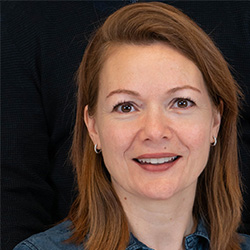
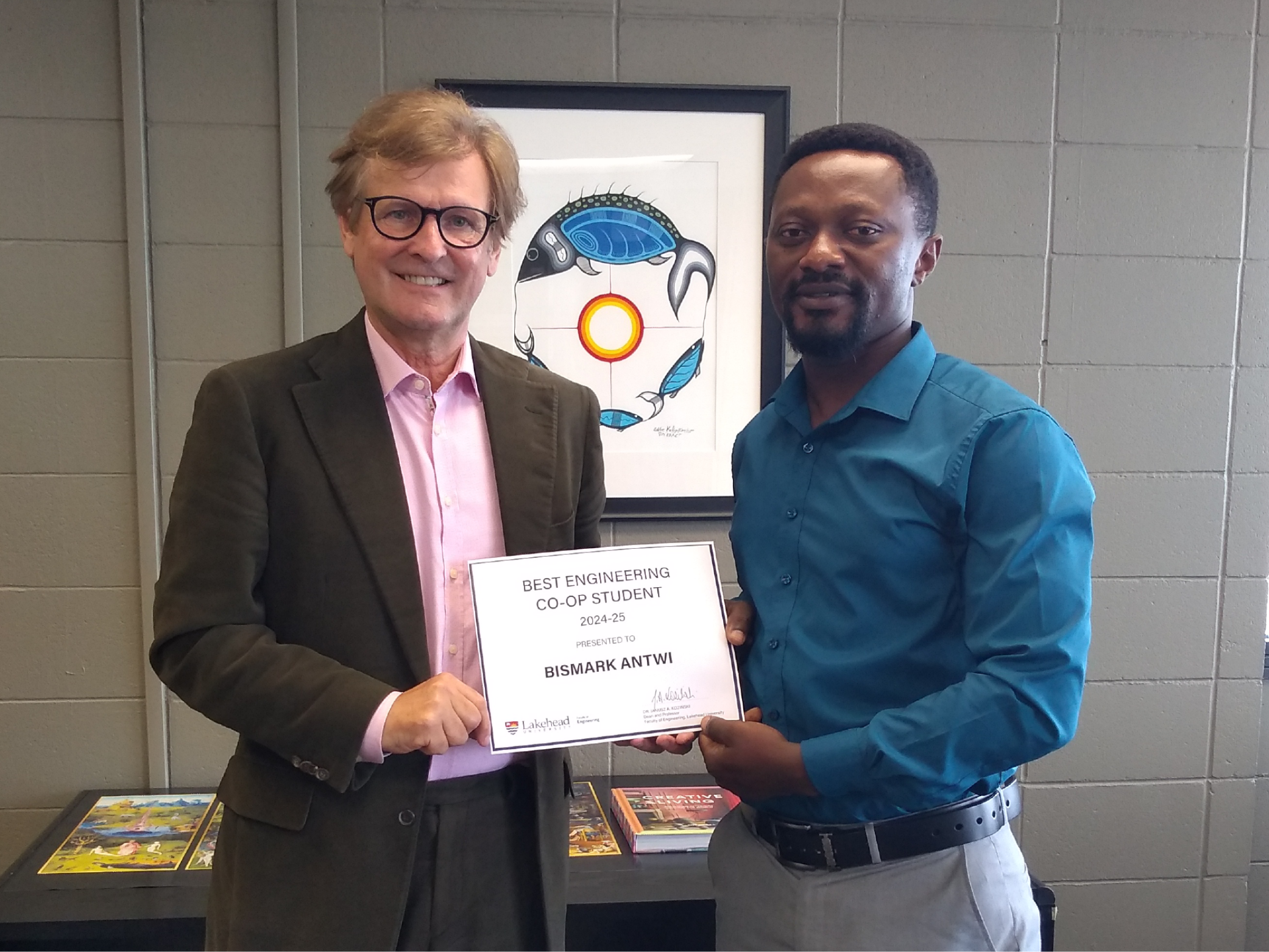
Bismark Antwi receives the co-op award from Dean Kozinski

Graduate student Bismark Antwi has been selected as the inaugural winner of the Best Engineering Co-op Student Award from the Faculty of Engineering.

“I am deeply honoured to receive this inaugural award that highlights the need to strive for excellence in any field you find yourself. I hope this award becomes a lasting emblem that motivates students to pursue a greater solution to the needs of humanity,” says Antwi.

He undertook his co-op placement at Elk Valley Resources, part of the Glencore Group, in Sparwood, British Columbia, between September 2024 and April 2025. He recently completed a Master’s degree in Environmental Engineering in the Faculty of Engineering.

The award recognizes the student who achieved the highest employer evaluation in the cohort of 2024-2025 engineering co-op students at Lakehead.

He received his award this month from Dr. Janusz Kozinski, Dean of Engineering. “Co-op is a critical component of engineering education, at both undergraduate and graduate level. It’s more important than ever for our students to gain hands-on experience and to start applying their professional skills to complex, real world projects before they graduate,” says Kozinski.

Bold Future Imagined for Lakehead University in New Strategic Plan

Shaping the Evolution Strategic Plan 2025 to 2030


Thunder Bay and Orillia, Ont. - Lakehead University unveiled a bold vision for the future with the launch of its new five-year strategic plan.

The plan, Shaping the EvoLUtion, reflects the unique and essential role of Lakehead University in Canada’s postsecondary landscape, serving northwestern and central Ontario — a place of progress and curiosity, where learning and research break down barriers, drive innovation, and create space for local solutions with global impact.

“Sixty years ago, Lakehead University was built by the community for the community,” said Dr. Gillian Siddall, President and Vice-Chancellor. “Today, we’re ready to write our boldest chapter yet — one of growth and transformation, where we reimagine and redefine Lakehead’s role in shaping society through exceptional teaching, groundbreaking research, and meaningful service.”

Informed by the voices of over 1,200 stakeholders, including students, faculty, staff, and community partners who together reimagined Lakehead’s potential, the plan outlines what Lakehead will achieve by 2030, why it matters, and how it will get there.

Grounded in values of integrity, community, belonging, curiosity and reconciliation, five themes form the foundation of this plan: 1) expanding student opportunity and success; 2) sustainable economic and community development and entrepreneurship; 3) advancing societal impact; 4) people and culture; and 5) financial sustainability.

It also reflects Lakehead’s commitment to academic and research excellence, advancing truth and reconciliation, strengthening community partnerships, and expanding our global impact.

“We heard clearly from our partners and the university community that the qualities that define Lakehead need to be celebrated and strengthened,” said Cathy Tuckwell, Chair of the Board of Governors. “This plan reflects those values, continuing Lakehead’s tradition of empowering students to shape their futures to tackle big questions and discover original solutions. The entire Lakehead community contributes to student success.”

Together with the university’s academic and operational plans, the new strategic plan will foster vibrant community partnerships and drive greater economic vitality for northwestern and central Ontario.

“The world is changing rapidly, and we know we will face challenges that require strategic approaches and leadership,” said Dr. Siddall. “Shaping the EvoLUtion will set that course and position us to adapt and respond dynamically, while educating the next generation of thought leaders and changemakers. Together, we will continue to evolve what makes Lakehead a special place — and a launchpad — for so many.”

Read the full plan here.

A Childhood Dream Comes True for Camryn Williams

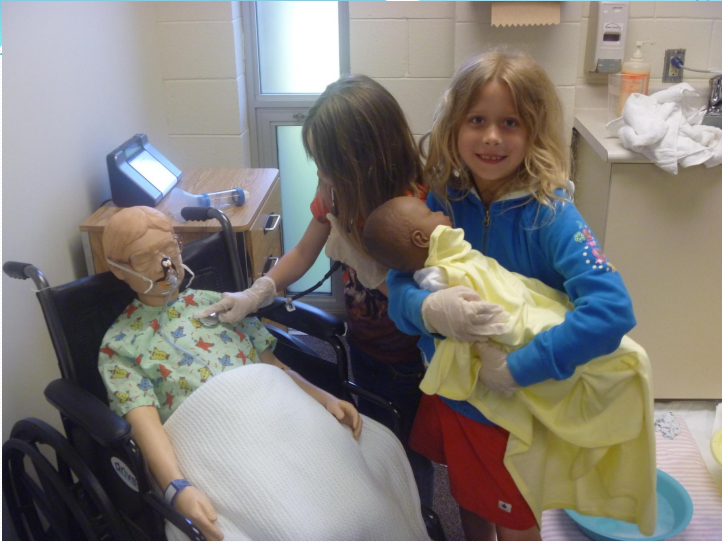
When Camryn Williams was nine years old, she toured Lakehead's Nursing Simulation Lab with fellow elementary students enrolled in the university's Achievement Program. The visiting youngsters were able to use medical equipment to listen to the heartbeats and take the blood pressure of the high-tech manikins that nursing students use to learn essential skills. 

It turned out to be a prophetic day for the young girl. Thirteen years after that visit—in May 2025—Camryn graduated from Lakehead with a Bachelor of Science in Nursing degree.

Camryn Williams and a fellow elementary student practice medical skills with mannikins in Lakehead's Nursing Simulation Lab

The moment Camryn realized she wanted to be a nurse: the opportunity to learn how nurses care for their patients and try out the equipment in Lakehead's Nursing Simulation Lab had a big impact on nine-year-old Camryn. Providing opportunities for students' personal growth and leadership development is a key aspect of the Achievement Program.

Camryn has also passed the National Council Licensure (NCLEX) exam for registered nurses and began working as a cardiac nurse at the Thunder Bay Regional Health Sciences Centre last month.

Camryn's hard work and intelligence have enabled her to reach these milestones, along with some assistance from the Achievement Program. It's an initiative committed to removing barriers to postsecondary education for every child in northern Ontario, so that they believe that a college or university education is possible for them.

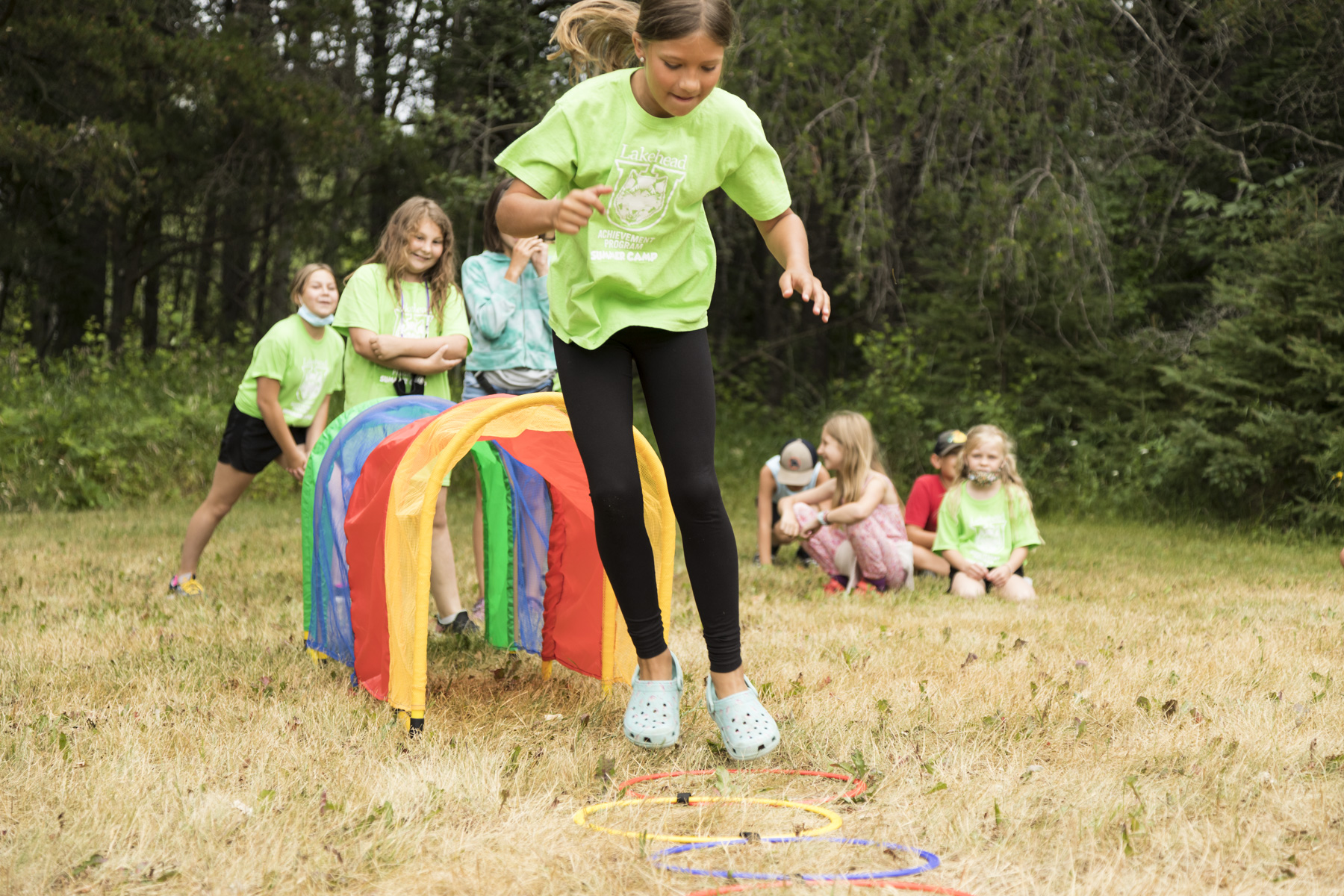
Achievement Program students run through an obstacle course during a 2021 Achievement Program summer camp

The Achievement Program is housed in Lakehead's Department of Athletics—providing a welcoming environment where students can experience the university through sports and fun recreational activities. From there, students are connected to faculties and departments where they can start thinking about what they might like to do when they grow up.

The Achievement Program does this by providing both mentorship and recreational, educational, and cultural programming to students facing socioeconomic challenges. Students enrol in the program in grade 4 and continue until they complete grade 12. By participating in Achievement Program activities and passing their grade every year, these students also earn financial support that covers their first year of tuition at Lakehead.

The Kid Who Wouldn't Give Up

Camryn is a member of the inaugural group of 13 students who enrolled in the Achievement Program in 2012, which was then part of the Lakehead Public Schools' summer literacy program. Since its founding, the Achievement Program has expanded to 464 students from school boards across the region.

"My mom signed me up because she was concerned that my grade-three reading level was below average," Camryn says. "She knew I could do better."

The next year, Camryn was proud to show her mother her report card. "I got an A in reading," she says. "The Achievement Program pushed me to try harder in school, and by the time I graduated from Hammarskjold High School, I was at the top of my class."

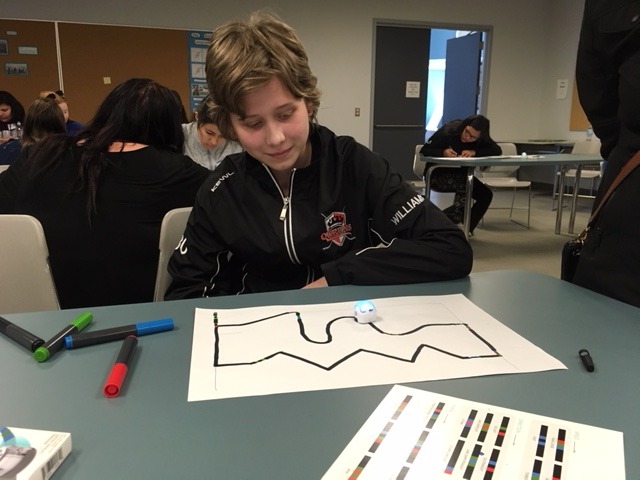
Camryn Williams watches an Ozobot create lines on paper during a Niijii Mentorship Program session in a Lakehead Thunder Bay classroom

In a session facilitated by the Niijii Mentorship Program, Camryn learned about computer coding with an Ozobot—a miniature robot with a sensor that can be coded to follow lines, read colour code combinations, and move in different directions. Throughout her four years at Lakehead, Camryn worked as an Achievement Program mentor, helping other children find their passions.

As a program participant, Camryn was often on the Lakehead campus. "It was a bit intimidating at first, but it got easier every year and it helped me transition into high school and university," she says.

She remembers making paper airplanes and putting them in a wind tunnel to understand the aerodynamics of flight, building and racing boats, chemistry lab experiments, and playing basketball and soccer.

When she entered high school, the focus shifted to preparing for higher education. "We'd have lunch sessions with Lakehead student-mentors and Amanda Stefanile, the Achievement Program coordinator. They'd teach us things like how to apply for OSAP and scholarships, how to study for exams, and how to budget."

Finding Her Calling

After countless activities, though, it was the Nursing Simulation Lab tour that stood out the most to Camryn.

"I didn't realize I wanted to be a nurse until the Achievement Program let me see first hand what it was like," she says. "I'd always been interested in science and biology and I thought it was cool that nursing could knit these fields together with my love of caring for others."

She was also influenced by her family—both her parents worked in health care and her grandmother had been a nurse. "Hearing their stories reinforced my decision to become a nurse."

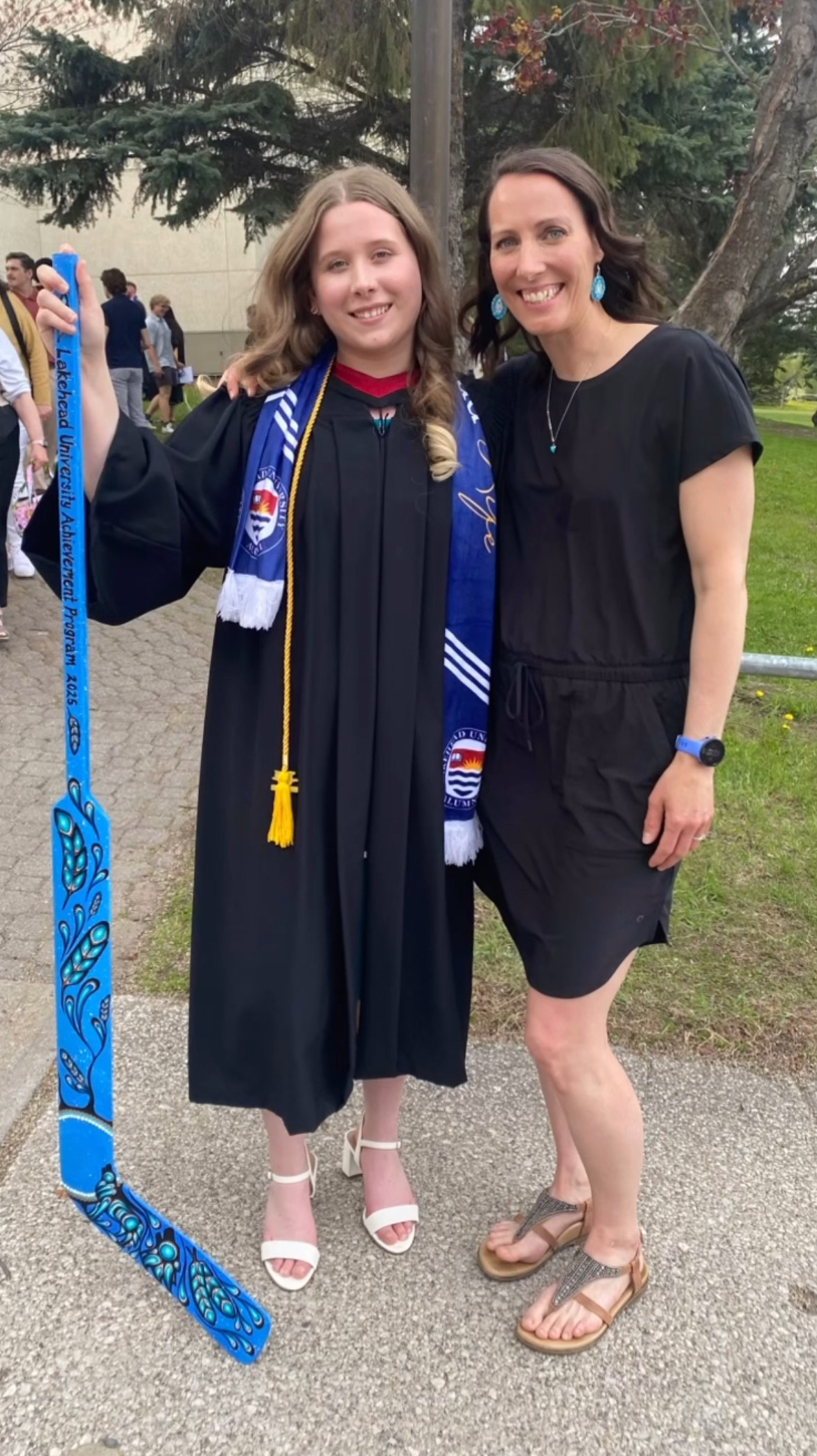
Camryn Williams wearing graduation robes and holding an Achievement Program hockey stick stands beside Achievement Program Coordinator Amanda Stefanile after a 2025 Lakehead convocation ceremony

"It was awesome to walk across the stage to get my Lakehead degree, especially since I wasn't able to have a high-school graduation ceremony because of the COVID pandemic," Camryn says. The beautifully decorated hockey stick Camryn received from the Achievement Program was a perfect graduation gift. Camryn has been playing hockey with the Thunder Bay Queens for the past 10 years.

Stepping onto campus as a university student in September 2021 was both exciting and familiar for Camryn.

"Lakehead's nursing program is great because it's one of the few schools where students have placements in hospitals and long-term care facilities beginning in their first year. I immediately began learning and applying real-life skills and developing relationships with patients."

Since that long-ago day in the Nursing Simulation Lab, Camryn has never looked back, and now she's looking forward to a wonderful future.

Congratulations to one of our newest Lakehead University alums!

We are incredibly grateful to the donors who support this program and who support our youth. Click here if you'd like to help Achievement Program students participate in yearly programming in school and on campus.


Faculty of Education Newsletter

The September 2025 issue of Education Exchange, the Faculty of Education's newsletter, has been published. This issue features news of the accreditation of the Keewatinase Indigenous Teacher Education program, the publication of the Faculty's Environmental Flourishing and Climate Action Planresults from the Contract Lecturer survey, alumni profiles, faculty news, and more. To access this issue, click here.

Education Exchange Newsletter

Student Spotlight: Meet Inspiring Animal Lover and Lakehead Student Zee Riley

Animals have been a constant in the life of Lakehead student Zhawanoogbiik (Zee) Riley. She's grown up surrounded by ducks, turkeys, chickens, dogs, and cats. More recently, horses and a cockatiel have joined her menagerie.

An orange tabby cat sitting on the ground

Photo Credit: Leylâ/Pexels

"My grandmother taught me how to rear domestic and wild animals by hand," Zee says. "I raised two geese in my bedroom until they were four months old. I had to clean my room four times a day until they were diaper trained."

Her rapport with animals made becoming a veterinarian a childhood dream.

"It's what I've wanted to do since I was six years old," she says.

Zee recently completed Lakehead's eight-month Indigenous STEM Access Program (ISTEM). The program offers preparatory courses and support to Indigenous students who want to apply to Lakehead degree programs in the sciences and engineering fields.

"ISTEM has been amazing," Zee says. "It gave me a university experience while teaching me time management and research skills. It also introduced me to different university services and helped me form a supportive community before starting my Honours Bachelor of Science this September."

Spirit Woman of the South

A bald eagle flight gets ready to land on the top of a dead tree

When it comes to her favourite animals, Zee says that she "gravitates to eagles, because it's my clan. I know where their nests are, and I can identify different eagles. I'm also very drawn to horses because of the bond and understanding I have with them." Photo Credit: David Dibert/Pexels

When she's not at Lakehead, Zee is at her family home, Riley Ranch on Three Fires, in southwestern Ontario. Zee's community is an integral part of her identity, always introducing herself in her language as: Zhawanoogbiik indizhinikaaz. Miigizi indoodem. Deshkan Ziibing indonjibaa. Anishinaabekwe indaaw.

This translates to: My name is Spirit Woman of the South. I am from Eagle Clan. I come from Antler River/Chippewa Thames First Nation. I am an Anishinaabe woman.

Riley Ranch is also the place where Zee runs a thriving business. "Last year, we began providing equine-assisted therapy to help young people aged 15-30 who are struggling with PTSD, intergenerational trauma, autism, ADHD, and depression," Zee says.

"Horses have an innate understanding of humans and our body language. They know if you are happy, anxious, sad, or mad. Our clients are coming from tough spots in their lives and aren't able to trust people, but they can trust horses."

A reddish-brown horse with white markings grazes near trees

Zee has a miniature horse, a quarter horse, and a Haflinger horse. As part of her equine-assisted therapy, each client is paired with a horse. "They become a team that learns to navigate obstacles together," Zee says. "Caring for an animal and developing a relationship based on mutual respect is a big part of healing." Photo Credit: Richard Burlton/richardworks/Unsplash

Standing Up for Animals

In addition to her therapy work, Zee is a passionate animal-welfare advocate. During the pandemic in 2020, while in high school, she established a no-cost animal food bank at the Riley Ranch on Three Fires.

These services became necessary after COVID-19 caused economic hardships and health orders made it necessary to impose restrictions on who could enter the Chippewa of the Thames First Nation, making it difficult for some community members to access veterinary care. "Some people were forced to choose between feeding their families and feeding their animals," Zee says. "Packs of wild dogs on the reserve began to get aggressive because they were starving."

A reddish-coloured dog with sad eyes

In 2022, Zee entered the Pow Wow Pitch entrepreneurship competition to raise awareness and money for her animal food bank. "I don't care what someone's financial situation is," Zee says. "If they need help for their animals, they'll get help." Photo Credit: RK Jajoria/Pexels

"We operate like a Tim Horton's drive-thru where people can pick up food for dogs and cats, but also hamsters, ferrets, and kangaroos," Zee continues.

"We even found food for a camel." Along with distributing food, Zee gives out free crates, leashes, and other pet supplies. Her animal-welfare activities extend to arranging at-cost spays, neuters, vaccinations, and other veterinarian services through her partnership with the East Village Animal Hospital in London.

Although Zee has just started her Lakehead degree, which is focused on animal sciences, she's already proven herself to be a fierce protector of all creatures, great and small.

Lakehead PhD Student Awarded AFCCE Scholarship

Mohammed Kamel AbuFoulMohammed Kamel AbuFoul, a graduate student from the Department of Electrical and Computer Engineering at Lakehead University, has been awarded the AFCCE Scholarship for the fall 2025 semester by the Association of Federal Communications Consulting Engineers (AFCCE), Washington, D.C., USA. This scholarship recognizes academic excellence in communications engineering and is awarded to graduate students who demonstrate strong potential for a career in telecommunications engineering.

Mohammed Kamel AbuFoul is a PhD candidate at the Thunder Bay campus under the supervision of Dr. Salama Ikki. He specializes in physical-layer communication and integrated sensing in high-mobility environments, including 6G waveform design and OTFS performance analysis.

He is also a sessional instructor in the Software Engineering and Computer Science departments at Lakehead. Recently, he was awarded a research grant from Mitacs–Lab2Market for the project "AutoSAR: Autonomous UAV Search and Rescue Using Deep Learning for Emergency Response in Remote and Infrastructure-Free Regions" (Ontario, Canada, 2025). He has also served as a peer reviewer for leading journals such as IEEE Wireless Communications Letters and SCIENCE CHINA Information Sciences.

The Association of Federal Communications Consulting Engineers (AFCCE) is a professional organization of individuals who are involved in the field of broadcast and wireless communications, many of whom regularly assist clients on technical issues before the Federal Communications Commission, FCC. In addition to its professional activities, AFCCE engages in charitable and educational activities, including the administration of this scholarship fund.

If You’re Seeking Peace, Try Walking a Labyrinth

Amidst the bustle of campus life, the Wellness Path near the Faculty of Education offers a place to slow down—a quiet refuge from the stresses and demands of modern life. Open to individuals, families, and the university community, the labyrinth welcomes anyone who ventures its way.

"The labyrinth is a walking, meditative path," says Devon Lee. Its twists and turns are sometimes seen as a symbol of those we experience on our own life journeys.

Devon Lee and Philosophy of Education students stand at the Wellness Path entrance

Devon Lee (third from left) and her Philosophy of Education students (L to R): Arafat Alamgir Shanto, Shakil Zaman, and Ayoola Jegede at the entrance of the Wellness Path. Devon's work focuses on climate education, the environment, and folk schooling (non-formal education for adults). Devon also worked on Lakehead’s Labyrinth Learning Project as a graduate assistant and as Lakehead’s sustainability coordinator. 

Lee is a Lakehead PhD student in Educational Studies and a contract lecturer who has been closely involved with the labyrinth since its inception.

"People can experience deep emotions in the labyrinth, and it can be a powerful way to deal with grief. As a teacher, I've also used it to help people get to know each other and to answer complex questions. Labyrinths can be a pilgrimage in both a secular and a religious sense," she adds.

Labyrinths Versus Mazes

Three students walk the Wellness Path labyrinth

The Wellness Path (above) isn’t the only labyrinth on the Thunder Bay campus. There’s a second labyrinth next to the CASES building. This labyrinth has a dual purpose—to encourage contemplation and to act as a stormwater catchment area.

The words "labyrinth" and "maze" are sometimes used interchangeably, but they are different in both purpose and design.

Mazes often have multiple entrances and branching paths that lead to dead ends. They're a puzzle meant to confuse the walker. Labyrinths are a single path that takes the walker to their centre. You can never lose your way in a labyrinth.

A labyrinth is a walking meditation that encourages the walker to slow down and reflect.

"No one really knows where labyrinths originated," Lee says. "They're ancient and they're found in cultures all over the world that had little or no contact with each other."

A labyrinth etched into a rock face at least 11,000 years ago in Nevada and the French medieval labyrinth found in Chartres Cathedral are just two examples.

"Recently, labyrinths have gained traction in schools, hospitals, and churches as a wellness or mindfulness practice," Lee says. "K-12 schools are using them indoors and outdoors to help children decompress."

Welcome to the Wellness Path

Four Lakehead Philosophy of Education students stand at the entrance of the Wellness Path labyrinth

Philosophy of Education students Nicholas McPherson, Natasha Nkrumah, and Portia Addai Adusei relax at the labyrinth after class. Besides walking labyrinths, there are also labyrinths that are painted on walls or printed on paper that allow people to trace their paths using their fingers.

Lakehead Professor Emeritus Dr. David Greenwood led the group that advocated for the construction of the Wellness Path. At the time, he was the university's Canada Research Chair in Environmental Education, within the Faculty of Education.

Dr. Greenwood worked with landscape architect Werner Schwar to design the labyrinth, which was completed in 2022.

It has 11 switchbacks and is modelled on the "Path of Peace" labyrinth form. It takes 5-20 minutes to complete, depending upon the walker's pace.

Some of the boulders in the labyrinth were quarried locally, including the two at the centre where people can sit once they've completed their journey.

Lakehead's labyrinth is also notable for fostering environmental wellness alongside human wellness.

"It's a place that was previously a monoculture of grass," Lee says. "Now, there's mountain ash, yarrow, coneflower, and other native plant species that are encouraging biodiversity."

Learning from the Labyrinth

Student Arafat Alamgir Shanto sit at the centre of the Wellness Path labyrinth

 "I find that people are often a little bit reluctant to walk the labyrinth, but once they do it, they feel more comfortable and walk it again and again," Devon Lee says.

Lee uses the labyrinth as a form of holistic and embodied learning. "That means using movement, our whole body, and our senses to learn," she explains.

"My education students walk the path with a specific question in mind, which they then journal about," Lee says. "For one of my recent classes, their question was, 'How can educators promote the conditions for democracy to thrive?'

The sense of inquiry and contemplation is much greater than if they were sitting in a classroom or writing an essay on their computers."

The Wellness Path supports two United Nations Sustainable Development Goals (SDGs)—SDG 3: Good Health and Well-Being and SDG 13: Climate Action. Visit the Wellness Path beside the Faculty of Education on Oliver Road to discover the power of a labyrinth.

Lakehead’s Natural Resource Management Experts Lead $1.67M Global Effort to Help Forests Adapt to Climate Change

Forscale TeamForests around the world face unprecedented challenges from a rapidly changing climate, and a team of Lakehead University researchers is stepping up to lead solutions.

Thanks to $1.67 million in funding from the Eva Mayr-Stihl Foundation in Germany, seven professors from Lakehead University’s Faculty of Natural Resources Management will play a central role in a groundbreaking international research network dedicated to forest adaptation called FORSCALE: Scale Effects in the Forest Adaptation to Climate Change. The research will explore forest adaptation at many levels — from tree genetics and whole ecosystems to policy and land-use planning — and examine how biological, ecological, and social systems interact to shape forest health in a changing climate.

The Canadian arm of the international project is led by Dr. Brigitte Leblon, Dean of the Faculty of Natural Resources Management and principal investigator for Canada. Joining her from Lakehead are: Dr. Ashley Thomson, Dr. Brian McLaren, Dr. QingLai Dang, Dr. Michel Laforge, Dr. Seung-Il Lee, and Dr. Dzhamal Amishev. These seven experts bring deep expertise in forest ecology, remote sensing, fire management, genomics, entomology, forest operations, wildlife management, and ecophysiology. Lakehead is collaborating with leading institutions across Canada and Germany, including: Université TÉLUQ, Université du Québec en Abitibi-Témiscamingue (UQAT), Université du Québec en Outaouais (UQO), Université du Québec à Montréal (UQAM), University of British Columbia, and University of Freiburg (Germany) with project coordinator: Professor Thomas Seifert. Canadian partners include the Canadian Forest Service, the Ministère des Ressources naturelles et des Forêts du Québec, DOMTAR (Thunder Bay and Québec), and other forestry-sector organizations. The German side of the project is supported in part by the Deutsche Forschungsgemeinschaft (DFG).

Over the next six years, 41 graduate students and post-doctoral researchers in Canada, along with 20 PhD students in Germany, will be co-supervised by professors in both countries. This collaborative model offers students immersive, hands-on research opportunities that span disciplines, borders, and perspectives.

“At the heart of this project is the chance to empower the next generation of forest scientists to make a real difference,” said Dr. Brigitte Leblon. “Our students will learn and contribute on a global scale, helping to shape climate solutions grounded in both science and collaboration.”

Lakehead University’s Faculty of Natural Resources Management (NRM) is a hub for hands-on learning and applied research in the heart of the boreal forest. Faculty and students work across forestry, wildlife, and environmental management, blending field training with advanced lab and data science to solve real-world problems. Partnering with governments, industry, communities, and Indigenous partners, NRM advances sustainable forest practices, climate adaptation, fire management, genomics, biodiversity conservation, and ecosystem resilience while preparing the next generation of resource professionals and researchers to lead in a changing world.

As one of the first initiatives to examine forest adaptation through a cross-scale, international lens, FORSCALE represents more than just research; it’s a model for how science can guide resilience. For students, it’s a gateway to high-impact learning. For the planet, it’s a pathway to more adaptive, sustainable forest management.

Thunder Bay Researcher Co-Leads $10.8M National Project to Improve Indigenous Youth Mental Health

Thunder Bay, Ont. – A national initiative to improve Indigenous youth mental health, co-led by local researcher Dr. Chris Mushquash, has secured an additional $10.8 million from the Canadian Institutes of Health Research (CIHR).

Chris MushquashDr. Mushquash, Canada Research Chair in Indigenous Mental Health and Addiction; Professor in the Department of Psychology at Lakehead University; Vice President Research at Thunder Bay Regional Health Sciences Centre; and Chief Scientist at Thunder Bay Regional Health Research Institute, and Dr. Srividya Iyer, Tier 1 Canada Research Chair in Youth, Mental Health, and Learning Health Systems and Professor in the Department of Psychiatry at McGill University, are co-leading the four-year project focused on building a trust-based learning network across Canada to support culturally-grounded mental health services for Indigenous youth.

Indigenous youth in Canada face significant mental health challenges, such as intergenerational trauma, cultural disconnect, increased poverty, and limited access to health services, often due to geographic location and systemic barriers. Despite these challenges, Indigenous youth have strong connections to culture, community, and land, which are powerful protective factors that promote well-being.

As part of the ACCESS Open Minds Indigenous Youth Mental Health and Wellness Network, this initiative will strengthen capacity amongst Indigenous communities and integrated youth services (IYS) networks to deliver inclusive, high-quality, culturally and contextually relevant, and responsive mental health services with, and for, Indigenous youth. The project is guided by the strength of multigenerational teaching and brings together Elders, Knowledge Holders, youth, families, and community leaders, including Dilico Anishinabek Family Care, who serve 13 First Nations across northwest Ontario.

“This is an incredible opportunity for our network to help close critical gaps by cultivating a trust-based, collaborative learning environment across Canada,” said Dr. Mushquash. “With this investment, we can translate knowledge into real-life improvements for Indigenous youth, ensuring that services are more culturally grounded, accessible, and responsive to community needs. Being able to co-lead this work from northwestern Ontario, and specifically Thunder Bay, is deeply significant, as it reflects both the challenges and strengths of the communities we serve.”

The project will utilize various forms of data, including stories, lived experiences, cultural teachings, and images, to guide and strengthen its work. Its goals are to build community capacity, nurture the next generation of Indigenous and allied leaders, and weave Indigenous knowledge systems into service delivery. The interdisciplinary research team also aims to advance approaches rooted in Indigenous worldviews and values. Through these efforts, the network will help empower Indigenous communities and support partner organizations in delivering high-quality, culturally grounded care, while fostering sustainable development and ongoing learning.

"Lakehead University is committed to serving the communities we are proud to be part of, and that includes driving progress through research to improve health outcomes for Indigenous youth here in northwestern Ontario and across Canada,” said Dr. Langis Roy, Vice-President, Research and Innovation at Lakehead University. “This project demonstrates the vital role universities play in advancing knowledge, fostering innovation, and partnering with communities to create meaningful, lasting change in society.”

The Government of Canada, through CIHR and Indigenous Services Canada, and its partners, the Graham Boeckh Foundation (GBF) and Bell-GBF Partnership, is investing more than $30 million over four years in the Integrated Youth Services Network of Networks (IYS-Net) to strengthen and expand research across Canada. An innovative approach to youth-focused mental health, IYS provides youth with equitable access to a range of services and supports that contribute to health. This includes mental health and substance use services, alongside primary care, peer support, work and study supports, and more.

Pages