Lakehead University Study Warns Canada's Cannabis Tracking Failing to Keep Pace with Market

Cannabis products


Photo by 2H Media on Unsplash

Thunder Bay, Ont. - Researchers at Lakehead University say Canada’s public health tracking tools are falling behind a rapidly evolving cannabis market that’s increasingly targeting young adults with high-potency, youth-appealing products.

The warning comes after a new study, published in the Substance Abuse Treatment, Prevention, and Policy journal, found that many cannabis products currently available in stores are missing from official tracking systems such as the Canadian Cannabis Survey. The researchers are also calling on Health Canada to enforce standardized labelling on the country’s cannabis products to protect public health and improve consumer understanding.

Chelsea Noel"There’s an overwhelming amount of new cannabis products on the market,” explained lead researcher and Lakehead Clinical Psychology PhD candidate Chelsea Noël. “New products and modes (how people are using products) are appearing faster than the current surveillance tools can keep up with, creating a much more complex monitoring environment than we’ve had in the past.”

After reviewing the online inventories of 10 large cannabis retailers in Ontario, researchers found that product potencies (THC and CBD concentrations) are often labelled using inconsistent, non-standard units across products.

The findings raise serious concerns for young adults aged 18-25, who are particularly vulnerable and face a higher risk of adverse health effects from frequent, high-potency cannabis use, including accidental overdose and altered brain development.

Deborah Scharf“Products are labelled so differently in terms of the drug concentration and potency; there is no comparing apples to apples,” said Dr. Deborah Scharf, Adjunct Professor of Psychology, Health Sciences, and Education at Lakehead University and Noël’s supervisor. “Without consistent and clear labelling, users may not know how much of the drug they’re actually taking. Different consumption methods also impact the body differently. For example, eating edibles loses some of the potency, whereas inhalation goes straight to the brain. Current product labels simply don’t provide adequate warnings.”

The study provides a consolidated resource for healthcare providers, policymakers, and care partners to help cannabis users make safer, more informed choices. It also offers a framework for public health agencies across Canada to update their tracking tools to match what is actually being sold in stores.

This project was funded through a Social Sciences and Humanities Research Council of Canada (SSHRC) Partnership Engage Grant with the Thunder Bay Drug Strategy. The full study can be viewed and downloaded at https://link.springer.com/article/10.1186/s13011-026-00735-4.

Local Farmers Count on Agricultural Expert Dr. Tarlok Singh Sahota

This Canadian Society of Agronomy Award Winner is Eager to Help

When northwestern Ontario farmers need advice, they turn to Dr. Tarlok Singh Sahota.

He's the director of the Lakehead University Agricultural Research Station (LUARS).

"I search throughout Canada for ideas to help local farmers and agribusinesses flourish," he says. "Rural communities have really rallied behind us."
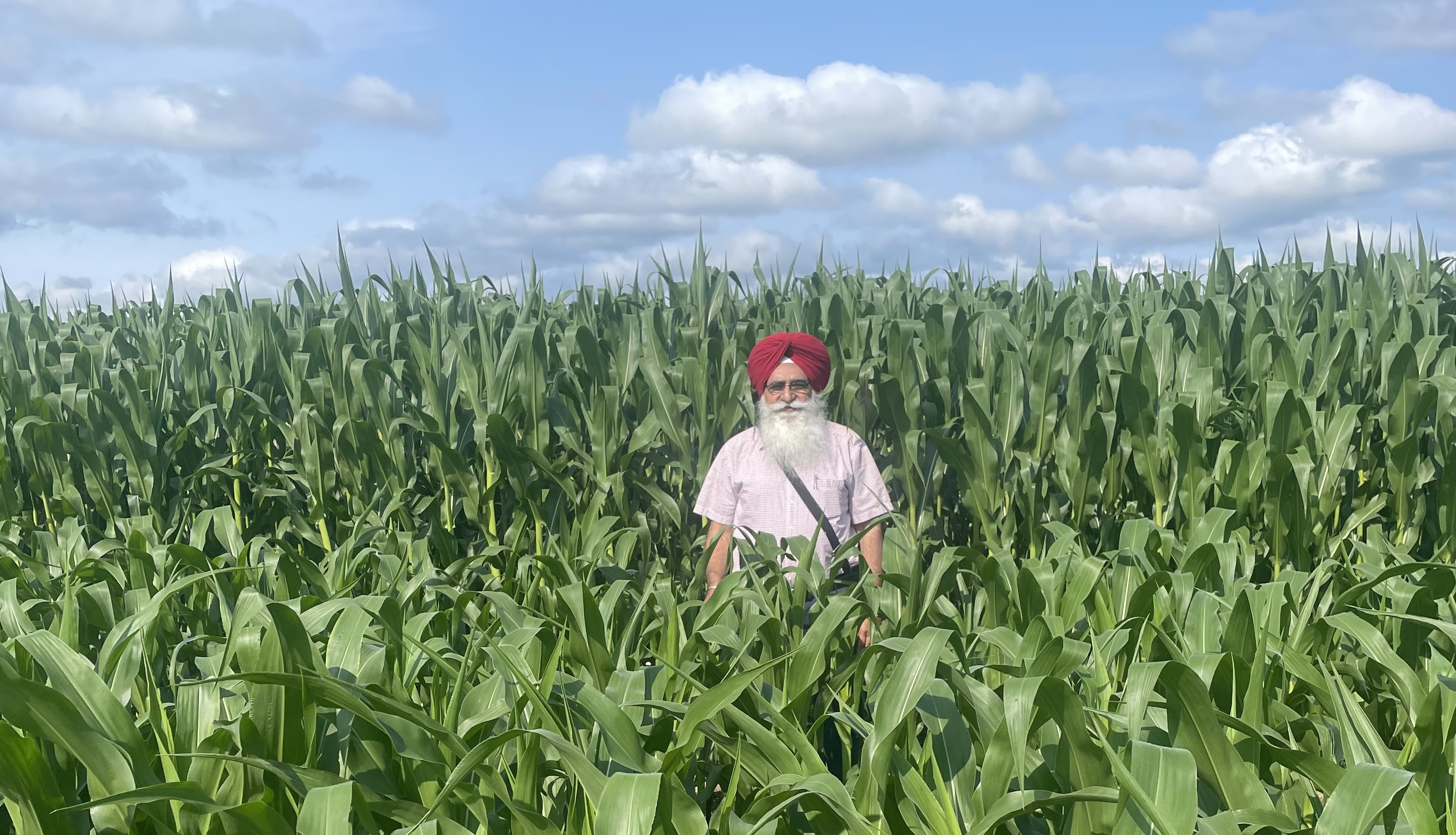
Dr. Tarlok Singh Sahota stands in a green cornfield on a summer day

Above, Dr. Singh Sahota demonstrates how plastic mulch can increase the yield of corn crops. The shorter corn plants in front of him were grown without plastic mulch while the taller plants behind him were grown with plastic mulch.

Dr. Singh Sahota has been with LUARS since 2004.

It's there, on the outskirts of Thunder Bay surrounded by the Nor'wester Mountains, that Dr. Singh Sahota conducts experiments and crop testing. He also takes the time to co-supervise graduate students in Lakehead's Faculty of Natural Resources Management and offers students experiential research opportunities.

If he's not at LUARS, he is likely to be out visiting farmers, assisting them with crop planning and troubleshooting.

A Farm Boy at Heart

Dr. Singh Sahota's love of agriculture has deep roots. Growing up, his family had a 10-acre farm in India's Punjab state.

"We grew corn, wheat, rice, sugar cane, cotton, and some foraging crops for cattle," he says.

"I did fieldwork after school, cultivating the fields with a pair of oxen. When I was in university, we got a tractor and I would go home on weekends to help my father and brothers with farm work."

Since then, Dr. Singh Sahota has garnered three university degrees and over 40 years of agricultural experience on four continents.
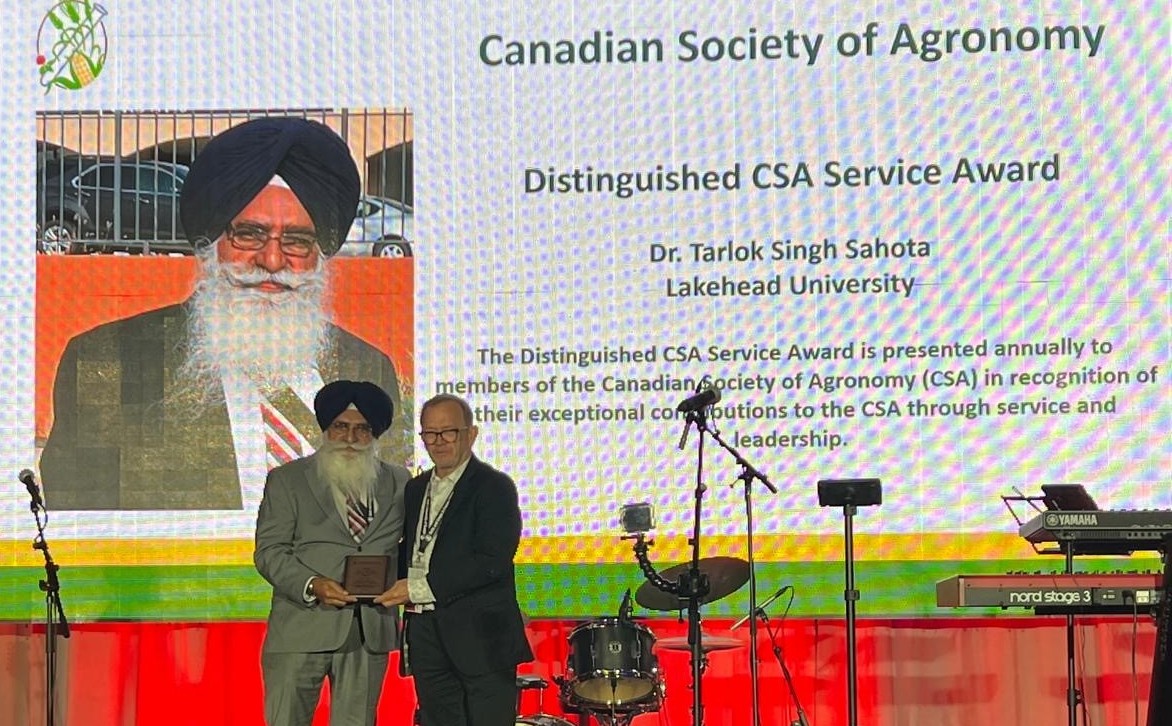
Dr. Tarlok Singh Sahota stands next to another man on a stage while holding an award plaque; behind them is a large screen with Dr. Singh Sahota's photo and text saying that Dr. Singh Sahota is the winner of the Distinguished CSA Service Award

 Dr. Singh Sahota at the 2026 Canadian Society of Agronomy award ceremony at the University of Guelph.

His achievements have earned him three awards from the Canadian Society of Agronomy (CSA).

He's the proud recipient of a 2018 CSA Fellow Award, a 2021 CSA Distinguished Agronomist Award, and on June 24, 2026, he received the inaugural Distinguished CSA Service Award.

The Distinguished CSA Service Award recognizes individuals who've demonstrated exceptional contributions to the CSA through dedicated service and leadership.

The North Faces Tough Agricultural Challenges

"Before I came to Thunder Bay, I knew the region had a short growing season because it's colder than other parts of Canada," Dr. Singh Sahota says.

Farmers also struggle with northwestern Ontario's shallow, rocky, and acidic soils.

That's why LUARS has two main focuses: improving fertilizer nutrient management and developing new high-yield disease-resistant crops varieties suited to the north.

"When I arrived, farmers were only growing foraging crops to feed their livestock," Dr. Singh Sahota says. "But I knew that by improving the soil fertility they could grow cash crops, too." Cash crops refers to crops that are planted with the intention of selling them after they've been harvested.
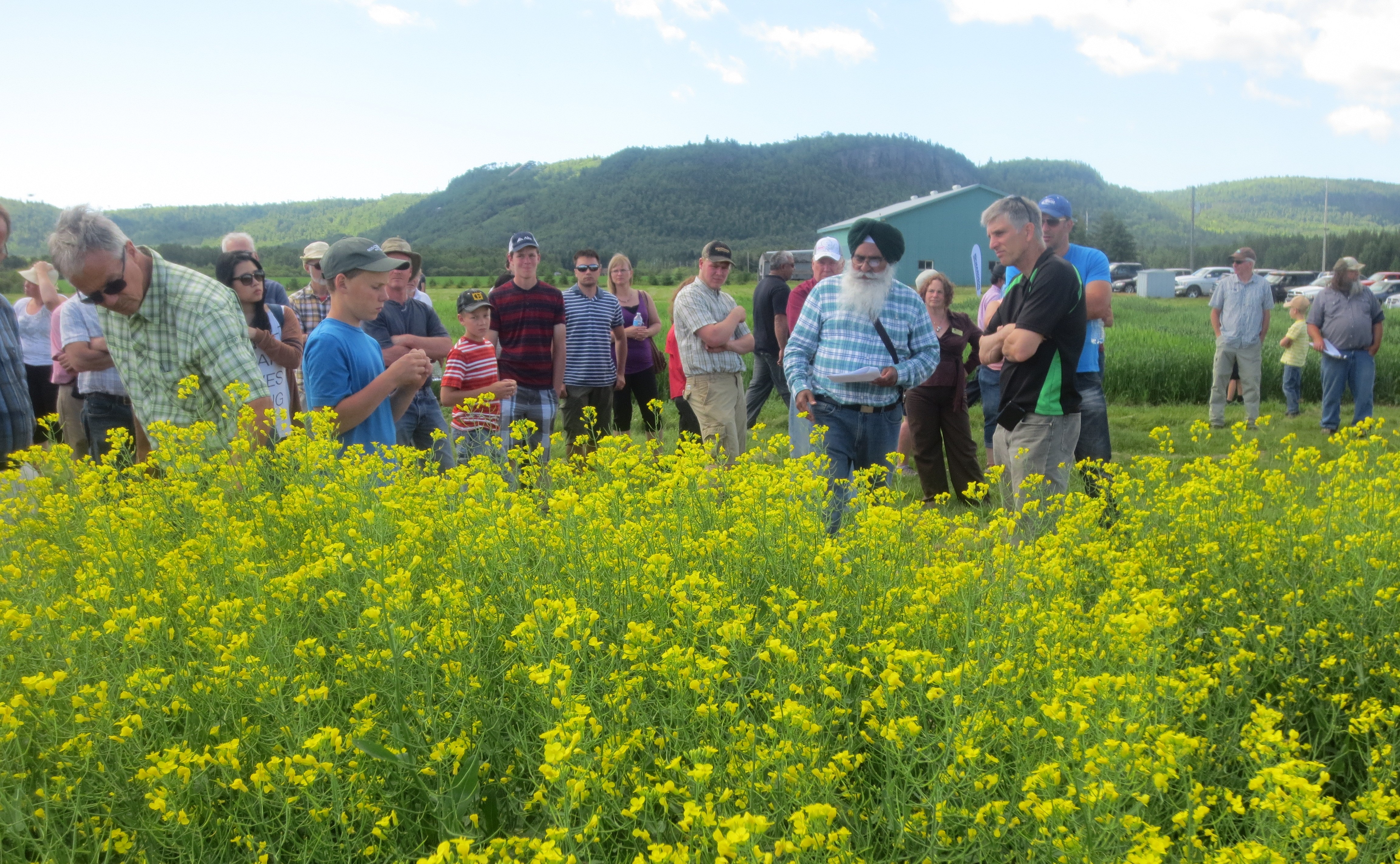
Dr. Tarlok Singh Sahota, holding sheets of paper, stands in front of canola plants with yellow flowers; a large group of casually dressed people surround him and mountains are visible in the distance

Dr. Singh Sahota has been responsible for many farming innovations in northwestern Ontario, such as encouraging disc harrowing in the fall and cultivation ploughing in the springtime. "Previously, farmers had been mouldboard ploughing in the fall," he explains. "By making this change, they were able to eliminate mouldboard ploughing in the fall and save 30-40% in fuel and time." Above, Dr. Singh Sahota gives farmers a tour of LUARS.

With Dr. Singh Sahota's guidance, local farmers have been successfully cultivating malting barley, winter wheat, winter rye, and canola among other cash crops.

"Winter wheat and winter rye are hardy crops that can be planted in September after the spring crops have been harvested. It's a way to create more income for farmers, and protect the soil," he adds.

Recently, Dr. Singh Sahota has been testing pink barley, black barley, and purple barley—varieties he chose because they don't have hulls and can be used as food for people.

If these varieties can adapt to northwestern Ontario's growing conditions, farmers will save time and money by eliminating dehulling from their harvesting process.

Healthy Soil Creates Healthy Crops

Nutrient deficiencies, which make crops unhealthy and more susceptible to disease, were a persistent problem that Dr. Singh Sahota has been able to address.
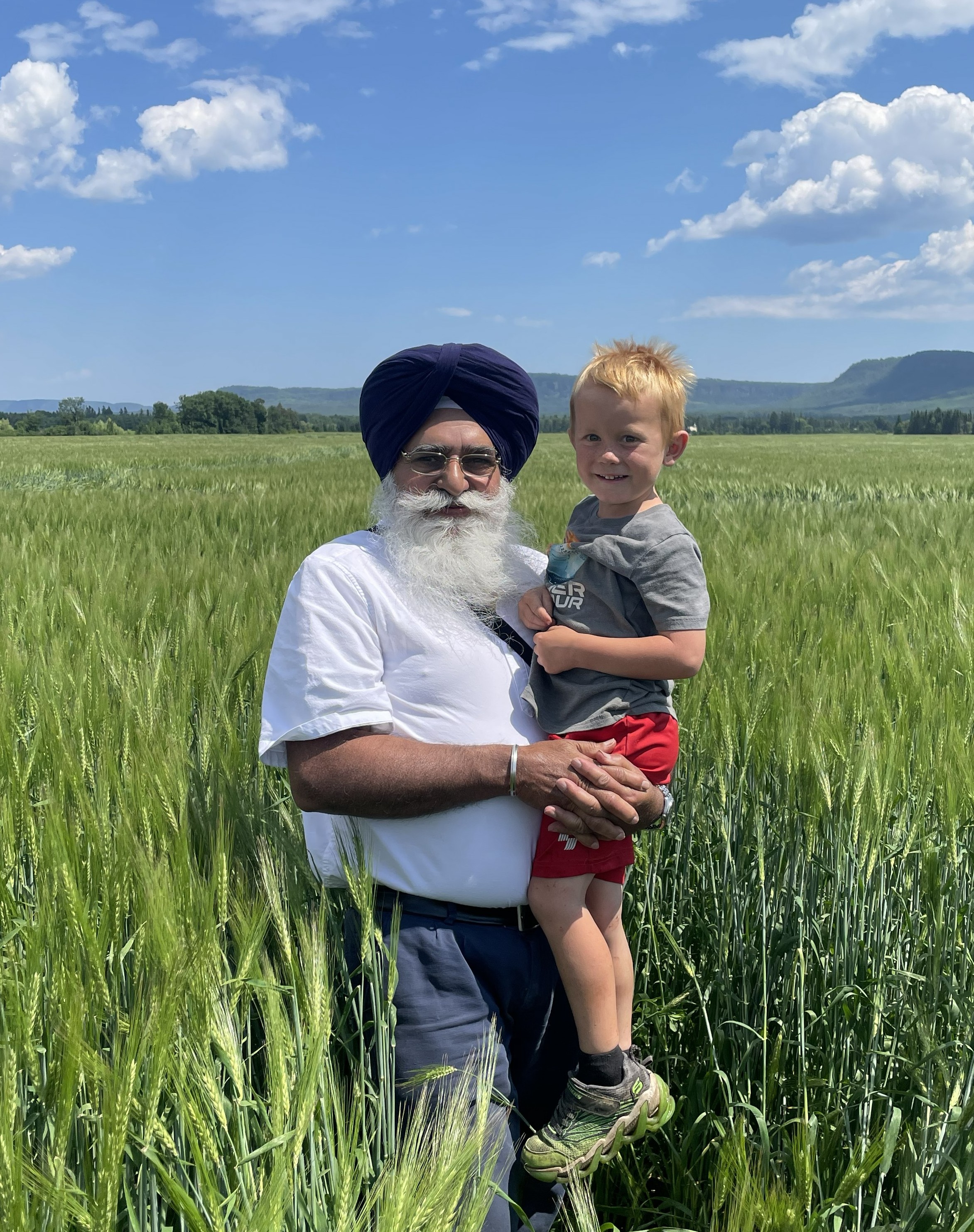
Dr. Tarlok Singh Sahota stands in a barley field on a sunny summer day and holds a small smiling boy in his armsDr. Singh Sahota convinced Richardson International, an agribusiness with grain elevators in Thunder Bay, to buy cash crops from local farmers. "I've found that western varieties of crops do better in Thunder Bay than southern Ontario varieties," he says. Above, he and a future farmer survey a barley crop at a local farm.

At his urging, farmers have switched to using an ammonium sulfate fertilizer to correct sulphur deficiencies, and they've improved their crop yields, especially for canola, by using a three-fertilizer blend developed by Dr. Singh Sahota.

They're also supplying their soil with micronutrients by spreading their fields with wood ash—an industrial waste product farmers acquire from Resolute Forest products.

"Our farmers now grow more than half a dozen crops, compared to southern Ontario where they usually grow just three crops: soybeans, corn, and winter wheat," Dr. Singh Sahota says.

The latest crop he's excited to be testing is called winter camelina. It's an oil-seed plant that can be used as sustainable jet-engine fuel, with the added benefit of protecting the soil in winter.

"My philosophy is that unless we try new crops, we'll never know if they can thrive here."

LUARS is funded in part by the Governments of Canada and Ontario under the Sustainable Canadian Agricultural Partnership (Sustainable CAP), a federal-provincial-territorial initiative administered by Agricultural Research and Innovation Ontario.

Watch Seeds of the North, a short documentary about the Lakehead University Agricultural Research Station.

Helping Kids Find Wonder in the Natural World

Rayanna Santiago Inspires the Best in People

“Winter camping is one of my favourite things,” says Master of Education student Rayanna Santiago.

“My family asks me, ‘How is that fun?’ but winter camping lets you connect with the land and slow down at a time when many animals are slowing down, too.”

Rayanna Santiago with Lakehead Leader AwardLakehead Leader Awards are given to students who embody the spirit of excellence, innovation, dedication, and community impact. “I was really honoured and grateful to be nominated for an award,” Rayanna says. “To this day, I don’t know who nominated me.”

Rayanna, who specializes in Environmental and Sustainability Education, is finishing her first year of the Education for Change program.

“Lakehead has empowered me to pursue my passions for social justice and fighting climate change,” she says. 

“I’m interested in intersectional ecofeminist values and practices as a way to implement ecologically and socially just ways of relating with each other to help all beings flourish.”

This April, Rayanna received a Lakehead Leader Luminary Award from the Student Success Centre for her efforts to foster environmental sustainability.

“It was exciting to receive the award because it allowed me to recognize that I’m doing meaningful work and it gave me a moment for self-reflection.”

Wilderness Adventures on Your Doorstep

Rayanna is a place-based educator—she helps children learn by engaging them in the social, ecological, economic, and cultural contexts of the places where they live.

“The local context of the place we live in becomes the foundation of learning,” Rayanna explains. “This could include visiting important cultural sites or getting kids into natural settings to learn from, and with, nature.”

As part of her commitment to this interactive style of learning, she’s volunteered at local forest schools in the Thunder Bay area.

Students on a Forest School Outing

Above, Rayanna takes elementary school students on a winter walk. “There’s a lot of focus on human-to-human connection in education, but not enough on the human-to-nature connection,” she says.

Her experiences at both the Tapiola Outdoor Education Centre and the Kingfisher Outdoor Education Centre, run by the Lakehead District School Board, have been immensely rewarding.

“There’s so much fantastic outdoor education, environmental education, and Indigenous land-based learning happening in northwestern Ontario,” she says.

Bringing her fellow outdoor educators together is equally important to Rayanna.

As a director-at-large with the Council of Outdoor Educators of Ontario (COEO), her goal is to help build a strong community of northwestern outdoor educators, organizations, and universities and to help these educators build relationships with each other.

“I also use this role to strengthen the ties between outdoor education and environmental sustainability, such as my work co-chairing COEO’s Make Peace with Winter Conference.”

Make Peace with Winter brought Ontario educators together to share creative approaches to connecting their students with the outdoors in wintertime.

“I was glad that I was able to secure a travel grant to bring five Lakehead students and staff to this conference at Camp Kawartha,” she adds.

Rayanna TAing a Lakehead Outdoor Rec Class

Above, Rayanna engages Lakehead outdoor recreation students in an activity illustrating how different parts of the natural world are connected.

Embracing the More-than-Human World

At the heart of Rayanna’s teaching is the concept of community.

"For me, this means people, the place that we live, and the more-than-human beings. The oak tree on my front lawn is as much my community member as my next-door neighbour. 

My aim is to foster relationships with the more-than-human world so that we can make ethical decisions and do the best we can for other beings, as well as ourselves.

That’s why I have my students spend a lot of time in nature. It sparks their curiosity by encouraging them to think about who we share this environment with—whether it's rocks and birds or lakes and fish.”

Rayanna at Temagami

Above, Rayanna on a 2022 camping trip to Temagami, Ontario. “After I graduate from Lakehead, I’d like to work at least a year at the Kingfisher Centre and as a contract university lecturer in critical education topics,” she says.

 Tracking animal footprints in the snow is always popular with her students.

“I ask them, ‘Who do you think was here and what were they doing?’

When you're tracking you’re never going to know all the answers, but it evokes a feeling of kinship with our fellow animals.”

An even simpler year-round activity Rayanna’s students enjoy is sitting by themselves in the forest for 5-10 minutes and observing their surroundings.

“It cultivates their sense of awe and stimulates their creativity,” she says. “Often, kids will tell me, ‘That was so magical!’”

“Education is a powerful way to change how people relate to the world.”

Dr. Ide Costa Appointed as Director of the Centre for Education and Research on Aging & Health

Idevania CostaDr. Langis Roy, Vice-President, Research and Innovation is pleased to announce the appointment of Dr. Ide Costa as the new Director of Lakehead’s Centre for Education and Research on Aging & Health (CERAH), effective July 1, 2026. 

Dr. Costa is an Associate Professor in the School of Nursing and has served as Associate Director of CERAH. She brings a strong record of leadership in health equity, aging, person-centred care, digital storytelling, wound prevention and care, and community-engaged research to the role.

As the founder and director of the research hub EQUIP@Action, Dr. Costa leads collaborative, action-oriented research focused on improving health systems and reducing inequities. Her work is grounded in lived experience, partnership, and knowledge mobilization for meaningful change.

Dr. Costa’s leadership, vision, and commitment to equity and community collaboration align closely with CERAH’s mission to advance education, research, and knowledge exchange in aging and health.

Dr. Costa is succeeding Dr. Kathy Kortes-Miller, who served as CERAH’s director since July 2021. For the last five years, Dr. Kortes-Miller has built on CERAH’s reputation for excellence in research and education by enhancing health and well-being for an aging population. The university community thanks Dr. Kortes-Miller for her administrative experience, excellent scholarship, and commitment to improving palliative and end of life care for all.

Please join us in warmly welcoming Dr. Ide Costa as Director of CERAH.

Active Commute Challenge

Are you already commuting to Lakehead University by bike, walking, taking the bus, or carpooling? If so, sign up for the TBDHU Active Commute Challenge for a chance to win prizes for actively commuting in the month of June.

You are able to backlog any active commutes you have done throughout the month, so make sure to add all of your June commutes when you sign up to increase your chance of winning prizes.

If you have any questions regarding the Active Commute Challenge, please reach out to Rachel Portinga, Sustainability Coordinator, at rporting@lakeheadu.ca.

Active Commute Challenge

Campus Beautification Days

Are you interested in helping to clean up the Thunder Bay Campus?

Join the Office of Sustainability for any of our Campus Beautification Days! All dates for the Campus Beautification Days are now available: June 24, July 15, August 20, and September 18 from 11 a.m. to 2 p.m.

If you'd like to register to volunteer, click here to sign up for one or more the dates available. Registration is preferred, but walk-ins are welcome.

If you have any questions regarding the Campus Beautification Days, please reach out to Rachel Portinga, Sustainability Coordinator, at rporting@lakeheadu.ca.

Campus Beautification Days

LU-nch Breakers

Feeling like you’re in your office by yourself? Want to be outside? Want to meet more people?

The Office of Sustainability is launching LU-nch Breakers, every Tuesday 12 to 1 p.m. from June 23 to September 29. The lunches will take place right outside the CASES Building at the picnic tables. The rain location will be inside the Agora in Alumni Commons.

Everyone is welcome and no RSVPs are required, please drop in and join for a lunch whenever you'd like!

LU-nch Breakers event

Etuaptmumk bimoseng (Two-Eyed Seeing Walk)

The Lakehead University Etuaptmumk bimoseng (Two-Eyed Seeing Walk) is a land-based learning experience that invites participants to explore the Indigenous history before contact, culture and relationships connected to the lands surrounding the Thunder Bay campus.

Etuaptmumk bimoseng (pronunciation) (Two-Eyed Seeing Walk) brings together both Indigenous and Western knowledge systems together in a balancing framework.

Guided along Lake Tamblyn, McIntyre River, and surrounding campus lands, participants engage with teachings connected to Anthropology, Indigenous traditional medicines, Treaties, colonization and the Truth and Reconciliation Commission.

The experience encourages participants to better understand the significance of reconciliation through experiential learning from the land.

Etuaptmumk bimoseng (Two-Eyed Seeing Walk) is currently being offered to faculty and students at Lakehead University as part of its pilot phase.

There are plans to expand access to the broader public and community participants as the pilot continues to develop and evolve.

Click here for more info.

Etuaptmumk bimoseng (Two-Eyed Seeing Walk)

Lakehead Geology Rocks The Rock

Two faculty members from the Department of Geology were honoured with awards at the joint annual meeting of the Geological Association of Canada) and the Mineralogical Association of Canada, held in St. John’s, Newfoundland.

Tobias Stephan receives his awardAssistant Professor Tobias Stephan was awarded the 2026 Elliot Best Paper Award by the Canadian Tectonics Group (CTG), a division of the Geological Association of Canada (GAC). The Elliot Best Paper Award recognizes an exceptional publication in the fields of tectonics and/or structural geology authored by a researcher at a Canadian institution or focused on a Canadian field area.

Dr. Stephan received the award for the paper “All Aligned on the Western Front of North America? Analyzing the Stress Field in the Northern Cordillera,” co-authored with Dr. Eva Enkelmann of the University of Calgary and published in the prominent journal Tectonics (Vol. 44, No. 9).The study was recognized by the selection committee “for its ambition, originality, and broad significance and received a unanimous endorsement from the reviewers.

With methodological innovation and rigor, the authors tackled a very large-scale problem and addressed major tectonic questions while also confronting apparent regional anomalies by examining stress field variations across the northern Cordilleran Orogen. Their work offers thoughtful new interpretations about the relationship between local structures and plate-scale stress fields. The combination of technical sophistication and scientific creativity makes the study both impactful and highly relevant to ongoing research in tectonics. In addition to receiving the Elliot Best Paper Award, Dr. Stephan was elected Secretary of the CTG Executive Committee, reflecting his growing leadership within the Canadian tectonics research community.

Dr Andrew ConlyDr. Andrew Conly, associate professor and chair of the Department of Geology, received the 2026 Leonard G. Berry Medal by the Mineralogical Association of Canada (MAC). Presented annually, the Leonard G. Berry Medal recognizes distinguished service to the association through leadership, long-term service in elected or appointed roles, and significant contributions that advance the mineral sciences in Canada or broaden the Canadian mineralogical perspective.

Dr. Conly was honoured for his longstanding commitment to MAC and his extensive record of service, including terms as Councillor (2010–2013), member of the Hawley Medal, student travel and research grant, and scholarship selection committees, and service on the Executive from 2018 to 2024. His contributions culminated in an extended term as President during the COVID-19 pandemic, a period marked by significant challenges for professional and scientific organizations. The award citation highlighted Dr. Conly’s financial stewardship and leadership during this period, noting his role in implementing strategic deficit-reduction measures and sound fiscal management practices that helped position the association on a stable and sustainable financial footing as it emerged from the pandemic. The award reflects Dr. Conly's significant contributions to the mineral sciences community and his sustained leadership within one of Canada's leading scientific associations.

Cooling Tower Maintenance

Please be advised that cooling tower cleaning at Lakehead University will be carried out from Tuesday, June 16 through Thursday, June 18. During this period, building interior temperatures may rise as the cooling system will be affected by the maintenance work.

Should you experience any issues or have concerns, please contact Jim Desaulniers, Operations Manager, at operationsmanager.plant@lakeheadu.ca. We appreciate your patience and understanding during this necessary maintenance activity.

Pages