



NSERC Funding Supports Research on Climate Resilience and Indigenous Knowledge Revival
Thunder Bay, Ont. – Lakehead University has received $3.2 million from the Natural Sciences and Engineering Research Council of Canada (NSERC) to support 18 faculty-led research projects over the next five years.
Dr. Nathan Basiliko, professor in the Faculty of Natural Resources Management and Director of the Lakehead University Environmental Laboratory, is receiving a $220,000 Discovery Grant.
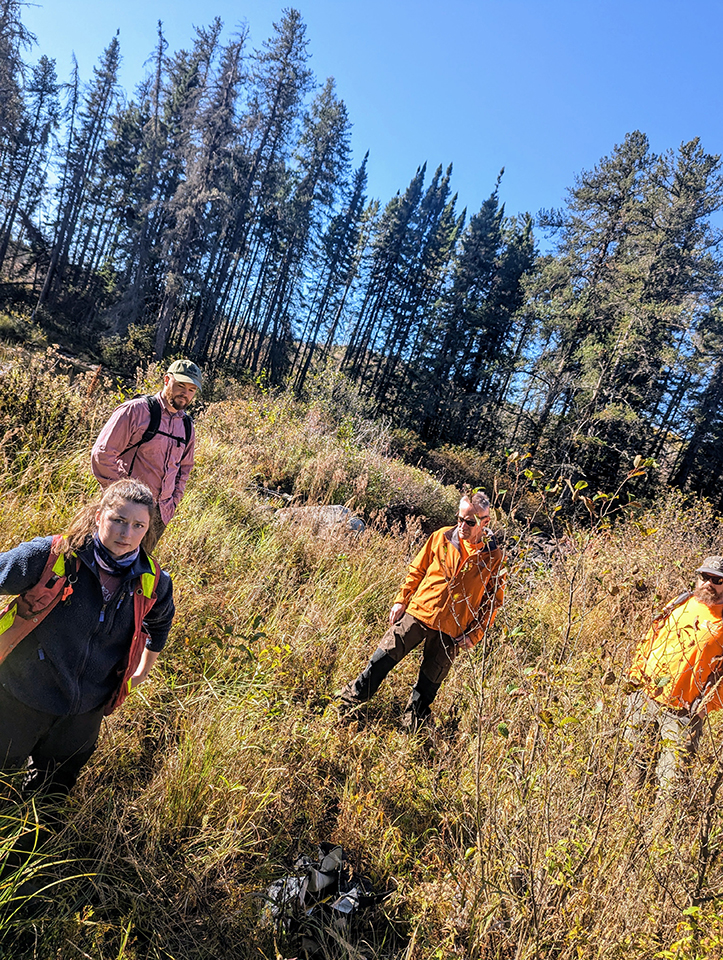 Dr. Basiliko and a team of student researchers will do hands-on fieldwork in forests, wetlands, and watersheds across northwestern Ontario and cutting-edge lab research to uncover how microorganisms, i.e., the bacteria and fungi in soil, water, and plants, affect an ecosystem’s response to climate change.
Canada’s boreal forests and wetlands play an important role in the fight against climate change, storing carbon and providing a large amount of the world’s freshwater and natural resources. But rising temperatures, invasive species, urban settlements, and resource development like mining and forestry are affecting these diverse habitats.
Lakehead graduate student Adelaide Huth (front left), post-doctoral fellow Dr. Patrick Levasseur (back left), and Ontario Ministry of Natural Resources research colleagues Dr. Alex Ross and Dr. Rob Mackereth (right), are standing in a small wetland area spanning between a recently harvested forest and a headwater stream off HWY 527. Adelaide’s research, in part supported by new NSERC Discovery funding, is exploring how new forest management approaches affect the anaerobic microbes in these poorly drained soils. (Photo credit: N Basiliko)
“Climate change mitigation relies on how boreal ecosystems adapt to these environmental stressors. Right now, that’s a major unknown,” said Dr. Basiliko.
To help answer this question, Dr. Basiliko’s research team will study how the microorganisms living within these ecosystems respond to environmental changes.
“Microorganisms are key players in boreal ecosystems because they break down organic matter, transform nutrients and pollutants, and produce and consume greenhouse gases,” he said. “Through these processes, these tiny communities impact our forest and freshwater resources and, ultimately, our planet’s future climate.”
Dr. Jessica Metcalfe, associate professor in the Department of Anthropology, is receiving a $468,345 Discovery Horizons Grant—one of only 11 awarded in Canada—for research that will investigate how bison have changed physical and cultural landscapes in Tsattine (Beaver Dene) territory in Alberta over the last 10,000 years.
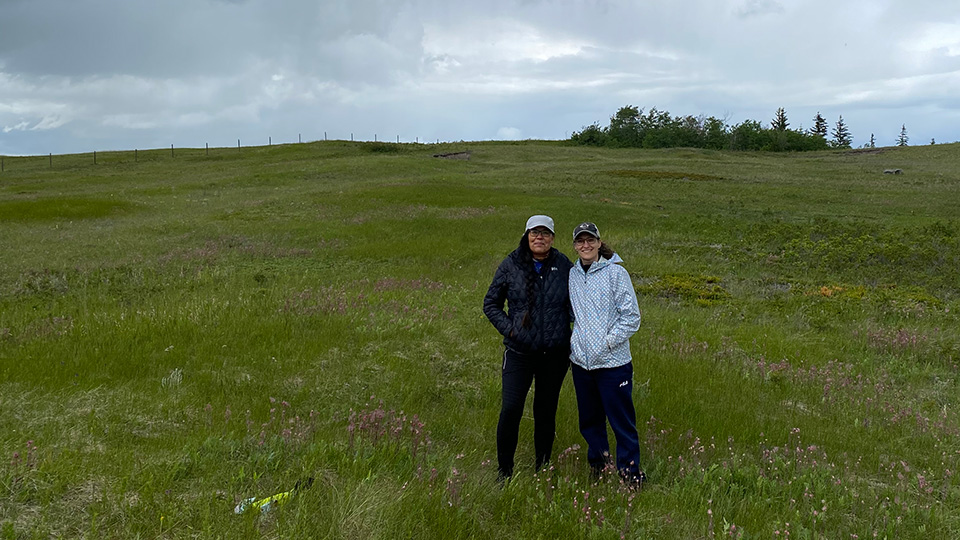 Dr. Jessica Metcalfe is a researcher in the Department of Anthropology is pictured with Tsattine research partner Victoria Wanihadie.
Working with Lakehead colleagues Dr. Scott Hamilton and Dr. Matthew Boyd, and Tsattine research partner Victoria Wanihadie, Dr. Metcalfe will combine Western science (chemical analyses of bones, digital mapping, experimental archaeology) and Indigenous storytelling, creative arts, and land-based learning to study more than 10,000 years of environmental change, land use, and food practices in northwestern Alberta.
“Bison—North America’s largest herbivore—are typically seen as creatures of the prairies, but they also have deep connections with Indigenous communities farther north,” explains Dr. Metcalfe. “Even though wild bison no longer inhabit Tsattine territory, they are guiding our research through their bones, trails, plants, and the ways they were processed and cooked. Our goal is to put bison and Tsattine people back on the map in northwestern Alberta, supporting the resurgence of a cultural group that was previously declared extinct.”
“This significant funding from NSERC is a testament to the research excellence of Lakehead’s faculty,” said Dr. Andrew P. Dean, Lakehead University’s Vice-President, Research and Innovation. “Our researchers are leading vital work across disciplines, addressing critical issues with innovative and impactful approaches.”
In 2024/25, Lakehead University received almost $2.8 million in assistance from the Research Support Fund to support the indirect costs of research, which include costs for supporting the management of intellectual property, research and administration, ethics and regulatory compliance, research resources, research facilities, and research security.
Lakehead University received a total of $3,203,374 from the Natural Sciences and Engineering Research Council of Canada (NSERC). The following Lakehead researchers have received grants:
Discovery Grants (five-year grants)
Dr. Malek Alsmadi, Department of Electrical Engineering, "Practical Joint Visible Light Communication and Positioning: Enhancing Spectrum Efficiency and Reliability", $202,500.
Dr. Nathan Basiliko, Faculty of Natural Resources Management, "Microbiomes mediating environmental change across boreal landscapes", $220,000.
Dr. Qing-Lai Dang, Faculty of Natural Resources Management, "Effects of drought frequency and severity on boreal conifers under predicted future climate conditions and different soil temperature and nutrient regimes", $195,000.
Dr. Hubert de Guise, Department of Physics, "Group methods and quantum technologies", $180,000.
Dr. Jian Deng, Department of Civil Engineering, "Further Studies on Stochastic Dynamic Stability of Complex Structures", $215,000.
Dr. Yong Deng, Department of Software Engineering, "Coding for Communication-Efficient and Straggler-Resilient Heterogeneous Distributed Computing", $192,500.
Dr. James Kryklywy, Department of Psychology, "Bidirectional control of affective sensation and cognitive processes", $177,500.
Dr. Michel Laforge, Faculty of Natural Resources Management, "Altered Spatial Strategies of Caribou in Disturbed Landscapes: Adaptive or Maladaptive Responses?", $177,500.
Dr. Deli Li, Department of Mathematical Sciences, "Asymptotic Behavior in Probability and Statistics with Applications", $175,500.
Dr. Baoqiang Liao, Department of Chemical Engineering, "Next Generation and Self-Sustainable Membrane Based Microalgal-Bacterial Processes for Wastewater Treatment", $215,000.
Dr. Xin Yang Lu, Department of Mathematical Sciences, "On the triple junction between PDE, material science, and image processing", $160,000.
Dr. Abdulsalam Yassine, Department of Software Engineering, "Advancing Collaborative Data-Driven AI for Enhanced Energy Management in Connected Electric Mobility", $185,000.
Discovery Horizons Grants (five-year grant)
Dr. Jessica Metcalfe, Department of Anthropology, "Follow the Bison: Insights into Environmental and Cultural Change", $468,345.
Discovery Development Grants (two-year grant)
Dr. Ruizhong Wei, Department of Computer Science, "Combinatorial structures and their applications", $44,000.
Dr. Andrew J. Dean, Department of Mathematical Sciences, "Classification of Gradings and Real Structures on C*-algebras", $44,000.
Dr. Mark Gallagher, Department of Physics, "On-surface synthesis and characterization of molecular based two-dimensional nanomaterials", $44,000.
Discovery Grant – Ship Time (one-year grant)
Dr. Michael D. Rennie, Department of Biology, "Quantifying productivity, biodiversity and genetic novelty of fishes at lakemounts", $159,674.
Research Tools and Instruments (RTI) Grants (one-year grant)
Dr. Kang Kang, Lakehead University - Biorefining Research Institute, "Advanced Tool for Investigating Thermochemical Conversion of Biomass into Renewable Energy and High-Value Chemicals", $147,855.