



Award-Winning Scholar Dr. Michel S. Beaulieu Explores Northwestern Ontario’s Overlooked History
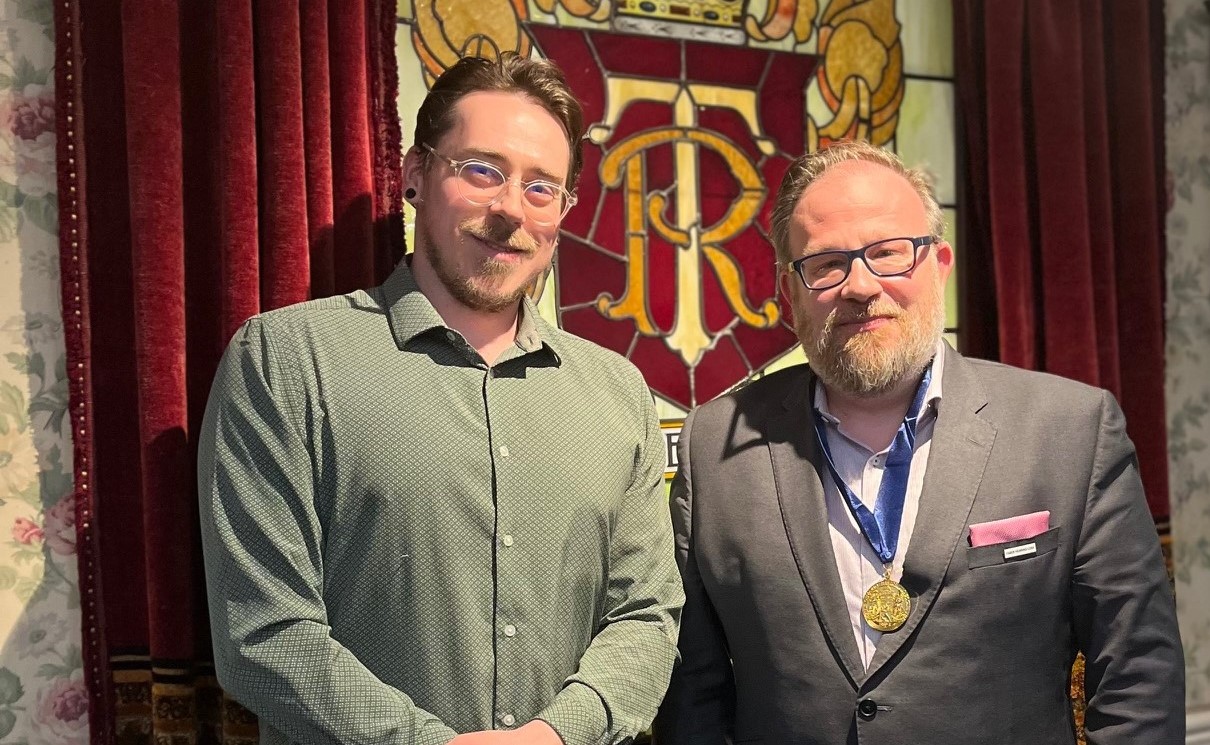
Dr. Michel S. Beaulieu (right) received the Cruikshank Gold Medal for Outstanding Service to the Ontario Historical Society in February 2025. In addition to his 2025 Cruikshank Gold Medal, Dr. Beaulieu received a King Charles III Coronation Medal in March 2025 for his contributions as educator, volunteer, and philanthropist.
"I'm very curious, if you dangle something in front of me that I don't know anything about, I'll latch onto it," Dr. Michel S. Beaulieu says.
That's plainly evident from Dr. Beaulieu's diverse body of work. He's a history professor specializing in northern Ontario, as well as Lakehead University's Associate Vice-Provost (Academic) and a Lakehead alum. Dr. Beaulieu has written about everything from labour and politics to resource development, including Second World War German POWs and the pioneering northwestern Ontario filmmaker Dorothea Mitchell—"the Lady Lumberjack" who also ran a sawmill.
His love of history extends beyond his roles as professor and researcher to encompass more than two decades spent volunteering with heritage and historical organizations such as the Ontario Historical Society (OHS), the Multicultural History Society of Ontario, the Northwestern Ontario Archivists' Association, and the Thunder Bay Historical Museum Society. Behind his efforts is a commitment to bring to light history that challenges prevailing views.
"There are certain grand narratives of Canadian history that overlook those who live in regions like northwestern Ontario," Dr. Beaulieu explains, "and it's not just that our story or region needs to be included, it's about countering narratives that are, at times, exclusionary, inaccurate, and that don't reflect the experiences of many geographic and ethnic communities in Canada."
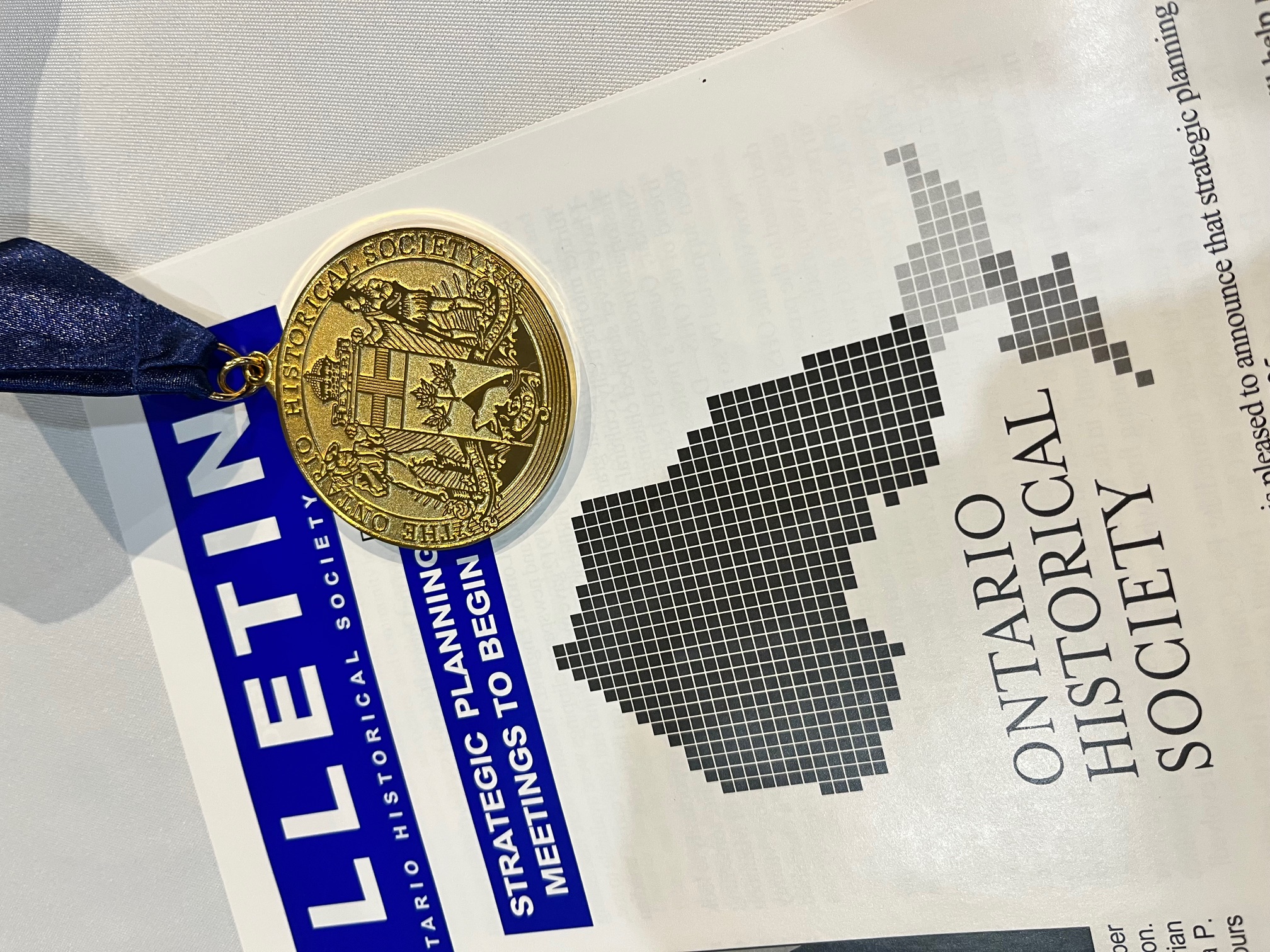
It's because of the high standard of his scholarship, his mentoring of students, his philanthropic work, and his time serving on boards, associations, and societies that Dr. Beaulieu was recently awarded the Ontario Historical Society's highest honour—the Cruikshank Gold Medal.
The medal, which is only rarely given out, recognizes individuals who've gone above and beyond to preserve, promote, and protect the history of Ontario and, in doing so, for their service for the OHS.
"I was overwhelmed when I found out," Dr. Beaulieu says. "Past award recipients are people that I've looked up to and admired."
In the presentation of the award, the OHS also drew special attention to Dr. Beaulieu's leadership in transitioning the journal Ontario History into an online publication and, as a result, bringing "Ontario's foremost history journal to readers on a global scale."
"I first came to Lakehead as an undergraduate student," Dr. Beaulieu says. "I chose Lakehead because of the interest that the faculty took in me as an individual, the volunteer opportunities, and the financial support—I was the first person in my family to go to university and that wouldn't have been possible without awards and scholarships." He's also grateful for the funding he's received from SSHRC and other organizations for his research.
"If we don't preserve and promote the histories and experiences of northwestern Ontario, who will?" Dr. Beaulieu asks. "Knowledge of our history shapes how we talk about the province and the nation, and I want to contribute to that."
"In many ways, I was drawn to history because of my mom and dad," adds Dr. Beaulieu, who grew up in Brampton, Ontario. "It was their suggestion that I volunteer with the Region of Peel Museum while I was in high school that sparked my life-long passion for volunteerism. The staff, particularly Bill Barber and Janice Calvert, introduced me to the good, the bad, and the fascinating in Ontario's history. It was a vastly different history from what I was taught previously."
He believes that some of the problems facing democracies today stem from a devaluing of history and historical education. "It's frustrating when decision makers are ignorant of the past or create skepticism about historical events. It's alarming and, frankly, dangerous, when individuals, organizations, and politicians, dispute, for example, the trauma caused by residential schools, the role racism has played in our society, or argue that the Holocaust never occurred."
Despite these hurdles, Dr. Beaulieu takes great joy in engaging people in our region's history. "History is meant to be shared. It's not meant to stay behind closed doors."