



Recalling Lakehead Moments – a conversation with Dr. Alice den Otter
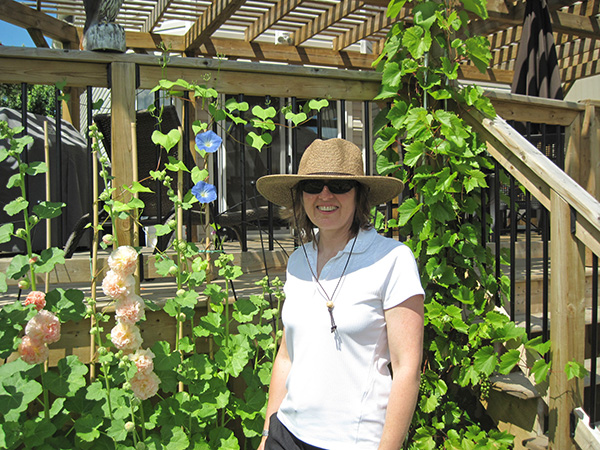
Dr. Alice den Otter, one of the founding faculty members of Lakehead’s Orillia campus, counts gardening as one of her interests, along with being a Romantic literature specialist.
As part of our celebrations of Lakehead University’s 50th Anniversary, I spoke to some of our faculty and staff to learn more about their experiences at both the Thunder Bay and Orillia campuses. My conversation with Dr. Alice den Otter, associate professor with the Interdisciplinary Studies and English departments, is the second of a six-part series.
When did you start working at Lakehead?
1995
Can you describe your first impression of Lakehead in three words?
Fun, friendly, and sincere.
Are there any exceptional or meaningful moments that standout in your memory from your time in Thunder Bay?
There have been many exceptional moments for me: fish jumping in Lake Tamblyn; a fox sleeping on the hood of a car in the parking lot; the campus closure of 1995 for two days due to a blizzard; a session with Lauri Gilchrist, the Vice-Provost of Aboriginal Affairs, on systemic racism; an Orientation ceremony one September, which took place in the gym with the faculty in full academic regalia and which began with Aboriginal drumming.
What is one thing you want people to know about Lakehead, or an interesting fact that not many people know about?
Most faculty members have a wide range of knowledge and interests. For example, a faculty member in Sustainability Sciences writes poetry and one from the English department plays the saxophone. My own interests/experience include vegetable and flower gardening, and although I no longer sew, knit, or crochet much, my mother taught me how to look at a dress or other item of clothing and use it as a model for creating a new one without a pattern.
I think diversity is what makes a university rich. We’re a team of individuals who bring many more skills and knowledge to the table than just our disciplinary specializations. In fact, faculty members are great models for students, showing them that these skills extend beyond academia to everyday life. We don’t spend all of our time in the office or lab. We apply our problem-solving, questioning, and research skills in whatever we do.
What personal success are you most proud of accomplishing during your time in Thunder Bay?
I organized a literary conference at Lakehead called “The Literary Modalities of Praise” and published the ensuing papers in a collection called Relocating Praise: Literary Modalities and Rhetorical Contexts. In 1997, a group of graduate reviewers suggested the English Department present a conference to help bring other scholars to campus. I asked why not now? Everyone thought it was a great idea. I thought it would be fun, so we applied for, and received, a Social Sciences and Humanities Research Council grant to help fund it. We sent out a call for papers and received several excellent proposals. One of the highlights was having well-known literary researchers come to Thunder Bay.
What is a Lakehead-wide achievement that you think the entire Lakehead community should be proud of?
The growth of Aboriginal presence and support programs.
How did you first hear about Orillia/the development of the Orillia campus?
I heard about it at a Social Sciences and Humanities Faculty Council meeting where Kim Fedderson and Lesley Lovett Doust talked about the possibility of a new campus with a joint Arts and Science program.
What was the biggest reason behind your motivation to cross the province and come to Orillia?
I’m from Southern Ontario and wanted to be closer to my mother. When my father died in 2001, I hadn’t seen him for half a year. I wanted to see my mother more often than that. I was also quite excited by the prospect of being part of a new adventure and a small campus that had the potential to grow. I attended an alternative parent-directed high school that was just starting up in the late 1970s. It was exciting to be part of a growing learning environment, where everyone was like family.
What is one similarity between the two campuses and one difference?
Both campuses foster warm collegiality among students, faculty, and staff. One difference is that Thunder Bay has more established traditions and relationships, whereas Orillia still is quite new.
What do you hope Lakehead can achieve in its next 50 years?
A mentoring system where first-year students are paired with upper level students who can guide them through the rough patches and encourage excellence. This would be especially important for first-generation learners and international students. It would help new students to have a go-to person of their own age level who could help them find answers to questions about registration, transportation, the library, etc. Sometimes new students are quite shy and don’t know who to ask. Orientation does a great job dealing with a lot of those things, but it would be helpful to have one person who remains a contact throughout the school year.
– 30 –
Stephanie Edwards is a fourth year Lakehead University student who works with Lakehead Orillia’s Communications office.
Celebrate with Us!
• Lakehead University's 50th Anniversary • 1965-2015
• Lakehead Orillia Homecoming: November 12 & 13, 2015
• Don't miss our 50th Anniversary Homecoming Dinner & Dance Party – a '60s Celebration! Enjoy a night of dinner and dancing at Casino Rama – November 13, with entertainment by Lance Anderson's Hitsville Revisited – The Music of Motown
• To purchase tickets, or to learn more about Lakehead’s 50th Anniversary events, visit 50.lakeheadu.ca