



People with Vision Loss Want Roundabouts to be Easier to Cross
PhD Candidate Omotunde Adeniran is Developing an Ingenious Solution
"Cities revolve around transportation," says civil engineering PhD candidate Omotunde Adeniran.
For the past few years, Omotunde—under his supervisors Dr. Juan Pernia and Dr. Sam Salem—has been applying his engineering skills to make traffic roundabouts safer for all community members.
It's become a pressing issue as roundabouts become more common in North America.
"Municipalities are embracing them because they ease traffic congestion and reduce severe vehicular collisions," Omotunde says.
They're also cheaper than traffic lights over the long term since they don't require as much electricity or infrastructure maintenance.
Coming Full Circle
Surprisingly, Omotunde wanted to avoid a civil engineering career when he was younger.
He grew up in Nigeria where his elder brother and several family members were civil engineers.
Wanting to do something different, Omotunde studied engineering physics before deciding that he wanted to be a pilot. This led him to a logistics and technical support job with a British Columbia-based helicopter company with a subsidiary in Nigeria.
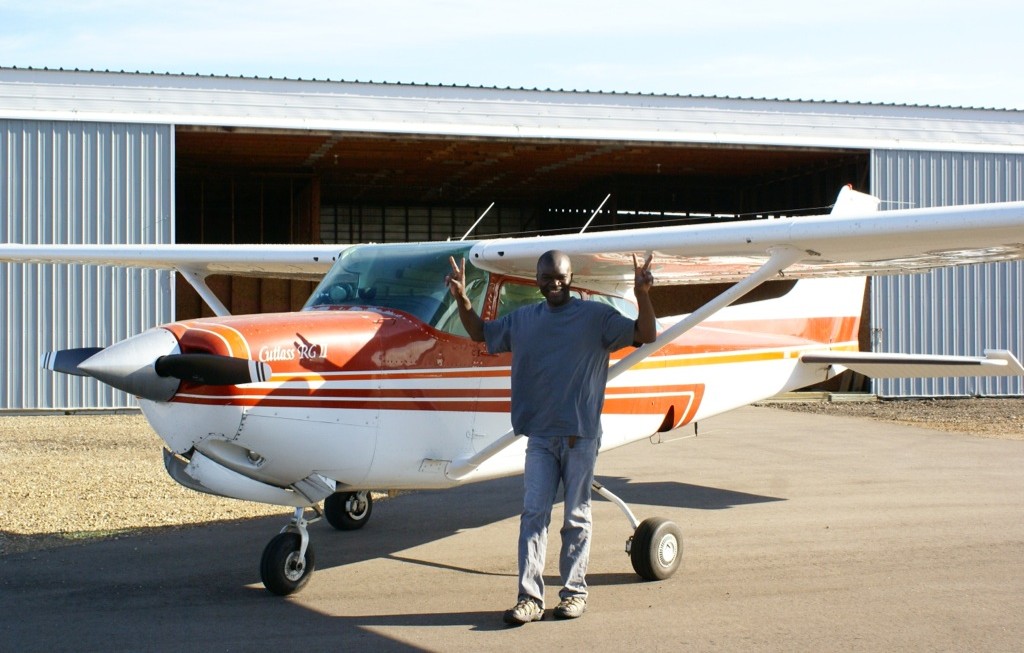
Omotunde learned to fly small single-engine planes and earned a Private Pilot Licence. While working at the Lakeside meat-packing plant in Brooks, Alberta, he liked to go flying with a friend who owned a Cessna plane. At the plant, Omotunde was responsible for food inspection and quality control. Then, for three-and-half years, he was on the crew that cleaned the plant. "I took college and university courses from about 9 am to 4 pm and then worked from 4 pm to midnight and, later, the graveyard shift, so that I could upgrade my education," he says.
He eventually moved to Canada and went back to school after spending several years working in demanding jobs, including one at a meat-packing plant in Brooks, Alberta.
"While taking general engineering courses at the University of Calgary, I realized that civil engineering came naturally to me and that I wanted to do something practical," he says.
He went on to earn a Bachelor of Science in Civil Engineering at the University of New Brunswick and a Master of Science in Civil Engineering at Lakehead and is now in finishing his PhD studies.
City Streets Should Be Safe for Everyone
Despite the many advantages of roundabouts, they sometimes present challenges for people with vision loss.
In Ontario, drivers are required to yield to pedestrians at designated roundabout crosswalks. Some roundabouts also have rectangular rapid flashing beacons (RRFB), which pedestrians can activate by pressing a button to signal to drivers that they want to cross.
Even so, a small percentage of drivers don't stop for pedestrians.
"This can be dangerous for kids, the elderly, and people with vision loss," Omotunde says. "If cars don't stop, pedestrians have to wait for another opportunity to cross."
_Aerial%20View%20of%20Thunder%20Bay%20Roundabout_Photo%20Credit%20City%20of%20Thunder%20Bay.PNG "Aerial View of Thunder Bay Roundabout")
Omotunde’s sensor-based system uses a signal from a camera to alert pedestrians to oncoming vehicles via a loudspeaker. “When activated, the system says: ‘Gap detected, use caution’ or ‘Vehicle approaching,’” he explains. “As an engineer, you always want the simplest option.” Photo Credit: City of Thunder Bay
Even when additional safety measures have been incorporated into roundabouts—such as tactile walking surface indicators and pedestrian refuge islands—people are still vulnerable.
"None of these measures indicate if drivers are yielding to pedestrians or give them a real-time assessment of how long they have to cross a roundabout road," Omotunde says.
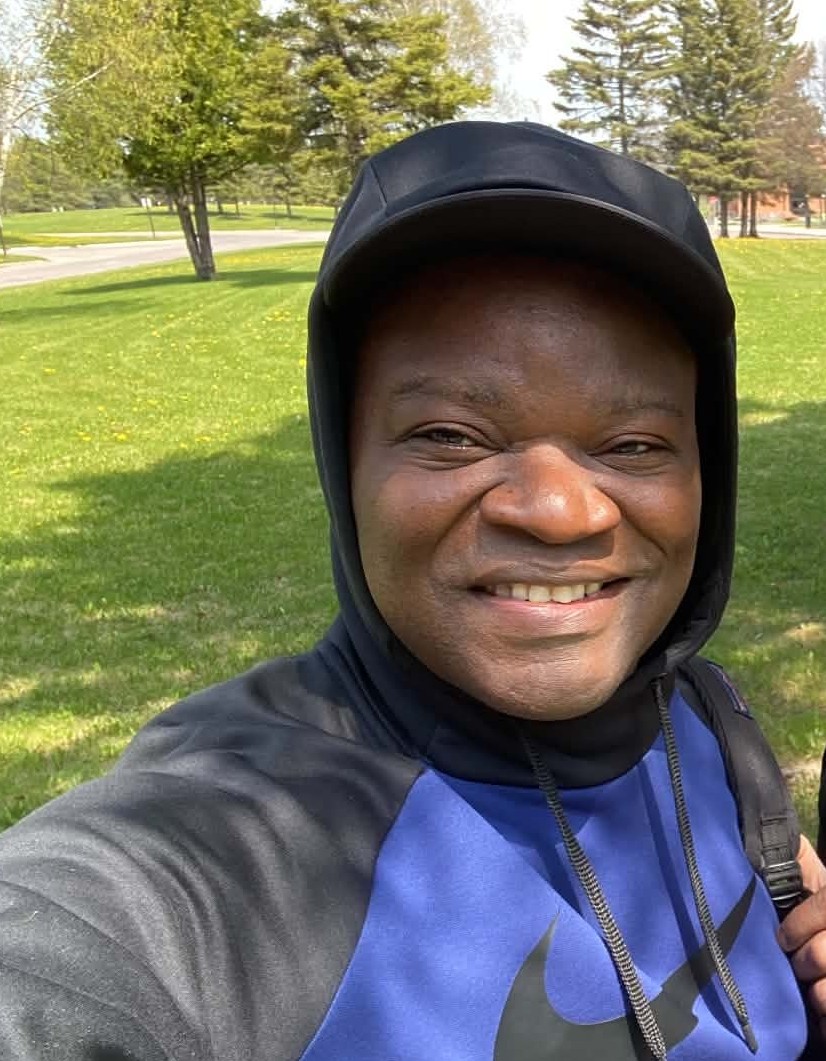
Omotunde started a community newsletter called The Integrand News: Keeping You in the equation! while living in Brooks, Alberta. “I wanted both the non-immigrant and the immigrant communities to see all the good things that were happening in Brooks,” he says. He also joined charitable and service organizations, including Rotary International, where he met educator Dr. Lyle Hamm who encouraged him to go back to university.
Concern about this situation prompted the Canadian National Institute for the Blind (CNIB) to reach out to Dr. Pernia.
"They wanted to know if it was possible to launch a nation-wide study investigating how to make roundabouts safer for people with vision loss," Omotunde says.
"We decided to begin the study at Thunder Bay's Edward Street and Redwood Avenue roundabout because the City of Thunder Bay was willing to support our research."
Omotunde's master's research focused on testing rumble strips that vibrated and made a 'tak tak' sound as cars drove over them, alerting pedestrians to their presence.
Although somewhat successful, this mechanical model had some flaws—including not being sufficiently audible if cars were rolling or travelling at extremely low speeds—that made it unable to completely resolve the concerns of people with vision loss.
A Rising Star in Transportation Safety
For his PhD research, Omotunde switched his attention to developing a sensor-based system that uses computer vision to detect approaching vehicles.
He's now built an impressive prototype that merges AI, coordinate mapping, and Real-Time Streaming Protocol (RTSP) to process camera images taken at roundabouts.
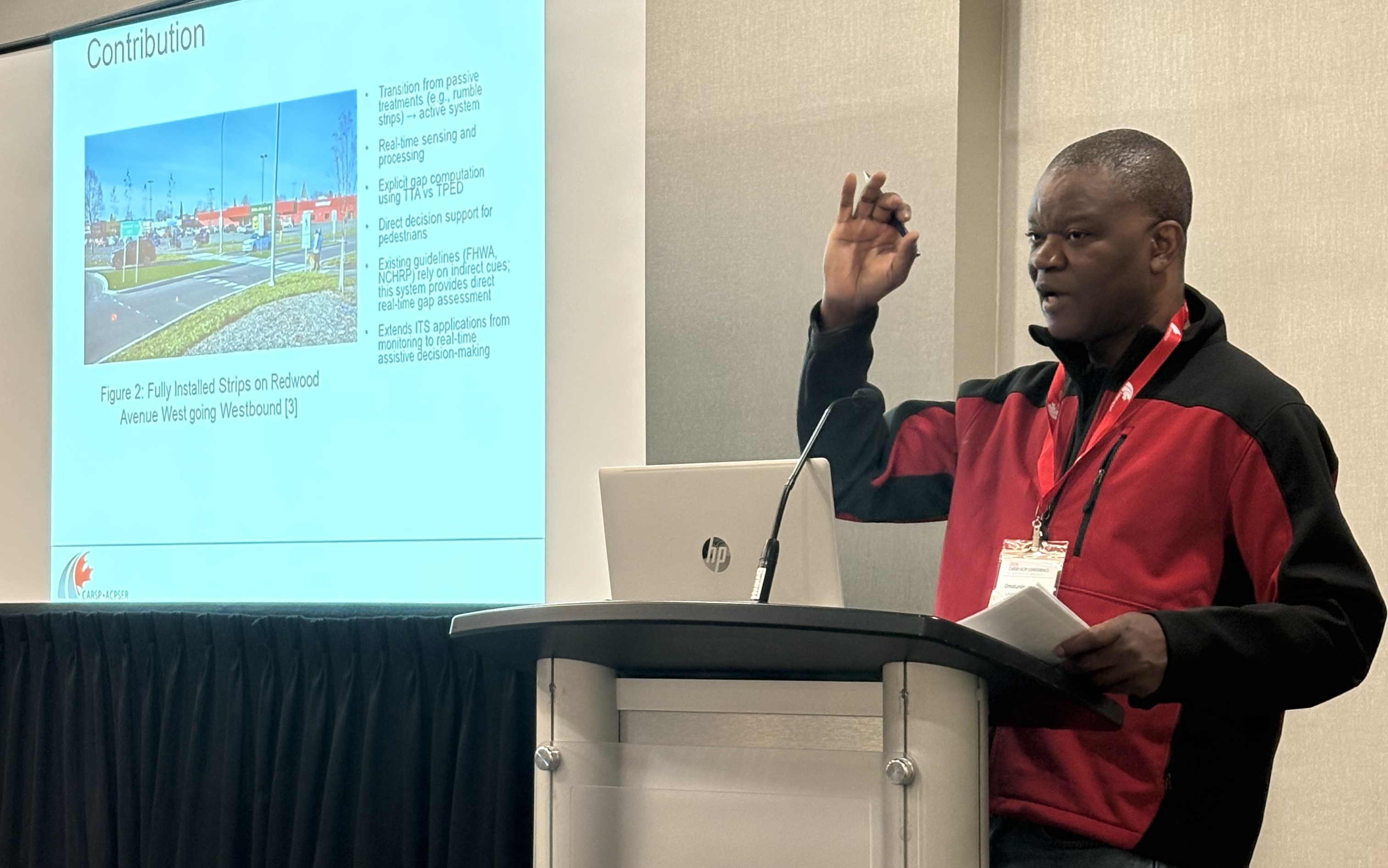
Omotunde won first place in the 2026 Canadian Association of Road Safety Professionals (CARSP) Student Paper Competition for his paper, "Field Testing of an Infrastructure-Mounted Sensor-Based Accessibility System for Unsignalized Roundabouts." Professionals from multiple countries who attended the CARSP conference were eager to learn more about Omotunde's concept. "I'm happy to be an ambassador for Lakehead and thankful for the support of my PhD thesis supervisors," he says.
Once triggered, Omotunde's system estimates vehicle time-to-arrival at a roundabout, computes estimated pedestrian crossing time, and uses a loudspeaker to let pedestrians know when there is a gap in traffic.
He's already conducted technical and field testing of the system and will be running a trial with CNIB volunteers at the Thunder Bay roundabout this summer.
"My work has broad applications," he says. "It could potentially help people with mobility issues and people distracted by their cellphones, as well as people with vision loss."
"We can't change the behaviour of drivers," Omotunde adds, "but we can give pedestrians more information to keep them safer."
Thank you to the City of Thunder Bay and Pioneer Construction for providing equipment, staff assistance, and access to the Edward Street/Redwood Avenue roundabout and its infrastructure.
Omotunde also thanks the multiple volunteers who helped make this research possible, including the CNIB, as well as Oasis Family Dental and Janzen Pharmacy who kindly provided access to their power outlets.
This research project directly aligns with United Nations Sustainable Development Goals (SDGs) #9: Industry, Innovation, and Infrastructure, #10: Reduced Inequalities, and #11: Sustainable Cities + Communities.