



Immerse Yourself in a Botanical World of Wonders
The Claude E. Garton Herbarium is an Amazing Educational Resource
Tucked into a corner of the Thunder Bay campus is a fascinating universe ready to welcome curious students, scientists, and community groups.
The Claude E. Garton Herbarium on the third floor of the Centennial Building houses a collection of over 115,000 preserved plant and tree specimens.
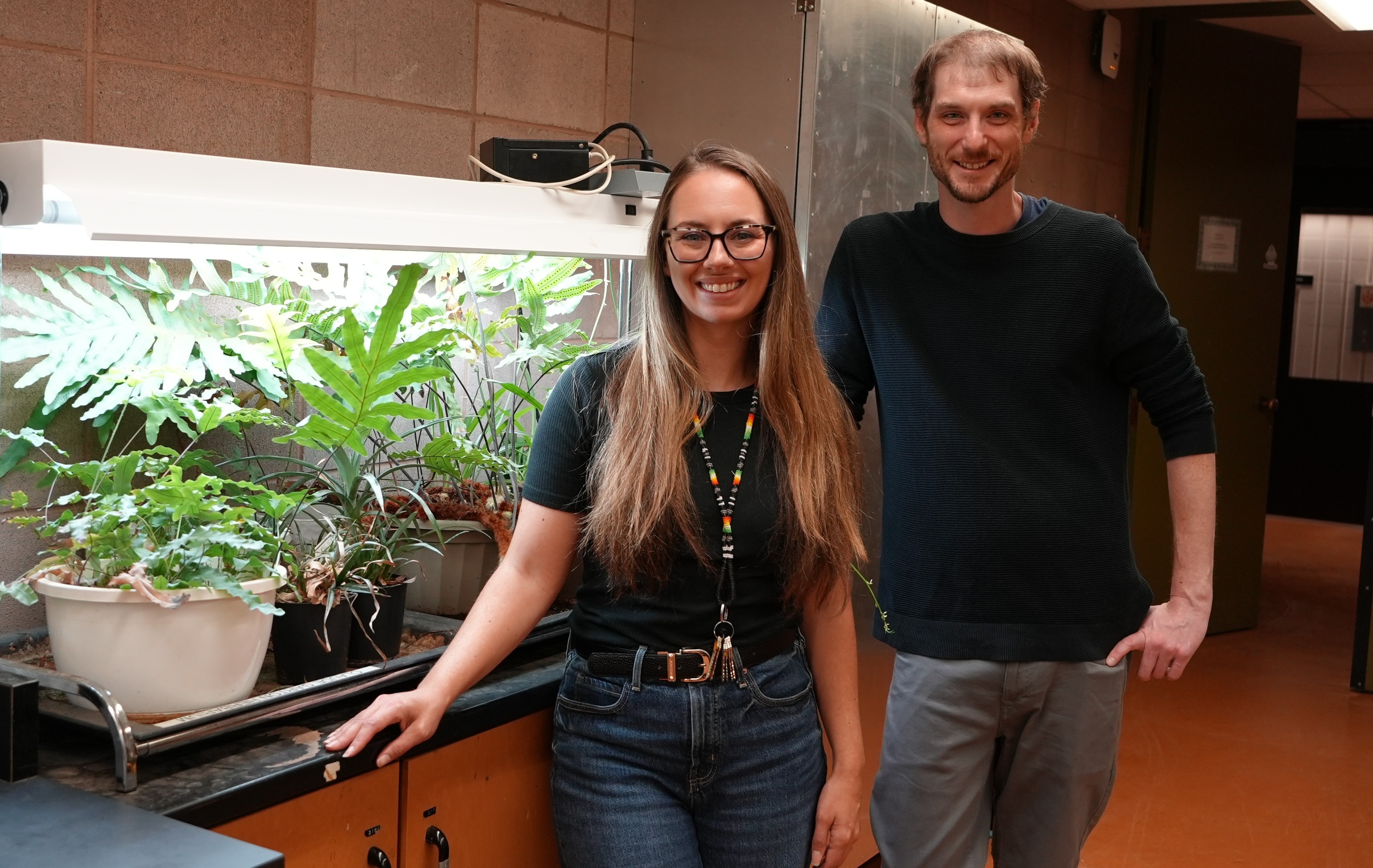
The herbarium was established in 1967 by Claude Garton, an elementary school teacher and amateur naturalist, who began collecting local plants in the Thunder Bay area in 1933. Above, Kristi Valley and Myles Cummins in the herbarium.
"A herbarium is a plant library, a database, and a museum," Acting Curator Kristi Valley explains.
Lakehead's Herbarium has a staggering array of flowering plants, ferns, shrubs, trees, cacti, mosses, lichens, grasses, and much more. These specimens come from across the globe and range in age from 200 years old to newly harvested.
"We're like a botanical time machine," says Herbarium Botanist Myles Cummins, a recent Master of Science in Forestry grad.
The collection is stored in secure cabinets in the form of vouchers—plant specimens that have been flattened in a press before being mounted on archival paper and labelled.
Plant vouchers can include stems, leaves, flowers, roots, seeds, bark, and cones—each preserving a record of where and when the plant was collected.
Herbariums Are Research and Discovery Hot Spots
The plants in herbarium collections have a multitude of real-world applications.
"Researchers—such as botanists, biologists, geologists, and anthropologists—rely upon our collection," Kristi explains.
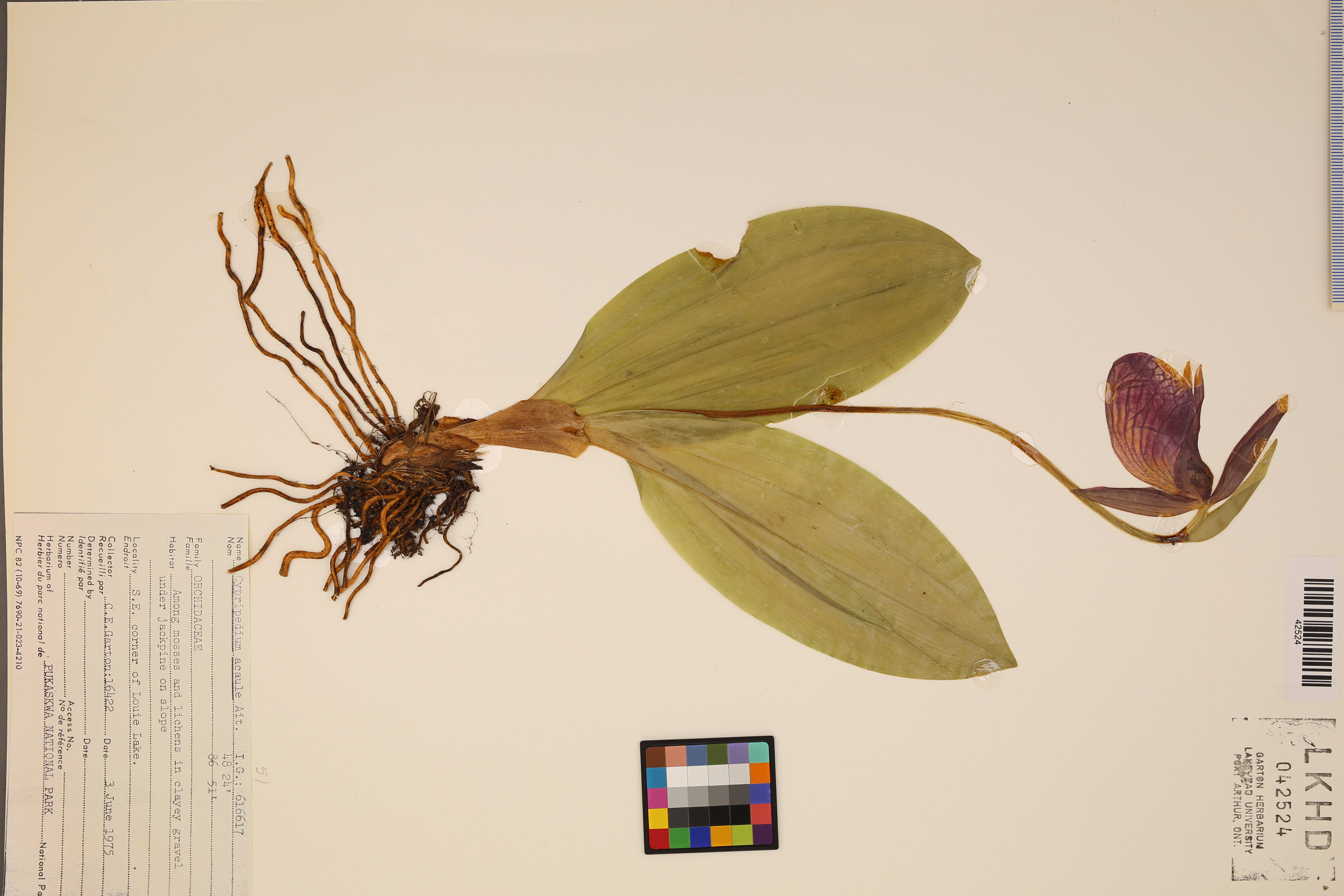
A beautiful Pink Lady's Slipper orchid (Cypripedium acaule) collected by Claude Garton in 1975 at Louie Lake in Pukaskwa National Park.
"Anthropologists, for example, have compared roots and seeds in our collection to plants at archaeological sites to learn more about the ecology and culture of past societies."
"We've also helped geologists identify tree species so that they can do vegetation-based mineral exploration, which involves analyzing specimens for metals absorbed into their leaves," Myles says.
Botanists are equally interested in the herbarium. "We've collaborated with herbaria across North America to more accurately name plant species," Kristi says.
Climate-change researchers are similarly keen to use the collection.
They germinate herbarium seeds and compare the plants that sprout from these seeds to plants growing today—allowing them to see how a warming climate has affected different plant species.
They also compare the flowering stages of specimens collected decades ago with living plants to document climate-change driven shifts in flowering times.
A Class Trip You Won't Forget
The Claude E. Garton Herbarium has become a popular destination for northwestern Ontario students, as well as researchers.
"Lakehead biology and natural resources management students frequently use our collection," Kristi says. "We also do outreach programming with local youth groups and high schools."
.jpg "Students with Plant List")
The herbarium teaches students and STEM organizations how to identify native plant species and invasive plant species by using a dichotomous key, as well as by using the iNaturalist app. The app allows them to monitor species distribution and climate change.
One of Kristi's favourite visits took place this past fall.
Students enrolled in Lakehead's Indigenous Transition Year Program (ITYP) and Indigenous STEM Access Program (ISTEM) toured the facility as part of a botany unit in their general science course.
"It was an experiential learning opportunity for them," says Indigenous Access Programs Coordinator Lisa Primavesi.
These students, who will pursue degrees at Lakehead once they've completed their ITYP and ISTEM studies, stood out for their level of enthusiasm.
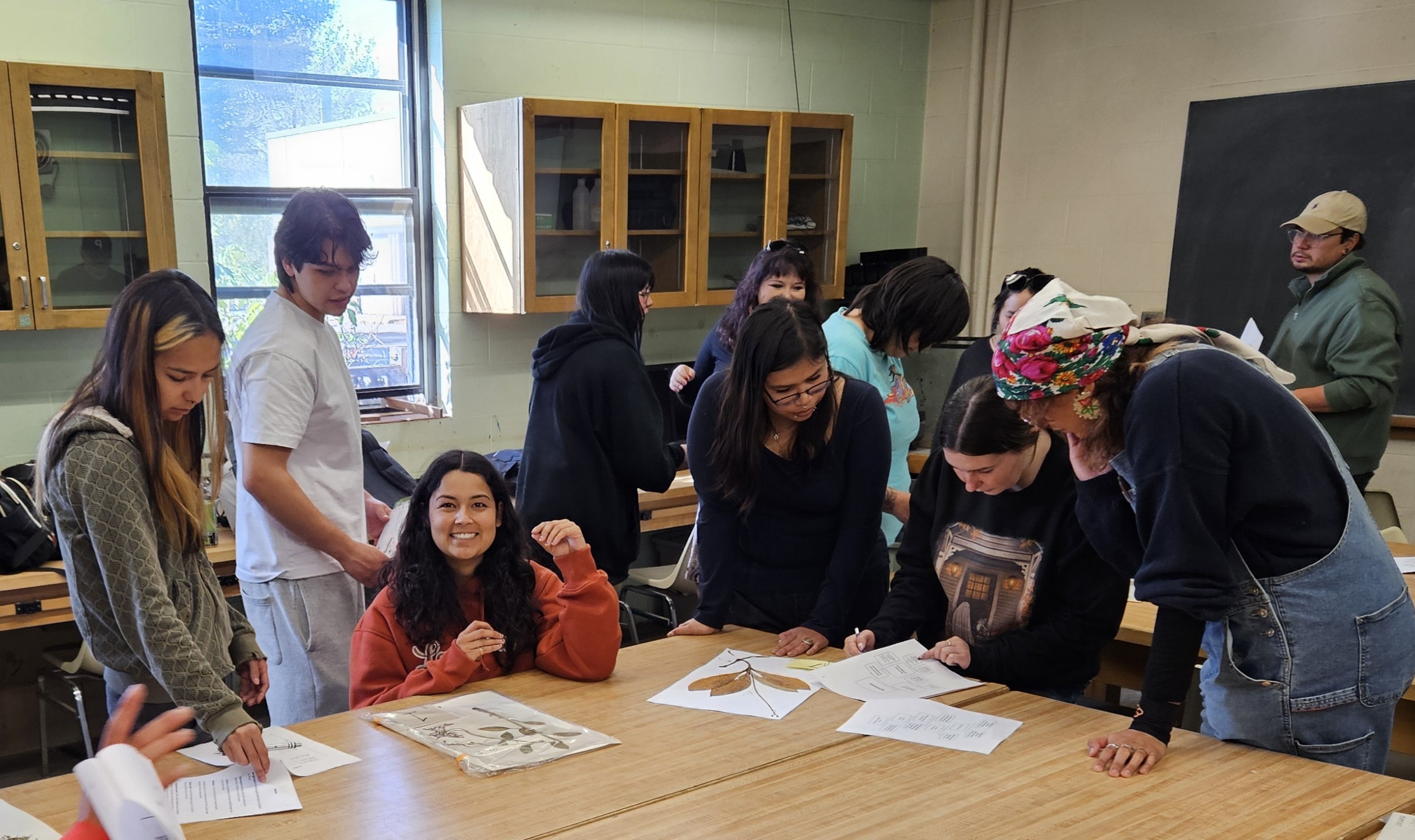
The plants in the herbarium are organized systematically by family, genus, and species. It has an almost complete collection of the vascular plants of the Thunder Bay area. Above, ITYP and ISTEM students employ a dichotomous key, similar to a decision tree, to correctly identify plants.
"I was blown away by their genuine excitement for botany," Kristi says. "Some of them even offered to volunteer at the herbarium."
The students took part in a plant ID challenge and spoke to PhD researcher Karla Ramirez Galicia who's studying jack pines.
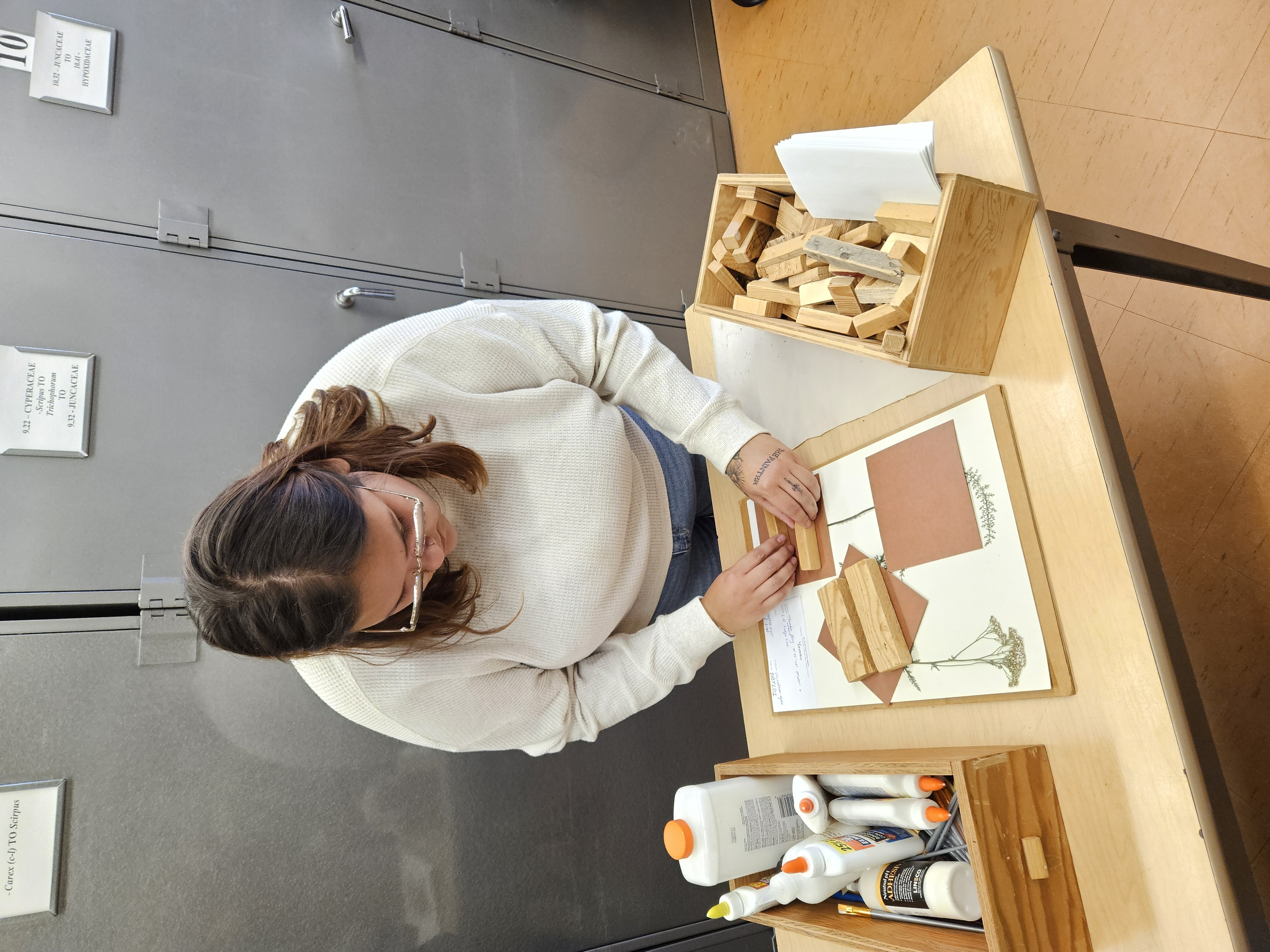 "The herbarium has a wealth of resources, and I'd like to thank Kristi for setting aside time for the students," says Indigenous Access Programs Coordinator Lisa Primavesi. "It was really special to have the class visit and learn about the herbarium." Right, a student makes a plant voucher.
Another highlight was the opportunity to create plant vouchers.
Prior to their visit, each student collected plants including yarrow, cocklebur, and red clover. They then pressed and mounted their plants before donating them to the herbarium.
Continuing to engage people throughout northwestern Ontario in outreach activities like this is critical to the herbarium's mission.
That's why they partner with the Thunder Bay Field Naturalists, and other organizations, to support community education and plant-identification training.
"We also accompany visiting Indigenous community members on plant walks," Myles says. "We help them source plant materials so that they can teach young people to make traditional medicines."
"Getting young people interested in plants is our goal," Kristi adds. "We're always ready to work with educators and community groups."
If you'd like to arrange a tour or workshop with the Claude E. Garton Herbarium, email Acting Curator Kristi Valley at: kedysiev@lakeheadu.ca
To support the Herbarium, click here.