



Sustainable Cities and Communities

This societal impact focuses on making cities and human settlements inclusive, safe, resilient, and sustainable.
Lakehead University is committed to addressing various urban challenges, including urbanization, infrastructure development, sustainable transportation and environmental sustainability, to create cities and settlements that provide a high quality of life for all. The university will continuously engage with local and surrounding communities to promote sustainable practices.
Support of Arts and Heritage
11.2.1 Public access to buildings
Does your university as a body provide public access to buildings, monuments or natural heritage landscapes of cultural significance?
Lakehead University provides the public with free access to all buildings, monuments, and natural heritage landscapes on both its campuses.
Lakehead University respectfully acknowledges its campuses are located on the traditional lands of Indigenous Peoples. Lakehead Thunder Bay is located on the traditional lands of the Fort William First Nation, Signatory to the Robinson Superior Treaty of 1850 and Lakehead Orillia is located on the traditional territory of the Anishinaabeg. The Anishinaabeg include the Ojibwe, Odawa, and Pottawatomi nations, collectively known as the Three Fires Confederacy. Lakehead University acknowledges the history that many nations hold in the areas around our campuses, and is committed to a relationship with First Nations, Métis, and Inuit Peoples based on the principles of mutual trust, respect, reciprocity, and collaboration in the spirit of reconciliation.
Lakehead’s commitment to reconciliation includes numerous cultural services on campus that are central to nurturing a sense of belonging among Indigenous students and the communities that we serve. Through the Office of Indigenous Initiatives, the Indigenous Student Services Centre (ISSC) hosts monthly sweat lodge ceremonies. The Lakehead University Sweat Lodge Site is a spiritual place where people come together for ceremonies that promote personal and collective healing. Participation in sweat lodge ceremonies is open to students, staff and the public.
Lakehead University's Bora Laskin Faculty of Law is located in the former "Port Arthur Collegiate Institute" (PACI), a designated heritage property in the central downtown core of the City of Thunder Bay. This property features war memorials to commemorate former students killed during both World Wars and memorial plaques and photographs were installed in the entrance area of the main floor hallway. This historical building is accessible to the public during regular business hours, Monday to Friday at no cost.
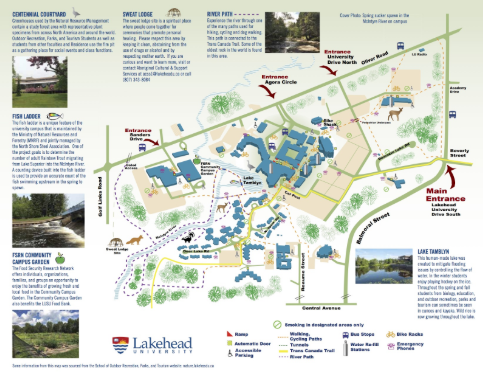
The Campus Map of Sustainability Features is an available resource for the Thunder Bay campus to the public which can be used for self-guided tours to explore Lakehead University’s campus. Sustainability tours can also be requested at no cost, where participants learn about the sustainability services and attractions on the Thunder Bay campus.
Year-round Lakehead University offers a virtual 360 of sustainability, which displays recent sustainability projects, services and features on the Lakehead Thunder Bay campus. It also includes stormwater management infrastructure, habitat restoration and the climate action park.
11.2.2 Public access to libraries
Does your university as a body provide public access to libraries including books and publications?
Our campuses in Thunder Bay and Orillia are open to the public, welcoming community members to explore the university’s library resources and collections.
Library services are available to students, staff, faculty, alumni and the general public. Access to computers is available throughout the University. Lakehead also has a shared library services platform hosting an extensive collection of digital teaching materials, research resources, and learning materials that can be borrowed. Community members are able to borrow library materials at no charge.
11.2.3 Public access to museums
Does your university as a body provide public access to museums, exhibition spaces/galleries and/or works of art and artifacts?
Lakehead University hosts several exhibits and galleries that are free and open to members of the community.
The Lakehead Arts Integrated Research (LAIR) gallery was founded in 2014 and features 7 gallery spaces curated on Lakehead's Thunder Bay campus. The gallery spaces are located throughout various buildings on campus, which are open to the public year-round, featuring art from alumni, students, staff and faculty with the purpose of inquiry, research, and learning through various art forms at no cost.
Annually, the university invites the public to its student art exhibits. In 2024, the Department of Visual Arts hosted the 39th Annual Juried Student Art Exhibition and the Honours Student Thesis Exhibition at the Thunder Bay Art Gallery.
Lakehead University proudly showcases various displays of departmental exhibits and artifacts that hold items of significant interest covering various fields including: Forestry Biology, Geology, Engineering, Anthropology, and Archaeology. The Department of Archaeology features an extensive collection of artifacts originating from Northwestern Ontario and beyond, spanning from Paleoindian to historic times. The collection contains examples of lithics, ceramics, metal, and faunal material. The collection is available to students and staff for teaching and research purposes and is available to the viewing public during regular business hours.
11.2.4 Public access to green spaces
Does your university as a body provide free public access to open spaces and green spaces?
Lakehead University's Thunder Bay campus has 116 hectares of land that is available for free public access. Roughly 35% of the campus land is tree cover, and another 40% includes lawn and other green spaces.
Lakehead University’s Thunder Bay campus is connected to several public trails that the community uses frequently, including one section that connects to the TransCanada Trail (also known as The Great Trail).
Both of Lakehead’s campuses feature community gardens and publicly accessible green spaces where students, staff and community members have the opportunity to grow their own fruits and vegetables. Community members are also encouraged to visit the campus for self-guided tours along the river path or on the cycling and walking trails. Lakehead University campuses also feature geocaching, inviting the public to explore the natural environments found on our campuses.
To support accessibility, Lakehead University offers free virtual tours of the Thunder Bay and Orillia campuses. These virtual tours are available to potential and current students and members of the public. They provide a platform for exploring and appreciating the extensive open green spaces offered by the university.
11.2.5 Arts and heritage contribution
Does your university as a body contribute to local arts, in terms of number of annual public performances of university choirs / theatre groups / orchestras etc?
Lakehead University contributes to promoting and enriching the local media arts through a variety of public performances and events, including choirs and musical performances and events. The Department of Music holds various concerts throughout the year under the title of LUMINA (Lakehead University Music in Action). During the 2023-2024 academic year, the Department of Music offered several public performances, providing meaningful opportunities for the public and Lakehead members to engage with music and the arts free of charge or for a small fee/donation.
11.2.6 Record and preserve cultural heritage
Does your university as a body deliver projects to record and/or preserve intangible cultural heritage such as local folklore, traditions, language, and knowledge? This can include the heritage of displaced communities.
Lakehead University respectfully acknowledges that its campuses are located on the traditional lands of Indigenous peoples, and is committed to a relationship with Indigenous peoples, advancing the Truth and Reconciliation Commission (TRC) 94 Calls to Action. Lakehead is committed to the long-term preservation and revitalization of Indigenous and regional cultural heritage through strategic action, campus programming, and community partnerships.
The TRC Calls to Action: #13-17 focus on language and culture. This includes the preservation of Indigenous folklore, traditions, language and knowledge which includes local & regional cultural heritage (e.g. communities signatory to the Robinson Superior Treaty of 1850), national cultural heritage (First Nations, Metis & Inuit peoples) and heritage of displaced communities (settlements & non-status reserves).
Activities include hosting annual feasts, smudging, sweat lodge and other cultural and spiritual events open to students, faculty, staff and members of the public.
In 2024, Lakehead hosted the Indigenous Veterans of Treaty #3 exhibit. The exhibit, curated in the spirit of collaboration and reconciliation, shares the triumphs and sometimes shocking realities faced by Indigenous veterans across Canada and specifically those from Treaty #3. With a focus on the First and Second World Wars, it mixes Indigenous and military culture, highlighting veterans, their triumphs and setbacks, and Indigenous women's roles. The exhibit highlighted veterans of Anishinabek Territory-Robinson Superior Treaty (1850) and Métis veterans and also included artifacts and photographs from the Thunder Bay Military Museum.
Lakehead continues its collective journey toward understanding and reconciliation by unveiling an Every Child Matters outdoor art installation during its National Centre for Truth and Reconciliation (NCTR) Survivors’ Flag. It commemorates Survivors and those who tragically lost their lives, but it also serves as a daily reminder of our responsibility to foster an inclusive and respectful community. It marks a central space on campus for reflection, dialogue, and connection. And, it stands as a strong symbol of belonging for the many Indigenous students, faculty, and staff who are an integral part of the Lakehead community.
The art installation, which is located in the Agora Circle and features seven white Eagle Feathers on an orange background, embodying the Seven Sacred Teachings: wisdom, love, respect, bravery, honesty, humility, and truth.
In addition, the Nanda Gikendan Gamik which means, Seek to Know, Seek to Learn Place was originally established in 1988 in conjunction with Lakehead University’s Lakehead Centre for Northern Studies. Initially created to encourage interest in northern and regional research, the mandate has been adjusted over the years to support ongoing modifications in Lakehead University's curriculum. In addition to northern topics, the collection now contains a substantial volume of material which focuses exclusively on Indigenous issues and the history, culture, and language of First Nations, Métis, and Inuit Peoples. The Centre’s collection is extensive and multifaceted and contains print materials including books, journals, government documents, newsletters, and reports; microfilm and microfiche; maps, and more. The collections and services of the resource centre are an important component of the research conducted by students and faculty of Lakehead University.
Since 2018, the Thunder Bay Museum has held public lectures sponsored by the Lakehead University History department. These talks are on a wide range of topics and are held on the fourth Tuesday of each month at the Thunder Bay Museum from September to March.
Over the years, presentations have explored a rich variety of historical, cultural, and social topics connected to Thunder Bay, Northwestern Ontario, and beyond. Guest speakers have examined Thunder Bay’s sports history, Indigenous traditions, community movements, and local industries, alongside stories of multiculturalism, heritage preservation, and notable historical figures.
Sustainable Practices
11.4.1 Sustainable practices targets
Does your university as a body measure and set targets for more sustainable commuting (walking, cycling or other non-motorized transport, vanpools, carpools, shuttle bus or public transportation, motorcycle, scooter or moped, or electric vehicles)?
Lakehead University, in collaboration with the City of Thunder Bay is actively involved in measuring and establishing targets for more sustainable commuting methods. These encompass a range of options including walking, cycling, non-motorized transport, carpools, public transportation, motorcycles, scooters, mopeds and electric vehicles. Currently, Lakehead University’s Office of Sustainability is exploring development and refinement of internal benchmarks to track progress in areas including EV charging access, bike usage, and sustainable commuting participation.
Our commitment aligns with the Thunder Bay Net-Zero Strategy, which outlines the following low-carbon transportation goals:
By 2030, 65% of trips within the city are done by transit, walking and cycling
By 2040, 100% of vehicle sales are electric vehicles
By 2040, all heavy-duty commercial vehicles are planned to use low-carbon fuels.
Transit is anticipated to transition to 100% electric by 2035.
Lakehead University’s Sustainability Plan emphasizes our dedication to supporting sustainable transportation and commuting alternatives for both students and employees. This includes the implementation of electric vehicle charging stations, the enhancement of cycling infrastructure, and exploring car-sharing programs. Progress towards these goals is tracked and reported within the university community.
Lakehead University encourages active commuting to campus through participation in annual initiatives such as the Commuter Challenge and Active Commute Challenge. In 2025, 62 teams participated in the “TBay On the Move - Active Commute Challenge”, Lakehead University ranked 2nd in total distance commuted with 2645 km.
Results from 2024 challenge are displayed below.

11.4.2 Promote sustainable commuting
Does your university as a body undertake actions to promote the % of more sustainable commuting (e.g. provision of free or subsidised buses or shared transport schemes, provision of bicycle parking & storage facilities, provision of cycle tracks, a bicycle and pedestrian plan or policy, bicycle sharing programme, free or reduced price transit passes, car/van pool or ride sharing programme, reduced parking fees or preferential parking for carpool or vanpool users, car sharing programme, provision of electric vehicle recharging stations, preferred parking for fuel-efficient vehicles)?
Lakehead University actively engages in various initiatives and schemes to promote increased participation in sustainable commuting among students, staff and faculty. Some of these initiatives include:
- Subsidized Public Transit: Lakehead University students at the Thunder Bay and Orillia campuses benefit from a subsidized bus pass, making public transportation more accessible.
- Bicycle Facilities: Lakehead University Thunder Bay campus has a bike shack, which offers affordable bike rentals at just $5 per week (with a $100 deposit) for students and members of the community. Lakehead also offers secure indoor and outdoor bike storage facilities
- Pedestrian Pathways: With campuses in Thunder Bay and Orillia, Lakehead University is well-integrated into its surrounding communities, offering convenient access to city amenities through dedicated pedestrian pathways. These routes connect the university to key areas which promote active transportation.
The Thunder Bay campus features a dedicated network of pathways, including a pedestrian underpass to allow pedestrians to safely cross underneath a campus roadway. Walking and cycling paths are denoted in the yellow dashed lines below.
Similarly, the Orillia campus features pedestrian routes which connect the university to the heart of the city, ensuring that students are seamlessly connected to local services, recreation, and cultural experiences.
4. Electric Vehicle Charging: In collaboration with the Thunder Bay CEDC and Plug-In Thunder Bay, Lakehead University has installed 16 electric vehicle charging stations available to students, staff and visitors.
11.4.3 Allow remote working
Does your university as a body promote or allow telecommuting or remote working for employees as a matter of policy or standard practice, and/or offer a condensed working week to reduce employee commuting?
Lakehead University permits employees to telecommute throughout the year at the discretion of their supervisor. Telecommuting is supported through the Zoom platform and a Virtual Private Network that enables staff, faculty and students to connect to the campus's internal resources such as file shares, printers and internet traffic from outside the network.
During the COVID-19 pandemic, most Lakehead employees had successfully pivoted to working from home. In 2023–24, Lakehead University began piloting its Alternative Work Arrangement Guidelines to formalize remote and hybrid work options for eligible employees, with an emphasis on sustainability and equity.
The policy and guidelines support inclusion, work-life balance, sustainability and the environmental footprint, along with staff engagement. With the support of the Wellness Strategy, Lakehead University pledges to enhance existing policies to provide opportunities for flexible working arrangements.
11.4.4 Affordable housing for employees
Does your university as a body provide affordable housing for employees?
Lakehead University pays all employees a living wage that reflects the cost of living in Thunder Bay and Simcoe County. While this supports affordability, the university also implements additional strategies related to housing access.
Lakehead University’s Moving/Travel Allowances Policy (last updated in 2005) offers financial relocation support for newly appointed faculty and staff. The policy supports expenses for faculty and staff to offset the increasing costs related to moving and travel. Assists with moving, travel, and house-hunting expenses for eligible new hires relocating to Thunder Bay, and covers transportation, lodging en route, moving household goods, and one pre-arrival house-hunting trip.
In addition, employees have access to rent year-round for short or long-term housing and accommodations on the Thunder Bay and Orillia campuses.
11.4.5 Affordable housing for students
Does your university as a body provide affordable housing for students?
Lakehead University is committed to providing safe and affordable housing to support the well-being and academic success of its students. In 2025, Lakehead University created the Student Housing Policy, (last updated in 2025), which ensures safe, affordable, and suitable living environments for students, addressing both on-campus and off-campus options.
Lakehead University is committed to guaranteeing on-campus housing for first-year international and domestic students who apply by the respective annual deadlines. On-campus accommodations at Lakehead are divided into three living styles: residence halls, apartments and townhouses.
Lakehead University recognizes the financial challenges students face with affordable housing, having evaluated affordable housing in the region and also offers off-campus housing and roommate matching services to assist students with housing costs. Additionally, Lakehead will provide general education and support for the housing search process (i.e. leasing and legal support).
Lakehead University has also recently established a new partnership with SpacesShared, an online platform which connects students in need of safe and affordable housing with older adults and individuals in the community who have a spare room to rent.
There is also financial aid available to domestic and international baccalaureate and graduate students to assist with affordability and ongoing costs associated with housing.
11.4.6 Pedestrian priority on campus
Does your university as a body prioritise pedestrian access on campus?
Lakehead University prioritizes pedestrian access by maintaining a network of multi-use paved and unpaved paths on campus. This network of paths and trails link to the TransCanada Great Trail, ensuring safe, all-season connectivity for students, staff, and the broader community.
The Lakehead Thunder Bay campus features a fully accessible tunnel system that enhances walkability during winter months. It also includes a pedestrian underpass allowing safe crossings beneath a campus roadway.
The campus tunnel system is denoted by green dashes on the campus map below. Campus walkways and cycle paths are denoted by a yellow dash. The pedestrian underpass is found along the University Drive North entrance between lots G8 and G3.
Lakehead University also offers a Safe Walk initiative, which dispatches a security guard to the students' location on campus to escort them anywhere on campus. This service is offered 24 hours a day, 365 days a year, particularly if walking alone or when visibility is poor. This service enhances safety for pedestrians across all seasons.
11.4.7 Local authority collaboration regarding planning and development
Does your university as a body work with local authorities to address planning issues/development, including ensuring that local residents are able to access affordable housing?
Lakehead University collaborates with local authorities and community stakeholders on various initiatives, including those related to urban planning and development and affordable housing. Lakehead University remains committed to supporting sustainable urban development and continues to expand local housing research collaborations and support planning processes that aim to reduce homelessness and improve housing access in the Thunder Bay and Orillia regions.
Lakehead University collaborated with the Lakehead Social Planning Council, Thunder Bay Health Unit and the Thunder Bay Indigenous Friendship Centre for the 2024 Thunder Bay Point in Time (PiT) Count results. A PiT count is a structured, nationwide initiative in Canada designed to provide a snapshot of homelessness within a specific community on a single night. The results reflect both the ongoing housing crisis and the complex challenges many face, from intergenerational trauma to health disparities and systemic inequality in Thunder Bay.
Lakehead University continues to collaborate with the Lakehead Social Planning Council through the 2022-2027 Poverty Reduction Strategy. This partnership supports initiatives such as the Coordinated Housing Access Table (CHAT), advocacy for by-law reform to enable affordable housing developments like tiny homes, and the integration of student voices in strategic planning. Through its contributions to community data and research, Lakehead helps inform planning and supports the development of more accessible and inclusive housing solutions in the region.
In 2023-24, Dr. Ahmed Elshaer and researcher Tristen Brown were involved in an innovative research project focused on modular home design. The project aims to enhance the quality of housing in Northern Indigenous communities and address the chronic housing shortages experienced by these communities.
Lakehead University researchers are actively participating in research, community engagement, education programs, and advocacy to address housing affordability and housing challenges in the communities we serve.
11.4.8 Planning development - new build standards
Does your university as a body build new buildings to sustainable standards? (If ‘yes’, are you following a national standard or body, e.g. the world green building council, that certifies it? Please indicate.)
Lakehead's Sustainable Building Policy (last reviewed in 2025) requires all retrofits and major renovations of existing buildings to be upgraded to the energy efficiency standards required by the internationally accepted third-party Leadership in Energy and Environmental Design (LEED) rating system. LEED is a widely recognized international green building standard that ensures environmental performance across energy, water, materials, and indoor quality. The policy requires:
Sustainable design, which includes energy, water, materials, and health considerations.
New buildings to achieve LEED Gold (Thunder Bay) or LEED Platinum (Orillia).
All new builds must adhere to the policy campus-wide.
11.4.9 Building on brownfield sites
Does your university as a body build on brownfield sites, where possible (brownfield sites are those where there has been previous, recent building)?
Lakehead University's Sustainable Building Policy (last reviewed in 2025) emphasizes the importance of sustainable development practices, including the adaptive reuse of existing infrastructure and the avoidance of unnecessary urban sprawl—principles that align with the use of brownfield sites. The Policy requires all retrofits and major renovations of existing buildings to be upgraded to the energy efficiency standards required by the internationally accepted third-party Leadership in Energy and Environmental Design (LEED) rating system. The LEED guidelines recognize the importance of rehabilitating and redeveloping brownfield sites to prevent urban sprawl and promote sustainable development.
As a way to lower the carbon footprint and environmental impact of demolition, Lakehead University leverages existing infrastructure through renovations/retrofits. To date, Lakehead University has not built on brownfield sites.
Many of the buildings on both campuses have been restored and adaptively reused to preserve historical significance, or have had renovations to improve amenities for the community and reduce energy and water usage. Buildings on the Lakehead campus that have gone through major renovations or retrofits in recent years include: