



Clean Water and Sanitation
Lakehead University engages in research and projects focused on water quality, conservation and equitable access to clean water resources. By studying local and global water systems, Lakehead University contributes to innovative solutions for water-related challenges.
This societal impact focuses on the availability and sustainable management of water and sanitation for all.
Water Consumption
6.2.1 Water consumption tracking
Does your university measure the total volume of water used in the university that is taken from mains supply, desalinated, or extracted from rivers, lakes, or aquifers?
Lakehead University is committed to sustainable water use and aims to reduce overall water consumption by implementing efficiency upgrades and monitoring use trends to inform conservation initiatives. Raw water is sourced from Lake Superior at the Thunder Bay campus and from Lake Couchiching and groundwater supply wells at the Orillia campus. The water is treated to meet Ontario drinking water regulations and is transported through municipal water supply systems.
In 2024, Lakehead University installed backflow prevention devices on the five main feeds to campus to enhance water system efficiency. These devices prevent the reverse flow of water (known as backflow) from campus plumbing systems into the public water supply, protecting water quality, improving performance and reducing unaccounted for water loss.
As illustrated in the data table below, the University has observed a substantial reduction in total water consumption since installation of this system. The improvement is significant enough to appear anomalous compared to previous years and has been verified with the municipality, confirming measurable efficiency improvements.
Lakehead University continues to track total water use through meter readings and billing data to evaluate building performance, identify anomalies, and guide future conservation and infrastructure planning.
Thunder Bay Campus Consumption (M3): December 2023 - November 2024
Location | Dec 2023 - Feb 2024 | Mar 2024 - May 2024 | Jun 2024 - Aug 2024 | Sep 2024 - Nov 2024 | Year-End |
707 Oliver Rd | 20 | 29 | 30 | 30 | 109 |
Bora Laskin | 2781 | 1887 | 646 | 2583 | 7897 |
955 Oliver Rd | 25 | 30 | -18 | 174 | 211 |
401 Red River Rd | 720 | 505 | 563 | 87 | 1875 |
960 Oliver Rd | 21 | 15 | 22 | 3 | 61 |
10th Ave | 2695 | 2855 | 1200 | 3082 | 9832 |
874 Tungsten | 44 | 242 | 258 | -389 | 155 |
955 Oliver Rd (2) | 1950 | 11420 | 8280 | 0 | 21650 |
1294 Balmoral | 31 | 111 | 309 | 111 | 562 |
Apts | 0 | 0 | 4 | 209 | 213 |
Sanders | 51 | 48 | 58 | 532 | 689 |
Total per Period | 8338 | 17142 | 11352 | 6422 | 43254 |
Orillia Campus Consumption (M3): January 2024 - December 2024
Loc | Jan - Mar 2024 | Mar - May 2024 | May - Jul 2024 | Jul - Sep 2024 | Sep - Nov 2024 | Nov - Jan 2024 | Year-End Total |
OR | 1571 | 1636 | 361 | 1022 | 1951 | 1581 | 8122 |
OC | 323 | 324 | 67 | 14 | 52 | 154 | 934 |
OA | 431 | 346 | 105 | 184 | 331 | 235 | 1632 |
Storm | 0 | 0 | 0 | 0 | 0 | 0 | 0 |
Total per Period | 2325 | 2306 | 533 | 1220 | 2334 | 1970 | 10688 |
Water Usage and Care
6.3.1 Wastewater treatment
Does your university as a body have a process in place to treat waste water?
Lakehead University is committed to reducing its environmental footprint by supporting wastewater minimization initiatives and exploring opportunities to improve on-campus pre-treatment processes and infrastructure through ongoing sustainability planning. Lakehead’s approach to water treatment protects local and regional ecosystems by adhering to water disposal standards identified by the Ministry of Environment, the City of Thunder Bay and Orillia water standards.
Lakehead University’s wastewater is treated by municipal wastewater treatment plants in the City of Thunder Bay and the City of Orillia. The university strictly adheres to municipal sewage and stormwater discharge by-laws, along with the water disposal standards identified by the Ministry of Environment. This ensures that no discharge poses a health or safety hazard, is hazardous to any person, animal, property or the environment, or contains substances that may obstruct or damage sewage infrastructure. Our commitment extends to implementing policies and programs to minimize stormwater runoff and water pollution while valuing water as a resource rather than a waste product.
6.3.2 Preventing water system pollution
Does your university as a body have processes to prevent polluted water entering the water system, including pollution caused by accidents and incidents at the university?
Lakehead University adheres to established processes, regulations and oversight agencies aimed at preventing polluted water from entering the water system, including pollution caused by accidents and incidents. These measures are designed to safeguard the quality of the water resources.
The university’s water pollution prevention framework comprises of several crucial components:
- Biosafety Policy and Procedures: Lakehead University’s procedures for the disposal of hazardous waste to safeguard staff, students, the general public, property and the environment. This policy was last updated in June 2024.
- Spill Reporting and Response: The Environmental Protection Act (EPA) and the Ontario Regulation 675/98 require immediate reporting of spills, including hazardous materials, to the Ministry of the Environment, Conservation and Parks’ Spills Action Centre. This allows for a rapid response to mitigate and clean up pollution incidents.
- Emergency Response Plans: Lakehead University maintains comprehensive emergency response plans, enabling a rapid and effective response to accidental spills or incidents.
- Environmental Assessment: Proposed developments and activities that may affect water quality are subject to environmental assessment processes to assess potential impacts and mitigation measures.
Both provincial and federal legislation govern water quantity and quality, encompassing various aspects of water protection including environmental compliance, spills management, source water protection, safe municipal water drinking systems, conservation efforts, guidelines for land use developments, wetland habitat preservation, transportation of hazardous materials, joint commissions for Canada-US border waters, marine pollution prevention, and public awareness and education initiatives.
These measures collectively work to prevent polluted water from entering water systems and to respond promptly to pollution incidents to minimize environmental and public health risks.
6.3.3 Free drinking water provided
Does your university as a body provide free drinking water for students, staff and/or visitors, e.g. drinking water fountains)?
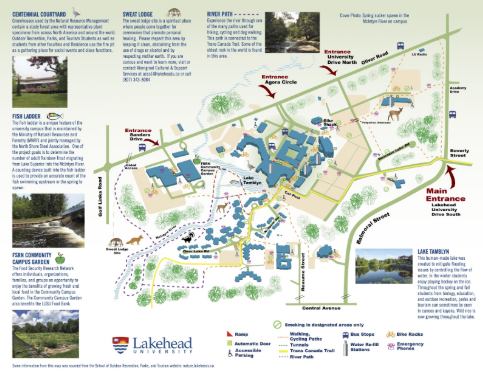
Water fountains and water bottle filling stations at Lakehead University are located throughout the Thunder Bay and Orillia campuses, which are free to use by students, staff and visitors. These chilled water bottle filling stations encourage users to avoid single-use plastic and are highlighted below on the Sustainability Campus Map with the water bottle icon.
In 2019, the Lakehead University Orillia campus introduced the Bottled Water Policy, which prohibits the purchase, sale and distribution of single-use bottled water on the Lakehead Orillia campus. This policy was last reviewed in December 2022. Lakehead University recognizes that access to clean, safe drinking water is a basic human right, and this initiative supports enhanced free public access to drinking water while reducing waste associated with single-use plastic bottles.
In 2023–24, Lakehead continued maintenance and upgrades of hydration stations and included signage on sustainable drinking practices across common student areas.
6.3.4 Water-conscious building standards
Does your university as a body apply building standards to minimise water use? (relevant standards to be indicated)
Lakehead’s Sustainable Building Policy, last reviewed in September 2025, articulates Lakehead’s dedication to building standards which encompass sustainable site planning, energy efficiency, resource conservation, indoor environmental quality and water preservation. This policy prioritizes sustainable building practices to minimize water use in accordance with the Leadership in Energy and Environmental Design (LEED) Rating system.
The Sustainable Building Policy states Lakehead University's commitment to environmental, economic and social stewardship through sustainable building practices for University buildings and facilities. This policy is being implemented to:
Reduce operating costs through energy and utility savings,
Provide a healthy environment for students, staff, faculty, and visitors,
Support conservation and protection of local environmental resources,
Promote sustainable building standards in Thunder Bay and Orillia.
Per the Sustainable Building Policy, Lakehead University must budget, plan, design, construct, manage, renovate, and maintain its facilities in a sustainable fashion. The LEED rating system and its associated Reference Guide shall be used as a design and measurement tool to determine what constitutes a sustainable building. All new facilities and major capital renovations shall meet and acquire the following:
Thunder Bay Campus: Minimum LEED Gold,
Orillia Campus: Minimum LEED Platinum,
Project teams are encouraged to exceed minimum LEED targets where possible,
The selection of design and construction teams must consider expertise in green building, LEED, and life cycle cost analysis.
Our efforts include building retrofits and innovative initiatives such as low-flow plumbing systems, conservation and restoration of local natural ecosystems, utilization of biowales on the Orillia campus, planting native species, and incorporating adaptive and drought-tolerant plants to reduce the need for supplemental watering. Lakehead University has also incorporated green roofs, bioretention areas for stormwater management, rain gardens, and outdoor classrooms that feature diverse native plants and ecosystems.
In 2023-24, Lakehead continued to leverage water audits and water-use assessments to identify opportunities for the installation of water-efficient fixtures and appliances, and to pursue available funding to support projects that further minimize water use across campus operations. In 2024, this included the installation of backflow prevention devices on the five main feeds to our Thunder Bay campus which protects water quality, improves water system performance, and minimizes water use.
6.3.5 Water-conscious planting
Does your university as a body plant landscapes to minimise water usage? (e.g. use drought-tolerant plants)
Lakehead University demonstrates its commitment to water conservation by incorporating drought-tolerant and native plants across campus landscaping. This is achieved by incorporating a combination of drought-tolerant and native plant species. This approach aligns with Lakehead’s broader commitment to sustainable building practices in accordance with the Leadership in Energy and Environmental Design (LEED) Rating system and Lakehead’s Sustainable Building Policy.
The LEED platinum campus in Orillia showcases many drought-tolerant and native plants in the landscaping, a water conservation feature that reduces the need for supplemental watering. For example, Orillia’s Academic Building includes a green roofing system, a geothermal energy source, and water collection ponds.
Lakehead actively manages precipitation on campus through the implementation of rain gardens and outdoor classroom spaces. These gardens absorb rainwater and snowmelt from downspouts and hard surfaces, effectively filtering pollutants through the soil and redirecting water away from storm drains that would otherwise discharge into nearby streams. Notably, the Braun Building Rain Garden serves as a compelling stormwater management demonstration and engagement site. It significantly reduces urban stormwater runoff and is a prominent feature during sustainability tours in the community, aimed at educating the public on the benefits and installation of rain gardens.
More recently, Lakehead University’s Office of Sustainability, in partnership with EcoSuperior Environmental Programs, conducted a Depave Paradise project on the Thunder Bay campus in the summer of 2019 to create the M'wade Gaazhi Namaadibinaanowin Outdoor Classroom. The project removed 100 m² of deteriorating grey infrastructure on campus and replaced it with native plants. Doing so increased the infiltration rate of the courtyard, recharged our groundwater supply, helped protect Lake Superior's water quality, helped cool the campus, and provided habitat for pollinators and insects. The space was transformed into an outdoor classroom with four demonstration gardens for use by undergraduate and graduate courses, as well as community events.
Water Usage and Care
6.4.1 Water reuse policy
Does your university as a body have a policy to maximise water reuse across the university?
Lakehead University’s Sustainable Building Policy, last reviewed in 2025, provides guidelines to maximize water reuse through dedicated resource conservation and sustainability practices. The policy promotes water efficiency and resource conservation in all major construction and renovation projects. The policy also promotes water conservation as part of the university’s operations including natural stormwater management, green infrastructure, incorporation of xeriscaping principles and maximizing water reuse across the University.
In 2023-2024 Lakehead University continues to explore opportunities for water reuse and conservation to reduce our water footprint with updates provided by the Office of Sustainability.
This policy is publicly available on Lakehead University’s official website under the Space and Property section.
6.4.2 Water reuse measurement
Does your university as a body measure the reuse of water across the university?
Lakehead University maintains a comprehensive water tracking system spanning over 20 years of data collection. This consistent monitoring, combined with successful water reduction and retrofit initiatives has enabled the university to achieve a substantial threefold decrease in overall water consumption.
Prior to 2005, the university’s average annual water use was approximately 462,585 m3. Through a major upgrade to water reusing tanks in the Aquatic Toxicology Research Centre and building retrofits to support low-flow plumbing the average water use dropped to 191,870 m3. This achievement demonstrates the university’s early commitment to sustainable water management and the measurement benefits of investing in water reuse technology.
Water Consumption by Campus: | ||
Year | Thunder Bay | Orillia |
2005-2006 | 185,597 | N/A |
2006-2007 | 194,929 | N/A |
2007-2008 | 222,230 | N/A |
2008-2009 | 109,078 | N/A |
2009-2010 | 146,551 | N/A |
2010-2011 | 157,290 | N/A |
2011-2012 | 161,794 | N/A |
2012-2013 | 203,900 | N/A |
2013-2014 | 276,043 | N/A |
2014-2015 | 279,646 | N/A |
2015-2016 | 294,670 | 3,628 |
2016-2017 | 193,198 | 12,035 |
2017-2018 | 302,995 | 13,189 |
2018-2019 | 248,941 | 14,575 |
2019-2020 | 224,555 | 10,471 |
2020-2021 | Covid-19 | Covid-19 |
2021-2022 | 311,688 | 10,037 |
2022-2023 | 242,197 | 9,662 |
2023-2024 | 43,254 | 10,688 |
In 2024, Lakehead University further advanced its water efficiency by installing backflow prevention devices on the five main feeds to the Thunder Bay campus. These devices prevent the reverse flow of water (known as backflow) from campus plumbing systems into the public water supply, protecting water quality, improving performance and reducing unaccounted for water loss. Since installation, the University has recorded a substantial and verified reduction in total water consumption from 251,859 m3 in the 2022 calendar year to 51,376 m3 in 2023 calendar year. (Note: These values are reported on a calendar year basis and differ from the financial year data presented above.) The improvement was significant enough to appear anomalous when compared to historical data, but subsequent verification with the municipality confirmed that these reductions reflect genuine water use reductions.
Lakehead University leverages natural landscaping features to maximize water reuse and reduce supplemental watering through: native plants that are adaptive and drought-tolerant, a green roof to control stormwater, a bioretention area and stormwater management landscaping to capture urban stormwater runoff.
Lakehead University’s Sustainability Plan recognizes that water is a non-renewable resource that needs to be conserved and not treated as a waste product. Lakehead continues to explore opportunities for increased water reuse in its operations.
Water in the Community
6.5.1 Water management educational opportunities
Does your university as a body provide educational opportunities for local communities to learn about good water management?
Lakehead University is committed to empowering local communities through both its academic programs and public outreach. The university aims to increase participation in water-related education events year over year. Through innovative programs, engaging workshops and collaborative initiatives, the university strives to raise awareness and understanding of responsible water stewardship.
Lakehead University offers an Honours Bachelor of Science in Water Resource Science with Specialization in Applied Environmental Water Management program which focuses on water resource management, water conservation, water quality analysis and sustainable water practices. This is a paid, 4-year program with successful graduates eligible to obtain certification as a Water and Wastewater Operator in Training (OIT) and Entry Level Drinking Water Operator (Ontario Provincial Certification).
As part of Lakehead University’s 2023 Research and Innovation Week, Dr. Vince Palace, Head Research Scientist at the IISD-Experimental Lakes Area “Developing Sustainable Co-culture of Wild Rice and Fish Farming with Indigenous Communities”. A multi-year research project to study changes to water quality and fish and aquatic ecosystem health associated with the co-culture of fish and wild rice. The project will develop and implement community-based water quality monitoring, assess the health of resident fish and the quality of aquatic habitats, and allow sustainable practices to be established for the co-culture of fish and wild rice by Indigenous communities.
In 2023–24, Lakehead University hosted “Protecting Our Waters” for World Water Day, an in-person and webinar event open to the public. This event featured Indigenous speakers and scholars addressing sustainable management of freshwater resources.
In 2024, the Lake Superior Living Labs Network (LSLLN) took part in a virtual summit to discuss Lake Superior Watershed: Reflections, Relationships, and Responsibilities. The summit includes a panel discussion, “Why Watersheds Matter – Shared Relationships and Responsibilities for Living Well.” In this session, panellists Courtney Vaughan, Sarah Siska, Quinn Meawasige, and Joan Chadde shared their perspectives from different disciplines, sectors, and places on how we think about, learn from, work responsibly in, and build relationships with watersheds. Drawing on their own experiences, they shared stories, histories, and current projects that expressed how they relate to watersheds.
6.5.2 Off-campus water conservation support
Does your university as a body support practical water conservation off campus?
Lakehead University actively supports water conservation efforts in the wider community through various initiatives and partnerships. By collaborating with local organizations, participating in community events and promoting water-saving practices, we contribute to a more water-conscious and environmentally responsible society. Examples of current partnerships and initiatives on water conservations off campus include:
The Freshwater Coastal Management Research Group at Lakehead University is an interdisciplinary group examining issues pertinent to freshwater coastal regions including source water in Northern Ontario and coastal communities along the shore of Lake Superior.
Lakehead University has a Memorandum of Understanding with the International Institute for Sustainable Development - Experimental Lakes Area (IISD ELA) to foster collaboration and support for understanding impacts on freshwater systems. This includes Dr. Michael Rennie's Community Ecology and Energetics (CEE) Lab works with the IISD's ELA to conduct research with the aim of restoring the ecology of lakes negatively impacted by industry. The CEE Lab also researches the impacts of microplastics on our local watershed. This research supports the conservation of water quality in the region.
Lakehead University is a key partner in the Lake Superior Living Labs Network (LSLLN), a collaborative platform that facilitates partnerships between academic institutions, government and community groups to co-create water-focused conservation projects. This network is dedicated to safeguarding the Lake Superior watershed, covering aspects related to water, land, food, climate, and energy. Throughout the year, the LSLLN hosts various events centred around the conservation and sustainable utilisation of water resources. These events include activities for World Water Day and initiatives that explore Indigenous connections to the Lake Superior watershed.
6.5.3 Sustainable water extraction on campus
Does your university as a body, where water is extracted (for example from aquifers, lakes or rivers), utilise sustainable water extraction technologies on associated university grounds on and off campus?
Raw water is sourced from Lake Superior at the Thunder Bay campus and from Lake Couchiching and groundwater supply wells at the Orillia campus. The water is treated to meet Ontario drinking water regulations and is transported through municipal water supply systems.
Water extracted from Lake Superior is treated by membrane ultrafiltration technology which removes impurities, minimizes chemical use and environmental impact and ensures the delivery of clean and safe drinking water to our campus and surrounding community. Wastewater generated on campus travels to the municipal water treatment plant and receives primary and secondary treatment to remove pollutants and contaminants, followed by a disinfection process. The treated wastewater is returned to Lake Superior, completing a closed-loop system that minimizes environmental impact.
Lakehead University is compliant with municipal sewage and stormwater discharge by-laws and does not discharge any matter that is hazardous to any person, animal, property or environment, or substances that may obstruct flow or cause damage to the sewage infrastructure.
Lakehead also actively manages precipitation on campus through the implementation of rain gardens and outdoor classroom spaces. These gardens absorb rainwater and snowmelt from downspouts and hard surfaces, effectively filtering pollutants through the soil and redirecting water away from storm drains that would otherwise discharge into nearby streams. Notably, the Braun Building Rain Garden serves as a compelling stormwater management demonstration and engagement site. It significantly reduces urban stormwater runoff and is a prominent feature during sustainability tours in the community, aimed at educating the public on the benefits and installation of rain gardens and watershed management.
Lakehead is committed to implementing policies and programs to reduce stormwater runoff and water pollution and to treat water as a resource rather than as a waste product.
6.5.4 Cooperation on water security
Does your university as a body cooperate with local, national, global governments on water security?
Lakehead University is committed to collaborative water security initiatives through partnerships with local governments and international research organizations.
LOCAL |
Restoring Thunder Bay’s Shoreline to Build Climate Resilience
In 2023-2024, Lakehead University researcher Dr. Robert Stewart, Associate Professor in the Department of Geography led collaborative efforts to protect and restore freshwater systems through shoreline restoration along the Lake Superior waterfront. These initiatives improve water quality by enhancing natural stormwater filtration, reducing erosion, and restoring aquatic habitats. Dr. Stewart has played a key role in advancing the North Shore of Lake Superior Remedial Action Plans, contributing scientific expertise and guidance to projects that address environmental degradation and promote long-term watershed health. Dr. Stewart collaborates with local governments and Indigenous communities to translate scientific research into practical shoreline restoration and water quality improvement strategies. More information can be found here.
REGIONAL |
Lake Superior Living Labs Network (LSLLN):
Dr. Charles Levkoe, Associate Professor in the Department of Health Sciences, and Canada Research Chair in Equitable and Sustainable Food Systems is the network lead of the Lake Superior Living Labs Network. In 2023-24 the network connected academic, community groups, Indigenous partners and government across the Lake Superior watershed in developing collaborative initiatives that intersect water, food, land, climate, energy and individual and community well-being. More information can be found here.
NATIONAL |
Pioneering Wetland Research to Combat Climate Change
In 2023-2024, Dr. Florin Pendea, Associate Professor of Geography and Environment and Sustainability Sciences, led a study investigating how human-constructed wetlands can slow climate change. Currently, wetlands have been built to collect stormwater run-off, redirect wastewater, and for flood control. This research, in partnership with the Town of Innisfil and the Lake Simcoe Region Conservation Authority, is considered the first in Canada to be studied from day one in terms of its carbon capture capacity and greenhouse gas emissions, in addition to redirecting wastewater, collecting stormwater run-off, and flood control. More information can be found here.
GLOBAL |
Freshwater Research Informing Policy on Pollution and Water Security
In 2023-2024, Dr. Michael Rennie, Director of the Aquatic Toxicology Research Center and Canada Research Chair in Freshwater Ecology and Fisheries, led Lakehead University’s Community Ecology and Energetics (CEE) Lab in a research project that advanced freshwater science and shaped environmental policy. The research, which was conducted at the IISD–Experimental Lakes Area (ELA), examines microplastic pollution, invasive species, and contaminants to inform decision-making on water security. By assessing the potential risks of contemporary levels of plastic pollution in freshwater ecosystems, Dr. Rennie and the CEE Lab are advancing Lakehead's role in shaping clean water policy solutions for regional and global water management. More information on this project can be found here.
6.5.5 Promoting conscious water usage on campus
Does your university as a body actively promote conscious water usage on campus?
In recent years, Lakehead has undertaken many initiatives to reduce water use on campus, enabled by community partnerships. While some initiatives are visible to students, staff and visitors, others are less visible as they are integrated into campus operations and infrastructure to support water conservation. Below are some of the water-saving projects Lakehead University has completed in recent years:
A ban on the sale of single-use water bottles on the Orillia campus,
Bioswales installation on the Orillia campus,
Native plants that are adaptive and drought-tolerant to minimize the need for supplemental watering,
A green roof to control stormwater runoff,
Bioretention area stormwater management landscaping,
An outdoor classroom that replaces a previously paved surface and incorporates various native plants and ecosystems on our Thunder Bay campus.
In 2024, the Thunder Bay campus installed backflow prevention devices on the five main feeds to campus which has resulted in a significant water usage reduction. Since installation, the University has recorded a substantial and verified reduction in total water consumption from 251,859 m3 in 2022-23 to 51,376 m3 in 2023-24.
6.5.6 Promoting conscious water usage in the wider community
Does your university as a body actively promote conscious water usage in the wider community?
Lakehead University actively promotes conscious water usage within the wider community through a variety of initiatives. With our Thunder Bay campus located on Lake Superior and our Orillia campus situated on Lake Simcoe, we are uniquely positioned to actively contribute to the protection and well-being of these important aquatic ecosystems.
- InfoSuperior Research and Information Network: Lakehead University is home to the InfoSuperior Research and Information Network and the Remedial Action Plan program. This network serves as a platform to connect citizens, students, academics, industry and government agencies around Lake Superior. Through community engagement, it identifies and addresses environmental concerns along the north shore of Lakehead Superior.
- Water Resource Science Program: Lakehead University offers a 4-year comprehensive Water Resource Science degree program which focuses on water resource management, water conservation, water quality analysis and sustainable aquatic stewardship practices. This program is training the next generation of water management and stewardship professionals contributing to the sustainability and protection of aquatic ecosystems.
- Lakehead University Environmental Laboratory (LUEL): The LUEL provides essential chemical analysis services for soils, foliage, water and wastewater. Through teaching and research, LUEL has developed partnerships to conduct land-field investigations related to water quality, wetlands and environmental monitoring.
- Rain Garden Demonstration: This Lakehead University stormwater management demonstration and engagement site is used to reduce urban stormwater runoff, project Lake Superior water quality. Members of the public are invited to explore the rain garden site to learn more about installing a rain garden in their own yards, as well as other stormwater management practices.