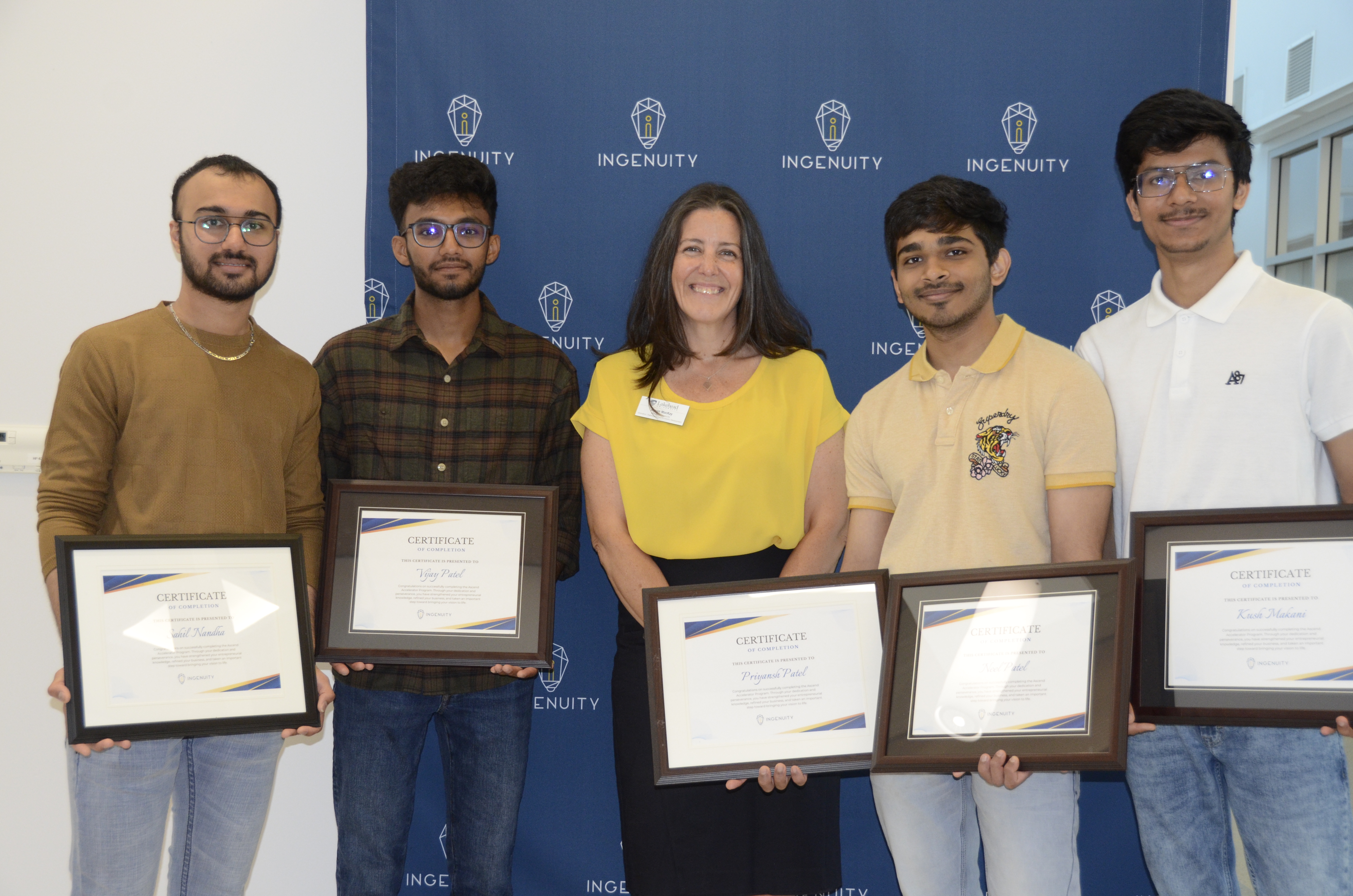

Barrie STEM Hub

TRV Visa Renewal Workshop

Have you recently renewed your study permit or obtained your post-grad work permit, and now need to renew your visa stamping in the passport? The visa stamping is used for entry to Canada. Please join our International Student Advisors as they walk through the process and requirements

Study Permit Extension Workshop

This session is for current international students at Lakehead University who will require a study permit extension. You must keep your study permit active the entire time you study in Canada and always apply for an extension before it expires. Join our International Student Advisor to learn more about the process and what is required.

Celebrating a Hall of Fame Award

Lakehead University's Orillia campus is feeling a lot of love right now.

Its Office of Community Engagement and Lifelong Learning (CELL) received the highest honour possible in the 2025 OrilliaMatters Community Builders Awards.

CELL has been inducted into the Community Builders Hall of Fame for its profound and lasting impact on the broader community.

CELL Director Nicky Locker, Bob Bowles, and Lakehead Administrative Officer and EA Leigh Kenderdine at the 2025 OrilliaMatters Community Builders awards ceremony.

"This award recognizes that CELL fosters relationships between countless instructors and countless lifelong learners of all ages," says Lakehead Orillia Principal Dr. Linda Rodenburg—and CELL's first director.

"We're always focused on being responsive to industry and community needs and interests," agrees current CELL Director Nicky Locker. "CELL allows people to forge new learning pathways, which may eventually lead to more formalized and degree programs, although that's not our main focus," she says.

CELL Director Nicky Locker (left), Bob Bowles (centre), and Lakehead University Administrative Officer and Executive Assistant Leigh Kenderdine (right) celebrate at the 2025 OrilliaMatters awards ceremony. Bob, who runs CELL's Ontario Master Naturalist Program, received a Community Builders Award for his environmental work.

Community is a Two-Way Street

CELL's programs, courses, and workshops have become hugely popular with Simcoe County residents—whether it's the Third Age Learning Lakehead (TALL) lecture series for seniors or the Ontario Master Naturalist Program for community members who want to learn more about the natural world and environmental stewardship.

Ontario Master Naturalist Program learners on a wildflower field trip in the woods

Community members learn about spring wildflowers during a May 2025 Ontario Master Naturalist Workshop.

Locker is just as enthusiastic about CELL's programming for local high school students. "Our tourism Specialist High Skills Major (SHSM) and environmental sustainability SHSM really help young people zero in on their career pathways."

CELL also offers professional development opportunities, including the Executive Leadership Program, and responsive programming for municipal and regional economic development offices and local organizations. 

Putting the Human in the Humanities

One of CELL's flagship programs is Humanities 101. "It gives people facing socioeconomic barriers a taste of the university experience and empowers them to become lifelong learners," Dr. Rodenburg says. "It's a true reminder that access to education enables people to change their lives, and the world around them, for the better."

2025 graduates of the Humanities 101 Program pose with their certificates of completion

 The 2025 graduates of the Humanities 101 program proudly hold up their certificates of completion.

"Humanities 101 is very dear to my heart because it welcomes people to campus who might otherwise not find opportunities to engage," Locker says. "Access and inclusion are at the forefront of everything we do."

Dr. Rodenburg says that Humanities 101 graduates have inspired her both as an educator and as a human being.

"One student taking the course was staying at a women's shelter. Afterwards, she was empowered to earn honours and master's degrees in social work at Lakehead. During her social work program, she chose to do a placement at the same shelter so she could help other women in crisis."

It's All About Connection

"Every day I meet new people and organizations and find new opportunities to create innovative programming," Locker says.

Recently, CELL partnered with Inclusive Orillia for Pride Month and this August, the Orillia Museum of Art and History will be hosting a children's day camp on Lakehead's campus for the first time.

This spirit of friendship and curiosity has driven CELL since its beginnings.

Anne Hilliard holds her 2025 Civitas Award while standing beside Dr. Linda Rodenburg (wearing convocation robes)

"I don't think Lakehead Orillia ever decided to 'start CELL,' but rather CELL grew out of a genuine desire to meet the learning needs of diverse members of our community," Dr. Rodenburg explains.

"As a founding Lakehead Orillia faculty member, I led the inaugural 'Meet the Professors' lecture series. It was a forum for faculty members to share their research and teaching interests with the community."

Dr. Linda Rodenburg (right) presents Anne Hilliard (left) with the Orillia Civitas Award at Lakehead’s June 2025 convocation ceremony. Anne is the community advisory committee chair of the CELL program, Third Age Learning at Lakehead (TALL).

CELL blossomed from this community-outreach initiative. Now, almost 20 years later, being given the OrilliaMatters Community Builders Hall of Fame award is a moving affirmation that Lakehead remains a community university at its core.

"We're committed to serving beyond the walls of the campus in this wonderful community we call home," Locker says.

Collection Notice

Under the authority of sections 12 and 14 of The Lakehead University Act, 1965 examinations held in some Lakehead University rooms are monitored by cameras, identified by signage, connected to Lakehead University's closed circuit television system, as a complement to the University's invigilation of those examinations and to related investigations under the University's Student Code of Conduct.  Access to recordings from these cameras is permitted only to University personnel who need the access to carry out their duties and to individuals who need the access to defend themselves in a Unive

Student Unpaid Placement Safety and Accident Reporting Information

Students participating in unpaid work placements as part of their academic program at Lakehead University may be eligible for workplace insurance coverage through the Ministry of Colleges and Universities (MCU) or Chubb Insurance. The type of coverage depends on the nature of the placement and the funding model of the program.

Please read the following information carefully to understand your responsibilities and the process for ensuring appropriate coverage and reporting.

 Need to report an injury during your Unpaid Placement?  Click here.


Health and Safety at Your Placement

Lakehead University is committed to ensuring that all students have access to safe and supportive placement environments. While on placement, students have the right to a safe and healthy workplace.  

If the placement takes place in Ontario, the students are considered workers while on placement and are therefore covered by the Occupational Health and Safety Act (OHSA). The Placement Employer is responsible for ensuring all OHSA requirements are met and to take every reasonable precaution to protect the student's health and safety. The Training Agency (Lakehead University) has a similar duty of care and must take precautions to ensure student safety. 

Some of the precautions that must be taken prior to the placement commencement include: 

Mandatory H&S Training

Students must complete mandatory training before their placement. Follow any direction provided by your Placement Coordinator to ensure you have completed all mandatory training through our online training platform.  Our training platform is found at:  Mycourselink Homepage

Job Specific Training


Placement hosts must also provide any additional job-specific safety training.  This includes:


  • The right to be informed of workplace hazards.

  • The right to receive proper safety training and supervision.

  • The right to refuse unsafe work without fear of reprisal.


If you have concerns about safety at your placement, contact your placement coordinator or the Health and Safety Office immediately. Your safety is a priority, and all placement partners are expected to comply with applicable health and safety legislation.


Insurance Coverage for Students on Unpaid Work Placements

MCU-Eligible Programs (WSIB Coverage)

Students participating in unpaid work placements that are part of MCU-eligible programs and serving placement in Ontario at an employer covered by the Workplace Safety and Insurance Act are covered by the Workplace Safety and Insurance Board (WSIB) through the Ministry. This coverage applies only to unpaid placements that are a requirement of the student’s academic program and meet the criteria outlined by the MCU.

A completed and signed Student Declaration of Understanding of WSIB or Private Insurance Coverage form must be submitted before the placement begins.

Non-MCU Programs (Chubb Insurance)

Students participating in unpaid work placements that are part of MCU-eligible programs and serving placement in Ontario at an employer who is not covered by the Workplace Safety and Insurance Act are covered by Chubb insurance provided through the Ministry. These placements must be approved by the university, and the same documentation is required.

If you are unsure about your eligibility, please contact your department’s placement coordinator.


Before Your Placement Begins

Before starting an unpaid placement, students must:


  • Confirm with their academic program whether the placement is MCU-eligible.
  • Complete the Student Declaration of Understanding form (WSIB/Chubb).
  • Submit the form to their department’s placement coordinator.
  • Receive confirmation that insurance coverage is in place.


In the Event of a Workplace Injury

If a student is injured during an unpaid work placement:

  • Seek medical attention immediately if needed.

  • Notify the placement supervisor at the host organization as soon as possible.

  • Submit an LU Student Placement Injury Report using the Accident Report Form within 24 hours of the incident.

  • You will need the following information to complete your report:

  • Placement agency's accident report

  • Signed Ministry Claim Form (You must download this file and open outside of a browser to view)

  • Signed Letter to Placement Employers (This was provided to you at the beginning of the academic year by your placement coordinator).

  • Contact your placement coordinator and/or LU’s Health and Safety Office for further guidance.


Prompt reporting is essential to ensure appropriate insurance claims can be filed in accordance with WSIB or Chubb requirements.


Forms and Resources


Contact Us

For questions or concerns about your unpaid placement, insurance coverage, or workplace safety, please contact:

Health, Safety & Wellness Office
Lakehead University
807-343-8010 ext. 8671 or ext. 8806

trmoore@lakeheadu.ca

Grow Your Own Lecture Series

Are you interested in learning more about how to grow your own food indoors and outdoors? If so, this new fully online lecture series is for you! Take advantage of our introductory pricing and explore various concepts ranging from physical science to design and creative innovation with an overarching goal of enabling participants to be better suited to growing their own food within the context of a changing climate.

Lakehead University makes top 100 list of global universities having real-world impact

Thunder Bay and Orillia, Ont. - Lakehead University is solidifying its presence on the national and global stage, ranking among the top 100 universities in the world addressing global challenges in the Times Higher Education 2025 Impact Rankings.

Lakehead is in the top 100 again this year, ranking 90th overall among 2,318 participating institutions worldwide, while maintaining its status as the top-ranked university with under 10,000 students in Canada and North America.

“Our faculty, students and staff are committed to research, education, and community partnerships that support the global sustainability agenda, including poverty, climate change, access to clean water, and Indigenous reconciliation,” explained Dr. Gillian Siddall, President and Vice-Chancellor. “The Impact Rankings shine a light on the work happening in our classrooms, campus labs, and through community-engaged research that is changing lives and contributing to the development of sustainable communities and societies, locally, nationally, and globally.”

The Times Higher Education (THE) Impact Rankings assess a university’s success in delivering on the United Nations’ 17 Sustainable Development Goals (SDGs) across the areas of research, stewardship, outreach and teaching using a range of quantitative and qualitative measures.

Lakehead’s ranking reflects key operational initiatives, curriculum development and research projects that focus on addressing societal issues such as responsible resource extraction, sustainability, agriculture, and health equity, among others.

“The future of our communities, countries, and world, depends on the next generation of talented graduates,” said Dr. David Richards, Interim Provost and Vice-President (Academic). “At Lakehead University, we offer one of the best educational experiences in the world with innovative academic programming including concentrations in social justice, climate leadership, and Indigenous law and education, empowering students to find solutions to society’s biggest challenges.”

Of the 2,318 post-secondary institutions evaluated, THE ranked Lakehead as a world leader in:

23rd in the world and 2nd in Canada for SDG1: No Poverty. Lakehead University’s campuses are located in regions where the median income is below the provincial and national average. As one of the largest employers, post-secondary institutions and economic hubs in Northwestern Ontario and Simcoe County, Lakehead has a direct impact on the economic and social resilience in the regions it serves. This ranking also reflects the many initiatives Lakehead offers to support students who face barriers to accessing university education, including financial barriers, as well as the innovative research being done by faculty related to poverty in rural and remote communities in northwestern Ontario.

26th in the world and 5th in Canada for SDG14: Life Below Water. Healthy lakes, rivers and oceans are essential to human existence and Lakehead is a world leader in conservation and sustainable use of fresh-water ecosystems. Through strategic partnerships, Lakehead is leveraging collective expertise to drive innovation and impact marine conservation initiatives to foster environmental stewardship. Lakehead supports healthy aquatic ecosystems through community outreach programs, research initiatives, and degree programs such as undergraduate studies in water resource science.

The Impact Rankings also placed Lakehead University as 65th in world and 7th in Canada for SDG 2: Zero Hunger; 58th in the world and 7th in Canada for SDG6: Clean Water and Sanitation; 98th in the world and 7th in Canada for SDG 7: Affordable and Clean Energy; 65th in the world and 7th in Canada for SDG 15: Life on Land; and 101-200 in the world and 7th in Canada for SDG 17: Partnerships for the Goals. Lakehead performed in the top 200 universities in the world in 11 of the 17 SDGs.

“This ranking shows that Lakehead isn’t just a place to learn about the world – it’s a place where people can change the world,” Dr. Siddall stated. “This is an exceptional achievement that students, faculty and staff can all take pride in.”

This year’s Impact Rankings evaluated post-secondary institutions from over 300 countries including 24 Canadian universities.

To view Lakehead’s full results, visit the university’s Times Higher Education profile at: https://www.timeshighereducation.com/world-university-rankings/lakehead-university 

Quick facts:

  • Lakehead is ranked 90th overall among 2,318 universities from over 300 countries in the Times Higher Education 2025 Impact Rankings.
  • For the sixth year in a row, Lakehead remains in the top 10% of global universities for social impact.
  • Lakehead is one of 24 participating Canadian universities, and the top ranked Canadian primarily undergraduate university.
  • Lakehead is the top ranked university in Canada with under 10,000 students.
  • Lakehead is the top ranked university in North America with under 10,000 students.

Engineering - Mechatronics

Mechatronics Engineering is the design of robotics, control systems, and electromechanical systems. This is a new and rapidly-growing multi-disciplinary branch of engineering at the intersection of Mechanical Engineering, Electrical Engineering, Software Engineering, and Computer Science.

You will gain the skills to design intelligent machines, from electric vehicles to large-scale industrial robots. During the program you’ll learn how to design systems that rely on mechanical elements, electrical power, sensing and control.

You will have the opportunity to undertake practical work throughout the degree, including lab work, projects, and co-op work that involve designing and building mechatronics components and systems.

What’s different about Mechatronics Engineering at Lakehead?

At Lakehead Engineering we believe integrated and sustainable technology design is critical for protecting the environment and improving the well-being of people and society.

That’s why our new BEng Mechatronics Engineering program has been designed to prepare students to create technologies that support the United Nations Sustainable Development Goals (UN SDGs).

With sustainability at its core, this unique program integrates business, law, and public safety into the learning experience giving students a deeper and broader insight to accompany their engineering expertise.

Applying to Lakehead University is easy and we are here to help you along the way.

Step 1 – Determine your general admission requirements:

To determine your general admission requirements, select one of the definitions below:

Ontario High School Students
 General Admission Requirements:
  • Completion of the Ontario Secondary School Diploma (OSSD);
  • A minimum of 6 Grade 12U or M courses, or equivalent, including program specific prerequisite courses;
  • A minimum 70%* overall final average**

*Higher averages may be required for admission to programs in which the demand for places by qualified applicants exceeds the supply of available spaces.
**Admission averages are calculated using the top 6 Grade 12 U or M courses.  

Other Canadian High School Students
 General Admission Requirements: 
  • Completion of Grade 12 and the Secondary School Diploma (see the Program Specific Prerequisites section for your particular provinces requirements);
  • Program specific prerequisite courses;
  • A minimum 70%* overall final average

*Higher averages may be required for admission to programs in which the demand for places by qualified applicants exceeds the supply of available spaces.

International Secondary School/ College or University
 General Admission Requirements:
  • Successful graduation from an academic secondary school program or equivalent (For most countries, the same academic preparation as is required for university entrance in that country is required for consideration. Refer to Admission Requirements by Country.) 
  • Program specific prerequisite courses;
  • Equivalent of a minimum 70% overall final average (Canadian)

    Note: Meeting the minimum admission requirements is not a guarantee of admission.

Canadian College
 General Admission Requirements:

College transfer applicants who are applying to a program that does not have a college transfer pathway are eligible for admission consideration if they have:

  • Completed a minimum of 1 year of full-time academic studies at an accredited community college since leaving high school;
  • Completed the appropriate program-specific prerequisite courses; and
  • Achieved a minimum overall average of 70%. 
Canadian University
 General Admission Requirements:
  • Attended a university and successful completion of university level course work since leaving high school/college;
  • Program specific prerequisite courses;
  • A minimum overall average of C or 60%.
Canadian Bible College
 General Admission Requirements:
  • A minimum overall average of C / 60% or equivalent;
  • College must be accredited by the Association of Biblical Higher Education (ABHE);
  • Successfully meets the minimum program specific preparatory course prerequisites at the Grade 12U or M level or equivalent;
  • If not eligible right out of high school, a minimum of two years of full time studies must be completed at the Bible College.

Step 2 – Determine your program-specific prerequisite requirements for your program(s) of choice:

To determine your program-specific prerequisite requirements, choose from the drop-down menus below:

Program Specific Requirements


  • Chemical Engineering (applies to the co-op and MBA options as well)
    Degree:
    Engineering
    Alberta/NWT/Nunavut:
    English Language Arts 30-1, Chemistry 30, Math 30-1 with a minimum grade of 60%, Physics 30
    Program Specific Requirements for Ontario High School Students:
    English (ENG4U), Advanced Functions (MHF4U) with a minimum grade of 60%, Chemistry (SCH4U), Physics (SPH4U)
    Program Specific Requirements for Alberta/NWT/Nunavut High School Students:
    English Language Arts 30-1, Chemistry 30, Math 30-1 with a minimum grade of 60%, Physics 30
    Program Specific Requirements for British Columbia/Yukon High School Students:
    English Studies 12 or English First Peoples 12, Chemistry 12, Physics 12, Pre-Calculus 12 with a minimum grade of 60%
    Program Specific Requirements for International Students:
    English, Chemistry, Math with a minimum grade of 60% (Canadian Equivalent), Physics
    Program Specific Requirements for Manitoba High School Students:
    English Language Arts (Comprehensive Focus, Literary Focus, or Transactional Focus) 40S, Chemistry 40S, Physics 40S, Pre-Calculus 40S with a minimum grade of 60%
    Program Specific Requirements for Mature/Transfer Students:
    English (ENG4U), Advanced Functions (MHF4U) with a minimum grade of 60%, Chemistry (SCH4U), Physics (SPH4U). Equivalent courses to the Ontario high school prerequisite requirements will be considered. College transfer students entering via a transfer pathway are not required to satisfy these specific prerequisite requirements.
    Program Specific Requirements for New Brunswick High School Students:
    English Language Arts 121 or 122, Chemistry 121 or 122, Physics 121 or 122, Pre-Calculus A120 or B120 with a minimum grade of 60%
    Program Specific Requirements for Newfoundland/Labrador High School Students:
    English 3201, Advanced Math 3200, Chemistry 3202, Physics 3204
    Program Specific Requirements for Nova Scotia High School Students:
    English 12 or English 12 African Heritage, Chemistry 12, Physics 12, Pre-Calculus 12 with a minimum grade of 60%
    Other Admission Requirements & Important Information:

    In addition to the above requirements, Calculus and Vectors (i.e. MCV4U in Ontario) is strongly recommended. Students who have completed Ontario's Grade 12 U Calculus & Vectors, with a minimum mark of 60%, will be exempted from MATH 1071 - Vectors and Matrices. A senior level Math, Science or Technological Education course is recommended. Lastly, students who do not meet all of the admission requirements will be evaluated on an individual basis.

    Program Specific Requirements for PEI High School Students:
    English 621A, Chemistry 621A, Physics 621A, Pre-Calculus 621B with a minimum grade of 60%
    Program Specific Requirements for Quebec (CEGEP) Students:
    2 English (603 or 604), Chemistry (2 from: NYA, NYB, or NYC), Linear Algebra I (201-NYC, 201-105, or 201-106) with a minimum grade of 60%, Physics (2 from: NYA, NYB, or NYC)
    Program Specific Requirements for Quebec (Private) Students:
    English (ENG4U), Advanced Functions (MHF4U) with a minimum grade of 60%, Chemistry (SCH4U), Physics (SPH4U). Equivalent courses to the Ontario high school prerequisite requirements will be considered.
    Program Specific Requirements for Saskatchewan High School Students:
    English A30 and B30, Chemistry 30, Physics 30, Pre-Calculus 30 with a minimum grade of 60%
  • Civil Engineering (applies to the co-op and MBA options as well)
    Degree:
    Engineering
    Alberta/NWT/Nunavut:
    English Language Arts 30-1, Chemistry 30, Math 30-1 with a minimum grade of 60%, Physics 30
    Program Specific Requirements for Ontario High School Students:
    English (ENG4U), Advanced Functions (MHF4U) with a minimum grade of 60%, Chemistry (SCH4U), Physics (SPH4U)
    Program Specific Requirements for Alberta/NWT/Nunavut High School Students:
    English Language Arts 30-1, Chemistry 30, Math 30-1 with a minimum grade of 60%, Physics 30
    Program Specific Requirements for British Columbia/Yukon High School Students:
    English Studies 12 or English First Peoples 12, Chemistry 12, Physics 12, Pre-Calculus 12 with a minimum grade of 60%
    Program Specific Requirements for International Students:
    English, Chemistry, Math with a minimum grade of 60% (Canadian Equivalent), Physics
    Program Specific Requirements for Manitoba High School Students:
    English Language Arts (Comprehensive Focus, Literary Focus, or Transactional Focus) 40S, Chemistry 40S, Physics 40S, Pre-Calculus 40S with a minimum grade of 60%
    Program Specific Requirements for Mature/Transfer Students:
    English (ENG4U), Advanced Functions (MHF4U) with a minimum grade of 60%, Chemistry (SCH4U), Physics (SPH4U). Equivalent courses to the Ontario high school prerequisite requirements will be considered. College transfer students entering via a transfer pathway are not required to satisfy these specific prerequisite requirements.
    Program Specific Requirements for New Brunswick High School Students:
    English Language Arts 121 or 122, Chemistry 121 or 122, Physics 121 or 122, Pre-Calculus A120 or B120 with a minimum grade of 60%
    Program Specific Requirements for Newfoundland/Labrador High School Students:
    English 3201, Advanced Math 3200, Chemistry 3202, Physics 3204
    Program Specific Requirements for Nova Scotia High School Students:
    English 12 or English 12 African Heritage, Chemistry 12, Physics 12, Pre-Calculus 12 with a minimum grade of 60%
    Other Admission Requirements & Important Information:

    In addition to the above requirements, Calculus and Vectors (i.e. MCV4U in Ontario) is strongly recommended. Students who have completed Ontario's Grade 12 U Calculus & Vectors, with a minimum mark of 60%, will be exempted from MATH 1071 - Vectors and Matrices. A senior level Math, Science or Technological Education course is recommended. Lastly, students who do not meet all of the admission requirements will be evaluated on an individual basis.

    Program Specific Requirements for PEI High School Students:
    English 621A, Chemistry 621A, Physics 621A, Pre-Calculus 621B with a minimum grade of 60%
    Program Specific Requirements for Quebec (CEGEP) Students:
    2 English (603 or 604), Chemistry (2 from: NYA, NYB, or NYC), Linear Algebra I (201-NYC, 201-105, or 201-106) with a minimum grade of 60%, Physics (2 from: NYA, NYB, or NYC)
    Program Specific Requirements for Quebec (Private) Students:
    English (ENG4U), Advanced Functions (MHF4U) with a minimum grade of 60%, Chemistry (SCH4U), Physics (SPH4U). Equivalent courses to the Ontario high school prerequisite requirements will be considered.
    Program Specific Requirements for Saskatchewan High School Students:
    English A30 and B30, Chemistry 30, Physics 30, Pre-Calculus 30 with a minimum grade of 60%
  • Common Year in Applied Science
    Degree:
    Engineering
    Alberta/NWT/Nunavut:
    5 Academic Grade 12 Courses (30 Level), Chemistry 20, English Language Arts 20-1 or English Language Arts 30-2, Math 20-1, Physics 20
    Program Specific Requirements for Ontario High School Students:
    6 Grade 12 U or M Courses, Chemistry (SCH3U or SCH4C), English (ENG3U or ENG4C), Mathematics (MCF3M or MCR3U), Physics (SPH3U or SPH4C)
    Program Specific Requirements for Alberta/NWT/Nunavut High School Students:
    5 Academic Grade 12 Courses (30 Level), Chemistry 20, English Language Arts 20-1 or English Language Arts 30-2, Math 20-1, Physics 20
    Program Specific Requirements for British Columbia/Yukon High School Students:
    4 Academic Grade 12 Courses, English (Composition) 11, Chemistry 11, Physics 11, Pre-Calculus 11
    Program Specific Requirements for International Students:
    English, Chemistry, Math, Physics
    Program Specific Requirements for Manitoba High School Students:
    5 Academic Grade 12 Courses (40S Level), Chemistry 30S, English Language Arts (Comprehensive Focus, Literary Focus, or Transactional Focus) 30S, Physics 30S, Pre-Calculus 30S
    Program Specific Requirements for Mature/Transfer Students:
    6 Grade 12 U or M credits, Chemistry (SCH3U or SCH4C), English (ENG3U or ENG4C), Mathematics (MCF3M or MCR3U), Physics (SPH3U or SPH4C). Equivalent courses to the Ontario high school prerequisite requirements will be considered.
    Program Specific Requirements for New Brunswick High School Students:
    5 Academic Grade 12 Courses (120, 121, or 122), Chemistry (111 or 112), English Language Arts (111, 112, or 123), Physics (Grade 11 [111 or 112])
    Program Specific Requirements for Newfoundland/Labrador High School Students:
    10 Academic Grade 12 Courses (3000 Level), Academic Math 2201 or Advanced Math 2200, Chemistry 2202, English (2201 or 3202), Physics 2204
    Program Specific Requirements for Nova Scotia High School Students:
    5 Grade 12 Academic or Advanced Courses, Chemistry 11, English 11, Physics 11, Pre-Calculus 11
    Other Admission Requirements & Important Information:

    Students who do not meet all of the above admission requirements will be evaluated on an individual basis.

    Program Specific Requirements for PEI High School Students:
    5 Academic Grade 12 Courses (611 or 621), Chemistry 521A, English 521, Math 521B, Physics 521A
    Program Specific Requirements for Quebec (CEGEP) Students:
    2 English (603 or 604), Chemistry (NYA, NYB, or NYC), Linear Algebra I (201-NYC, 201-105, or 201-106), Physics (NYA, NYB, or NYC)
    Program Specific Requirements for Quebec (Private) Students:
    6 Grade 12 U or M Courses, Chemistry (SCH3U or SCH4C), English (ENG3U or ENG4C), Mathematics (MCF3M or MCR3U), Physics (SPH3U or SPH4C). Equivalent courses to the Ontario high school prerequisite requirements will be considered.
    Program Specific Requirements for Saskatchewan High School Students:
    5 Academic Grade 12 Courses (30 Level), English Language Arts 20, Chemistry 20, Physics 20, Pre-Calculus Mathematics 20
  • Electrical Engineering (applies to the co-op and MBA options as well)
    Degree:
    Engineering
    Alberta/NWT/Nunavut:
    English Language Arts 30-1, Chemistry 30, Math 30-1 with a minimum grade of 60%, Physics 30
    Program Specific Requirements for Ontario High School Students:
    English (ENG4U), Advanced Functions (MHF4U) with a minimum grade of 60%, Chemistry (SCH4U), Physics (SPH4U)
    Program Specific Requirements for Alberta/NWT/Nunavut High School Students:
    English Language Arts 30-1, Chemistry 30, Math 30-1 with a minimum grade of 60%, Physics 30
    Program Specific Requirements for British Columbia/Yukon High School Students:
    English Studies 12 or English First Peoples 12, Chemistry 12, Physics 12, Pre-Calculus 12 with a minimum grade of 60%
    Program Specific Requirements for International Students:
    English, Chemistry, Math with a minimum grade of 60% (Canadian Equivalent), Physics
    Program Specific Requirements for Manitoba High School Students:
    English Language Arts (Comprehensive Focus, Literary Focus, or Transactional Focus) 40S, Chemistry 40S, Physics 40S, Pre-Calculus 40S with a minimum grade of 60%
    Program Specific Requirements for Mature/Transfer Students:
    English (ENG4U), Advanced Functions (MHF4U) with a minimum grade of 60%, Chemistry (SCH4U), Physics (SPH4U). Equivalent courses to the Ontario high school prerequisite requirements will be considered. College transfer students entering via a transfer pathway are not required to satisfy these specific prerequisite requirements.
    Program Specific Requirements for New Brunswick High School Students:
    English Language Arts 121 or 122, Chemistry 121 or 122, Physics 121 or 122, Pre-Calculus A120 or B120 with a minimum grade of 60%
    Program Specific Requirements for Newfoundland/Labrador High School Students:
    English 3201, Advanced Math 3200, Chemistry 3202, Physics 3204
    Program Specific Requirements for Nova Scotia High School Students:
    English 12 or English 12 African Heritage, Chemistry 12, Physics 12, Pre-Calculus 12 with a minimum grade of 60%
    Other Admission Requirements & Important Information:

    In addition to the above requirements, Calculus and Vectors (i.e. MCV4U in Ontario) is strongly recommended. Students who have completed Ontario's Grade 12 U Calculus & Vectors, with a minimum mark of 60%, will be exempted from MATH 1071 - Vectors and Matrices. A senior level Math, Science or Technological Education course is recommended. Lastly, students who do not meet all of the admission requirements will be evaluated on an individual basis.

    Program Specific Requirements for PEI High School Students:
    English 621A, Chemistry 621A, Physics 621A, Pre-Calculus 621B with a minimum grade of 60%
    Program Specific Requirements for Quebec (CEGEP) Students:
    2 English (603 or 604), Chemistry (2 from: NYA, NYB, or NYC), Linear Algebra I (201-NYC, 201-105, or 201-106) with a minimum grade of 60%, Physics (2 from: NYA, NYB, or NYC)
    Program Specific Requirements for Quebec (Private) Students:
    English (ENG4U), Advanced Functions (MHF4U) with a minimum grade of 60%, Chemistry (SCH4U), Physics (SPH4U). Equivalent courses to the Ontario high school prerequisite requirements will be considered.
    Program Specific Requirements for Saskatchewan High School Students:
    English A30 and B30, Chemistry 30, Physics 30, Pre-Calculus 30 with a minimum grade of 60%
  • Mechanical Engineering (applies to the co-op and MBA options as well)
    Degree:
    Engineering
    Alberta/NWT/Nunavut:
    English Language Arts 30-1, Chemistry 30, Math 30-1 with a minimum grade of 60%, Physics 30
    Program Specific Requirements for Ontario High School Students:
    English (ENG4U), Advanced Functions (MHF4U) with a minimum grade of 60%, Chemistry (SCH4U), Physics (SPH4U)
    Program Specific Requirements for Alberta/NWT/Nunavut High School Students:
    English Language Arts 30-1, Chemistry 30, Math 30-1 with a minimum grade of 60%, Physics 30
    Program Specific Requirements for British Columbia/Yukon High School Students:
    English Studies 12 or English First Peoples 12, Chemistry 12, Physics 12, Pre-Calculus 12 with a minimum grade of 60%
    Program Specific Requirements for International Students:
    English, Chemistry, Math with a minimum grade of 60% (Canadian Equivalent), Physics
    Program Specific Requirements for Manitoba High School Students:
    English Language Arts (Comprehensive Focus, Literary Focus, or Transactional Focus) 40S, Chemistry 40S, Physics 40S, Pre-Calculus 40S with a minimum grade of 60%
    Program Specific Requirements for Mature/Transfer Students:
    English (ENG4U), Advanced Functions (MHF4U) with a minimum grade of 60%, Chemistry (SCH4U), Physics (SPH4U). Equivalent courses to the Ontario high school prerequisite requirements will be considered. College transfer students entering via a transfer pathway are not required to satisfy these specific prerequisite requirements.
    Program Specific Requirements for New Brunswick High School Students:
    English Language Arts 121 or 122, Chemistry 121 or 122, Physics 121 or 122, Pre-Calculus A120 or B120 with a minimum grade of 60%
    Program Specific Requirements for Newfoundland/Labrador High School Students:
    English 3201, Advanced Math 3200, Chemistry 3202, Physics 3204
    Program Specific Requirements for Nova Scotia High School Students:
    English 12 or English 12 African Heritage, Chemistry 12, Physics 12, Pre-Calculus 12 with a minimum grade of 60%
    Other Admission Requirements & Important Information:

    In addition to the above requirements, Calculus and Vectors (i.e. MCV4U in Ontario) is strongly recommended. Students who have completed Ontario's Grade 12 U Calculus & Vectors, with a minimum mark of 60%, will be exempted from MATH 1071 - Vectors and Matrices. A senior level Math, Science or Technological Education course is recommended. Lastly, students who do not meet all of the admission requirements will be evaluated on an individual basis.

    Program Specific Requirements for PEI High School Students:
    English 621A, Chemistry 621A, Physics 621A, Pre-Calculus 621B with a minimum grade of 60%
    Program Specific Requirements for Quebec (CEGEP) Students:
    2 English (603 or 604), Chemistry (2 from: NYA, NYB, or NYC), Linear Algebra I (201-NYC, 201-105, or 201-106) with a minimum grade of 60%, Physics (2 from: NYA, NYB, or NYC)
    Program Specific Requirements for Quebec (Private) Students:
    English (ENG4U), Advanced Functions (MHF4U) with a minimum grade of 60%, Chemistry (SCH4U), Physics (SPH4U). Equivalent courses to the Ontario high school prerequisite requirements will be considered.
    Program Specific Requirements for Saskatchewan High School Students:
    English A30 and B30, Chemistry 30, Physics 30, Pre-Calculus 30 with a minimum grade of 60%
  • Mechatronics Engineering
    Degree:
    Engineering
    Alberta/NWT/Nunavut:
    English Language Arts 30-1, Chemistry 30, Math 30-1 with a minimum grade of 60%, Physics 30
    Program Specific Requirements for Ontario High School Students:
    English (ENG4U), Advanced Functions (MHF4U) with a minimum grade of 60%, Chemistry (SCH4U), Physics (SPH4U)
    Program Specific Requirements for Alberta/NWT/Nunavut High School Students:
    English Language Arts 30-1, Chemistry 30, Math 30-1 with a minimum grade of 60%, Physics 30
    Program Specific Requirements for British Columbia/Yukon High School Students:
    English Studies 12 or English First Peoples 12, Chemistry 12, Physics 12, Pre-Calculus 12 with a minimum grade of 60%
    Program Specific Requirements for International Students:
    English, Chemistry, Math with a minimum grade of 60% (Canadian Equivalent), Physics
    Program Specific Requirements for Manitoba High School Students:
    English Language Arts (Comprehensive Focus, Literary Focus, or Transactional Focus) 40S, Chemistry 40S, Physics 40S, Pre-Calculus 40S with a minimum grade of 60%
    Program Specific Requirements for Mature/Transfer Students:
    English (ENG4U), Advanced Functions (MHF4U) with a minimum grade of 60%, Chemistry (SCH4U), Physics (SPH4U). Equivalent courses to the Ontario high school prerequisite requirements will be considered. College transfer students entering via a transfer pathway are not required to satisfy these specific prerequisite requirements
    Program Specific Requirements for New Brunswick High School Students:
    English Language Arts 121 or 122, Chemistry 121 or 122, Physics 121 or 122, Pre-Calculus A120 or B120 with a minimum grade of 60%
    Program Specific Requirements for Newfoundland/Labrador High School Students:
    English 3201, Advanced Math 3200, Chemistry 3202, Physics 3204
    Program Specific Requirements for Nova Scotia High School Students:
    English 12 or English 12 African Heritage, Chemistry 12, Physics 12, Pre-Calculus 12 with a minimum grade of 60%
    Other Admission Requirements & Important Information:

    In addition to the above requirements, Calculus and Vectors (i.e., MCV4U in Ontario) is strongly recommended. Students who have completed Ontario's Grade 12 U Calculus & Vectors, with a minimum mark of 60%, will be exempted from MATH 1071 - Vectors and Matrices. A senior level Math, Science or Technological Education course is recommended. Lastly, students who do not meet all of the admission requirements will be evaluated on an individual basis.

    Program Specific Requirements for PEI High School Students:
    English 621A, Chemistry 621A, Physics 621A, Pre-Calculus 621B with a minimum grade of 60%
    Program Specific Requirements for Quebec (CEGEP) Students:
    2 English (603 or 604), Chemistry (2 from: NYA, NYB, or NYC), Linear Algebra I (201-NYC, 201-105, or 201-106) with a minimum grade of 60%, Physics (2 from: NYA, NYB, or NYC)
    Program Specific Requirements for Quebec (Private) Students:
    English (ENG4U), Advanced Functions (MHF4U) with a minimum grade of 60%, Chemistry (SCH4U), Physics (SPH4U). Equivalent courses to the Ontario high school prerequisite requirements will be considered.
    Program Specific Requirements for Saskatchewan High School Students:
    English A30 and B30, Chemistry 30, Physics 30, Pre-Calculus 30 with a minimum grade of 60%
  • Software Engineering (applies to the co-op and MBA options as well)
    Degree:
    Engineering
    Alberta/NWT/Nunavut:
    English Language Arts 30-1, Math 30-1 with a minimum grade of 60% and 1 from Biology 30, Chemistry 30 or Computer Science 30.
    Program Specific Requirements for Ontario High School Students:
    English (ENG4U), Advanced Functions (MHF4U) with a minimum grade of 60%, and 1 from Biology (SBI4U), Chemistry (SCH4U) or Computer Science (ICS4U).
    Program Specific Requirements for Alberta/NWT/Nunavut High School Students:
    English Language Arts 30-1, Math 30-1 with a minimum grade of 60% and 1 from Biology 30, Chemistry 30 or Computer Science 30.
    Program Specific Requirements for British Columbia/Yukon High School Students:
    English Studies 12 or English First Peoples 12, Pre-Calculus 12 with a minimum grade of 60%, and 1 from Anatomy & Physiology 12, Chemistry 12 or Computer Science 12.
    Program Specific Requirements for International Students:
    English, Math with a minimum grade of 60% (Canadian Equivalent), and 1 from Biology, Chemistry or Computer Science.
    Program Specific Requirements for Manitoba High School Students:
    English Language Arts (Comprehensive Focus, Literary Focus, or Transactional Focus) 40S, Pre-Calculus 40S with a minimum grade of 60%, and 1 from Biology 40S, Chemistry 40S or Computer Science 40S.
    Program Specific Requirements for Mature/Transfer Students:
    English (ENG4U), Advanced Functions (MHF4U) with a minimum grade of 60%, and 1 from Biology (SBI4U), Chemistry (SCH4U) or Computer Science (ICS4U). Equivalent courses to the Ontario high school prerequisite requirements will be considered. College transfer students entering via a transfer pathway are not required to satisfy these specific prerequisite requirements.
    Program Specific Requirements for New Brunswick High School Students:
    English Language Arts 121 or 122, Pre-Calculus A120 or B120 with a minimum grade of 60%, and 1 from Biology 121 or 122, Chemistry 121 or 122 or Computer Science 120.
    Program Specific Requirements for Newfoundland/Labrador High School Students:
    English 3201, Advanced Math 3200 and 1 from Biology 3201, Chemistry 3202 or Communications Technology 3104.
    Program Specific Requirements for Nova Scotia High School Students:
    English 12 or English 12 African Heritage, Pre-Calculus 12 with a minimum grade of 60%, and 1 from Biology 12, Chemistry 12 or Computer Science 12.
    Other Admission Requirements & Important Information:

    In addition to the above requirements, Calculus and Vectors (i.e. MCV4U in Ontario) and Computer Science (ICS4U) is strongly recommended. Lastly, students who do not meet all of the admission requirements will be evaluated on an individual basis.

    Program Specific Requirements for PEI High School Students:
    English 621A, Pre-Calculus 621B with a minimum grade of 60%, and 1 from Biology 621A, Chemistry 621A or Computer Studies (CMP621A).
    Program Specific Requirements for Quebec (CEGEP) Students:
    2 English (603 or 604), Linear Algebra I (201-NYC, 201-105, or 201-106) with a minimum grade of 60% and Biology (101) or Chemistry (2 from: NYA, NYB, or NYC).
    Program Specific Requirements for Quebec (Private) Students:
    English (ENG4U), Advanced Functions (MHF4U) with a minimum grade of 60%, and 1 from Biology (SBI4U), Chemistry (SCH4U) or Computer Science (ICS4U). Equivalent courses to the Ontario high school prerequisite requirements will be considered.
    Program Specific Requirements for Saskatchewan High School Students:
    English A30 and B30, Pre-Calculus 30 with a minimum grade of 60%, and 1 from Biology 30, Chemistry 30 or Computer Science 30.


Some of the courses you’ll take: 

  • Engineering Mechanics
  • Robotics and Automation
  • Big Data & Cloud Computing
  • Innovation and Entrepreneurship
  • Mechatronics Design
  • Kinematics & Dynamics of Machines
  • Materials, Manufacturing & Waste
  • Computer Hardware & Software Systems

Graduates of the Bachelor of Engineering - Mechatronics program will be awarded a Lakehead University Bachelor of Engineering (BEng) degree. In addition, the BEng-Mechatronics program will seek accreditation with the Canadian Engineering  Accreditation Board (CEAB) when the initial cohort reaches Year 4 per the standard CEAB process used for all Lakehead BEng programs.


Unique Learning Opportunities

Lakehead University's Mechatronics Engineering program offers the combination of applied technology experience along with advanced knowledge in engineering design culminating in senior degree projects in diverse areas such as  Formula SAE® race cars, human-powered vehicles, remote-controlled drones and airplanes and concussion-testing equipment for sports applications such as hockey.


Co-operative/Internship Option

Lakehead University’s Mechatronics Engineering program features an integrated co-op term.


Clubs & Societies

The Lakehead University Student Union (LUSU) is proud to support nearly 100 clubs across the Thunder Bay and Orillia campuses. They broaden your ways of thinking and doing, and almost anyone can join or found a club on campus.


No results found. It is possible that the program you have selected is not available at this campus. Please try again.
Subscribe to Barrie STEM Hub