



Multiphase Flow Research Laboratory (MFR)
The Multiphase Flow Research (MFR) Laboratory at Lakehead University is a leading research facility established by Dr. Leila Pakzad within the Centre for Advanced Studies in Engineering and Sciences (FB 2017).
Supported by the Canada Foundation for Innovation and the Natural Sciences and Engineering Research Council, the lab serves as a hub for advanced experimental and computational research in multiphase flow systems.
The laboratory combines specialized experimental setups with high-performance computational tools to investigate complex interactions between gas, liquid, and solid phases. Its research spans gas–liquid systems relevant to wastewater treatment and liquid–liquid systems used in pharmaceutical and biochemical processes, with a particular focus on non-Newtonian fluids and the role of rheological properties in flow behavior and system performance.
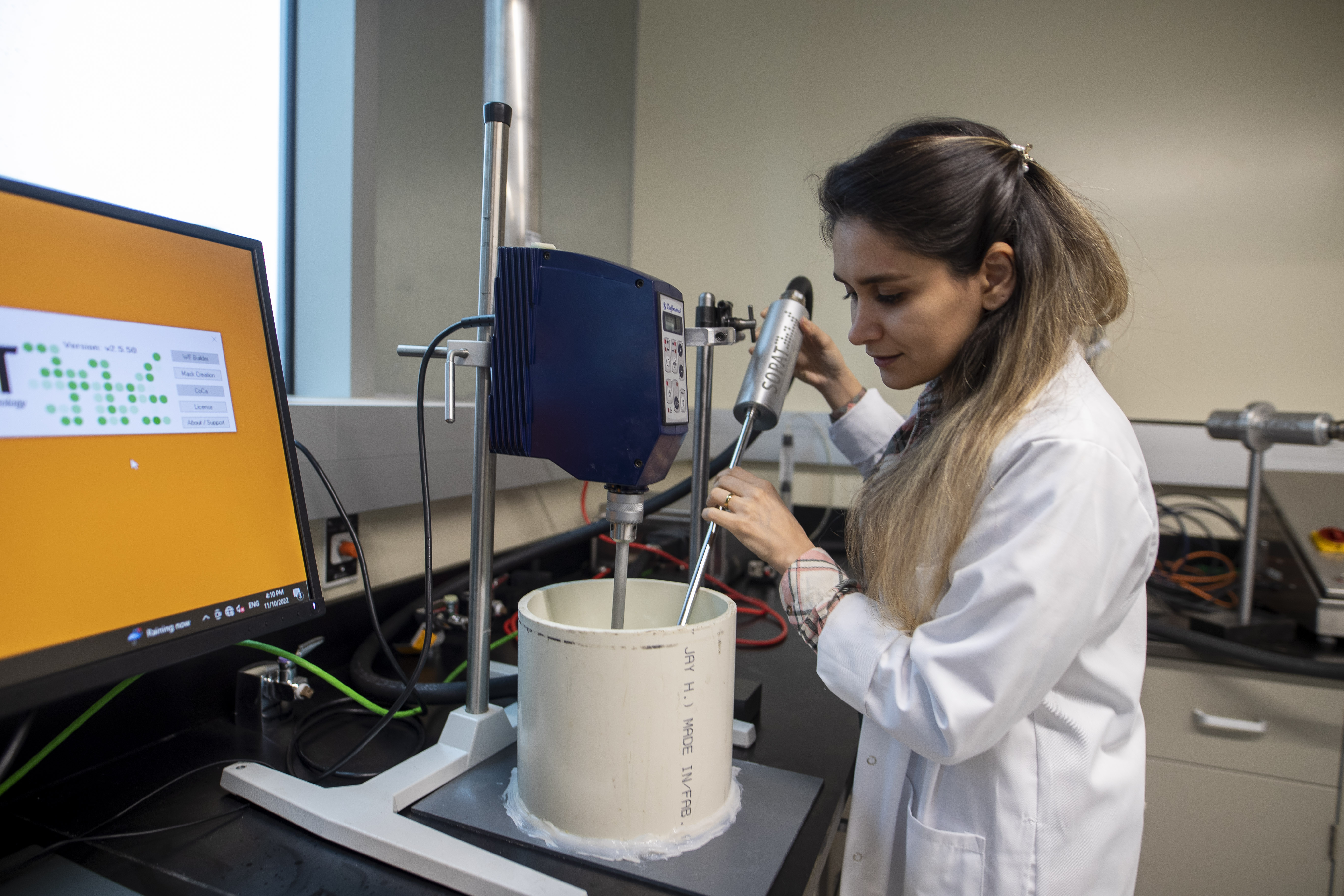
The experimental facility is equipped with advanced instrumentation, including electrical resistance tomography (ERT), mixing tanks with various impeller configurations, an oscillatory baffle column (OBC), a SOPAT particle analysis probe, and a next-generation pharmaceutical impactor (NGI). These capabilities are complemented by computational fluid dynamics (CFD) simulations using ANSYS Fluent and high-performance computing resources, enabling detailed analysis and validation of multiphase systems.
Research in the MFR Laboratory (Google Scholar) focuses on particle dynamics—bubbles, droplets, and solid particles—in complex fluids, with particular emphasis on particle size and distribution as key determinants of process efficiency. This integrated experimental and numerical approach has led to innovations in system design, including energy-efficient mixing technologies and advanced multiphase CFD models.
Building on this foundation, the lab has developed a strong focus on inhaled drug delivery and spray technology. By combining multiphase flow expertise with aerosol science, the laboratory investigates particle transport and deposition in respiratory systems using inhaler devices such as pressurized metered-dose inhalers (pMDIs) and soft mist inhalers (SMIs). Experimental validation and modeling efforts aim to enhance aerosol performance, improve drug delivery efficiency, and advance next-generation healthcare technologies.
In addition to its research contributions, the MFR Laboratory has played a significant role in training highly qualified personnel. Numerous undergraduate, master's, and PhD students have been trained in the lab and have gone on to work in academia and industry across Canada. The laboratory has also produced high-quality publications that contribute to the advancement of knowledge in multiphase flow and are widely applicable in sectors such as biochemical and pharmaceutical engineering.
Overall, the MFR Laboratory bridges fundamental fluid dynamics with practical applications across environmental, industrial, and biomedical engineering, with particular strength in multiphase systems and aerosol-based technologies.