


The Arts and a Cure for HIV
Published in The Chronicle Journal on February 20, 2026
By EMILY DONTSOS
In 2020, Dr. Pauline Sameshima received an unexpected email: A group of top HIV scientists based in the United States wanted her to join their research collaboration.
Called the HIV Obstruction by Programmed Epigenetics (HOPE) Collaboratory, the group was working on finding a cure for HIV using a novel approach.
Dr. Sameshima—professor and former Canada Research Chair in Arts Integrated Studies at Lakehead University—had never participated in HIV-related research. But the call represented the culmination of her work as a pioneer in the use of art, imagination, and creativity to transform learning and help people understand complex research outcomes.
“These brilliant scientists are leading the world in HIV research. They’re getting closer to a cure rooted in the ‘block-lock-stop’ approach, which aims to permanently control the virus by making it dormant and unable to reproduce,” says Dr. Sameshima.
“Treatment will likely be in the form of an injectable, so educating the public about what that means and where to access it is incredibly important.”
The HOPE Collaboratory scientists were drawn to the potential of Dr. Sameshima’s work to help them develop creative strategies for reaching people at risk of, and diagnosed with, HIV/AIDS. Rooted in a research model called Parallaxic Praxis, which Dr. Sameshima developed, her approach centres on the idea that sharing information from multiple perspectives and through multiple formats enables scientific outcomes to reach more people with greater results.
“The beautiful part about Parallaxic Praxis is that it takes into account the viewpoints of everyone involved in an issue—so the perspectives of people living with HIV are equally as important as the perspectives of the scientists developing the cure,” she says.
From Poetry to Dance and Beyond
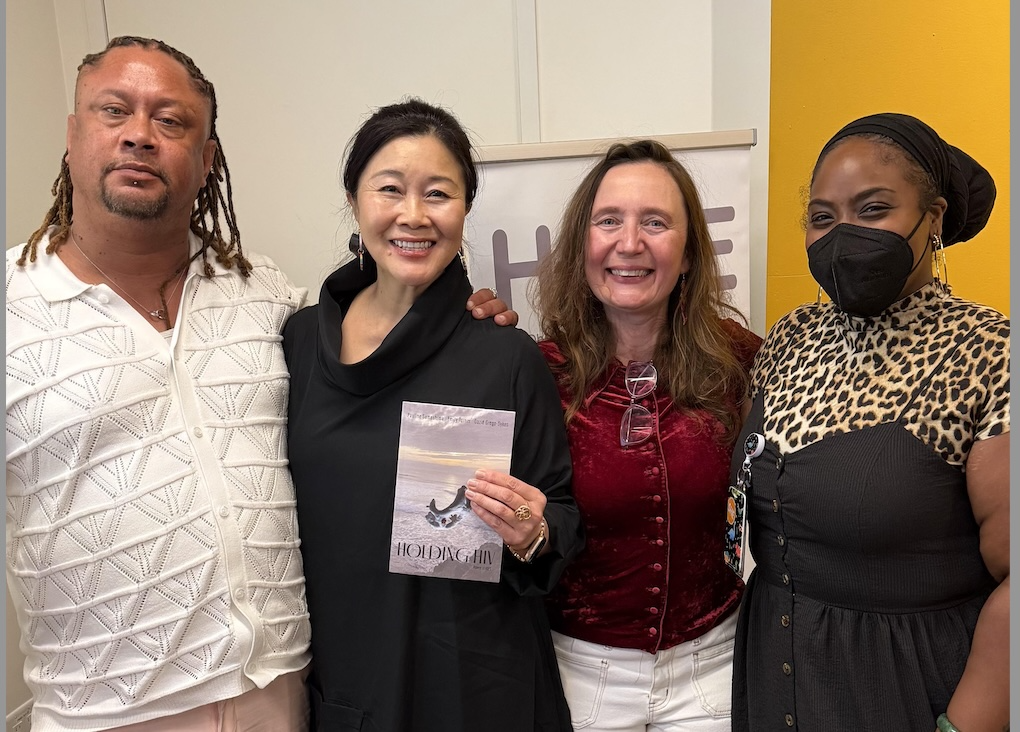
Members of the HOPE Collaboratory community at a book launch event for Holding HIV: Poems of HOPE in San Francisco. L to R: Dazié Grego, co-author, poet, performance artist, and HOPE Collaboratory community member; Dr. Pauline Sameshima, co-author, professor, HOPE Collaboratory Community Arts Integrated Research Lead; Dr. Patricia Defechereux, HOPE Collaboratory Community Engagement Coordinator; and Ebony Gordon, San Francisco AIDS Foundation HOPE Collaboratory liaison.
One of Dr. Sameshima’s major achievements in her work with the HOPE Collaboratory is the recent publication of Holding HIV: Poems of HOPE, a book of poetry exploring what a cure would mean for people living with HIV.
Each poem draws on the voices and perspectives of 27 community members in San Francisco who are living with or affected by HIV/AIDS.
Participants were asked to respond creatively to two questions: “What excites you about an HIV cure?” and “What are your fears regarding an HIV cure?” The result is a collection of raw, powerful insights that aim to build compassion, reduce stigma, and raise awareness about the necessity of a cure in the face of a volatile funding landscape for HIV research.
“We are really proud of this book, which is widely available to the public,” says Dr. Sameshima, who notes that 2,500 copies of the book are being freely shared. “It’s been a highlight of my career, bringing research together with art and community engagement in a way that gets ideas and data out into public spaces through creative avenues.”
Dr. Sameshima’s work extends beyond public education—she is also focused on shifting the perspectives of scientists themselves through the power of the arts.
During her work with the HOPE Collaboratory, Dr. Sameshima designed a dance activity that represented the ‘block-lock-stop’ approach to an HIV cure. All participants were part of the research team, and many were apprehensive about dancing.
“We used different strategies to help them feel more comfortable, which allowed them to see how this concept can be applied to public education around an HIV cure,” she says.
“For example, they now have a better understanding of the importance of offering treatment directly in communities where people living with HIV are already accessing services—places they feel comfortable, safe, and supported.”
Dr. Sameshima’s body of work advances a number of United Nations Sustainable Development Goals (SDGs), including #3: Good Health and Well-Being, #4: Quality Education, and #10: Reduced Inequalities.
A Champion of Imagination in Research
When she considers the long-term benefits of her work, Dr. Sameshima—who wrote her PhD thesis as a fictional novel to encourage more people to read it—says she hopes to demonstrate that imagination has a critical place in research.
“If we can imagine something, that’s the first step to making it a reality,” she says. “I want to support and champion the freedom and space to imagine, especially in the context of education and research.”
As a poet, writer, and artist in academia, she believes telling people’s stories in creative ways is crucial to building a more compassionate future.
“Everyone’s voice matters, and bringing those voices to the forefront offers important perspectives that uplift our lives and work—not just in the sciences, but in every sector of society.”
A book launch for Holding HIV: Poems of HOPE will take place during Lakehead’s Research and Innovation Week at Entershine Bookshop in Thunder Bay on February 24 at 7:00 pm. Dr. Sameshima is also curating an art exhibit during Research and Innovation Week from February 21 to 27. The Art Walk Tour will take place on February 24 at 4:00 pm in the CASES Building. Featuring works by community members from Lakehead, Thunder Bay, and beyond, the exhibit will showcase the power of creative practice to foster connections between people and communities.
Research in Action highlights the work of Lakehead University in various fields of research.