


Research in Action: Protecting Workers
A version of this article was originally posted in The Chronicle Journal on June 20, 2025
By EMILY DONTSOS

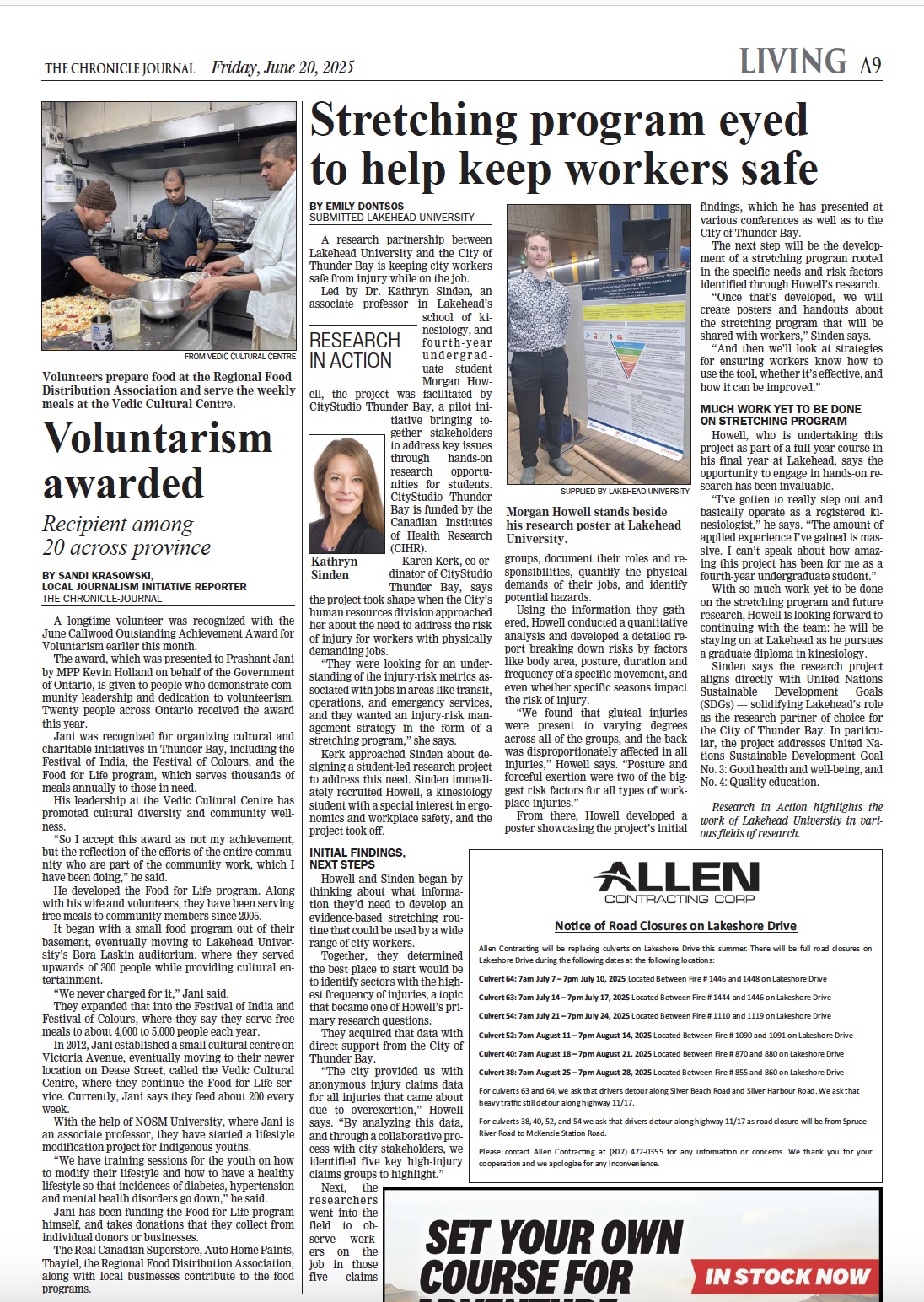
A unique research partnership between Lakehead University and the City of Thunder Bay is keeping city workers safe from injury while on the job.
Led by Dr. Kathryn Sinden, an associate professor in Lakehead’s School of Kinesiology, and fourth-year undergraduate student Morgan Howell, the project was facilitated by CityStudio Thunder Bay—an innovative pilot initiative bringing together multiple stakeholders to address key issues through hands-on research opportunities for students. CityStudio Thunder Bay is funded by the Canadian Institutes of Health Research (CIHR).
Karen Kerk, coordinator of CityStudio Thunder Bay, says the project took shape when the city’s Human Resources Division approached her about the need to address the risk of injury for workers with physically demanding jobs.
“They were looking for an understanding of the injury-risk metrics associated with jobs in areas like transit, operations, and emergency services, and they wanted an injury-risk management strategy in the form of a stretching program,” she says.
Kerk approached Dr. Sinden about designing a student-led research project to address this need. Dr. Sinden immediately recruited Howell, a kinesiology student with a special interest in ergonomics and workplace safety, and the project took off.
The Benefits of Stretching
Howell and Dr. Sinden began by thinking about what information they’d need to develop an evidence-based stretching routine that could be used by a wide range of city workers.
Together, they determined the best place to start would be to identify sectors with the highest frequency of injuries—a topic that became one of Howell’s primary research questions.
They acquired that data with direct support from the City of Thunder Bay.
“The city provided us with anonymous injury claims data for all injuries that came about due to overexertion,” says Howell. “By analyzing this data, and through a collaborative process with city stakeholders, we identified five key high injury claims groups to highlight.”
Next, the researchers went into the field to observe workers on the job in those five claims groups, document their roles and responsibilities, quantify the physical demands of their jobs, and identify potential hazards.
Using the information they gathered, Howell conducted a quantitative analysis and developed a detailed report breaking down risks by factors like body area, posture, duration and frequency of a specific movement, and even whether specific seasons impact the risk of injury.
“We found that gluteal injuries were present to varying degrees across all of the groups, and the back was disproportionately affected in all injuries,” Howell says. “Posture and forceful exertion were two of the biggest risk factors for all types of workplace injuries.”
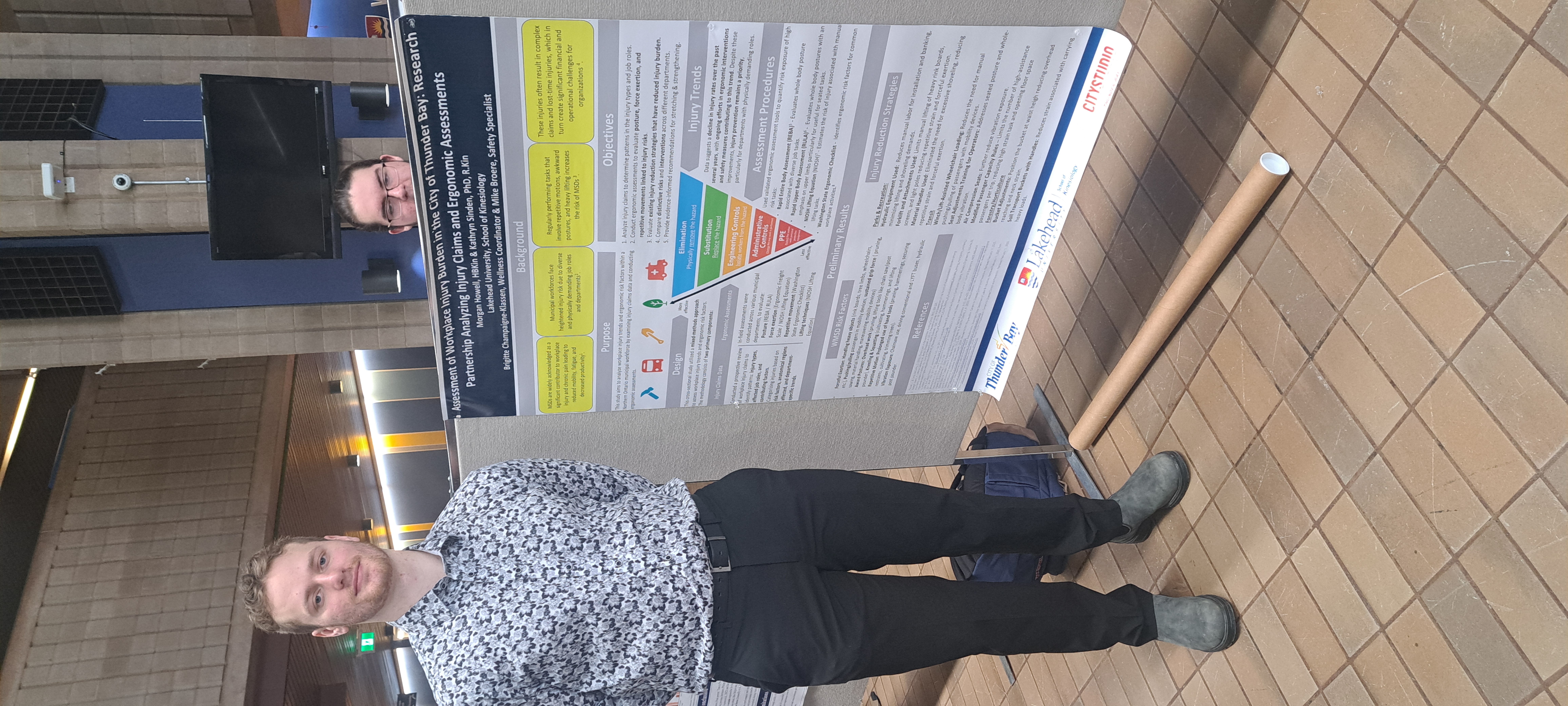 From there, Howell developed a poster showcasing the project’s initial findings, which he has presented at various conferences as well as to the City of Thunder Bay.
The next step will be the development of a stretching program rooted in the specific needs and risk factors identified through Howell’s research.
“Once that’s developed, we will create posters and handouts about the stretching program that will be shared with workers,” Dr. Sinden says. “And then we’ll look at strategies for ensuring workers know how to use the tool, whether it’s effective, and how it can be improved.”
An Invaluable Opportunity
Howell, who is undertaking this project as part of a full-year course in his final year at Lakehead, says the opportunity to engage in hands-on research has been invaluable.
“I’ve gotten to really step out and basically operate as a registered kinesiologist,” he says. “The amount of applied experience I’ve gained is massive. I can’t speak about how amazing this project has been for me as a fourth-year undergraduate student.”
With so much work yet to be done on the stretching program and future research, Howell is looking forward to continuing with the team: he will be staying on at Lakehead as he pursues a graduate diploma in kinesiology.
Dr. Sinden says the research project aligns directly with United Nations Sustainable Development Goals (SDGs)—solidifying Lakehead’s role as the research partner of choice for the City of Thunder Bay. In particular, the project addresses SDG #3: Good Health and Well-being and SDG #4: Quality Education.
Research in Action highlights the work of Lakehead University in various fields of research.