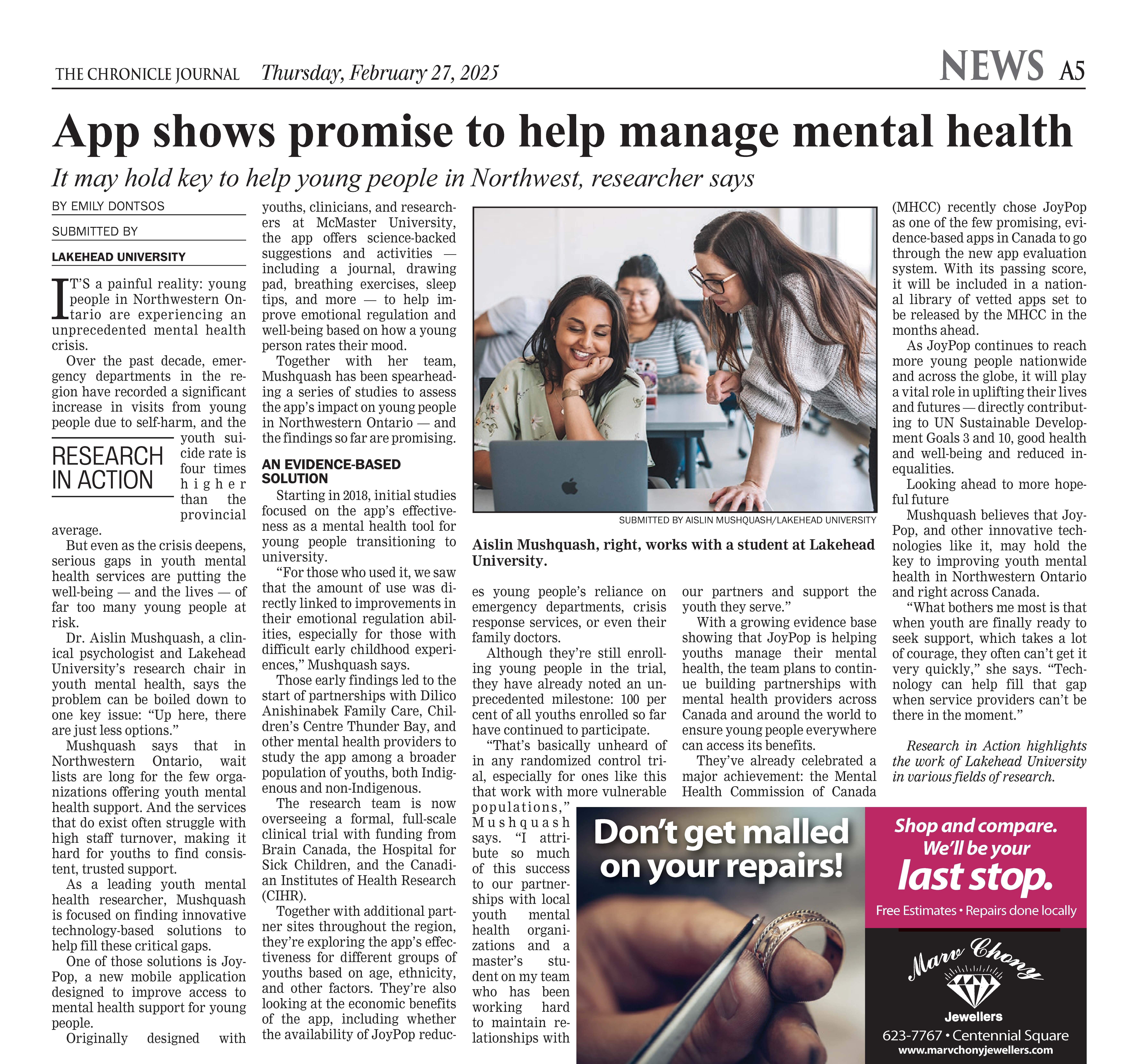



Research in Action - New app shows promise in addressing Northwestern Ontario’s youth mental health crisis
Originally posted in The Chronicle Journal on February 27, 2025.
By EMILY DONTSOS
It’s a painful reality: young people in Northwestern Ontario are experiencing an unprecedented mental health crisis.
Over the past decade, emergency departments in the region have recorded a significant increase in visits from young people due to self-harm, and the youth suicide rate is four times higher than the provincial average.
But even as the crisis deepens, serious gaps in youth mental health services are putting the well-being — and the lives — of far too many young people at risk.
 Dr. Aislin Mushquash, a clinical psychologist and Lakehead University’s Research Chair in Youth Mental Health, says the problem can be boiled down to one key issue: “Up here, there are just less options.”
Dr. Mushquash says that in Northwestern Ontario, wait lists are long for the few organizations offering youth mental health support. And the services that do exist often struggle with high staff turnover, making it hard for youth to find consistent, trusted support.
As a leading youth mental health researcher, Dr. Mushquash is focused on finding innovative technology-based solutions to help fill these critical gaps.
One of those solutions is JoyPop, a groundbreaking new mobile app designed to improve access to mental health support for young people.
Originally designed with youth, clinicians, and researchers at McMaster University, the app offers science-backed suggestions and activities — including a journal, drawing pad, breathing exercises, sleep tips, and more — to help improve emotional regulation and well-being based on how a young person rates their mood.
Together with her team, Dr. Mushquash has been spearheading a series of studies to assess the app’s impact on young people in Northwestern Ontario — and the findings so far are promising. 
An evidence-based solution
Starting in 2018, initial studies focused on the app’s effectiveness as a mental health tool for young people transitioning to university.
“For those who used it, we saw that the amount of use was directly linked to improvements in their emotional regulation abilities, especially for those with difficult early childhood experiences,” says Mushquash.
Those early findings led to the launch of partnerships with Dilico Anishinabek Family Care, Children’s Centre Thunder Bay, and other mental health providers to study the app among a broader population of youth, both Indigenous and non-Indigenous.
The research team is now overseeing a formal, full-scale clinical trial with funding from Brain Canada, the Hospital for Sick Children, and the Canadian Institutes of Health Research (CIHR).
Together with additional partner sites throughout the region, they’re exploring the app’s effectiveness for different groups of youth based on age, ethnicity, and other factors. They’re also looking at the economic benefits of the app, including whether the availability of JoyPop reduces young people’s reliance on emergency departments, crisis response services, or even their family physicians.
Although they’re still enrolling young people in the trial, they have already noted an unprecedented milestone: 100 percent of all youth enrolled so far have continued to participate.
“That’s basically unheard of in any randomized control trial, especially for ones like this that work with more vulnerable populations,” says Dr. Mushquash. “I attribute so much of this success to our partnerships with local youth mental health organizations and a master’s student on my team who has been working hard to maintain relationships with our partners and support the youth they serve.”
With a growing evidence base showing that JoyPop is helping youth manage their mental health, the team plans to continue building partnerships with mental health providers across Canada and around the world to ensure young people everywhere can access its benefits. 
They’ve already celebrated a major achievement: the Mental Health Commission of Canada (MHCC) recently chose JoyPop as one of the few promising, evidence-based apps in Canada to go through the new app evaluation system. With its passing score, it will be included in a national library of vetted apps set to be released by the MHCC in the months ahead.
As JoyPop continues to reach more young people nationwide and across the globe, it will play a vital role in uplifting their lives and futures — directly contributing to UN Sustainable Development Goals 3 and 10, good health and well-being and reduced inequalities.
Looking ahead to a more hopeful future
Ultimately, Dr. Mushquash believes that JoyPop, and other innovative technologies like it, may hold the key to improving youth mental health in Northwestern Ontario and right across Canada.
“What bothers me most is that when youth are finally ready to seek support, which takes a lot of courage, they often can’t get it very quickly,” she says. “Technology can help fill that gap when service providers can’t be there in the moment.”
Research in Action highlights the work of Lakehead University in various fields of research.