
Truth and Reconciliation

Jared Visitor Helps Indigenous Youth Find their Place and their Power

His Leadership is Building Bridges and Fostering Hope in the North

Lakehead student Jared Visitor has had many transformative moments in his life.

One of them was interviewing the trailblazing Indigenous leader, The Honourable Murray Sinclair.

The interview took place just months before the former Senator and Chief Commissioner of the Truth and Reconciliation Commission of Canada passed away in November 2024.

It was part of Jared's work with The Gord Downie & Chanie Wenjack Fund, which aims to foster reconciliation between Indigenous and non-Indigenous peoples. Chanie Wenjack was only twelve years old when he escaped from residential school in 1966 and died trying to walk 600 km back to his family. This tragedy sparked an investigation into Canada's residential school system.

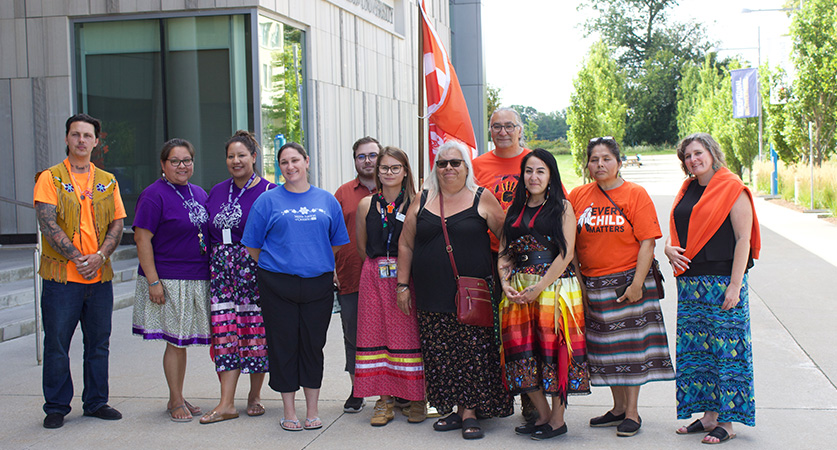
Jared Visitor on the grounds of Lakehead University's Sweat Lodge Site with Outland students in the distance

"Working with youth has set me on a good path and the right direction," Jared says. Above, Jared teaches experimental archaeology to high school students in the Outland Youth Employment Program.

Jared came away from his encounter with The Honourable Murray Sinclair with a deeper knowledge of himself.

"He gifted me with advice and new perspectives to consider," Jared says. "During our conversation, he told me that my spirit name, Rainbow, may mean that my role in life is to bring people together. He said that each colour of the rainbow is distinct and unique, but that these colours merge at the ends."

A Winding Journey

Jared, a member of Sachigo Lake First Nation and a great-nephew of Chanie Wenjack, grew up in Moose Factory, Ontario, and Thunder Bay before his family moved to Pickle Lake, Ontario.

Education is not just desks and fluorescent lights. Learning happens everywhere—in the forest, in your backyard, and with your friends.

It was in Pickle Lake, at the age of 15, that Jared was hired to work for a Ministry of Natural Resources fire base, getting supplies ready for firefighters. When he was 18, Jared became a firefighter himself.

"I thought that firefighting was a waste of time in terms of figuring out my career path, but it taught me a lot," Jared says.

Jared Visitor seated in a living room getting ready to play a drum

Jared has given back to the community in many ways, including volunteering with The New Hope Youth Centre and Urban Abbey. "When I work with youth, I always try to help them figure out what makes them feel alive. For me, that's music."

In the firefighting off-season, Jared began working one-on-one with special education students.

"I had a job as the custodian at the Moose Factory Academy of Christian Education, but I began filling in as an education assistant because they were short-staffed."

The experience made Jared realize that education was his calling. Working as an education assistant at Joy Ottereyes Rainbow Memorial School in Quebec only confirmed this insight.

For Jared, education is deeply intertwined with Truth and Reconciliation.

"We have to reconcile with ourselves, our families, and our communities," he says. "Once you reconcile these relationships, then you can begin reconciling between different peoples—education is integral to this process."

A Leader on the Rise

Jared enrolled in Lakehead's Honours Bachelor of Arts in Psychology and Bachelor of Education concurrent program in 2021.

On campus, he found work as a Department of Anthropology lab assistant and as a mentor with the Niijii Indigenous Mentorship Program. Niijii provides educational programming to Indigenous youth throughout northwestern Ontario and gives them the confidence to consider postsecondary education.
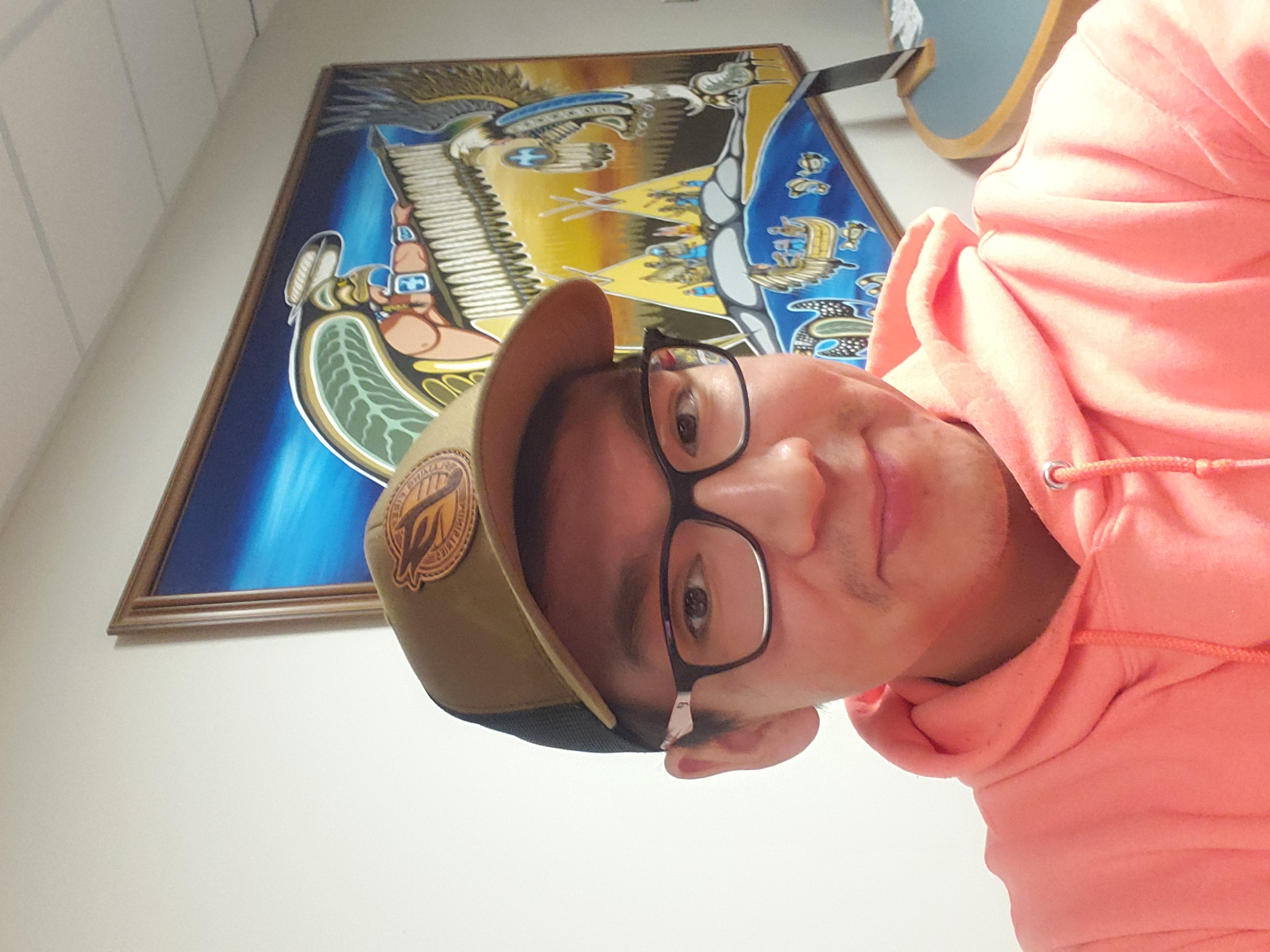
Jared Visitor stands in front of a Woodland Style painting

"My parents' instilled their love of education in me," Jared says. "As a kid, I remember riding the bus with my mom to Lakehead's Thunder Bay campus where she was studying for her education degree."

Jared is now Niijii's outreach coordinator, something that surprises him. "I used to be very shy and walled off, but young people helped heal me. That's why I want to see them fly as much as I can."

Part of helping them fly has meant shifting his career goals. "I planned to be a teacher and then a special education coordinator. Now, I want to change the minds of people who dictate what education is.

Education is not just desks and fluorescent lights. Learning happens everywhere—in the forest, in your backyard, and with your friends."

Click here to watch Jared's 2024 interview with the Honourable Murray Sinclair.
 

Tashie Broadbent Harnesses the Power of Art to Heal

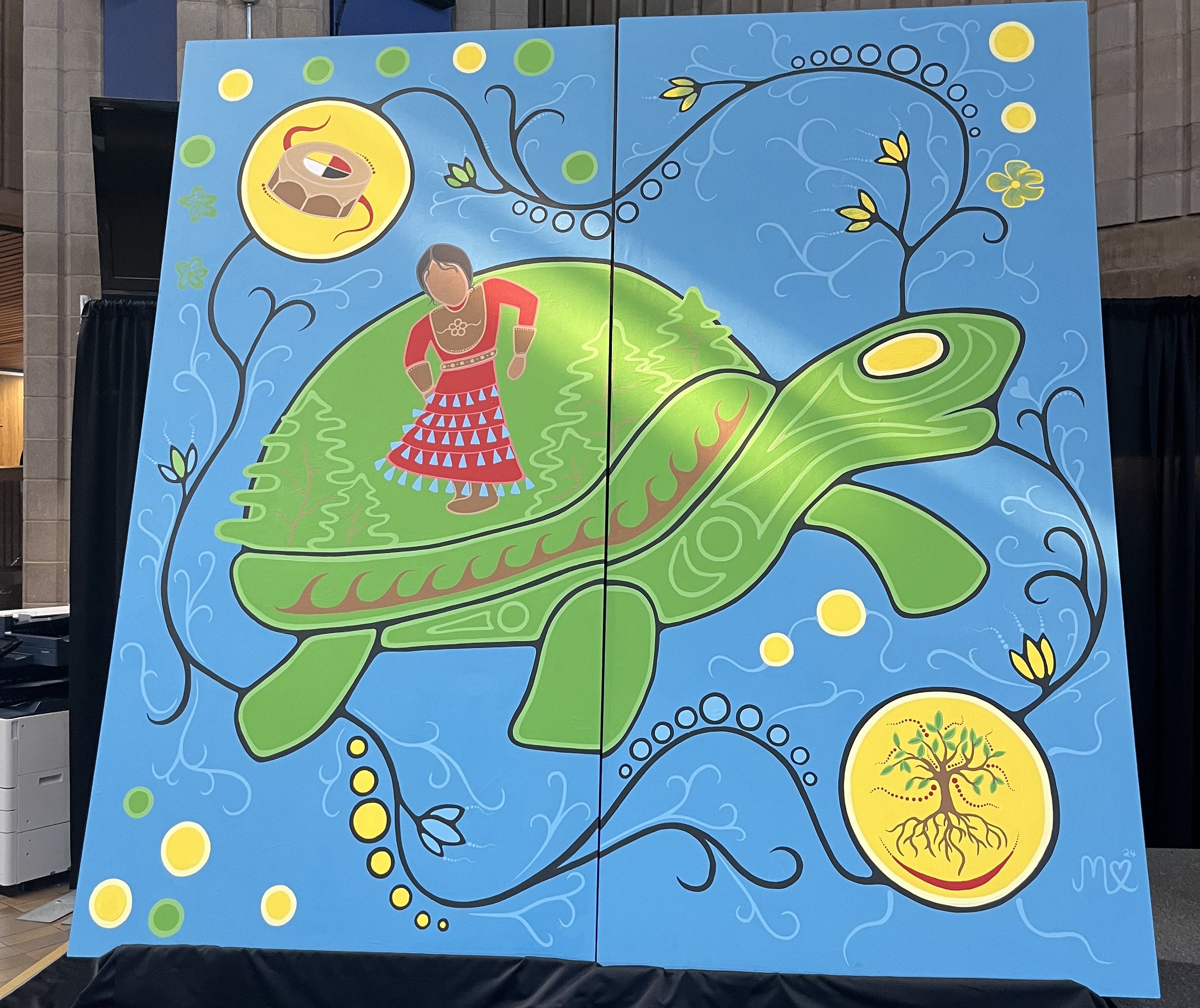
Northwestern Ontario community members made the decision to be part of Canada's journey to reconciliation by creating the stunning painting Maamawi, which now hangs in the Agora on the Thunder Bay campus.

"Maamawi refers to the action of coming together," says Tashie Broadbent, an Anishinaabekwe artist and Lakehead visual arts student who led this powerful community-based art project in September 2024.

Maamawi painting featuring a turtle and a jingle dress dancer

Lakehead's Office of Indigenous Initiatives reached out to Tashie about leading this unique art project. "Maamawi was a community effort," Tashie says, "and the process of creating the piece was the main point. I'm very grateful that I got to be the carrier of the community's ideas."

Reconciliation has a strong personal resonance for Tashie.

"My father is a Sixties Scoop survivor who began searching for his mother as an adult," Tashie says. After finding her, Tashie's family moved from London, Ontario, to his home community of Manitou Rapids in northwestern Ontario where his mother was living. "This allowed me to absorb cultural influences, especially at powwows," Tashie says. It was in Manitou Rapids that she became familiar with the Woodland style of art that was used to create Maamawi.

"Woodland art employs bold lines, colours, and symbolism to illustrate Indigenous stories and teachings that I take inspiration from," Tashie explains. "There are times when Indigenous knowledge and perspectives should be at the forefront and, for this initiative, painting in the Woodland style made sense."

The Maamawi project was open to the general public, and more than 40 people took part in a brainstorming session to conceptualize the artwork and to talk about how they were fostering reconciliation. Along with community members, grade 7 and grade 8 students from Bishop EQ Jennings school, Lakehead University Indigenous Transition Year students, and Lakehead University Indigenous Learning students engaged in the artistic process.

"The imagery I chose to symbolize reconciliation—and to design the sketch that formed the basis of the painting—came from the participants' thoughts and intentions," Tashie says. "Many of the Indigenous participants said they were advancing reconciliation through practices like singing and dancing to keep their culture alive. Many of the settler participants said it was by educating themselves about the injustices faced by Indigenous Peoples in Canada and by acknowledging the damage this has caused. This is the significance of the turtle in the artwork—in the Anishinaabe Seven Grandfather teachings, the turtle is an embodiment of both the truth and the land. The jingle dress dancer that appears on the turtle is dancing to heal the land and its inhabitants."

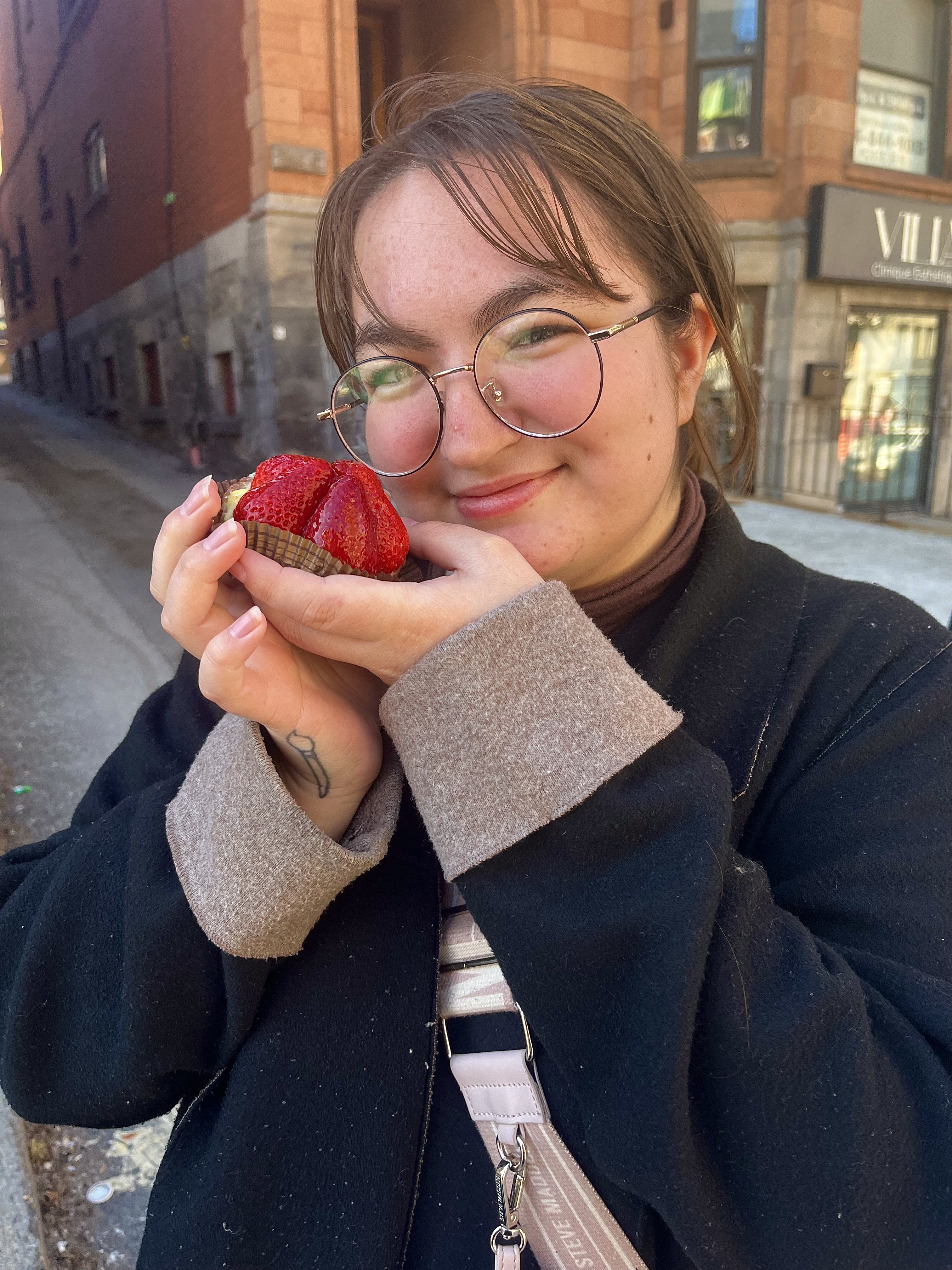
Tashie Broadbent holds a strawberry tart in front of a building

Tashie has loved art since she was a child, but she only began thinking of it as a vocation after her parents began reconnecting with their culture. "My mom motivated me to pursue visual arts and she's given me little lessons over the years about my connection to art."

In the painting's upper left corner, a circle containing a drum represents the Indigenous community, which is joined by a line of connection to a circle in the bottom right corner containing a tree. "The tree represents the settler community and the learning and growth that's transforming it. The line of connection is wavy to signify the detours that reconciliation will take."

The actual painting process, guided by Tashie, happened in a second session. Afterward, Tashie worked nonstop to fix up the line work and the details in the circles and the turtle's shell, not finishing until the night before the artwork's unveiling. She was incredibly nervous about whether people would like it, but she arrived at the ceremony to find her family, friends, and professors there to support her. "It was so special to have people I look up to congratulating me," she says.

Tashie believes that projects like hers are important to reconciliation because "art is medicine and art can bridge cultures. Maamawi wouldn't have come together without people coming together."

Meet Tashie and get a behind-the-scenes look at the making of Maamawi.

Survivors’ Flag flies at Orillia Campus

Lakehead Orillia raises Survivors' Flag

September 5, 2023 – Orillia, Ont.

An important symbol of remembrance, honour and action was raised at Lakehead University’s Orillia Campus on Tuesday.

After beginning the gathering in a good way, Dr. Linda Rodenburg, Interim Principal of Lakehead Orillia, alongside Dr. Cynthia Wesley Esquimaux, Chair on Truth and Reconciliation, and Brandon Rhéal Amyot, Vice President Lakehead University Student Union, raised the National Centre for Truth and Reconciliation (NCTR) Survivors’ Flag outside the campus’s Simcoe Hall.

For Dr. Rodenburg, who purposefully walks the Orillia Campus’s pathway to reconciliation each day, symbols like the Survivors’ Flag are a daily reminder of the commitment she makes to the reconciliation process and the Indigenous community.

“On this day, it’s particularly important that we recognize as a whole community that reconciliation is important work to do, particularly as allies with our Indigenous communities. As Survivors, their children and grandchildren are walking pathways to healing, we are walking alongside them on our path to truth and knowledge.”

“It’s a time for new beginnings and deep reflection for everyone,” said Dr. Wesley-Esquimaux, stating that individuals across the country need to be engaged in this conversation, not just Indigenous Peoples.

“The youth who join us today do so in a good way with choices, futures, the support of their peers, faculty and families. You’ve been given opportunities that a lot of our Indigenous children never got to have because they had to work hard just to survive. That’s why we’re commemorating this day and that’s why we’re talking about it.”

Raising the Survivors’ Flag is part of a shared commitment and obligation to enact and participate in reconciliation as a journey.

“Lakehead University recognizes the importance of education in the act of reconciliation; we’ve collaborated across multiple Nations and communities to engage in reconciliation,” said Denise Baxter, Vice-Provost, Indigenous Initiatives. “Though we work on this all year, September is a time to recognize efforts throughout the year and to recommit to collaborating with communities and nations on pathways forward.”

Learning and commemorating the truth of Canada’s history is an important part of the path to reconciliation. Lakehead will be holding learning opportunities on truth and reconciliation leading up to the National Day for Truth and Reconciliation on September 30. Members of the public are welcome to attend.

Elder Tipi Talk and TRC Calls to Action
Wednesday, Sept. 27
10 a.m. to 12:30 p.m.
Tipi (behind Simcoe Hall)

“Are universities meeting the challenge of reconciliation”: A Conversation with Cynthia Wesley-Esquimaux
Thursday, Sept. 28
12 to 1 p.m.
Via Zoom
Register at: https://lakeheadu.zoom.us/meeting/register/tJMtd--trjIsHdKr1bEuEQnQfsWJr-2CKc68#/registration

Lakehead has long been a leader when it comes to educating students about Indigenous issues and Canada’s past, launching the first Indigenous Content Requirement in 2016, and creating the first Indigenous Chair on Truth and Reconciliation in Canada in 2016.

-30-

Media: For more information or interviews, please contact Jaclyn Bucik, Media, Communications and Marketing Associate, at 705-330-4010 ext. 2014 or mediarelations@lakeheadu.ca.


Lakehead University is a fully comprehensive university with approximately 9,700 full-time equivalent students and over 2,000 faculty and staff at two campuses in Orillia and Thunder Bay, Ontario. Lakehead has nine faculties, including Business Administration, Education, Engineering, Graduate Studies, Health & Behavioural Sciences, Law, Natural Resources Management, Science & Environmental Studies, and Social Sciences & Humanities. Lakehead University’s achievements have been recognized nationally and internationally, including being ranked in the top half of Times Higher Education's 2023 World Universities Rankings for the fourth consecutive year, and the number one university in the world with fewer than 9,000 students in THE’s 2023 Impact Rankings (which assesses institutions against the United Nations’ 17 Sustainable Development Goals). Visit www.lakeheadu.ca.

Lakehead University continuing dialogue on residential schools

July 14, 2021 – Orillia, Ont.

The recent discoveries of missing children and unmarked graves have brought a tragic history to our collective doors. On Monday, July 19 at 8 p.m. Lakehead University will be hosting “When History Hurts: A Community Dialogue” a free, live online event that will continue the conversation about residential schools, the story of Indigenous-Settler relations, and the role each of us can play in truth and reconciliation.

Join Dr. Linda Rodenburg, Director of Community Engagement and Lifelong Learning, in conversation with Chief Ted Williams and Councillor Lorraine McRae from Chippewas of Rama First Nation; Jesse Boiteau, Senior Archivist at the National Centre for Truth and Reconciliation; and Dr. Cynthia Wesley-Esquimaux, Chair on Truth and Reconciliation at Lakehead University.

This discussion is for anyone who wants to begin having these culturally safe conversations.

When History Hurts: A Community Dialogue
Date: Monday, July 19, 2021
Time: 8 p.m.
Live on Zoom

Register today at www.lakeheadu.ca/about/orillia-campus/community-programs/when-history-hurts.

-30-

Media:  For further information or to arrange an interview, contact Jaclyn Bucik, Media, Communications & Marketing Associate, at 705-330-4010 ext. 2014 or  jbucik@lakeheadu.ca

Lakehead University is a fully comprehensive university with approximately 9,700 full-time equivalent students and over 2,000 faculty and staff at two campuses in Orillia and Thunder Bay, Ontario. Lakehead has 10 faculties, including Business Administration, Education, Engineering, Graduate Studies, Health & Behavioural Sciences, Law, Natural Resources Management, the Northern Ontario School of Medicine, Science & Environmental Studies, and Social Sciences & Humanities. Lakehead University’s achievements have been recognized nationally and internationally, including being ranked, once again, among Canada’s Top 10 primarily undergraduate universities in Maclean’s 2021 University Rankings; as well as included in the top half of Times Higher Education's 2020 World Universities Rankings for the second consecutive year, and 99th among 1,115 universities from around the world in THE's 2021 Impact Rankings (which assesses institutions against the United Nations’ 17 Sustainable Development Goals). Visit www.lakeheadu.ca.

When History Hurts: A Community Dialogue Hosted by Lakehead University
Subscribe to Truth and Reconciliation