

Indigenous Youth

Thunder Bay Researcher Co-Leads $10.8M National Project to Improve Indigenous Youth Mental Health

Thunder Bay, Ont. – A national initiative to improve Indigenous youth mental health, co-led by local researcher Dr. Chris Mushquash, has secured an additional $10.8 million from the Canadian Institutes of Health Research (CIHR).

Chris MushquashDr. Mushquash, Canada Research Chair in Indigenous Mental Health and Addiction; Professor in the Department of Psychology at Lakehead University; Vice President Research at Thunder Bay Regional Health Sciences Centre; and Chief Scientist at Thunder Bay Regional Health Research Institute, and Dr. Srividya Iyer, Tier 1 Canada Research Chair in Youth, Mental Health, and Learning Health Systems and Professor in the Department of Psychiatry at McGill University, are co-leading the four-year project focused on building a trust-based learning network across Canada to support culturally-grounded mental health services for Indigenous youth.

Indigenous youth in Canada face significant mental health challenges, such as intergenerational trauma, cultural disconnect, increased poverty, and limited access to health services, often due to geographic location and systemic barriers. Despite these challenges, Indigenous youth have strong connections to culture, community, and land, which are powerful protective factors that promote well-being.

As part of the ACCESS Open Minds Indigenous Youth Mental Health and Wellness Network, this initiative will strengthen capacity amongst Indigenous communities and integrated youth services (IYS) networks to deliver inclusive, high-quality, culturally and contextually relevant, and responsive mental health services with, and for, Indigenous youth. The project is guided by the strength of multigenerational teaching and brings together Elders, Knowledge Holders, youth, families, and community leaders, including Dilico Anishinabek Family Care, who serve 13 First Nations across northwest Ontario.

“This is an incredible opportunity for our network to help close critical gaps by cultivating a trust-based, collaborative learning environment across Canada,” said Dr. Mushquash. “With this investment, we can translate knowledge into real-life improvements for Indigenous youth, ensuring that services are more culturally grounded, accessible, and responsive to community needs. Being able to co-lead this work from northwestern Ontario, and specifically Thunder Bay, is deeply significant, as it reflects both the challenges and strengths of the communities we serve.”

The project will utilize various forms of data, including stories, lived experiences, cultural teachings, and images, to guide and strengthen its work. Its goals are to build community capacity, nurture the next generation of Indigenous and allied leaders, and weave Indigenous knowledge systems into service delivery. The interdisciplinary research team also aims to advance approaches rooted in Indigenous worldviews and values. Through these efforts, the network will help empower Indigenous communities and support partner organizations in delivering high-quality, culturally grounded care, while fostering sustainable development and ongoing learning.

"Lakehead University is committed to serving the communities we are proud to be part of, and that includes driving progress through research to improve health outcomes for Indigenous youth here in northwestern Ontario and across Canada,” said Dr. Langis Roy, Vice-President, Research and Innovation at Lakehead University. “This project demonstrates the vital role universities play in advancing knowledge, fostering innovation, and partnering with communities to create meaningful, lasting change in society.”

The Government of Canada, through CIHR and Indigenous Services Canada, and its partners, the Graham Boeckh Foundation (GBF) and Bell-GBF Partnership, is investing more than $30 million over four years in the Integrated Youth Services Network of Networks (IYS-Net) to strengthen and expand research across Canada. An innovative approach to youth-focused mental health, IYS provides youth with equitable access to a range of services and supports that contribute to health. This includes mental health and substance use services, alongside primary care, peer support, work and study supports, and more.
Lakehead University launches tuition waiver for youth in care

November 26, 2021 – Orillia, Ont.

Lakehead University has introduced a new tuition waiver that will reduce barriers to postsecondary education for individuals in the foster care system.

Announced today in collaboration with the Child Welfare Political Action Committee (Child Welfare PAC), the Youth in Care Tuition Waiver will support the full cost of tuition and affiliated program fees for current and former youth in care working toward an undergraduate degree at Lakehead University.

Starting in September 2022, the Youth in Care Tuition Waiver will be available to students of any age pursuing their first postsecondary credential at Lakehead University. In its first year the program will support two full-time students – one at the Thunder Bay campus and one at the Orillia campus – gradually increasing to a maximum of eight students annually. The program will accept applications from current and incoming high-school graduates and mature students who are currently or were formerly in the foster care system in Simcoe County or Northwestern Ontario for at least one year. The bursary will be renewable for up to four years.

“Youth who have experienced the child welfare system are uniquely vulnerable and require specifically tailored support mechanisms to realize success within structures of higher learning,” said Child Welfare PAC Canada President Ingrid Palmer. “By adopting a relevant and responsive pathway to accessible postsecondary education, Lakehead University will also nurture upward social and economic mobility for those who have already endured undue hardship. Thank you, Lakehead, for opening up equitable access to postsecondary education in the North!”

“All Ontarians deserve access to a postsecondary education experience and a higher education system that embraces accessibility and inclusivity and promotes success,” said Jill Dunlop, Minister of Colleges and Universities. “This is a key government priority because we know learners need the opportunity to get the training required for good jobs and because diverse representation in education and the workplace is integral to building a stronger and more innovative province and economy.”

Ensuring that students have the opportunity to access education regardless of their circumstance is one of the reasons why the Higher Education Quality Council of Ontario has referred to Lakehead University as an equity of access powerhouse, explained Dr. Moira McPherson, President and Vice-Chancellor of Lakehead University.

“The launch of Lakehead’s Youth in Care Tuition Waiver is in keeping with our strategic priorities to provide access to a transformative university experience grounded in exceptional scholarship and student potential,” she said.

It also aligns with the University’s commitment to serving and removing barriers to education for underrepresented students in Simcoe County and Northwestern Ontario. In addition to the tuition waiver, Lakehead University also offers the Gateway Program and Indigenous Transition Year Program to help students from underrepresented groups and students who don’t meet traditional admission requirements access a university-level education.

“We want our students to succeed and feel supported during their time at Lakehead,” explained Andrea Tarsitano, Vice-Provost (Students) and Registrar. “This tuition waiver is just an extension of the wraparound supports and individualized services that Lakehead already provides to our students to help them navigate the transition to university and support them throughout their education.”

More information on the Youth in Care Tuition Waiver can be found at www.lakeheadu.ca/studentcentral/financing-budgeting/yic_waiver.

-30-

Media: Jaclyn Bucik, Media, Communications & Marketing Associate, at 705-330-4010 ext. 2014 or mediarelations@lakeheadu.ca

Lakehead University is a fully comprehensive university with approximately 9,700 full-time equivalent students and over 2,000 faculty and staff at two campuses in Orillia and Thunder Bay, Ontario. Lakehead has 10 faculties, including Business Administration, Education, Engineering, Graduate Studies, Health & Behavioural Sciences, Law, Natural Resources Management, the Northern Ontario School of Medicine, Science & Environmental Studies, and Social Sciences & Humanities. Lakehead University’s achievements have been recognized nationally and internationally, including being ranked, once again, among Canada’s Top 10 primarily undergraduate universities in Maclean’s 2022University Rankings; as well as included in the top half of Times Higher Education's 2021 World Universities Rankings for the second consecutive year, and 99th among 1,115 universities from around the world in THE's 2021 Impact Rankings (which assesses institutions against the United Nations’ 17 Sustainable Development Goals). Visit www.lakeheadu.ca.

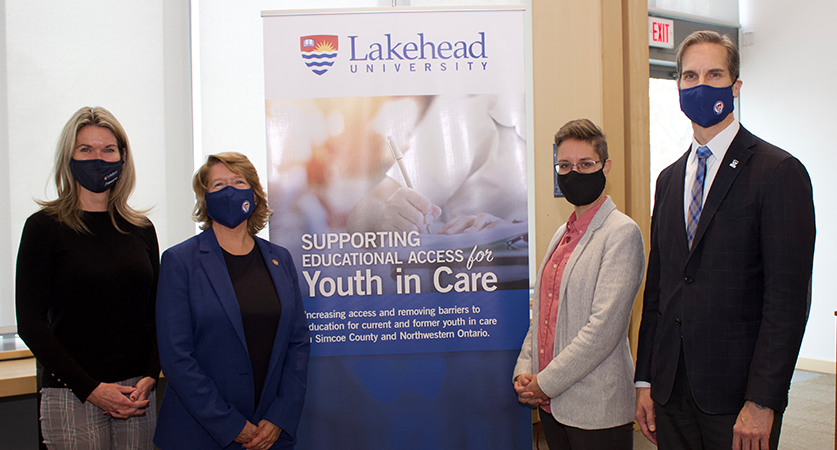
Minister Jill Dunlop Dr. Moira McPherson Dr. Renee Ferguson and Dr. Dean Jobin-Bevans stand in front of a banner supporting youth in care

Outland Youth Employment Program (OYEP) stops by the Department of Biology for Water Quality Assessment Activities

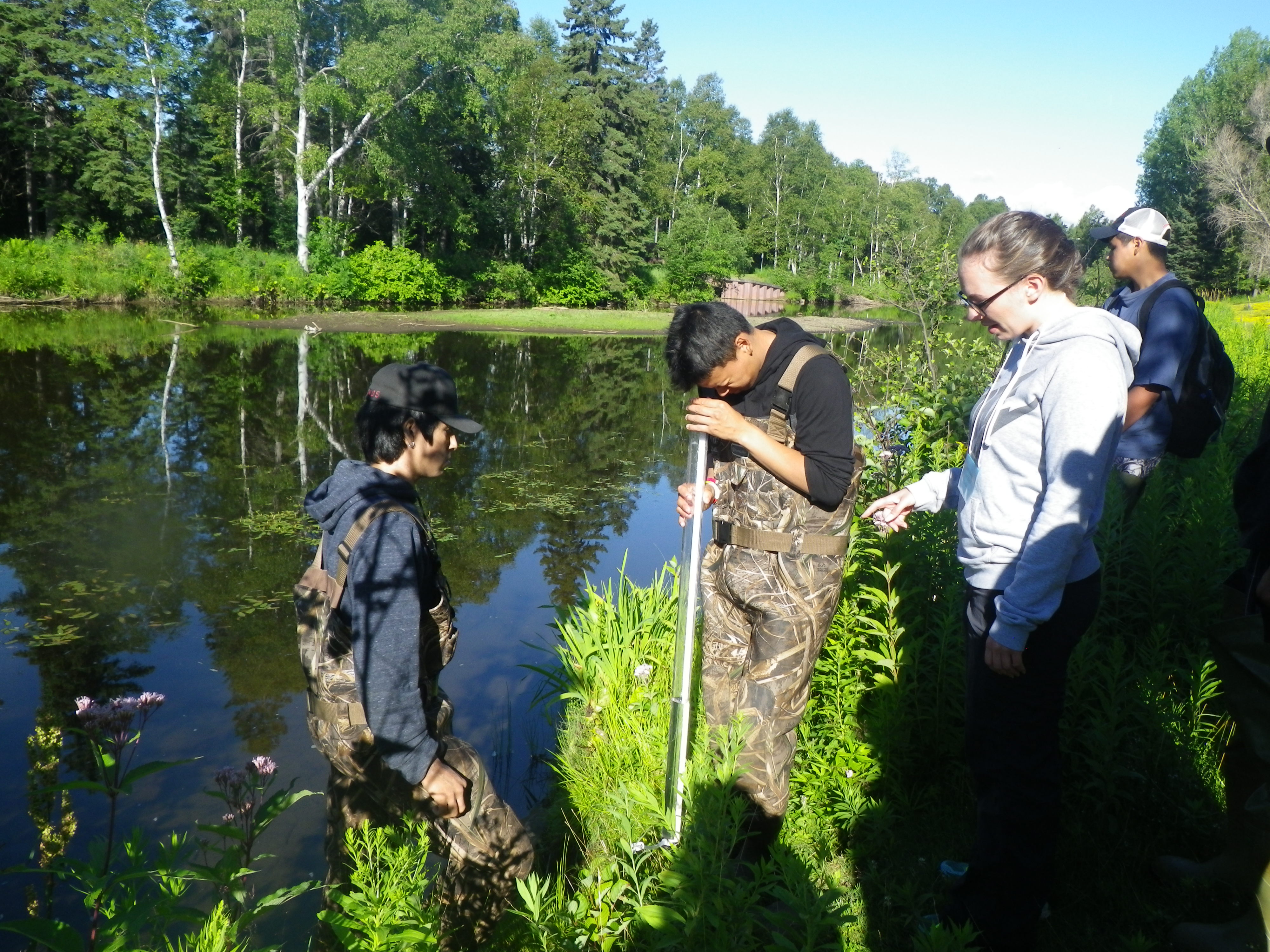
On the morning of August 2nd, Indigenous youth participating in the Mink Lake/Sandbar Outland Program stopped by the Department of Biology to learn some common techniques for assessing water quality.  Lead by the department's newest technician, Kristi Dysievick, youth measured water clarity and temperature before collecting water and benthic samples from Lake Tamblyn and the McIntyre River.

Youth brought their samples back to the lab where they identified invertebrates found in the sediment, some of which were determined to be invasive to our river system.  For water quality, students used probes and colourimetric kits to measure pH, colour, nitrate, and dissolved oxygen.

Biology Technicians Daniel Brazeau and Susanne Walford provided additional assistance.  Special thanks to Aquatic Ecologist/Benthic Taxonomist Nancy Serediak (Streamline Consulting) for volunteering her expertise and assistance with this activity.


Subscribe to Indigenous Youth