



Lakehead and Hydro One are Building a Flourishing Future for Ontario’s Power System
Hydro One and the Faculty of Natural Resources Management (NRM) are embarking on a first-of-its-kind partnership to build a more resilient power system for people across Ontario through transformative research into vegetation management.
As Ontario’s largest electricity transmission and distribution service provider, Hydro One manages over 33,000 kilometres of transmission lines provincewide. These lines are located above power corridors—strips of land that must be kept clear of tall-growing trees and vegetation to reduce the risk of power supply disruption and wildfires.
Hydro One has long been a leader in the targeted use of herbicides for vegetation management, an environmentally conscious approach that enables low-growing vegetation to thrive. But the company is constantly seeking new and innovative ways of applying herbicides to achieve the same outcomes with less product.
That’s why Hydro One’s forestry division decided to undertake its first formal research collaboration, choosing Lakehead’s Faculty of Natural Resources Management as its partner.
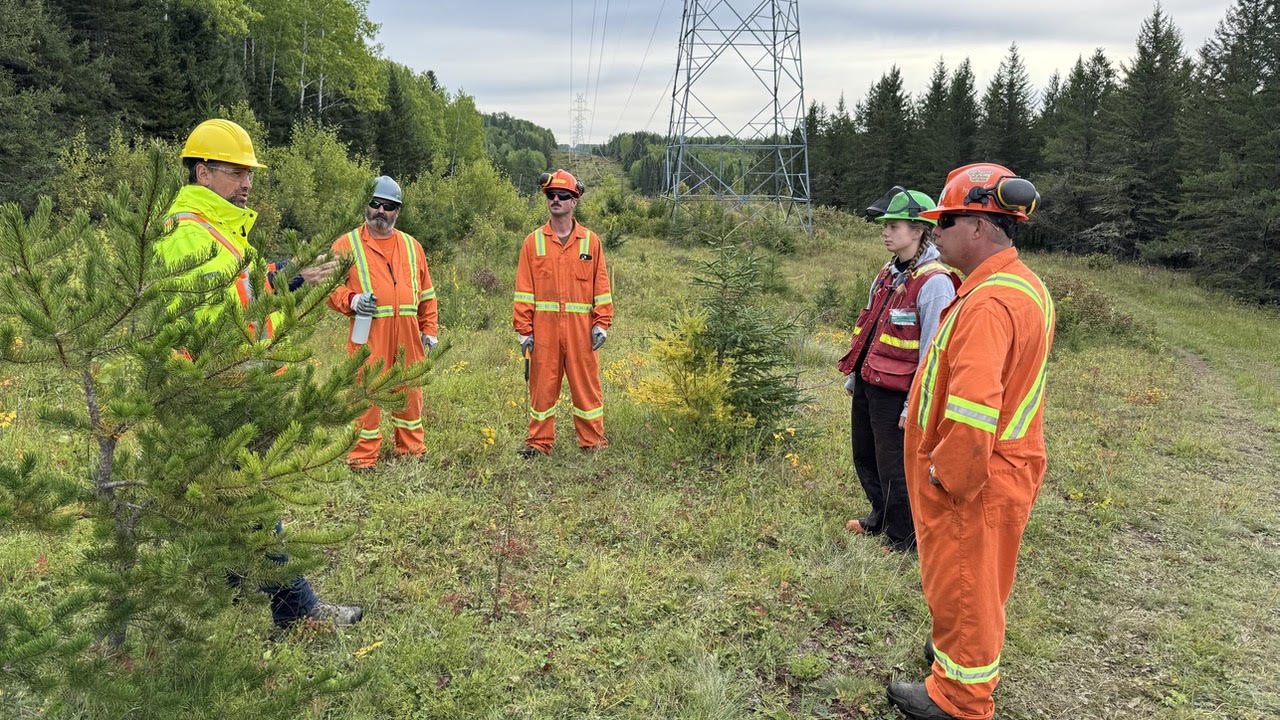
Assistant Professor Dzhamal Amishev (yellow helmet), MSc student Caitlin Stewart (green helmet), and Hydro One staff discuss the herbicide plan along the power transmission corridor in Thunder Bay.
“We spoke to multiple schools, but we chose Lakehead because of the NRM faculty’s expertise and operational on-the-ground forestry-management experience across Ontario’s diverse forest regions,” says Anthony Shi, the Hydro One Forestry program manager who initiated the project. “Their academically rigorous work will allow us to stand behind the research as we make important decisions about evolving our practices.”
Together with researchers and staff from Hydro One, the Lakehead team —including NRM dean, professor of remote sensing, and principal investigator Dr. Brigitte Leblon and co-investigators Dr. Dzhamal Amishev and Dr. Seung-Il Lee—is testing different methods of applying herbicides in two forested regions of Ontario.
They are also leveraging this research opportunity to explore new ways of assessing the effectiveness of each method and how these methods will affect pollinator populations.
Three Lines of Inquiry
Each member of the Lakehead’s research team is leading a different aspect of the project, which is funded by a major grant from the Natural Sciences and Engineering Research Council of Canada (NSERC) and Hydro One.
Dr. Leblon is using aerial imagery and deep-learning methods to detect and assess tree mortality in power corridors before and after herbicide treatment—an innovative approach which will help the research team understand the effectiveness of each treatment method at scale. Her work assessing fuel moisture from radar images will also be used to inform forest-management practices focused on reducing the risk of wildfires in powerline corridors.
“Vegetation in these corridors is difficult to monitor because of the lines, and climate change makes power corridor vegetation more prone to fire. New methods need to be developed for monitoring both fire hazards and vegetation growth,” Dr. Leblon says.
Meanwhile, Dr. Amishev—a forestry professional and assistant professor in forest management and operations—is comparing the effectiveness of several different approaches to highly targeted herbicide application, including methods that reduce the amount of active chemical ingredients required.
Jonathan Marriott (HBSc’06), senior manager of forestry business and innovation at Hydro One and a Lakehead alumnus, says Dr. Amishev’s work aims to identify new methods that can be used at scale across Hydro One’s network.
“If we don’t perform this research, we’ll never know if there are better approaches out there that achieve the same outcome while drastically reducing the amount of chemicals being used,” he says.
And Dr. Lee, whose research focuses on how insects respond to different forest-management practices, is looking at how these alternate methods impact pollinators compared to existing practices.
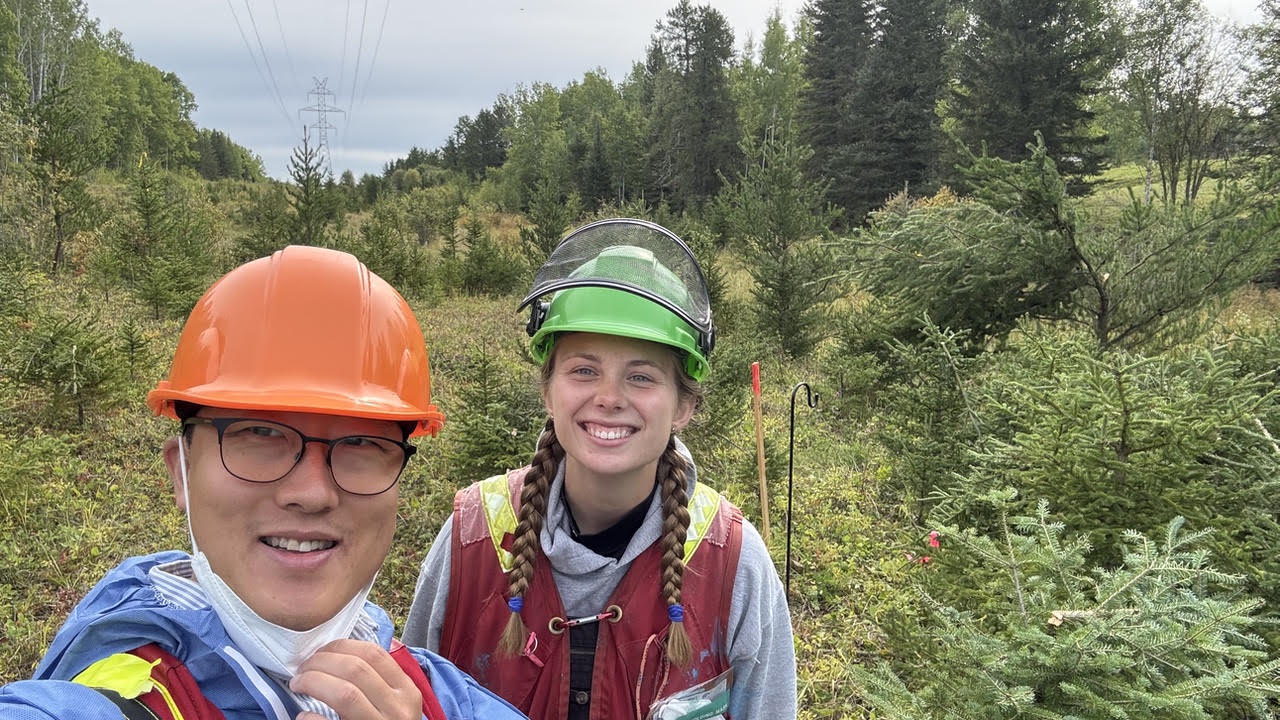
Assistant professor Seung-Il Lee and MSc student Caitlin Stewart in the herbicide experimental site along the power transmission corridor in Thunder Bay
“Power corridors are really important habitats for pollinator populations like bees and butterflies, which also play a crucial role in pollinating crops in nearby farm fields,” Dr. Lee says. “While it’s extremely important to control vegetation in these corridors, we need to understand how different methods of applying herbicides affect pollinators so we can minimize the impact as much as possible.”
We Need Science-backed Practices
Andrew McNeil, manager of Hydro One’s forestry business and innovation group, says this project is especially critical as the company’s power grid expands while storms become increasingly intense in the face of climate change.
“We need science-backed practices that will enable better vegetation management strategies while supporting a strong, reliable power network,” he says. “This research is giving us invaluable insights and tools to work with.”
Through its leadership within Canada’s network of utility companies, Hydro One will share research findings from this project—including with major providers like BC Hydro and Hydro-Québec—to extend its impact nationally.
“We’re really excited to be part of this pioneering work, and we see it bringing real value to the entire utility industry,” Shi says.
This collaborative research project directly aligns with United Nations Sustainable Development Goals (SDGs) #3: Good Health and Well-Being, #9: Industry, Innovation, and Infrastructure, #13: Climate Action, and #15: Life On Land.