


A Tiny Predator Is Putting Northern Ontario’s Walleye Population—and Those Who Eat Them—at Risk
Published in The Chronicle Journal on May 8, 2026
By EMILY DONTSOS
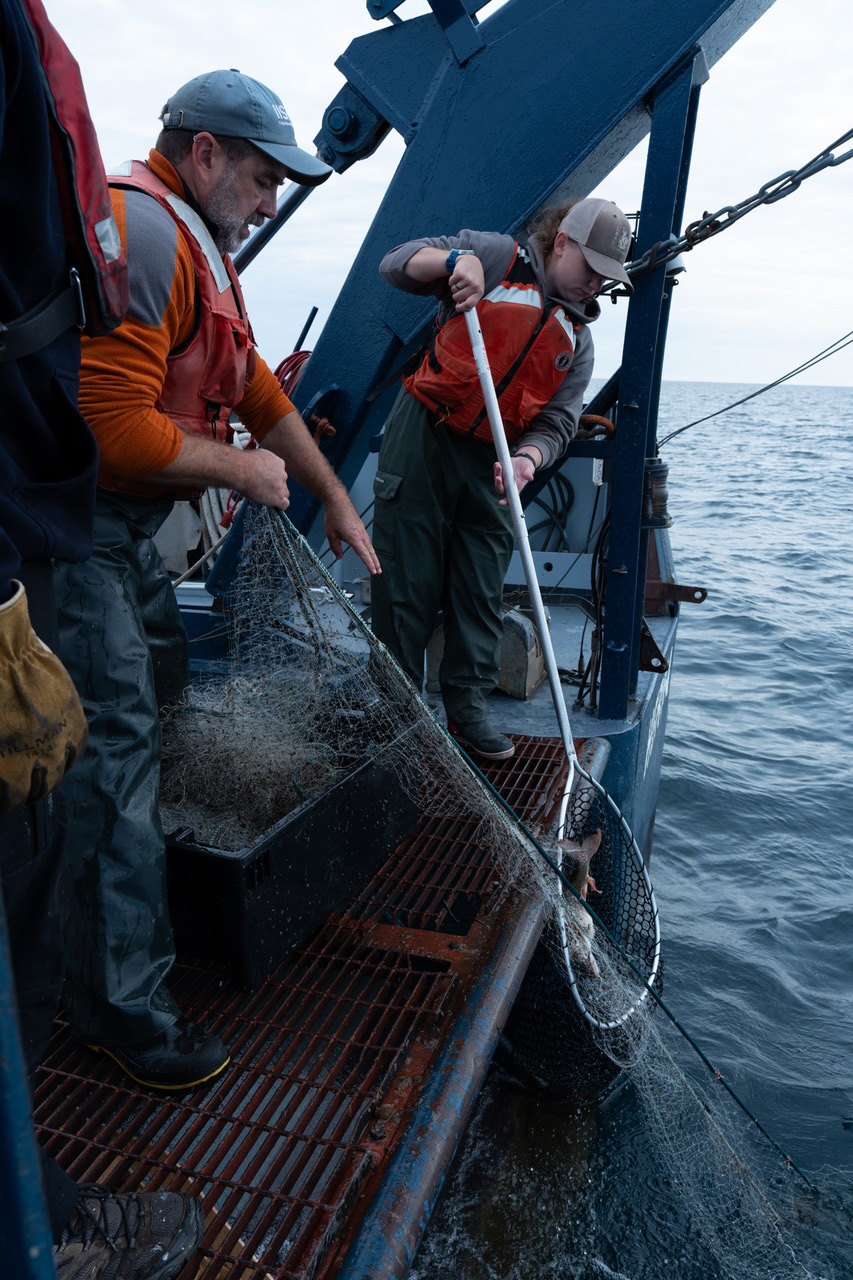
Retrieving short-set gillnets on the Research Vessel Blue Heron on Lake Superior. Similar capture methods are used for monitoring walleye on Rainy Lake and other inland lakes.
Every year, hundreds of thousands of anglers take to the waters of northern Ontario to fish for walleye, an abundant native species beloved by tourists and residents alike.
It’s been a booming industry for generations, contributing nearly half a billion dollars annually to the province’s GDP and bringing vast economic benefits to the region.
But walleye now face emerging threats that pose risks to both the fish themselves and those who consume them—threats that Dr. Michael Rennie, an applied ecologist and associate professor at Lakehead University, is working to get ahead of before it’s too late.
His biggest concern? A tiny invasive crustacean known as the spiny water flea. Hardly more than a centimetre in length, this miniscule predator is causing critical changes to the walleye population that could damage ecosystems, the economy, and human health.
“Spiny water fleas first appeared in Ontario’s lakes in the 1980s and have spread rapidly since then,” Dr. Rennie says.
“The main issue is that they compete with larval walleye for food, which sets young walleye on a slower growth trajectory. Walleye that grow slowly accumulate more mercury over time, which is then consumed by the people who catch and eat them.”
Diving into the Data
With the support of a master’s student, Eric Randall, Dr. Rennie is studying the impact of the spiny water flea, and other factors, on walleye populations in Rainy Lake—a popular fishery located between Fort Frances, Ontario, and International Falls, Minnesota.
Their research project is supported by funding from the Rainy Lake Conservancy and the Rainy Lakes Fishery Charity Trust. Both organizations are dedicated to preserving and protecting Rainy Lake and the surrounding watershed.
For the first time, their work is bringing together walleye population data from Minnesota state agencies and the Ontario Ministry of Natural Resources. By analyzing this data, the researchers are working to build a comprehensive picture of how the fishery in the complex lake system, which itself was invaded by the spiny water flea in the mid-2000s, has changed over time.
“A formal assessment of the Rainy Lake walleye fishery hadn’t been done in over a decade, and no one has ever brought together binational data from all of these different, disparate survey methods before,” Dr. Rennie says.
While they are still analyzing data, one thing is clear: the spiny water flea presents an outsized risk to northern Ontario’s walleye population and those who rely on it for sustenance, income, and recreation.
Dr. Rennie hopes to leverage his findings to advocate for proactive fishery management.
“We want to get ahead of this issue before we can see the impacts in front of us, such as dangerous levels of mercury in walleye or changes to the population size,” he says. "In my experience, by the time it’s clear something is wrong with a fishery, it can be too late—which is why proactive, data-driven mitigation strategies are so critical.”
Changes on the Horizon
Based on their findings, Dr. Rennie is pushing for updates to safe fish consumption guidelines, which in some cases are based on data collected in the 1970s.
“This is especially critical for First Nations communities that rely on walleye as a daily dietary staple and may be unknowingly consuming dangerous amounts of mercury,” he says.
Building on the binational data collection and analysis his team has already done to date, Dr. Rennie also hopes to advocate for greater collaboration between researchers and policymakers in Ontario and Minnesota. Despite sharing vast resources, the two currently operate entirely independently of one another.
“Right now, we have people on both sides of the border who really want to work together to understand the health of our shared lake systems and how we can protect their future,” he says. “I’m grateful to be part of it.”
Dr. Michael Rennie’s research project directly aligns with United Nations Sustainable Development Goals (SDGs) #3: Good Health and Well-Being, #6: Clean Water and Sanitation, #12: Responsible Consumption and Production, and #14: Life Below Water.
Research in Action highlights the work of Lakehead University in various fields of research.