



National Day of Remembrance and Action on Violence Against Women
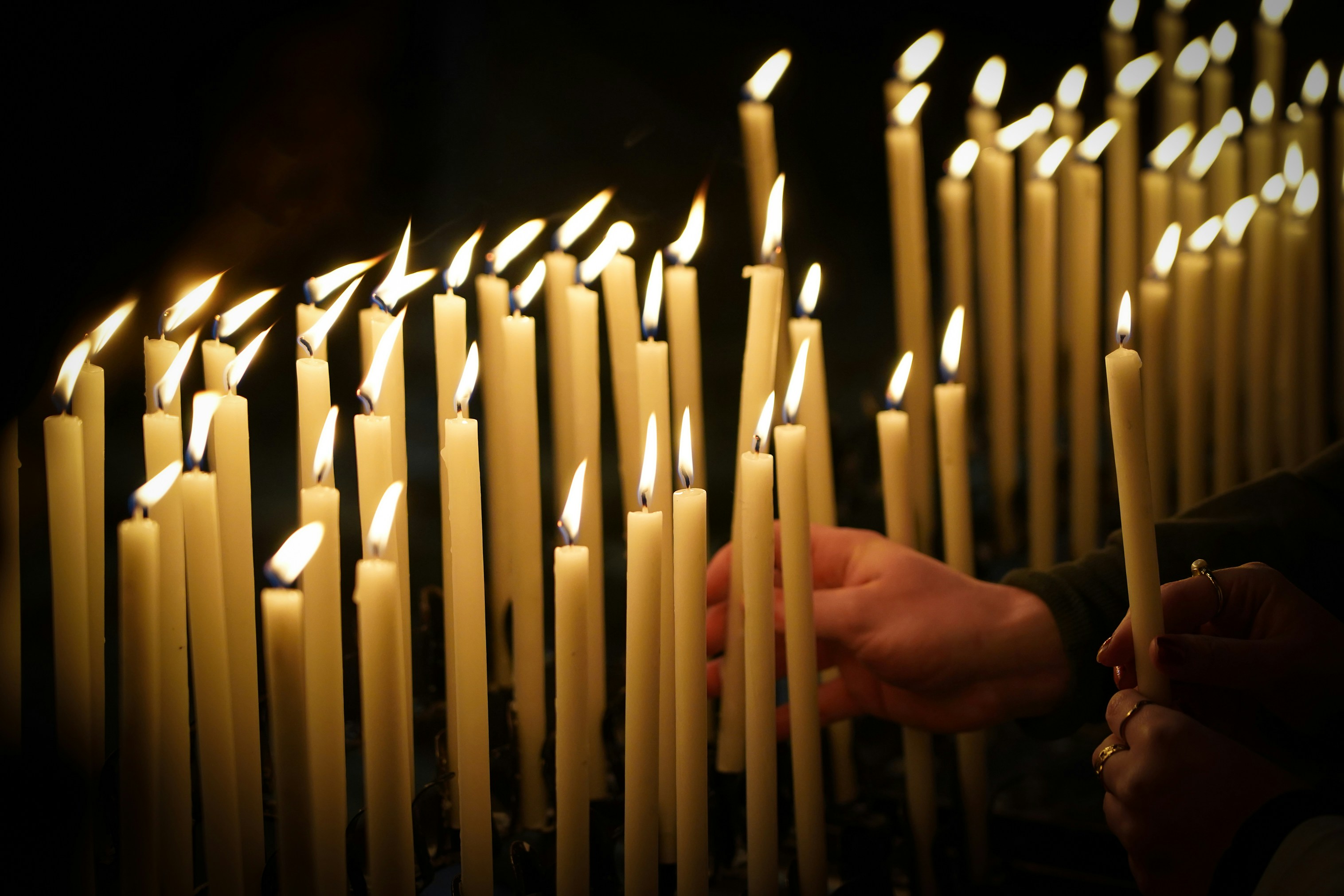
Photo Credit: Unsplash/Nick Fewings
A sombre time of the year is approaching for Lakehead University, and for all Canadians.
December 6 marks the anniversary of the murders of 14 young women at Montreal's École Polytechnique in 1989.
Targeted in an act of misogynistic violence, the women ranged in age from 20 to 31.
Among the dead were nursing student Barbara Klucznik-Widajewicz and Maryse Laganière, a polytechnique finance employee. The other 12 victims were engineering students.
This mass femicide, which became known as the "Montreal Massacre," led Canada to declare December 6 the National Day of Remembrance and Action on Violence Against Women. It's also known as White Ribbon Day.
The families and friends of the women still mourn their loved ones. We join together with them in solidarity, pledging to never forget the victims of this tragedy.
Every December 6, We Remember:
- Geneviève Bergeron, Mechanical Engineering Student, aged 21
- Hélène Colgan, Mechanical Engineering Student, aged 23
- Nathalie Croteau, Mechanical Engineering Student, aged 23
- Barbara Daigneault, Mechanical Engineering Student, aged 22
- Anne-Marie Edward, Chemical Engineering Student, aged 21
- Maud Haviernick, Metallurgical Engineering Student, aged 29
- Maryse Laganière, École Polytechnique Finance Employee, aged 25
- Maryse Leclair, Metallurgical Engineering Student, aged 23
- Anne-Marie Lemay, Mechanical Engineering Student, aged 22
- Sonia Pelletier, Mechanical Engineering Student, aged 28
- Michèle Richard, Metallurgical Engineering Student, aged 21
- Annie St-Arneault, Mechanical Engineering Student, aged 23
- Annie Turcotte, Metallurgical Engineering Student, aged 20
- Barbara Klucznik-Widajewicz, Université de Montréal Nursing Student, aged 31
Engineering Students and Activists Grapple with a Devastating Legacy
"Things have changed for women in engineering," says Sana Sharif, a Lakehead electrical and computer engineering PhD student. "There's more acceptance, even since I began my studies.
But in 2025, we are still fighting because there is still violence. White Ribbon Day is a powerful reminder of the brilliant female engineering students whose lives were stolen. I'm standing on their shoulders."
What happened in 1989 led to debates and soul searching by a country in shock.
"It's ironic that it took this horrific mass casualty to spur Canadians to take serious steps to attempt to stop gender-based violence (GBV)," says Lakehead Health Sciences professor Dr. Helle Møller.
"Although policies and legislation to protect women existed in 1989, research evaluating their effectiveness largely hadn't been done. This was, and continues to be, reflected in the underreporting of gender-based violence."
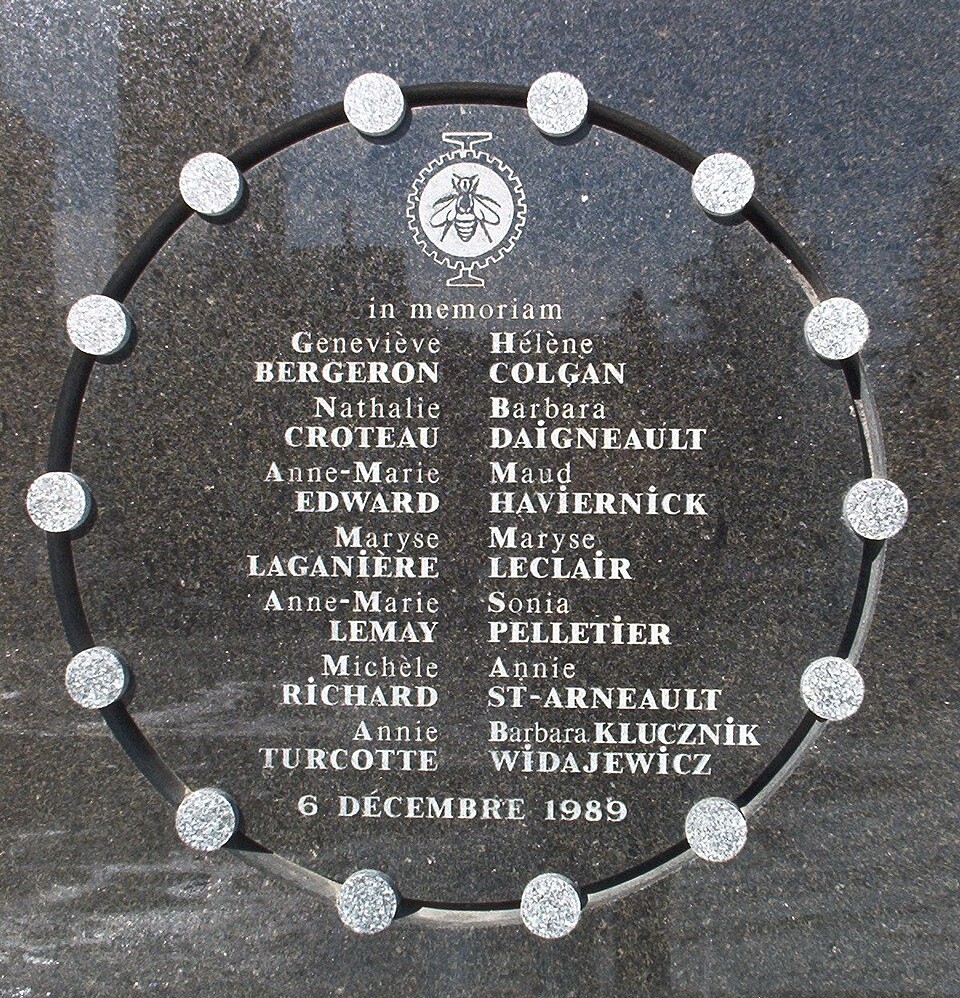
The commemorative plaque on the southwest wall of École Polytechnique's Main Building (now renamed Polytechnique Montréal), which bears the school's coat of arms and the names of the 14 victims. Photo Credit: Wikimedia Commons/Bobanny
In partnership with the Thunder Bay District Health Unit and Southeast Public Health, Dr. Møller and her fellow Lakehead researchers Oriana Rodriguez and Nana Nyarkoa-Oduro have spent the last year developing a framework to prevent gender-based violence.
The newly launched framework provides a foundation for public health units to address the root causes of gender-based violence, and take evidence-based action across different sectors.
"We've come a long way as a society when it comes to gender-based violence, but often we still don't act until it's too late," Dr. Møller says.
"This is evident from the refusal of the federal government, and most provincial governments, to declare GBV an epidemic, despite rising GBV stats in Canada. United Nations Secretary-General António Guterres has described violence directed at women and girls as 'the world's longest, deadliest pandemic.'"
At Lakehead, many other researchers are involved in crucial work to build a society that is safe for women and girls—including Gender and Women's Studies Professor Dr. Lori Chambers and Social Work Professors Dr. Angela Hovey, Dr. Susan Scott, and Dr. Jodie Murphy.
They are making important strides in understanding and overcoming gender-based violence, as are student researchers like Erika Puiras and Casey Oliver.
A New Generation Committed to Change
"When do revolutions start?" asks Parvinder Kaur. "Where does the spark come from, and how do we keep it alive to keep making our world a better place?"
As the coordinator of the Lakehead University Student Union Gender Equity Centre, ending gender-based violence is one of her goals.
"I am an international student and, according to my parents, I have always questioned inequality. Gender became a focus when I started volunteering as a crisis responder with Shamsaha."
Shamsaha is a non-profit in Bahrain that helps women facing domestic and sexual abuse.
I very quickly learnt that voice is a privilege, and what good would it be if I didn't use mine.
Parvinder now works to make Lakehead's campus a safer space for all students through initiatives like the recent Survivors Solidarity event hosted by Pride and Gender Equity Centre.
"I tried to connect students with the office of Human Rights and Equity on campus along with counselors for sexual and intimate partner violence from Thunder Bay Counselling," Parvinder says.
"Education is key, and so is remembering our history," she adds.
As the anniversary of the Montreal Massacre draws near, Lakehead University would like to pause and reflect on the lives of these young women, and to renew its commitment to ending gender-based violence.
"If we don't remind people of what happened on December 6, 1989, it will be forgotten," Dr. Møller says. "It's now more important than ever to continue fighting."
"There is no place for violence in our classrooms, our institutions, or our society," adds Sana Sharif. "We need women's ideas and their leadership."
Commemorate White Ribbon Day by:
- Observing a moment of silence at 11:00 am on December 6
- Wearing a white ribbon
- Donating to a local women's organization or to the White Ribbon campaign, the world's largest movement of men and boys working to end gender-based violence
- Participating in the 16 Days of Activism Against Gender-based Violence between November 25 to December 10
- Using the social media hashtags #Rememberthe14 and #16Days and following the LUSU Gender Equity Centre Instagram account @gec_lusu
Click here to learn more about the vibrant young women who died on December 6, 1989.


