

Lakehead University Biology Dr. Michael Rennie Lake Trout

Can a Tiny Shrimp Reverse an Environmental Disaster? Biologist Dr. Michael Rennie has the answer.

Michael Rennie standing beside a boat filled with equipment at the shore of a lake

The general public and policymakers at all levels of government use Dr. Rennie's stellar research work for the sustainable resource management of aquatic ecosystems.

Acid rain fell unrelentingly on Canada's lakes from the Industrial Revolution until the 1980s when modern environmental regulations came into effect.

The effects of this rain, generated by manufacturing and coal-burning industries belching pollutants into the atmosphere, were catastrophic. Many pristine northern Ontario lakes were acidified and the plants, fish, and other aquatic life native to them died off. But for several years, Lakehead University's Dr. Michael Rennie and his team of students have been researching how to reverse this environmental devastation.

"The lakes were greatly helped by bi-lateral agreements between Canada and the United States that dramatically reduced the levels of sulfur dioxide and nitrogen oxides that cause acid rain," explains Dr. Rennie—a Lakehead University biology professor and the head of the Community Ecology and Energetics Lab.

"By the 2000s, the pH levels of many lakes had returned to normal, but the diversity of fish, zooplankton, and invertebrate communities were very low, indicating that these lakes had not recovered biologically."

To restore these fragile ecosystems, Dr. Rennie focused on Lake 223 in northwestern Ontario, one of 58 lakes that are part of the International Institute for Sustainable Development's Experimental Lakes Area (IISD-ELA)—the world's largest freshwater laboratory.

An Unassuming Crustacean Becomes a Mighty Hero

A Mysis Shrimp resting on a human's thumbnail

"The IISD-ELA purposely acidified Lake 223 in the 1970s to study acid rain," Dr. Rennie says. "They discovered that lake trout populations declined during the experiment, starving as the animals they ate were decimated by acidification."

It's not only humans who love shrimp. Mysis diluviana is a high-protein food that's a favourite of lake trout.

This included Mysis diluviana—a googly-eyed crustacean about the size of your thumbnail commonly known as opossum shrimp—which turned out to be a keystone animal species that many aquatic creatures rely upon for food. "Although the pH of the lake recovered, the remaining lake trout population was smaller in size, fewer in number, and had higher mercury concentrations after the shrimp were extirpated."

Dr. Rennie's team developed a new scientific method to extract Mysis DNA from sediment cores in Lake 223. The lake itself was important in developing the method because the extirpation date of Mysis was known. "The disappearance of the DNA from the dated core corresponded exactly to the date we knew they were no longer found in the lake—1979."

The implications go far beyond this single lake. "Lake 223 is proof of concept that analyzing DNA in sediment cores enables us to identify the aquatic organisms that previously lived in disturbed lakes, allowing managers to use this information to guide biological restoration."

His team has also shown that reintroduction can work. From 2018 to 2021, they reintroduced small numbers of opossum shrimp into the lake and there's now an abundance of them. "It's the first time ever that these shrimp have been successfully re-established in a lake where they were extirpated."

Dr. Rennie and his team continue to track the lake's recovery. "It'll be a few years for us to tell if the lake trout population will recover, but things are looking good so far." Dr. Rennie is currently collaborating with government, industry, and researchers to apply the same technology to reveal historical biological communities in lake sediments in the Sudbury area to guide the restoration of lakes damaged by former nickel smelting operations.

His hope is that future Earth Days will be times for celebrating healthy lakes that sustain all of us.

Dr. Rennie received an NSERC Discovery Grant and a Government of Ontario Early Career Researcher Award for his ecosystem restoration work. He currently has an NSERC Alliance Grant for his work to restore lakes in the Sudbury area.
Lake Trout adjust their behaviour in the face of a changing climate, new study

August 15, 2017 – Thunder Bay, ON

Canadian scientists have discovered that certain lake predators are altering their behaviour due to climate change, revealing what the future may hold for these fish and their food.

For years scientists told tales of fish such as Lake Trout adapting their feeding behaviour as temperatures change, but no empirical evidence existed. Now, a recently completed 11-year study at IISD Experimental Lakes Area (IISD-ELA) in northwestern Ontario reveals that Lake Trout have a remarkable ability to adjust their behaviour in the face of changing water temperatures.

“These findings are important for understanding how Lake Trout and other temperature-sensitive fish will respond to climate change,” said Matthew Guzzo, a PhD candidate in the University of Manitoba’s Department of Biological Sciences and lead author of the study published in the Proceedings of the National Academy of Sciences. “Lake Trout are reacting rapidly to changes in water temperature. As soon as the water became too warm, the fish left the shallow, more productive water, and went to the deep part of the lake where the food is of lower quality. And when a top predator is forced to change what it eats, it impacts not only its own well-being, but the whole food web.”

Guzzo and co-authors Paul Blanchfield, Research Scientist at Fisheries and Oceans Canada, and Michael Rennie, Canada Research Chair in Freshwater Ecology and Fisheries at Lakehead University, found that changes in water temperatures, not food availability, guide the Lake Trout’s movements. This fact comes with complex repercussions.

“Our study confirms the importance of springtime shoreline resources in these small boreal lakes for Lake Trout, and how in warmer years their access to this resource is limited,” said Rennie.  “The prediction from this observation is that climate warming should result in slower-growing trout in poorer condition, due to reduced shoreline access.”

The study focused on the ice-free season in the lakes. In a world warming due to climate change, earlier springs bring an earlier opportunity for the trout to forage on energy-rich minnows in shallow water. But a warmer climate means longer, hotter summers, and the water quickly heats beyond the predator’s preference, forcing them to move to cool, deep, less productive water. As a result, the scientists observed a reduction in the fish’s growth and condition, which can impact their reproductive success.

“Lake Trout are a sentinel species – the canary in the coal mine for boreal lakes,” said Blanchfield.  “Our findings provide evidence that Lake Trout are struggling to cope with a rapidly-changing and stressful thermal environment.”

All this could have profound and severe impacts on future populations and their ability to persist through the ever-intensifying effects of climate change.

“This current study isn’t the whole climate change story. It’s showing that fish can adapt to changing conditions. Their behaviour is not static. They’re not just sitting ducks,” said Guzzo. “We are showing that for now Lake Trout can continue to live in these areas that will warm by making the best of a bad situation, but what this means for the long-term persistence of these and other cold-water fish populations is unclear.”

Funding for “Behavioural response to annual temperature variation alter the dominant energy pathway, growth, and condition of cold-water predator” was provided by the Natural Sciences and Engineering Research Council of Canada, the W. Garfield Weston Foundation, Manitoba Fish Futures, the University of Manitoba, DeBeers Canada, Fisheries and Oceans Canada, and IISD-ELA.

-30-

Interviews: The researchers are available for interviews upon request.

For more information, please contact:

Brandon Walker, Media Relations Officer, Lakehead University, 807-343-8177, or mediarelations@lakeheadu.ca

Sean Moore, Communications Officer, University of Manitoba, 204-474-7963, or sean_moore@umanitoba.ca

Sumeep Bath, Media and Communications Officer, IISD-ELA, 204-958-7700 ext. 740, or sbath@iisd.ca


Lakehead University has about 9,700 full-time equivalent students and 2,000 faculty and staff in 10 faculties at two campuses in Orillia and Thunder Bay, Ontario. Lakehead is a fully comprehensive university: home to Ontario’s newest Faculty of Law in 44 years, the Northern Ontario School of Medicine, and faculties of Engineering, Business Administration, Health & Behavioural Sciences, Social Sciences & Humanities, Science & Environmental Studies, Natural Resources Management, Education, and Graduate Studies. In 2016, for the second consecutive year, Re$earch Infosource ranked Lakehead first among Canada’s undergraduate universities. Visit www.lakeheadu.ca.

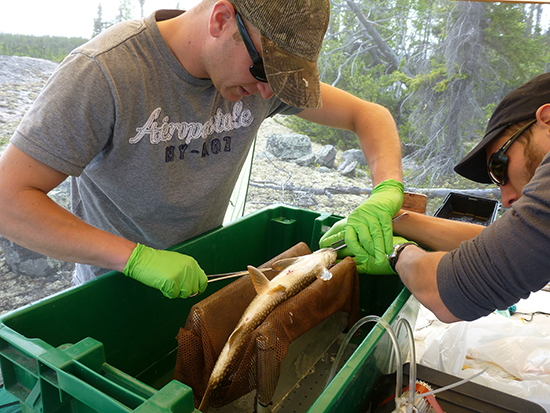
University of Manitoba PhD student Matthew Guzzo inserts a telemetry tag into a Lake Trout. It harmlessly records valuable information.
Subscribe to Lakehead University Biology Dr. Michael Rennie Lake Trout