Enhancing the Prevention of Injury & Disability at Work

Postdoctoral Fellow in Research Impact Evaluation

Lakehead University, Thunder Bay Campus, invites applications for a Full-time Postdoctoral Fellow in Research Impact Evaluation at the EPID@Work Research Institute. The Postdoctoral Fellow in Research Impact Evaluation will be responsible for leading the assessment of knowledge mobilization and implementation (KMI) strategies at the EPID@Work Research Institute under the leadership of Dr. Vicki Kristman. The successful candidate will design, implement, evaluate, and report on the impact of KMI activities, ensuring evidence-based decision making to enhance research translation and societal benefit. Location: Thunder Bay Campus, In Person ONLY. For more information and application instructions, view the full job posting

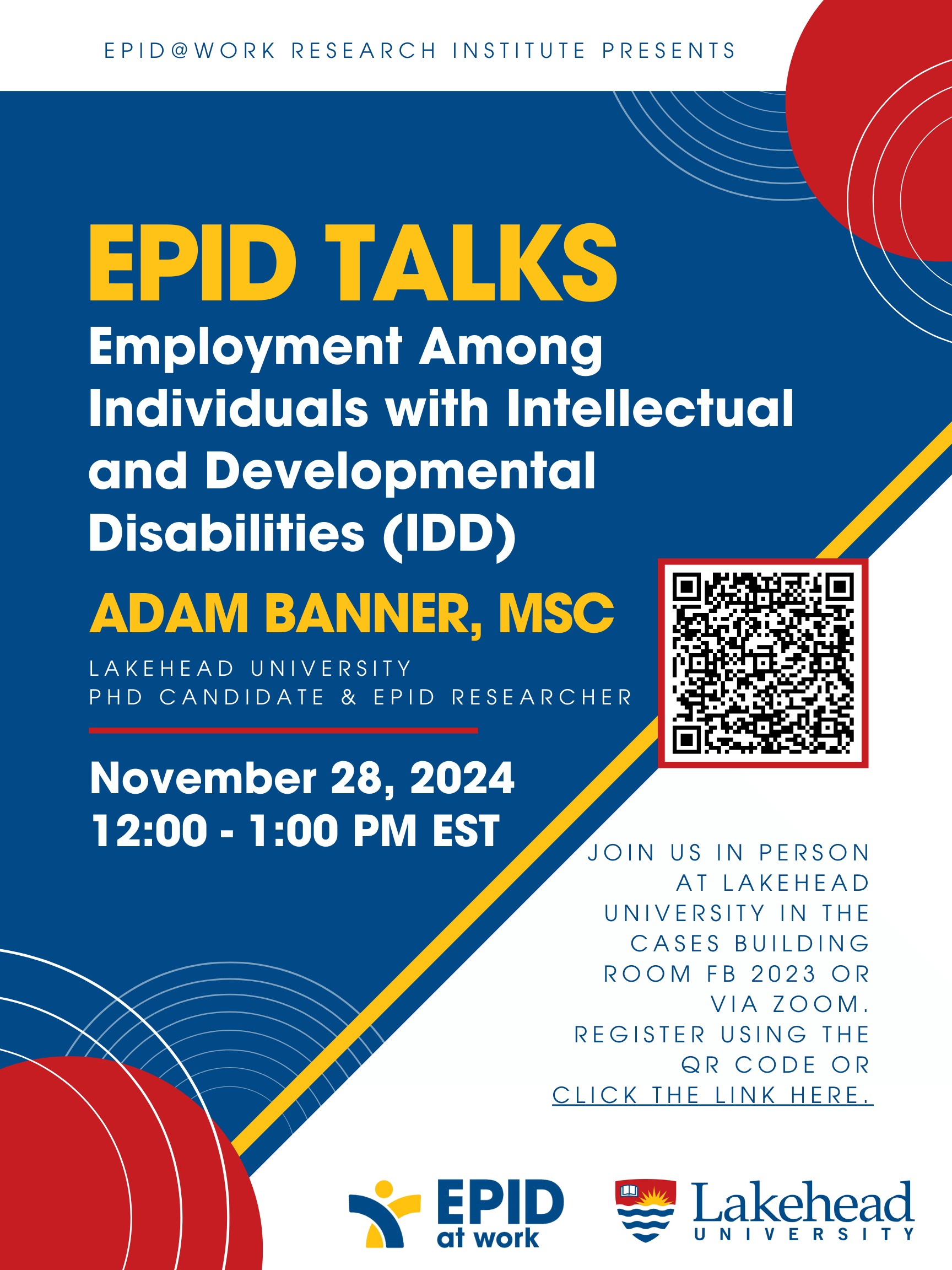
EPID Talks November 28 - "Employment Among Individuals with Intellectual and Developmental Disabilities (IDD)"

EPID@Work is excited to announce that registration for our upcoming EPID Talks on November 28, 2024 from 12:00 - 1:00 p.m. EST is now open! The session will include a presentation by Adam Banner, a PhD candidate at Lakehead University, entitled “Employment Among Individuals with Intellectual and Developmental Disabilities (IDD).”
 
Please find registration info on the attached poster or by clicking the link here.

Please join us in-person at Lakehead University (CASES Building room FB 2023) or online via Zoom. After registering, you will receive a confirmation email containing information about joining the meeting virtually and in-person. 


Please share with your network and with anyone who may be interested in attending; we look forward to seeing you there!

EPID Talks November 28

EPID@Work Research Into Action Conference

Research Into Action Conference

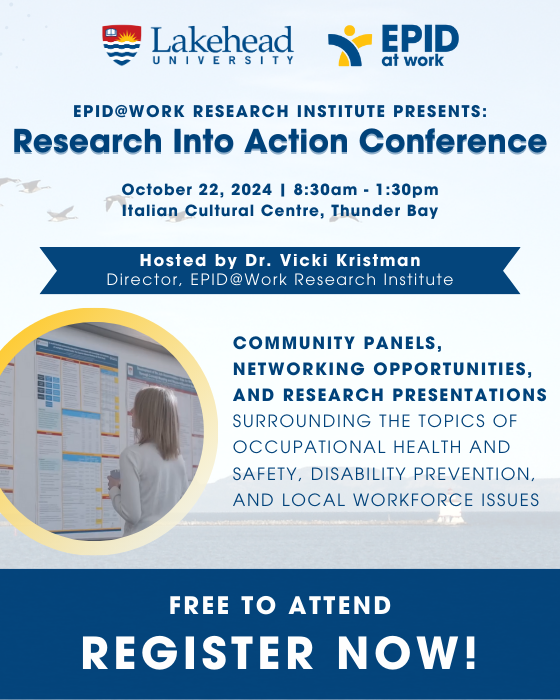
Hosted by the EPID@Work Research Institute at Lakehead University, our Research Into Action Conference will include community panels discussing why research matters in Northwestern Ontario, research presentations from EPID@Work scientists and researchers, and networking opportunities with professionals interested in occupational health and safety, disability prevention, and local workforce issues.

The Research Into Action Conference will be held on October 22, 2024 from 8:30 a.m. to 1:30 p.m. at the Italian Cultural Centre in Thunder Bay, ON. The conference is free to attend, but we are asking for donations to the Regional Food Distribution Association in lieu of a registration fee. Cash or non-perishable goods can be donated at the door. A complimentary lunch buffet and refreshments will be provided for all attendees.

Ultimately, the focus is to create understanding of why researcher-community collaboration matters and how regional research and knowledge transfer can impact Thunder Bay and Northwestern Ontario as a whole.

To register, visit https://tinyurl.com/4je245rn.

If you have any questions or would like to share the event poster with your network, please contact Ryley at epidevents@lakeheadu.ca or rafingle@lakeheadu.ca. To learn more about our institute, visit www.lakeheadu.ca/epid.

We look forward to seeing you there!

New study seeks to improve workplace mental health for Indigenous workers

Thunder Bay, Ont. - A new study will bring together members of the Nokiiwin Tribal Council and researchers from Lakehead University to address a pressing need for tailored mental health interventions for Indigenous workers in Northwestern Ontario. The study is receiving $1.97 million in funding from the Canadian Institutes of Health Research (CIHR).

“Indigenous individuals are less likely to seek help for mental health and accordingly have rates of suicide at least twice as high as non-Indigenous counterparts,” explained Dr. Vicki Kristman, principal investigator and the Director of Enhancing the Prevention of Injury & Disability at Work (EPID@Work) and the Ontario Research Chair in Injury and Disability Prevention at Lakehead.

In a recent study supported by CIHR, Kristman and her team evaluated the Wiiji app, an e-mental health tool designed to support Indigenous workers dealing with challenging work environments. Although the research team found that the app provided valuable assistance to some workers, they determined a more effective approach would be to create long-term changes within workplaces themselves to offer more impactful and sustainable improvements to mental health.

“By changing workplace environments to better support Indigenous mental health, we can increase participation in employment, reduce work-related disabilities, and improve overall well-being in Indigenous communities,” Kristman added.

Over the next five years, Kristman’s research team will work alongside Tribal Council members to identify workplace factors that contribute to mental health challenges for Indigenous workers and propose actionable interventions. The findings will help Nokiiwin serve their employer clients better, and support the Tribal Council as they work to establish an Indigenous-specific Health and Safety Association within Ontario.

"As we strive to create a supportive and inclusive workplace, through our work together [EPID@Work and Nokiiwin], we are reaching a greater understanding on the role that workplaces play in providing support and appropriate resources to employees who may be experiencing mental health issues,” stated Audrey Gilbeau, Executive Director and Governance Advisor at Nokiiwin Tribal Council. “Acknowledging these challenges not only fosters understanding and compassion among colleagues, but also empowers individuals to seek the support they need to thrive. Together, we can build a culture of care that prioritizes mental well-being and strengthens our community as a whole.”

Improving workplace mental health for Indigenous workers has far-reaching benefits. By supporting Indigenous workers, employers can boost productivity, reduce absenteeism, and foster a healthier workforce. The anticipated improvements in mental health and employment participation will also ripple out to benefit Indigenous families, communities, and the broader economy.

In 2023/24, Lakehead University received more than $2 million in assistance from the Research Support Fund to support the indirect costs of research, which includes costs for supporting the management of intellectual property, research and administration, ethics and regulatory compliance, research resources, research facilities, and research security.

Pages

Subscribe to Enhancing the Prevention of Injury & Disability at Work