

Exploring Place with an Alternative Campus Tour

In the Fall 2015/Winter 2016, Dr. David Greenwood (Canada Research Chair in Environmental Education) and three graduate assistants (Leanne Bazdarick, Muga Miyakawa, Gemma Romano) in the Education Faculty conducted a research project around the theme of place. The project was funded by the Centre for Place and Sustainability Studies via the Faculty of Education and a SSHRC grant. The research began with the three graduate assistants developing an “alternative” campus tour. Their work has been inspired by Dr. Anders Sandberg who runs a similar project at York University. This alternative tour engages participants (students, staff, or faculty) to critically think about how various sites on campus relate to sustainability. It is designed to open space for discussion around how a particular place came to be, the multiple perspectives of that place, and different human and more-than-human experiences and stories of that place. In doing so, it enhances community engagement and encourages people to think critically in the role they play as place-makers.

In considering relationship to place, the research project was taken to a first and fourth-year undergraduate course. Both classes were given assignments that explored questions around how the university community engages with the campus as a place, and what meaning the place has to them.

The first year undergraduate class (approx. 30 students) from the school of Outdoor Recreation, Parks, and Tourism (ORPT), visited a site of their choice within campus and were instructed to reflect on their personal relationship to the place using 500 words and a photo. They did this twice to see how their experience changed.

The fourth year undergraduate class (approx.  20 students) also from ORPT, came up with proposals to engage the student body around place and relationship to place. Ideas included a geocaching activity, a database for sustainability events and activities, and a living mural in a high-traffic hallway of the history of Lakehead.

The experiences with the two classes are being used to publish an academic paper.

The alternative campus tour is still being developed and will be further funded by the Office of the Provost and VP Academic/Office of Sustainability. It will be offered as an orientation activity in Fall 2016. The project acknowledges that ‘big picture’ sustainability requires a culture shift that goes beyond facts and figures, and rather calls on individuals to reflect on their personal connection to, and impact on, the places they inhabit.
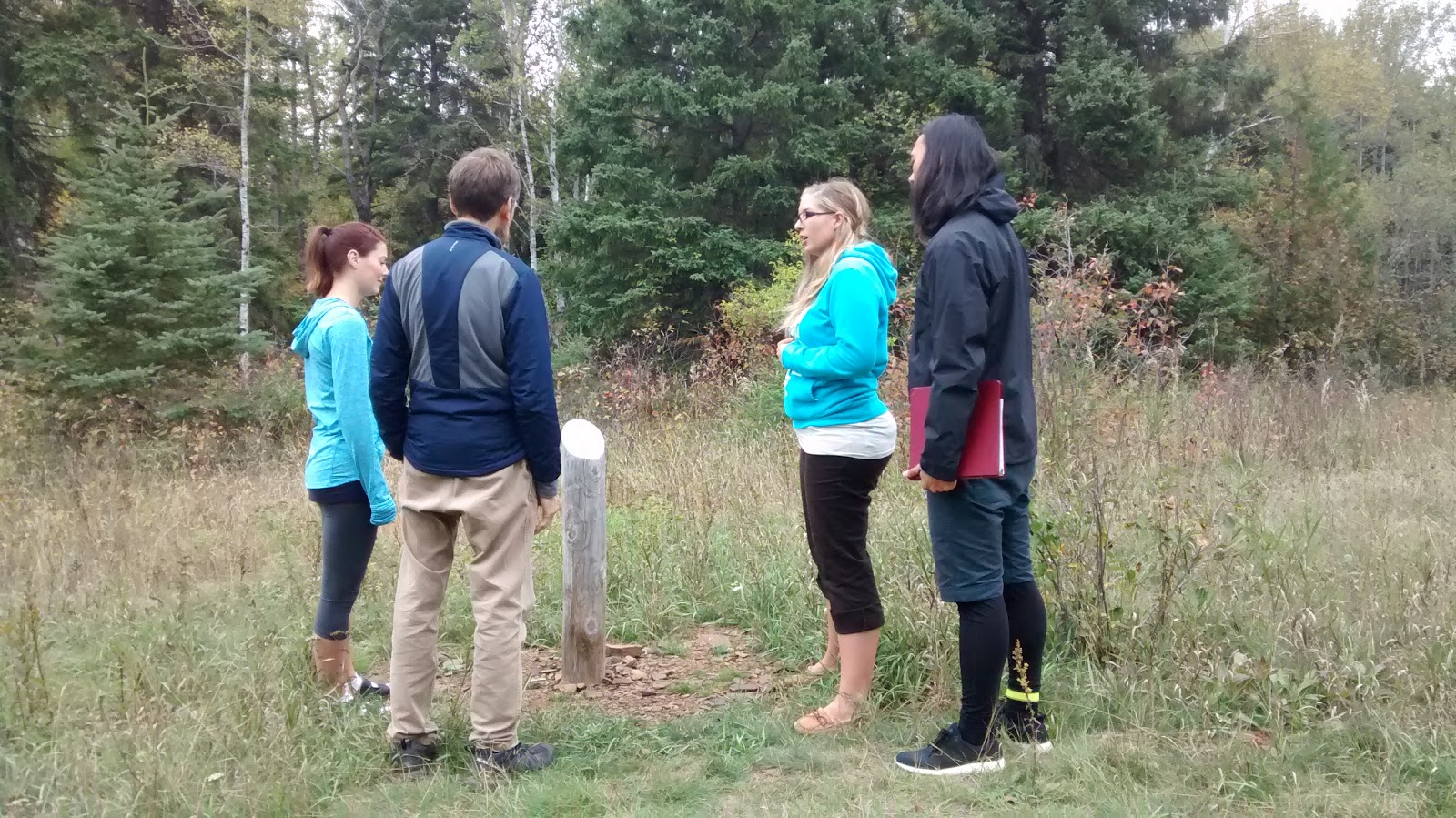
Group of students outside

American Researcher to Interview Hunters, Anglers and Others about Impact of Climate Change

See whole CBC article here.

From Boreal Heartbeat:

"How does climate change affect our well-being?

We know that there will be many changes in our natural environment. In Ontario, milder, shorter winters may lead to earlier snowmelt, less ice cover, and changing rainfall patterns. We may see more extreme weather events, more insect and disease outbreaks, forest fires and fewer cold water species of fish (source). 

But how will we, the people of Ontario, be impacted?

Boreal Heartbeat is a study that will document the experiences of people who "live close to the land," in the Lake Superior basin of northwestern Ontario. Our team will be interviewing hunters, trappers, fishermen, farmers, herbalists, and people working in forestry and the tourism industry about their connection to place, their own observations of climate-related changes in the region, and the ways those changes have impacted them personally."

Cultivating Leaders in Sustainability and Environmental Education - Teacher Education

The Faculty of Education at Lakehead University recognizes that sustainability is one of the biggest challenges of our times. By including sustainability content in the curriculum, future​students​ will have access to teachers who are literate and knowledgeable in this field. Lakehead University is providing leadership in this area by being one of the first universities in Canada to offer a Climate Change Pedagogy course to teacher candidates.

In 2013​/2014​ Lakehead University began offering Climate Change Pedagogy as a course in the Faculty of Education at both the undergraduate and graduate level. Climate Change Pedagogy is a special topics course. It explores climate change as a defining issue for educators, students, and citizens. It inquires into how humans – including teachers – can effectively engage with climate change as an environmental, economic, political, and social justice issue.

This course is meant to develop our capacities as engaging and effective climate change educators. Bringing together theory and practice, the course will consider questions such as: What responsibility do educators have to engage with climate change? Do we hope our students will change private-sphere behaviours or become active politically as a response to climate change? How do we balance teaching about the negative impacts of climate change with the opportunities responding to climate change presents? How can teachers teach about issues of politics, science, and ethics in our classrooms? Which is most important? What role can educators play in shaping a living future?

Pages