



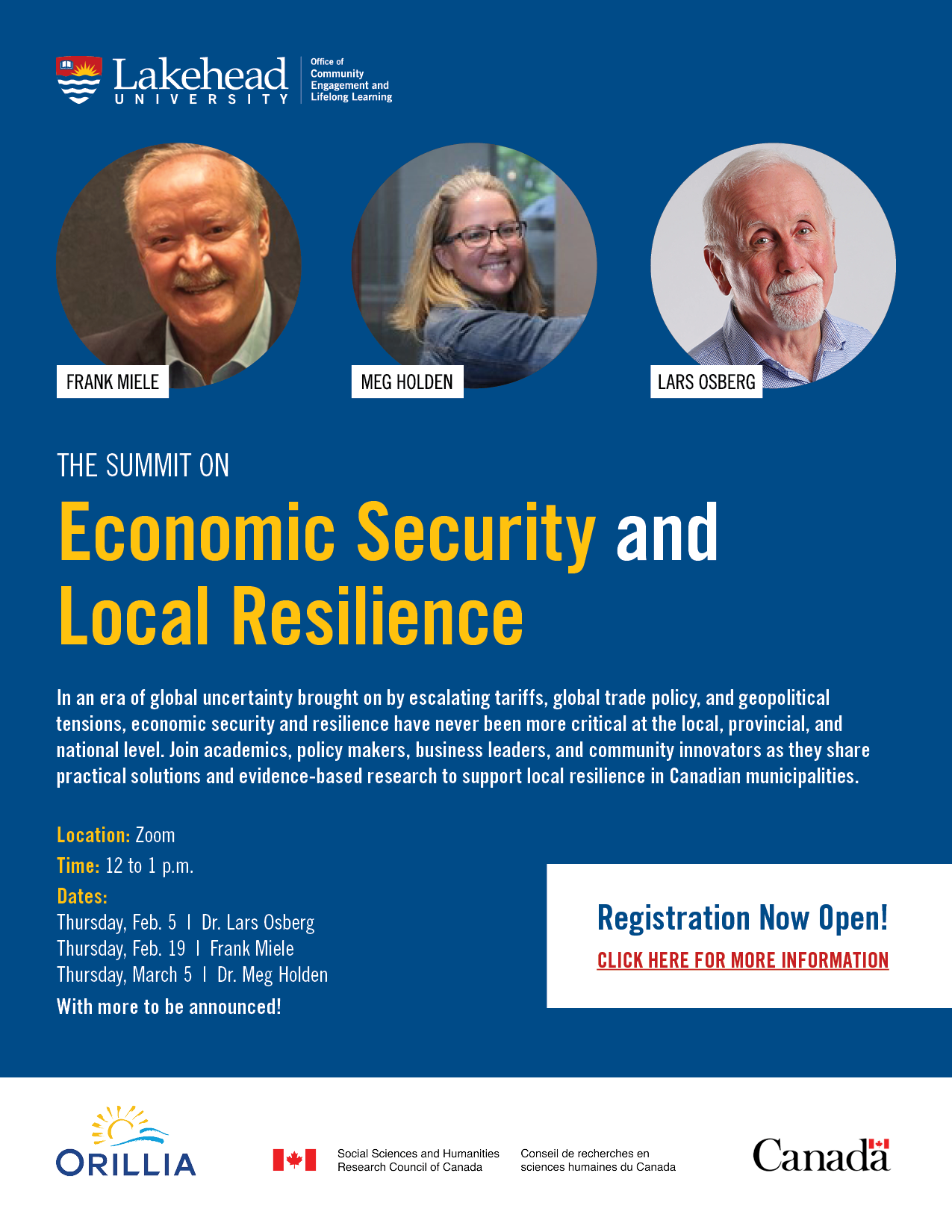
The Summit on Economic Security and Local Resilience
Build a More Secure, Resilient Future–Together!
In an era of global uncertainty brought on by escalating tariffs, global trade policy, and geopolitical tensions, economic security and resilience have never been more critical at the local, provincial, and national level.
Join academics, policy makers, business leaders, and community innovators at the Summit on Economic Security and Local Resilience (SESLR) as they share practical solutions and evidence-based research to support local resilience in Canadian municipalities.
Explore key topics including:
- Economic security in Canadian cities
- Urban planning and sustainability
- Sustainable innovation and creative local economy
- Climate resilient development
Whether you’re driving policy or shaping community development, you’ll gain valuable insights into evidence-based practices from some of Canada’s leading researchers, and walk away with creative, actionable solutions to drive resilience and sustainability locally, as our communities and cities look to succeed in a changing and challenging global economy.
Reserve your seat and be part of the local conversation on resiliency and sustainability.
Date(s): February 5,19 and 26, and March 5
Time: 12 to 1 p.m.
Place: Zoom
Price: FREE
The Many Costs of Economic Insecurity

Dr. Lars Osberg
Thursday, Feb. 5, 2026
Lars Osberg is currently McCulloch Professor of Economics at Dalhousie University, Halifax, but he began life in Ottawa, Ontario. As an undergraduate, he attended Queen’s University, Kingston and the London School of Economics and Political Science. After two years working for the Tanzania Sisal Corporation as a CUSO volunteer, he went to Yale University for his PhD. He has had visiting positions at the economics departments of New York University and the Universities of Cambridge, Sydney, New South Wales, Essex and Queensland and at Research on Poverty Alleviation (REPOA), Dar es Salaam, the Indira Ghandi Institute for Development Research, Mumbai, the Statistics Directorate, Organization for Economic Co-operation and Development (OECD), Paris and the Institute for New Economic Thinking, Oxford.
His first book was Economic Inequality in Canada (1981). His 2018 book The Age of Increasing Inequality: the Astonishing Rise of Canada’s 1% was awarded the 2019 Purvis Prize of the Canadian Economics Association. His two most recent books are The Scandalous Rise of Inequality in Canada (September, 2024) and Not Fair: Inequality of Opportunity in Canada (October, 2025). As well, there have been nine other books, four editions of an introductory economics textbook, 85 refereed articles in professional journals and numerous book chapters, reviews, reports and miscellaneous publications. Among other professional responsibilities, he was President of the Canadian Economics Association in 1999-2000. His current research emphasizes the measurement and causes of inequality, poverty, economic insecurity and inequality of opportunity and their implications for economic well-being, social stability and political freedoms.
Ambassadors of Growth: A Case Study in Relationship-Based Economic Development

Frank Miele
Thursday, Feb. 19, 2026
A proactive economic development strategy extends beyond land, infrastructure, and incentives; it is increasingly defined by relationships, trust, and access to local insight. Communities seeking to attract high-quality employment investment must differentiate themselves not only at the point of entry, but throughout the full business lifecycle—from initial location decisions to expansion and long-term retention. In this context, the Business Ambassador Program emerges as a highly effective tool for forward-looking municipalities.
Grimsby’s economic development approach is intentionally relationship-based. The Business Ambassador Program enhances the investor experience by connecting prospective and existing businesses with respected local leaders who understand the community, its sectors, and its operating environment. These peer-to-peer connections provide credibility, practical insight, and reassurance that cannot be achieved through traditional marketing alone. Investors benefit from candid perspectives on doing business locally, while ambassadors help communicate Grimsby’s strengths in a way that is authentic and informed.
When combined with concierge-style service delivery and proactive corporate outreach, the Business Ambassador Program positions Grimsby as a community that is accessible, responsive, and invested in business success. This level of engagement reflects a mature economic development strategy—one that recognizes that high-quality investment follows communities that prioritize collaboration, relationship-building, and long-term partnership over transactional approaches.
Frank Miele holds an undergraduate degree in Urban Planning and a Master's Degree in Local Economic Development from the University of Waterloo, and has held senior leadership positions in municipal government for over 40 years and has been teaching Local Economic Development at Toronto Metropolitan University and York University, Toronto since 1992.
Frank began his municipal career as a planner with the City of Niagara Falls and has held progressively senior positions with the Cities of Scarborough, Vaughan, and, currently, the Economic Development Manager in Grimsby. He also served as Chief Administrative Officer for three small rural Ontario towns.
Throughout his career, Frank has been an active contributor to broader municipal initiatives at the regional, provincial, and national levels, staying current and ensuring that his municipality is exposed to new and best practices. Frank is a credentialed municipal manager through the Ontario Municipal Management Institute.
Among his many accomplishments in municipal planning and administration, Frank has been an active voice on several inter-municipal boards and associations. He was recognized by the Economic Developers’ Association of Ontario with the prestigious Economic Development Achievement Award, and the International Economic Development Council education award for his contribution to the profession. He was also the President of the Ontario Municipal Management Institute.
Urban Resilience and Self-sufficiency: A Growing Necessity
Dr. Pierre Filion
Thursday, Feb. 26, 2026
Pierre Filion is professor emeritus at the School of Planning of the University of Waterloo and a Fellow of the Canadian Institute of Planners. His areas of research include metropolitan-scale planning, downtown areas and suburban centres, infrastructures, and emerging forms of urban development. He was co-editor of Critical Perspectives on Suburban Infrastructures (University of Toronto Press, 2019), Cities at Risk (Routledge, 2015) five editions of Canadian Cities in Transition (Oxford University Press), and Global Reflections on COVID-19 and Urban Inequalities (Policy Press, 2021). He has published close to 200 articles and book chapters.
Pierre Filion has been vice-president of the Planning and Real Estate Advisory Committee of the National Capital Commission, a member of the Central Zone Panel, which contributed to the formulation of the Ontario Government Growth Plan, and a member of the International Joint Commission (on the Great Lakes) Scientific Advisory Committee. The most citied among his publications include “The uneven geography of housing affordability stress in Canadian metropolitan areas” (with T. Bunting and A. R. Walks) Housing Studies 2004, “The successful few: Healthy downtowns of small metropolitan regions” (with H. Hoernig, T. Bunting and G. Sands) Journal of the American Planning Association 2004, “The entrenchment of urban dispersion: Residential preferences and location patterns in the dispersed city” (with T. Bunting and K. Warriner) Urban Studies 1999, “Suburban inertia: The entrenchment of dispersed suburbanism” International Journal of Urban and Regional Research 2015, and “Contested infrastructures: Tension, inequity and innovation in the global suburb” (with R. Keil) Urban Policy and Research 2017.
Sweet Spots for Complete Communities

Dr. Meg Holden
Thursday, March 5, 2026
In this webinar, Professor Meg Holden reviews different ways of understanding and assessing development in economics, epidemiology, political science, and planning, and argues for the value of sweet spot or optimization thinking, rather than maximization thinking, to steer us more toward complete community development in Canada. The failures of maximization thinking within B.C.'s lightning rod complete communities policy today will be confessed. Nevertheless, there are still positive pathways forward. The presentation will conclude with some pointers toward optimization in contemporary community development and the research underway to understand and institutionalize them.
Meg Holden (PhD, RPP) is a professor of urban studies and resources and environmental management at Simon Fraser University, where she also directs the Centre for Sustainable Development. Meg conducts and mobilizes research in urban and regional planning and policy, sustainable development and well-being, and pragmatic philosophy to create a more sustainable and climate-resilient urban future. As a professional planner and an urban environmental pragmatist, Professor Holden’s research career bridges gaps between theory and practice, utopian and incremental prescriptions, and is built upon a foundation of diverse trans-sectoral partnerships and negotiation of interdisciplinary approaches to generate and implement more sustainable development paths at the local scale. Professor Holden founded the first local urban observatory within the UN Habitat Global Urban Observatory network in the developed world, is a founding member of the editorial board of the International Journal of Community Well-Being, and co-leads the Ecourbanism Research Network. She publishes widely in academic and non-academic venues and highly values the pursuit of more lively, informed, self-reflexive collaborative and deliberative writing. Meg is a fifth generation Canadian settler, whose Irish ancestors came to Kingsbridge, Ontario seeking life opportunities during the potato famine.