Indigenous

When Woolly Mammoths and Lions Roamed North America

Dr. Jessica Metcalfe Studies Megafauna to Understand Our Past

"North America was a dangerous place during the last ice age," says Lakehead University Associate Professor of Anthropology Dr. Jessica Metcalfe.

Until around 10,000 years ago, sabre-toothed cats, lions, and short-faced bears prowled across the continent. They hunted giant herbivores—including giant beavers, giant sloths, giant bison, mastodons, and woolly mammoths, which are the focus of Dr. Metcalfe's research.
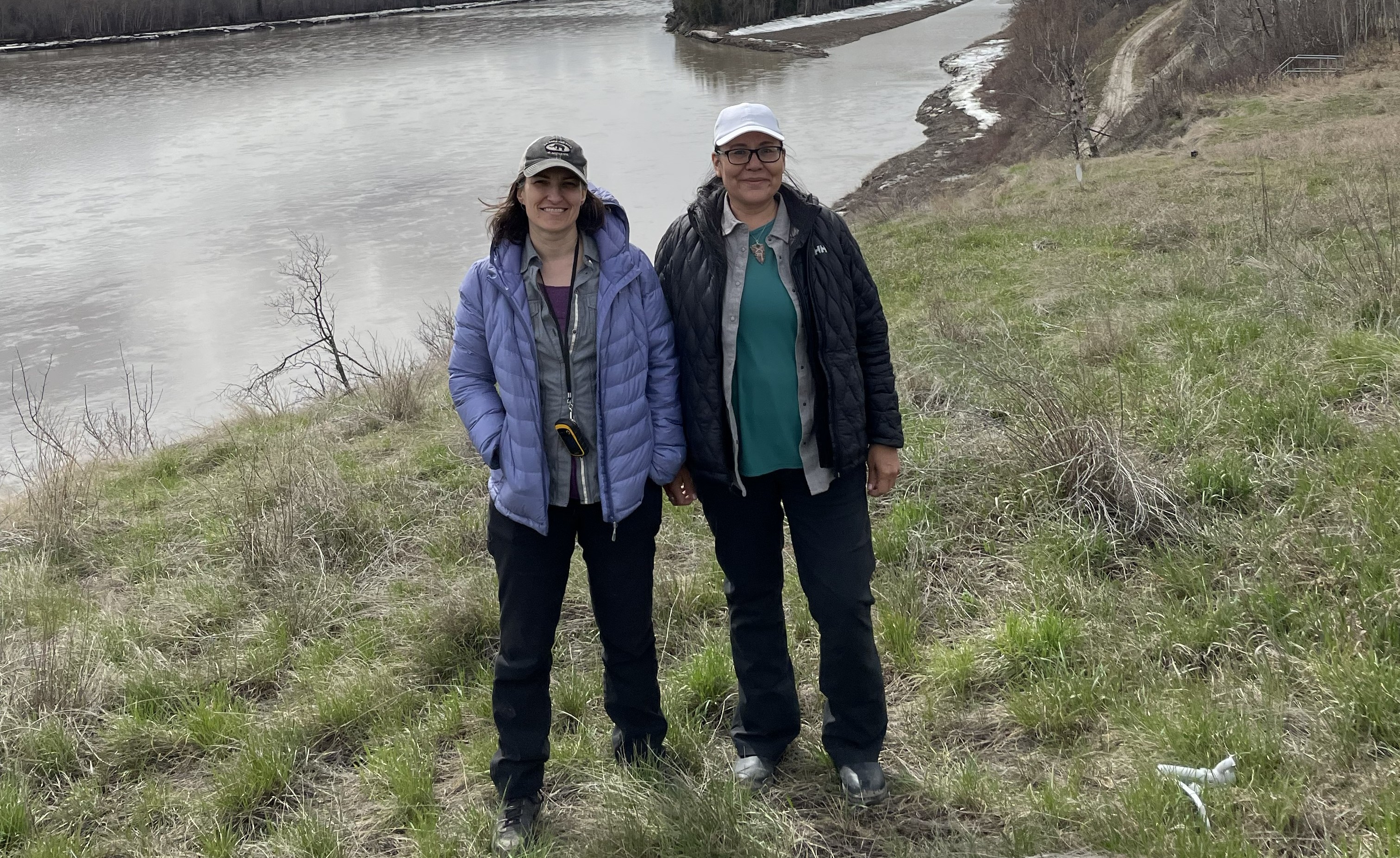
Two women stand beside a river

Dr. Metcalfe (left) with research partner Victoria Wanihadie (right) near Green Island along the Peace River in Alberta (Tsattine territory) in 2022 as part of her community-based research with Tsattine people. Dr. Metcalfe is one of the authors of the article Paleogenomic insight into the collapse, recovery, and management of American bison published in the August 2026 issue of the prestigious journal Science. "My bison research provides a more recent window into the human past around 10,000 years ago," she says.

Indigenous people, who have been in North America for tens of thousands of years, had to learn how to share their environment with these ancient giant mammals, which researchers call megafauna.

"I study the remains of ancient megafauna to learn more about their diets and past climate and ecological changes," Dr. Metcalfe says.

"Megafauna are fascinating and they help us understand human history. There was a great diversity of them on every continent until just after the ice age ended, when many of the largest ones went extinct. Some megafauna like bison have persisted, but they became smaller in size."

According to Dr. Metcalfe, megafauna were important to human survival. They were hunted for food, their bones were used to make houses and tools, and their fur and skin were made into clothing. They also had—and still have—spiritual importance to Indigenous Peoples.
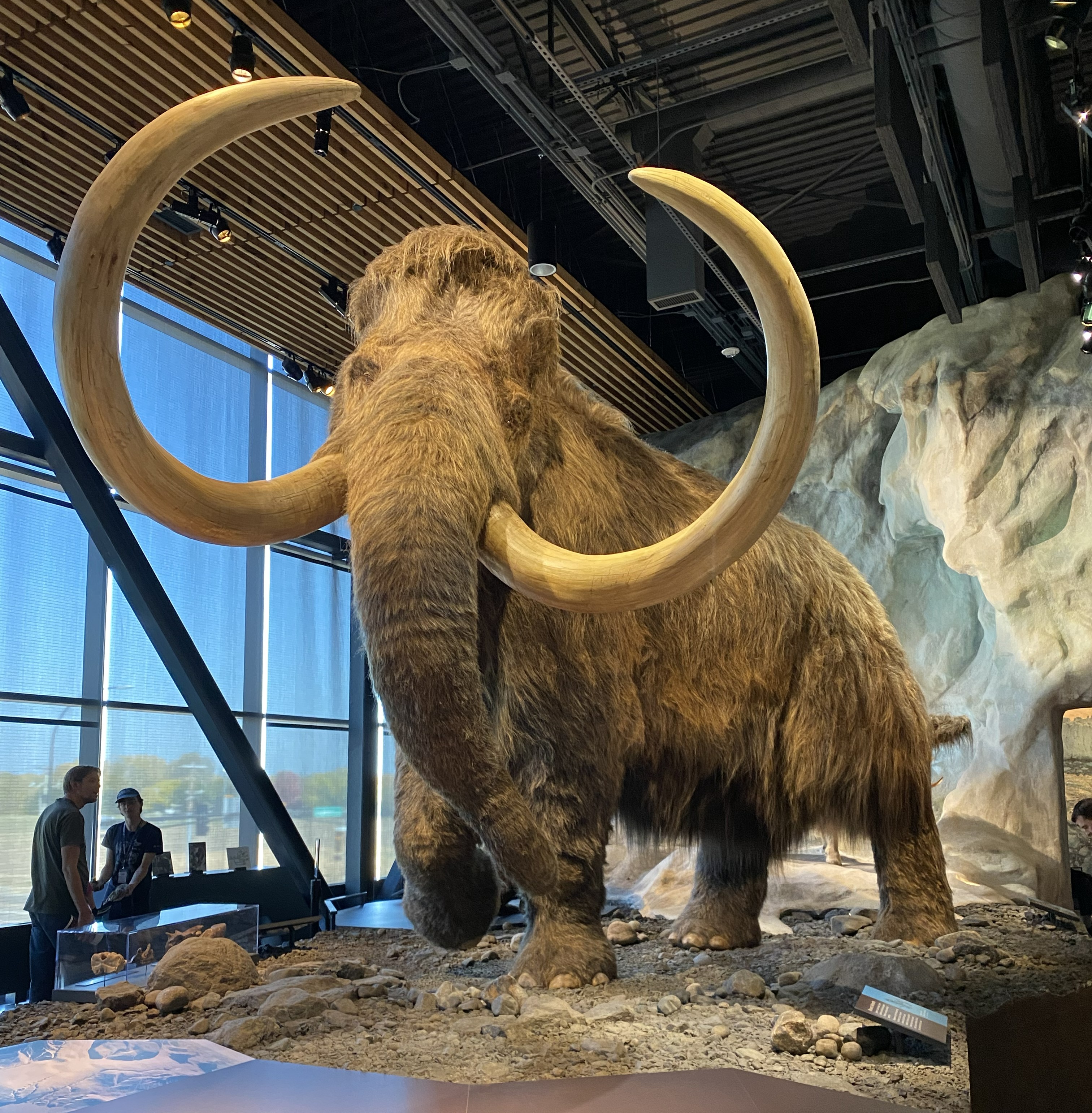
A reconstruction of a woolly mammoth on display at a museum

Dr. Metcalfe has found that Clovis-era woolly mammoths in Arizona that lived circa 13,050 to 12,750 years ago became extinct when monsoon rains stopped and the region became drier. Left, a reconstruction of a woolly mammoth, Mammuthus primigenius, at the Bell Museum in St. Paul, Minnesota.

The fossils of these animals are located across the traditional territories of Indigenous Peoples, and Dr. Metcalfe's research has found that anthropologists, archaeologists, and palaeontologists can learn a lot from Indigenous oral histories.

"Indigenous Peoples who co-existed with megafauna have rich stories about creatures like woolly mammoths and giant beavers the size of bears. They also talk about how perilous it was to live alongside megafauna."

Engaging in community-based anthropological research with Indigenous partners—such as the Tsattine (Beaver Dene) in Alberta—is integral to her work. "I'm trying to work toward braiding Indigenous knowledge and western knowledge through an approach known as 'two-eyed seeing.'"

This approach is becoming more common among settler scholars who are seeking to conduct ethical and responsible research and counteract harms caused by old approaches.

"There is a long history of western scientists ignoring Indigenous knowledge and removing ancient remains from their territories without permission," Dr. Metcalfe says. "The situation was worsened by anthropologists who treated Indigenous peoples as subjects to be studied, rather than as collaborators in learning."

Unlocking the Secrets of Megafauna

Dr. Metcalfe doesn't usually make her discoveries on far-flung archaeological digs. Instead, she concentrates on studying the biogeochemical compositions of previously collected materials housed in museum and university collections.

In her Metcalfe Archaeological Studies (MASS) research lab on Lakehead University's Thunder Bay campus, she reconstructs the diets and migrations of megafauna and their interactions with humans and the environment.

She uses sophisticated instruments to study the hair, bones, and teeth of megafauna fossils.
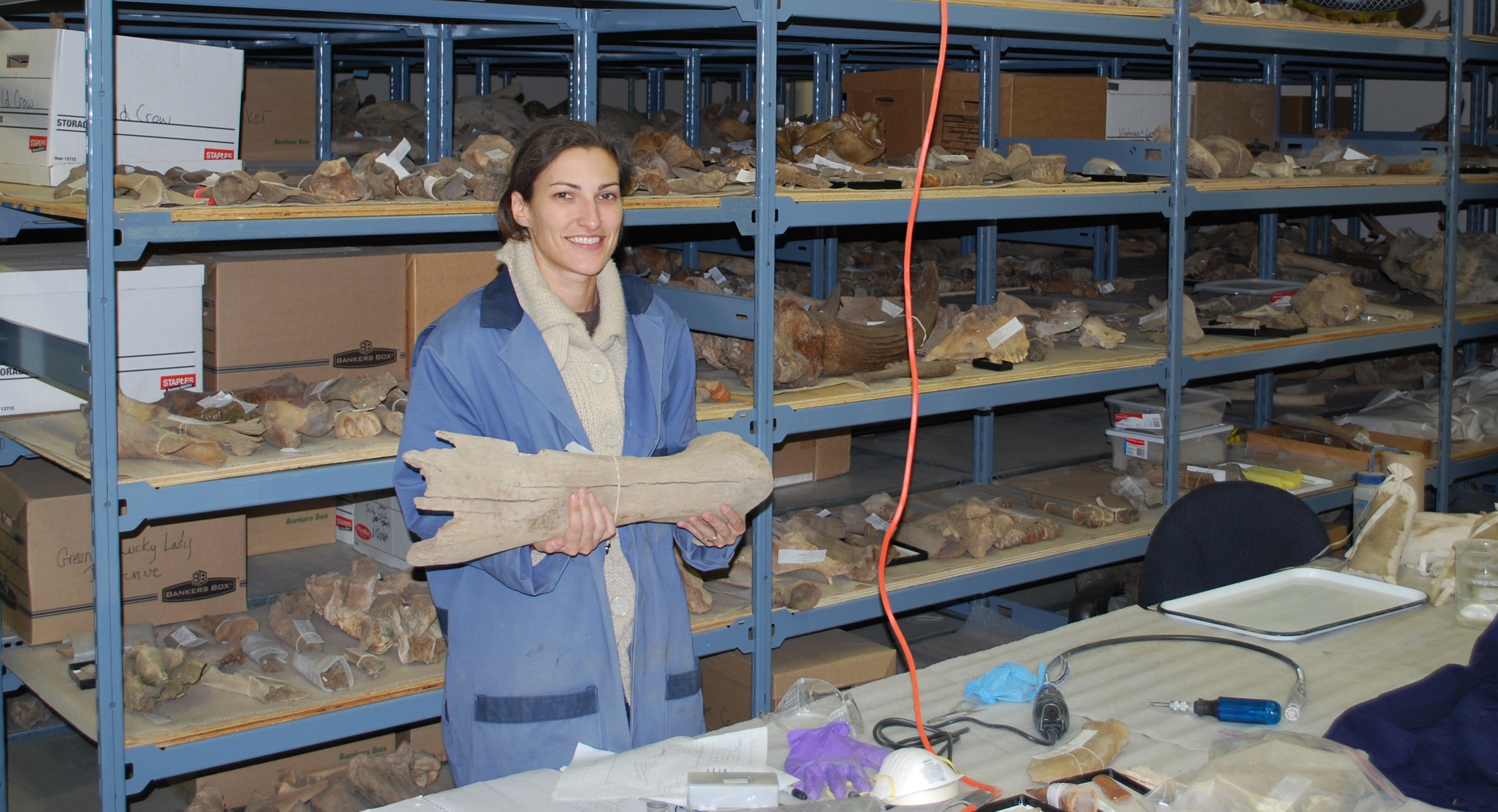
Dr. Jessica Metcalfe with Woolly Mammoth Bone

Dr. Jessica Metcalfe sampled woolly mammoth bones in Yukon as part of her PhD research. Above, Dr. Jessica Metcalfe holds a woolly mammoth bone in 2008 when she was a PhD student.

Mass spectrometers, for instance, enable her to examine tiny mass variations in carbon, nitrogen, oxygen, sulfur, and other non-radioactive chemical elements in fossils. These stable isotopes do not break down over time, so they provide a record of the environmental conditions when the animal was alive.

"Fossil bones and teeth can indicate the type of climate megafauna lived in. You can tell whether it was warm, cold, wet, or dry, and how animals responded to these climatic conditions in terms of which types of plants they ate and their mobility patterns."

A Land of Mammoths and Mastodons

Dr. Metcalfe's methods, in combination with Indigenous knowledge, have helped her uncover crucial insights into megafauna. This includes her bison research and the mammoth and mastodon research that she has recently returned to.
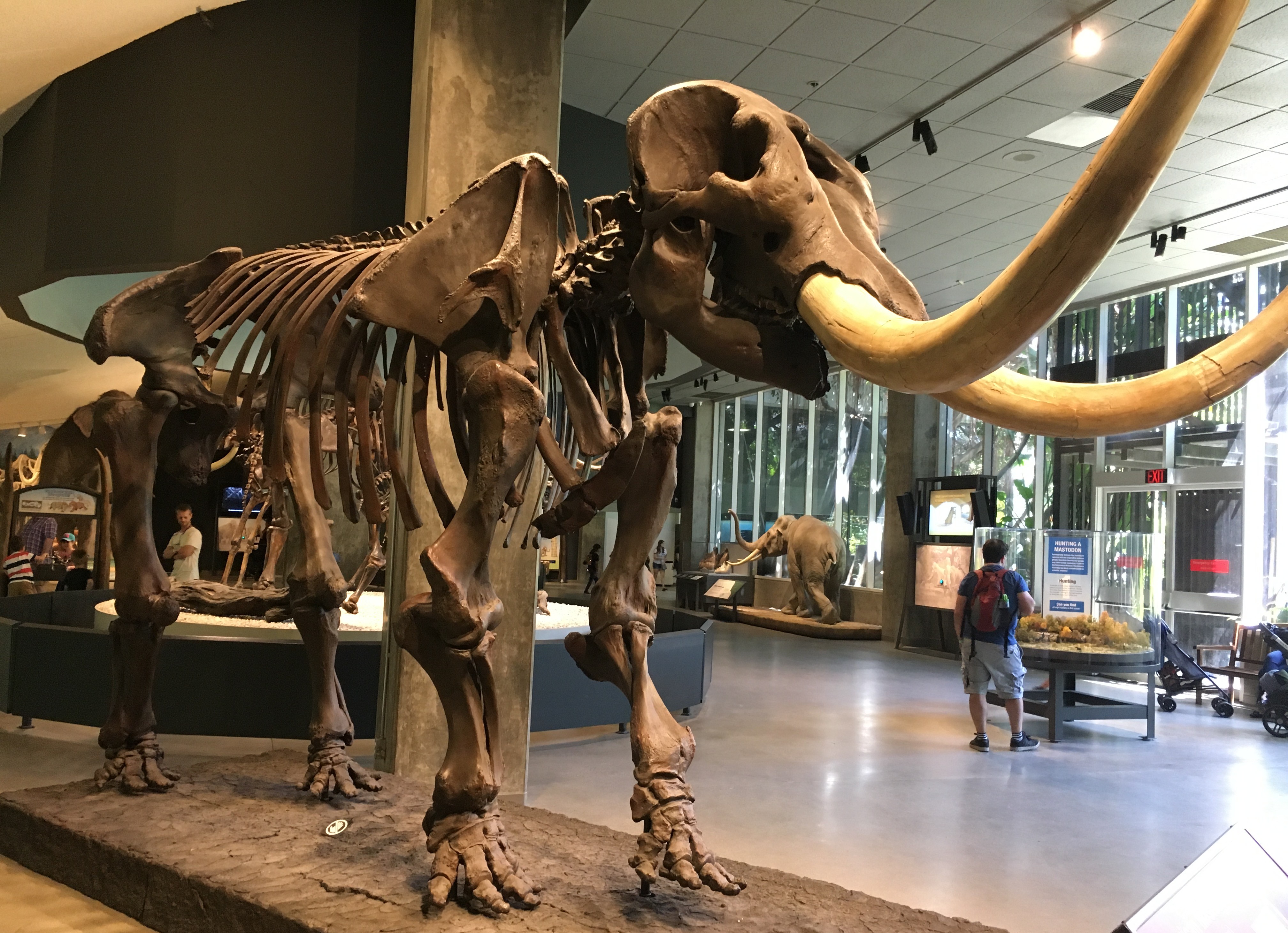
A mastodon skeleton on display at a museum

Elephants, woolly mammoths, and mastodons are all members of the proboscidean family. Woolly mammoths and mastodons weighed up to eight tons, while elephants can weigh up to seven tons. When it comes to megafauna, Dr. Metcalfe says she's partial to herbivores, but she has a hard time picking her favourite one. "If push came to shove, I would say mastodons are my favourite. I also love giant beavers and giant sloths, which lumbered around using their massive claws to eat trees and maybe even dig up roots." Above, an American mastodon, Mammut americanum, skeleton at the La Brea Tar Pits Museum, California.

Her study of the tooth enamel of mastodons in southern Ontario suggests mastodons were able to adapt to a warmer climate after deglaciation before going extinct. This finding was strengthened by her analysis of mastodon bone collagen that suggested that the disappearance of mastodons' wetland habitat was a greater factor in their extinction than warmer weather.

Some of Dr. Metcalfe's current research into woolly mammoths is being done in collaboration with Yukon government palaeontologist Dr. Grant Zazula, who was also part of a 2026 Canadian Quaternary Association session on megafauna that Dr. Metcalfe organized.

"We reconnected because of a well-preserved baby mammoth, named Nun cho ga, that emerged from the Yukon permafrost on National Indigenous Peoples Day in 2022. It was the first time that a woolly mammoth with soft tissues was found in North America," she says.
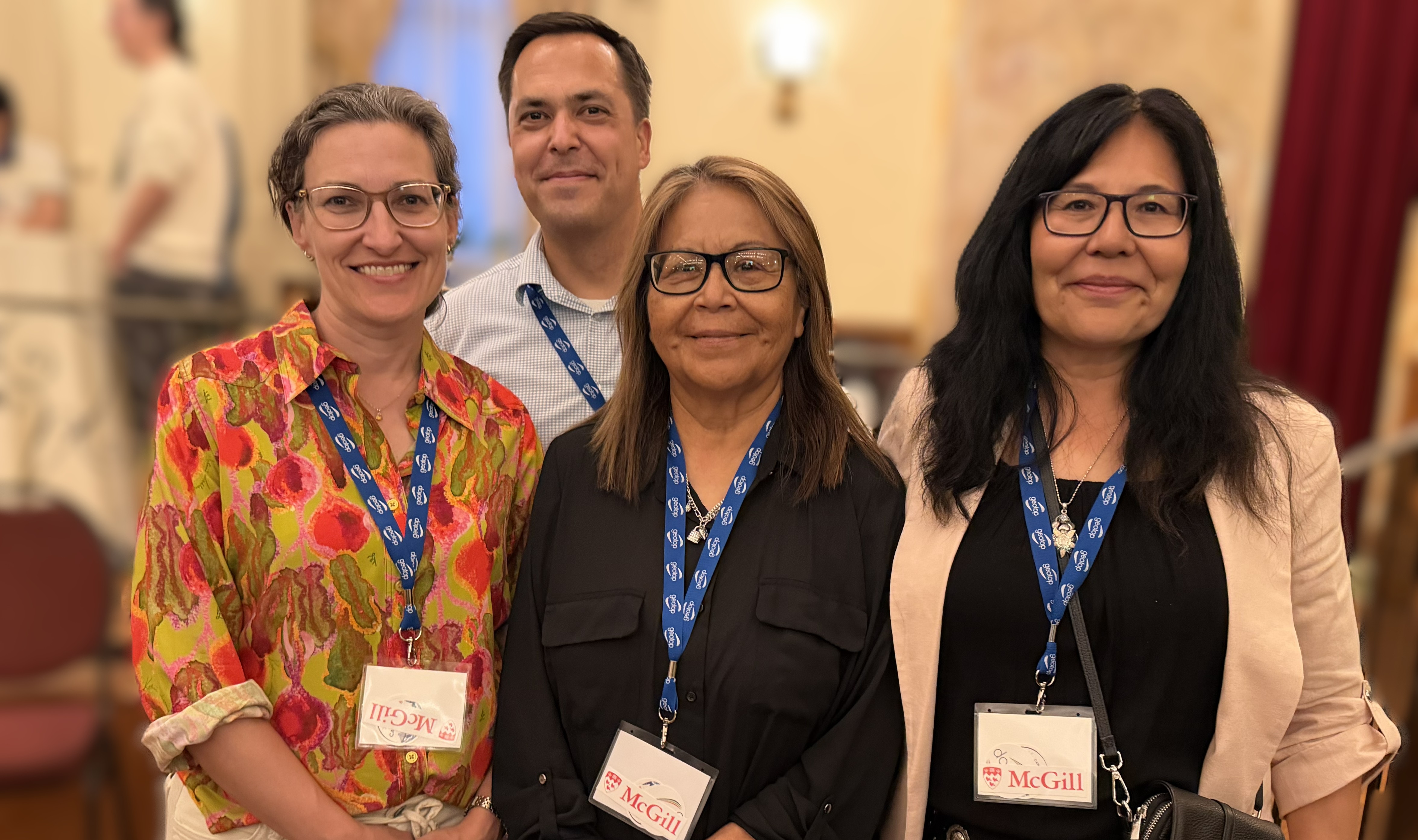
A group of four people wearing lanyards and business casual clothing

In June 2026, Dr. Metcalfe organized a Canadian Quaternary Association session called "Powerful megafauna: Palaeontological and Indigenous perspectives on giant animals in western Canada." Session organizers and presenters Jessica Metcalfe (far left) and Victoria Wanihadie (far right) presented on what they have learned from their collaborative research in western Canada. Presenters Edward Jolie (middle left) and Sharon Gloshay (middle right) discussed the footprints at White Sands National Park as evidence of Native American relationships with megafauna. Dr. Metcalfe is currently co-editing a special issue in the journal Palaeogeography, Palaeoclimatology, Palaeoecology about proboscideans.

Instead of taking this ancient baby animal as government property, Dr. Zazula immediately partnered with the Trʼondëk Hwëchʼin First Nation, on whose land the animal was found, and who named the woolly mammoth Nun cho ga.
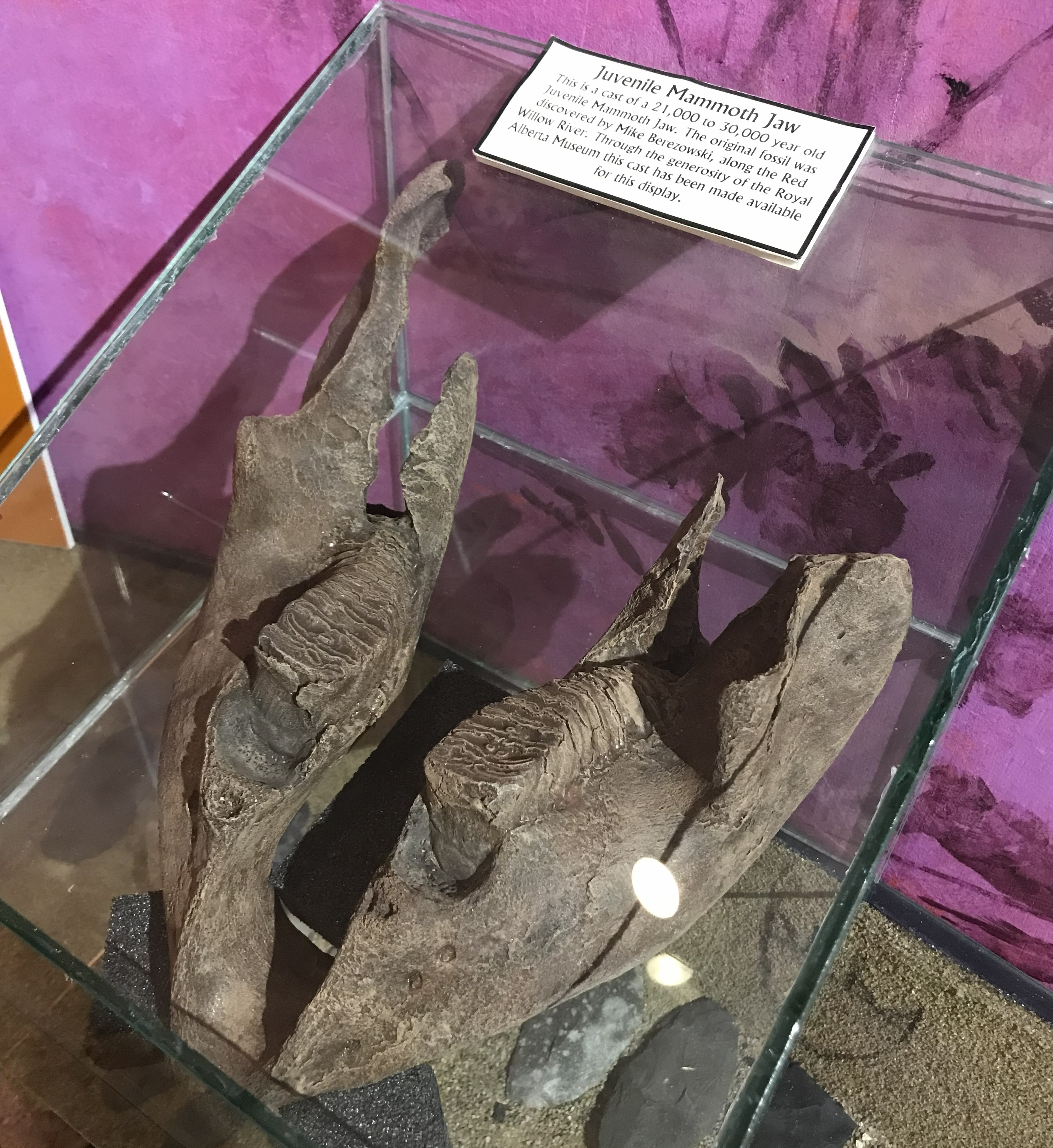
A cast of a juvenile mammoth jaw bone in a display case

"One of the differences between mammoths and mastodons is that their teeth were extremely different," Dr. Metcalfe says. "Mammoth teeth were like washboards for grinding toughgrasses while mastodons had big pointy peaked teeth for eating woody plants and shrubs." Left, a cast of a juvenile mammoth jaw on display at the Grande Prairie Museum, Alberta.

"They speak of Nun cho ga as an ancestor and a relative, which is very different from seeing it as a scientific specimen," Dr. Metcalfe says. "Nun cho ga has brought their community together and become a focus for asserting their rights as Indigenous people."

Dr. Metcalfe's previous research has provided a window into how Yukon woolly mammoths reared their young. Her analysis of the bones and teeth of woolly mammoth calves indicates that they nursed for a long time, similar to modern elephants in stressful environments.

"This was likely related to the long nights of darkness in the Arctic region, which meant that baby mammoths had to stay very close to their mothers to avoid predators such as Beringian lions," she says.

"Megafaunal fossil remains are the literal and metaphorical bones that archaeology and palaeontology are built upon," she adds.

Lakehead University gratefully acknowledges the following grants Dr. Metcalfe has received for her research:

2025 NSERC Discovery Horizons Grant (five-year grant) for the research project, Follow the Bison: Insights into Environmental and Cultural Change

2019 SSHRC Insight Development Grant (two-year grant) for the research project, Dene Bison Hunting and Migration: Western Science and Indigenous Perspectives
Lakehead University Wins 2026 County of Simcoe Age-Friendly Award

Third Age Learning Program Enables Lifelong Learning for Seniors

Lakehead University's Office of Community Engagement and Lifelong Learning (CELL) has received a 2026 County of Simcoe Age‑Friendly Business Recognition Award.

These awards celebrate local businesses, organizations, and community members who help create welcoming, inclusive, and accessible environments for older adults across the region.

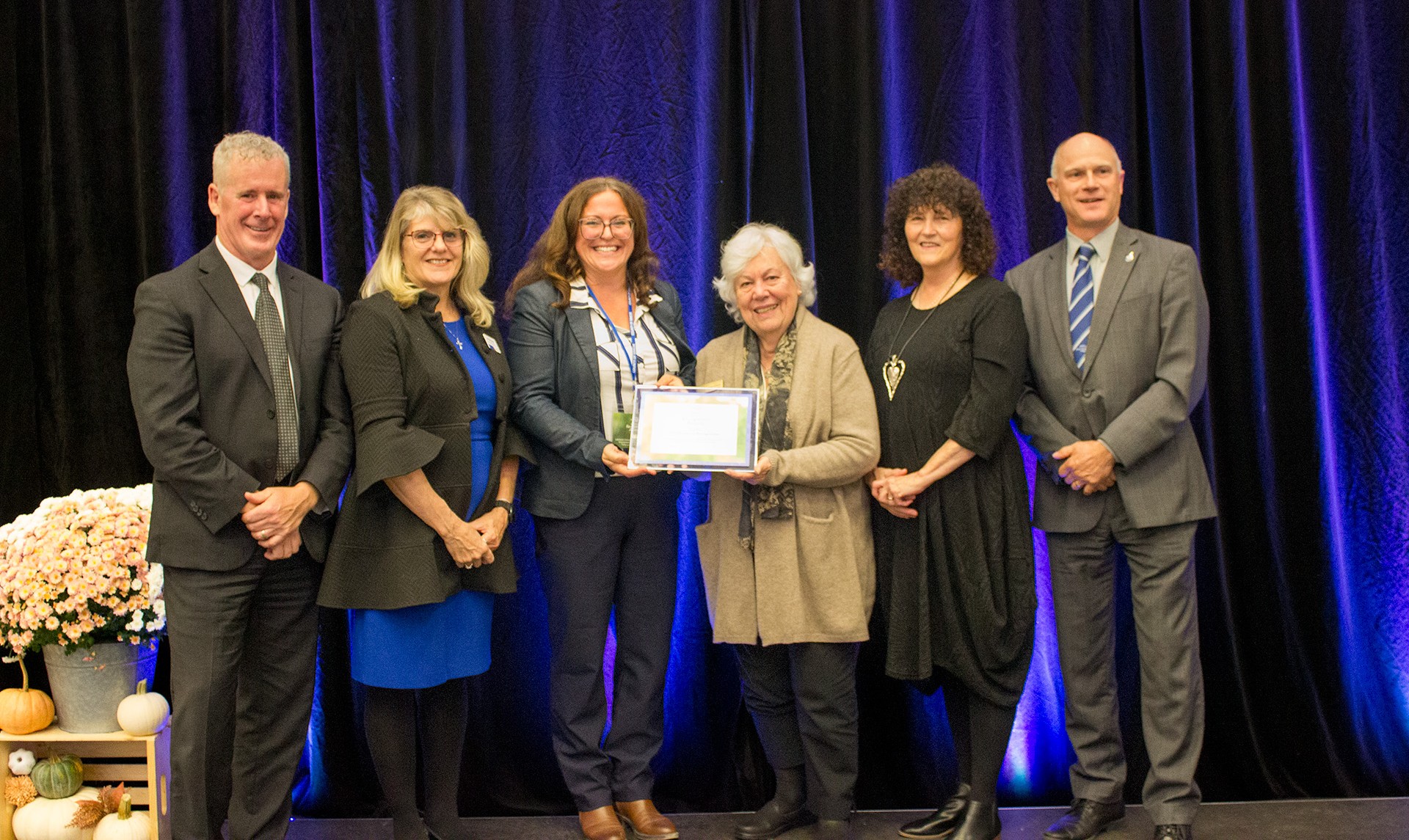
A group of people stand on a stage with a blue curtain behind them; two women in the centre hold a plaque

Above, CELL Director Nicky Locker (third from left) and TALL Coordinator Anne Hilliard (third from right) accept CELL's 2026 County of Simcoe Age‑Friendly Business Recognition Award from Township of Oro-Medonte Mayor Randy Greenlaw, Commissioner of Health & Emergency Services Jane Sinclair, Township of Essa Mayor Sandie Macdonald, and Warden Basil Clarke.

"Third Age Learning Lakehead (TALL) is one of our flagship age-friendly programs, and we are humbled to be recognized in this way," says CELL Director Nicky Locker. "Seniors are central members of Lakehead University's academic community here in Simcoe County, and their passion for lifelong learning is inspiring for all of us."

TALL includes a five-part lecture series that delivers thought-provoking educational opportunities for adult learners over 50, alongside additional learning opportunities. A volunteer committee of seniors chaired by Anne Hilliard—a retired Simcoe County elementary school principal—advises on focus areas and ensures the program meets the needs of its participants.

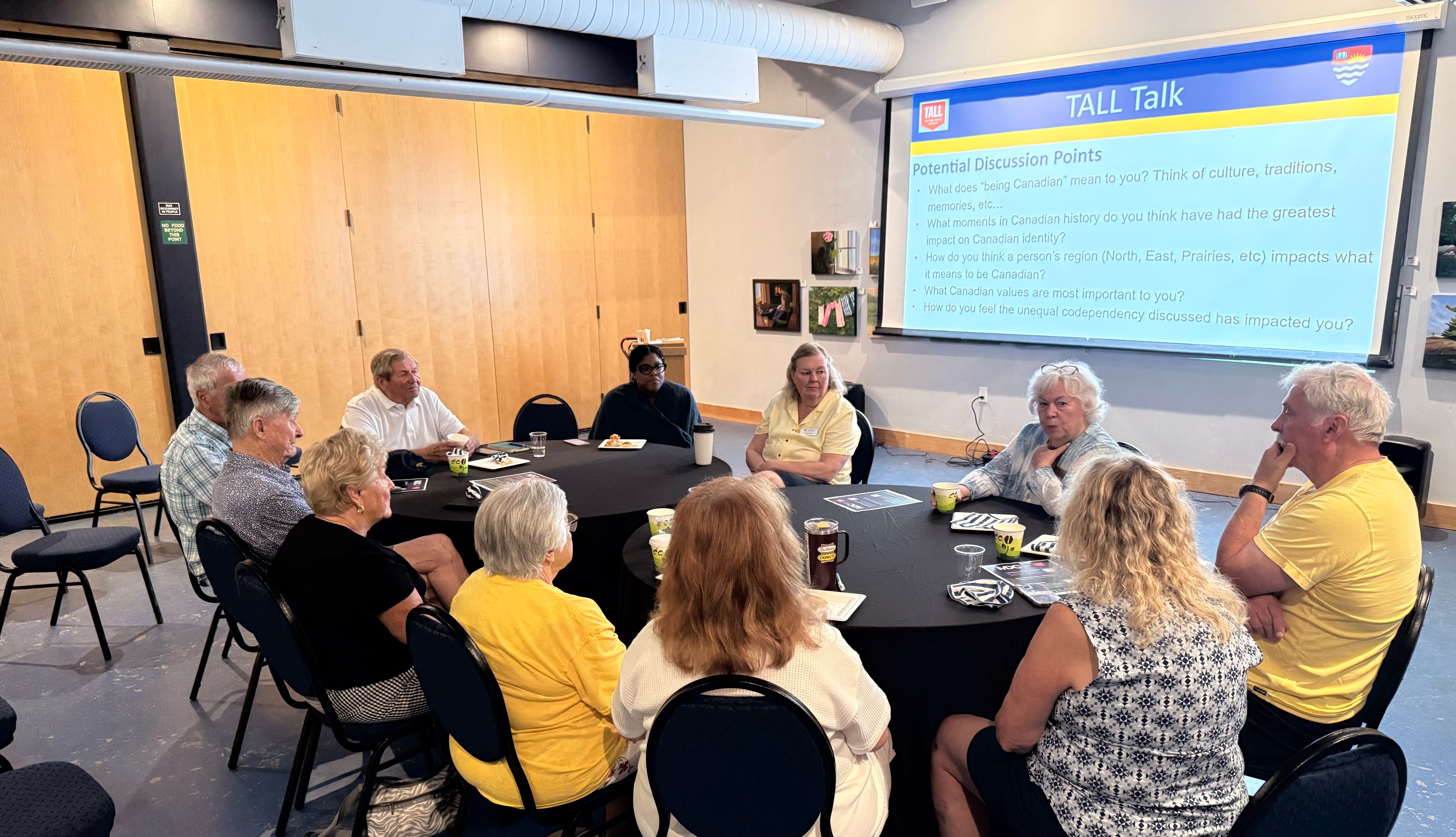
A group of older adults, and one young person, sit at two tables in a room with cabinets and a large display screen

A meeting of TALL Committee members.

"TALL enables engagement, connection, and lifelong learning." Locker says. "We want to foster social networks and a sense of community."

CELL does this by making TALL, and other programming that seniors can participate in, easy to access. Events are held on Lakehead University's Orillia campus, locations throughout Simcoe County, and via livestream so that people from across the country—including alumni and people in Lakehead University's Thunder Bay and Barrie communities—can attend.

There are also plans to begin hosting in-person events on the Thunder Bay campus soon.

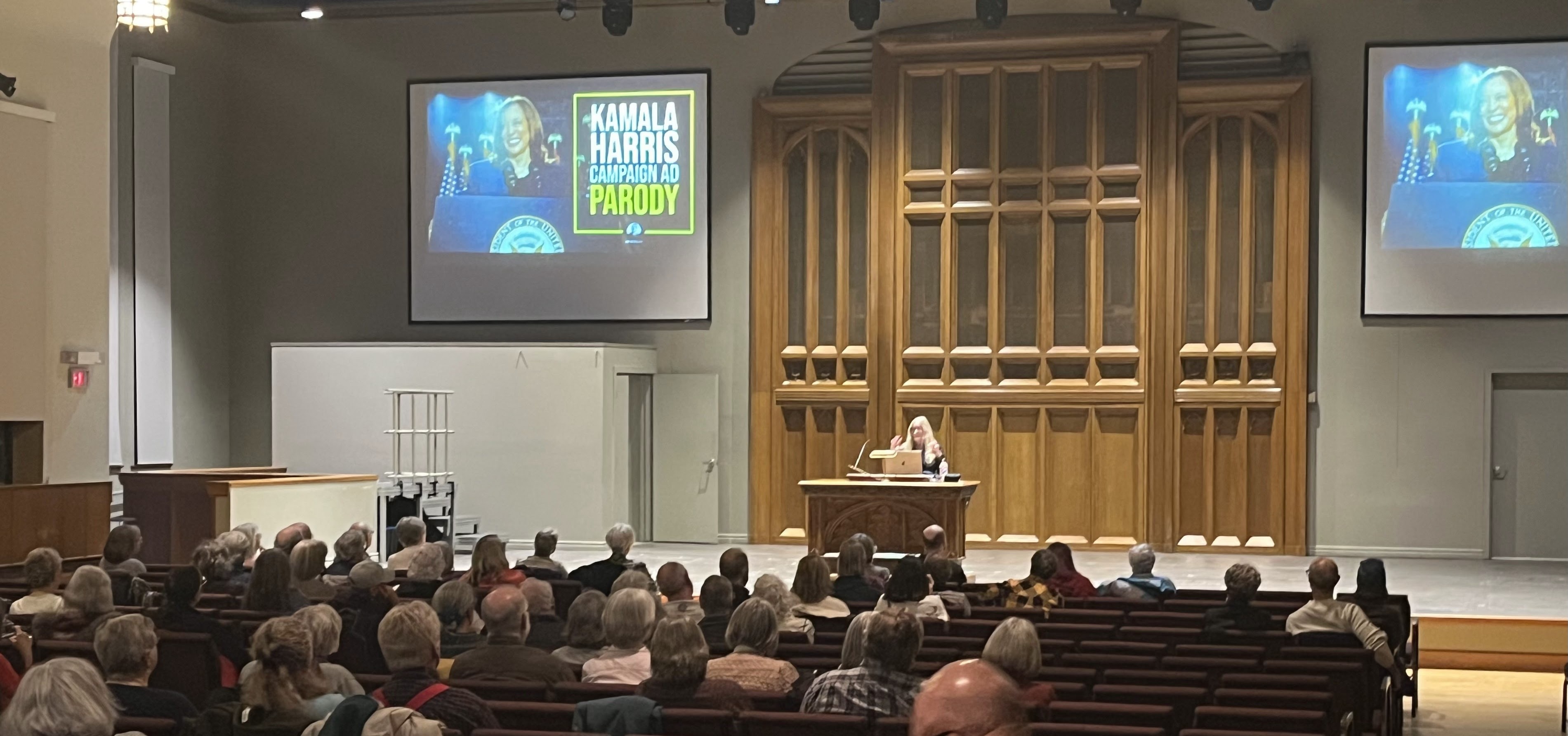
An audience in a church listen to a woman speak on stage; there are two large projection screens on the wall

TALL lectures include a 20-minute coffee break to give attendees time to discuss what they've heard and to think of questions to ask during the Q & A session that follows every lecture. Above, a TALL wine-and-cheese event held at Orillia's St. Paul's Church in March 2025. Lakehead professor Dr. Sandra Jeppesen gave a lecture entitled, "Disinformation, deepfakes, memes, and riots in the context of US elections: Is public debate bad for democracy?"

"When I coordinate CELL activities like TALL, the Ontario Master Naturalist Program (OMNP), Professional Development Training courses, and other CELL workshops, seniors and retirees are often among the first ones to sign up," Locker says.

In fact, a local senior leads the OMNP. Bob Bowles, 81, established this program at Lakehead University 14 years ago, which was the first of its kind in the country. OMNP participants can choose the nine-week online certificate program or individual workshops that take place locally to learn about nature and environmental stewardship.

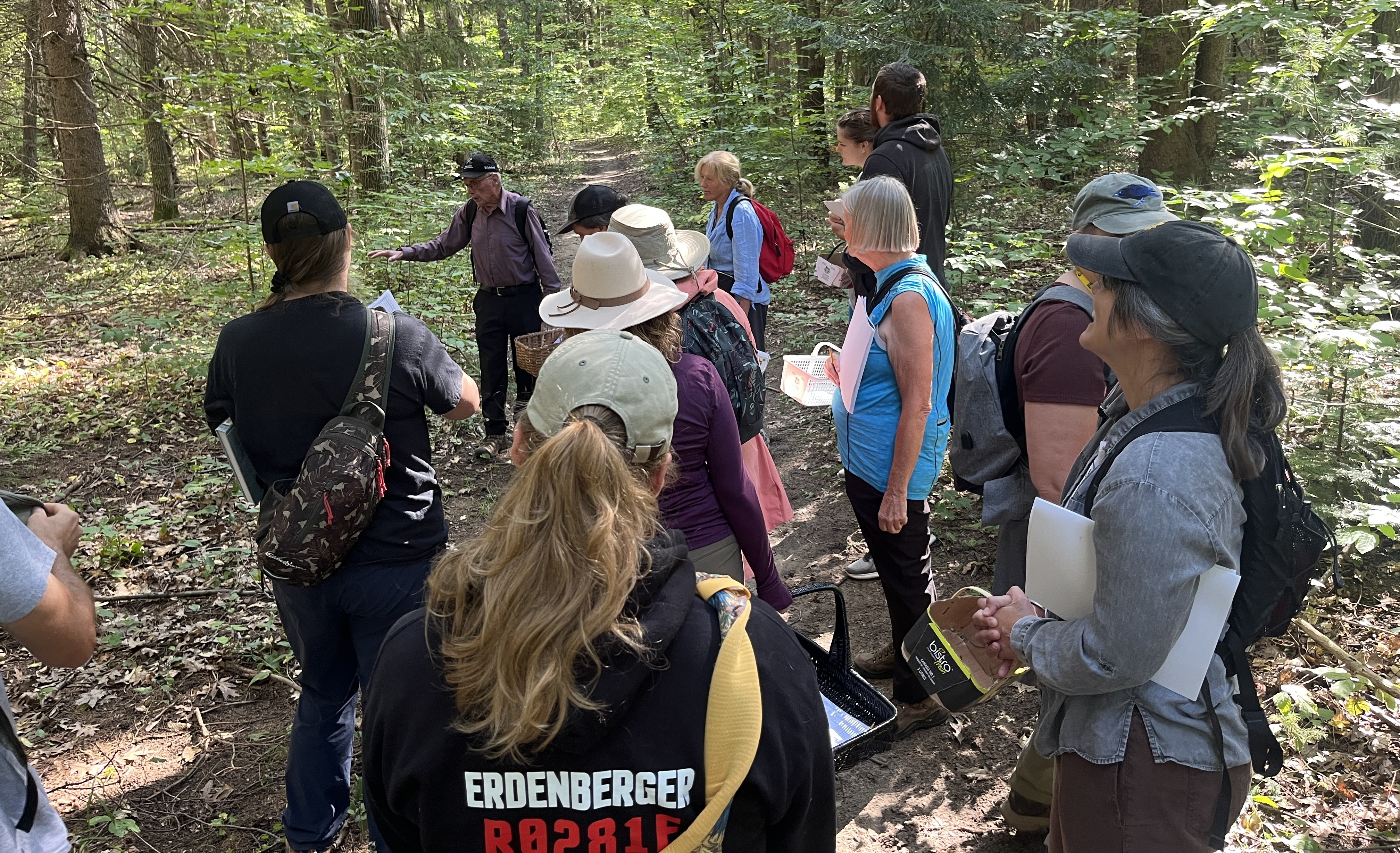
A group of people in a forest holding baskets listen to an older man speak

"The presence of CELL in our community allows seniors to network across all generations, learn, and mentor others," CELL Director Nicky Locker says. "They frequently bring their children and grandchildren to our programming." Above, 81-year-old master naturalist Bob Bowles leads participants interested in learning about mushrooms on a three-hour trek through Simcoe Country's Copeland Forest in his "Magical, Mystical Mushrooms" workshop held on September 13, 2026.

Locker notes that seniors who participate in TALL and OMNP are keen to "show up and be part of the solution when it comes to making the world a better place. They don't shy away from complex issues, such as environmental and social justice, and they often express a desire to get their children and grandchildren involved."

The next TALL series faces these issues head-on. October 7 marks the start of the 2026-27 TALL lecture series "A Time for Change: Evolving Our Civilization" with a talk from climate-technology expert Akhil Puri discussing how we can build lives and institutions capable of meeting the challenges of both today and tomorrow—including AI risk, inequality, climate change, and political polarization.

One lecture that will be sure to get people talking takes place on October 21. "Watching Trump from Afar - Elbows Up World," will be presented by Larry Black, an 89-year-old former NATO research fellow and Canadian Security and Intelligence Service instructor.

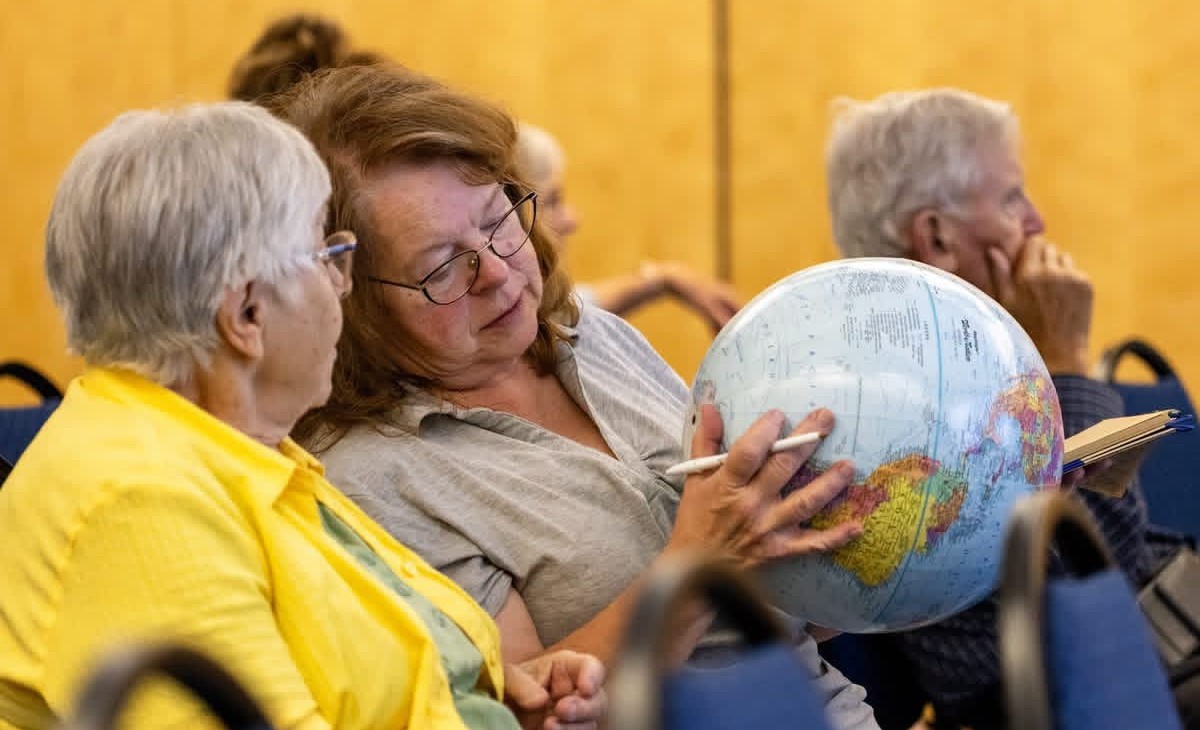
A seated older woman holds a globe while another seated older woman looks on

CELL partners with diverse community organizations like the Orillia Museum of Art and History, the Couchiching Conservancy, and the Muskoka Discovery Centre to host unique events, workshops, and programming. "We're working together to make our region a place where everyone can participate, share their stories, and continue to learn together," CELL Director Nicky Locker says. Above, participants at a September 16, 2026, TALL session held at the Muskoka Discovery Centre. It was led by Lakehead education professor Dr. Gary Pluim and was called "Reading the World: The Case for Geographic Literacy in Education."

Locker is committed to continuing to do the work that led to Lakehead University's nomination for the County of Simcoe award. "Seniors ask us to tell it to them straight, to give them hope, and to show them how they can take action. They want to leave a legacy of care and activism."

"At its core, CELL promotes an age-friendly philosophy by ensuring older adults have opportunities to learn, contribute, participate, and connect," says Lakehead University Orillia Principal Dr. Linda Rodenburg.

The first talk in the TALL lecture series, "How to Build a Self-Correcting Life—and Civilization," is taking place this morning. TALL talks cost $20 per lecture or $80 for the entire series.

Trash to Treasure Table - Now Open!

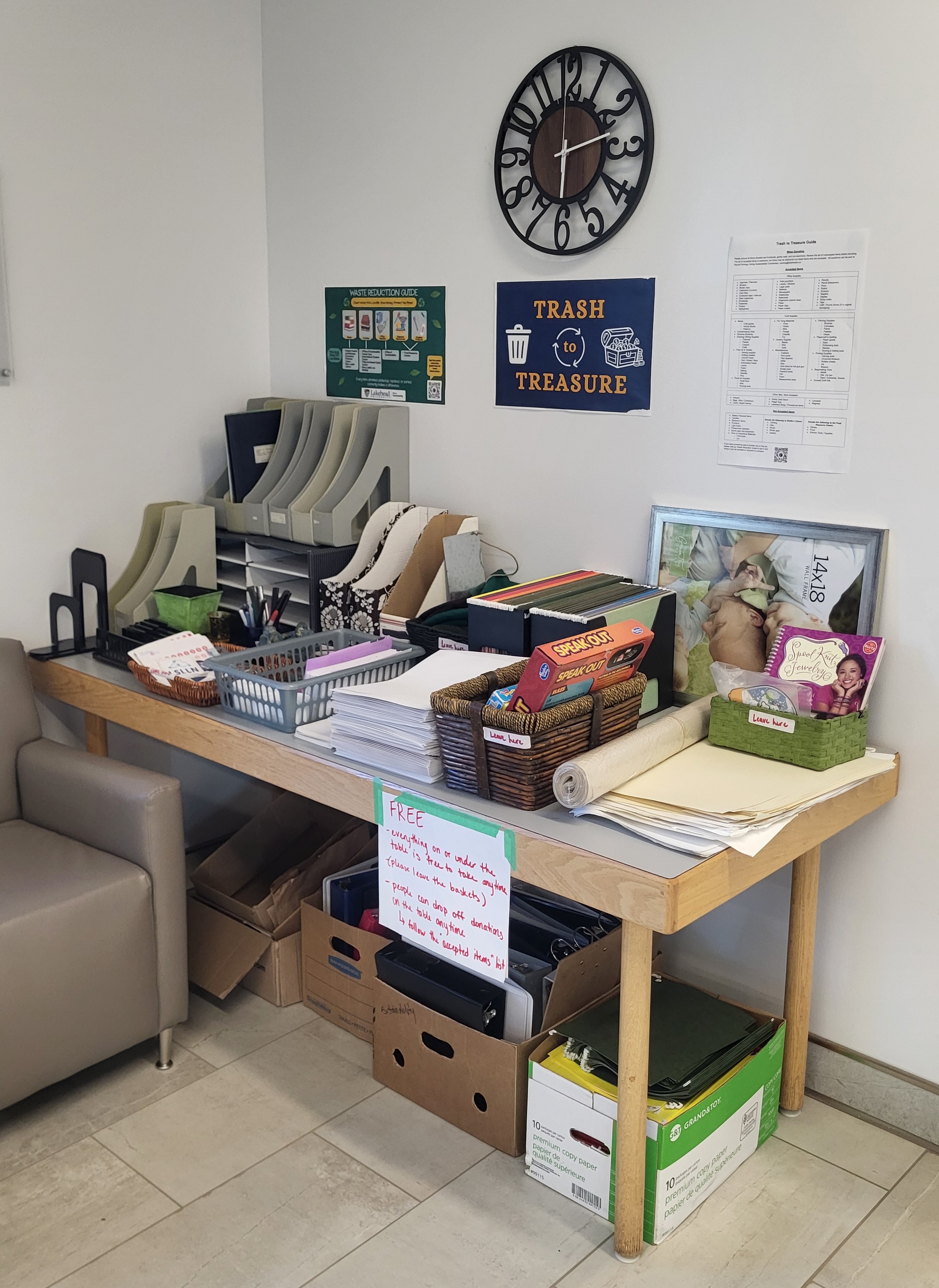
The Office of Sustainability is proud to launch Lakehead University's first Trash to Treasure Table!

Available on the Thunder Bay Campus, this table of incredible finds can be found in the CASES Building Lobby, next to the Graduate Student Lounge (FB-2010). We invite all students, staff, and faculty to use this table to donate or take items, free of charge!Table full of donated office supplies

Looking to donate?

This table accepts new and gently used office and craft supplies, games, and a few other miscellaneous items. Please do not donate electronic items. See the full list of accepted donations here.  If you want to know where to donate books, clothes, and kitchen items on the Thunder Bay campus, check out our Waste Reduction Guide. 

If you have any questions about the Trash to Treasure table, please reach out to the Sustainability Coordinator, Rachel Portinga, at rporting@lakeheadu.ca. Happy swapping!


Introducing a Veterinary Student Eager to Make a Difference in the North

Hope Has Been Caring for Animals Since Childhood

Hope Grootenboer is one of the students who'll be helping address northern Ontario's long-term veterinarian shortage.

"I grew up in Murillo, outside of Thunder Bay, on a second-generation dairy farm started by my grandparents," Hope says.

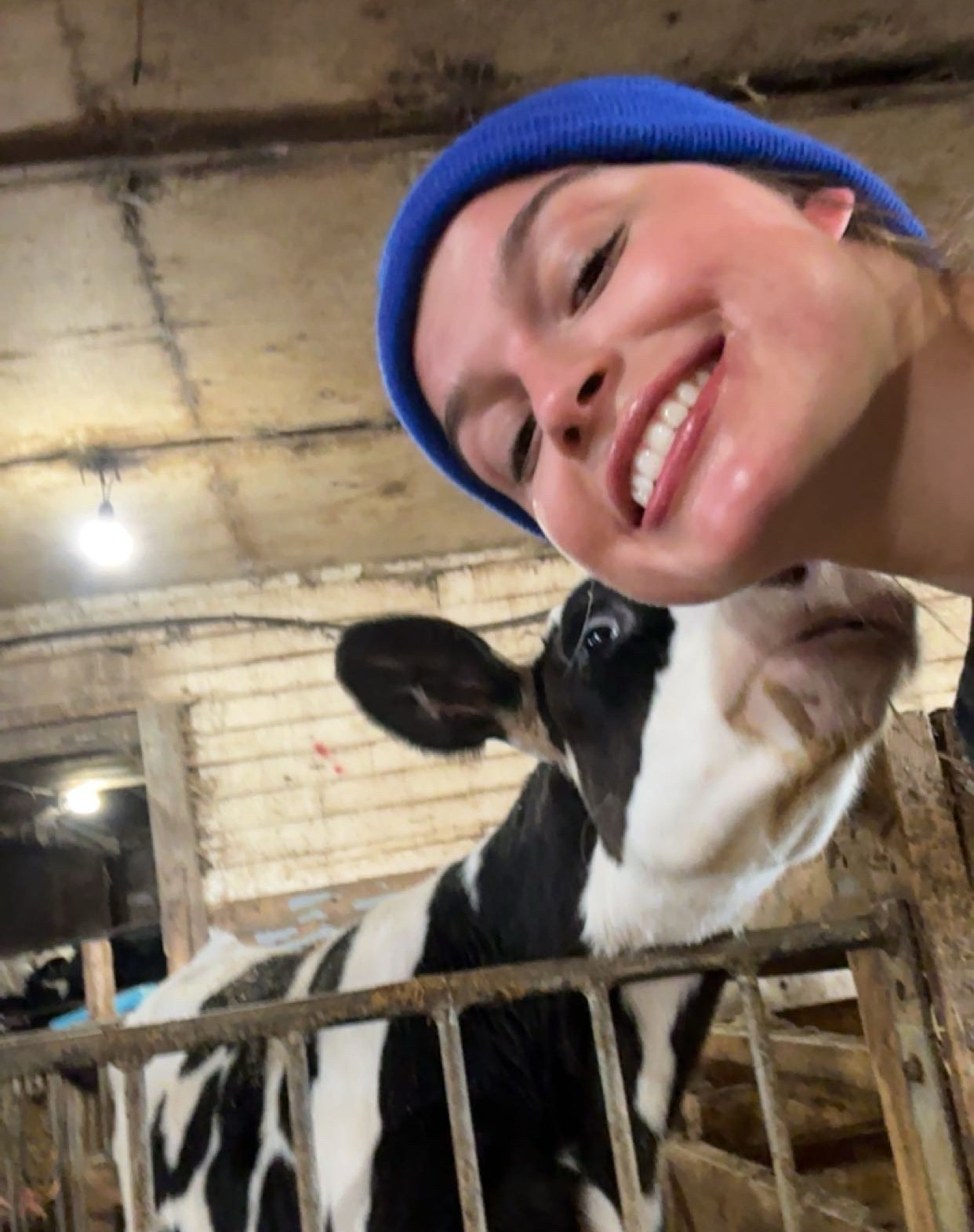
Hope Grootenboer, in a barn, leans her head towards a black-and-white calf as it lifts its head towards her neck

Hope's career ambitions were shaped by her mother as well as her father. "My mom was an emergency room nurse at the Thunder Bay Regional Health Sciences Centre, and I loved hearing about her job," Hope says. "I think that being a veterinarian is the perfect marriage of nursing and farming."

She's just begun her second year in the Collaborative Doctor of Veterinary Medicine Program (CDVMP)—an innovative partnership between Lakehead University and the University of Guelph's Ontario Veterinary College (OVC).

Every year, the CDVMP accepts up to 20 students from northern Ontario to train to become licensed veterinarians. The goal is to help alleviate the veterinary shortage in northern Ontario and ensure that more animals in rural, remote, and Indigenous communities receive proper care.

Beginning in September 2027, CDVMP students will complete the first year of their degree on Lakehead's Thunder Bay campus and their final three years at the OVC in Guelph.

A Born Veterinarian

It's not surprising that when the CDVMP was launched last year, Hope was among those chosen to be a member of its inaugural class.

She'd already accumulated an impressive amount of hands-on experience.

"As a kid, I was always in the barn with the cows or out in the fields with my dad," she recalls. "My Oma would tell people that I would know when a cow was sick before anyone else did."

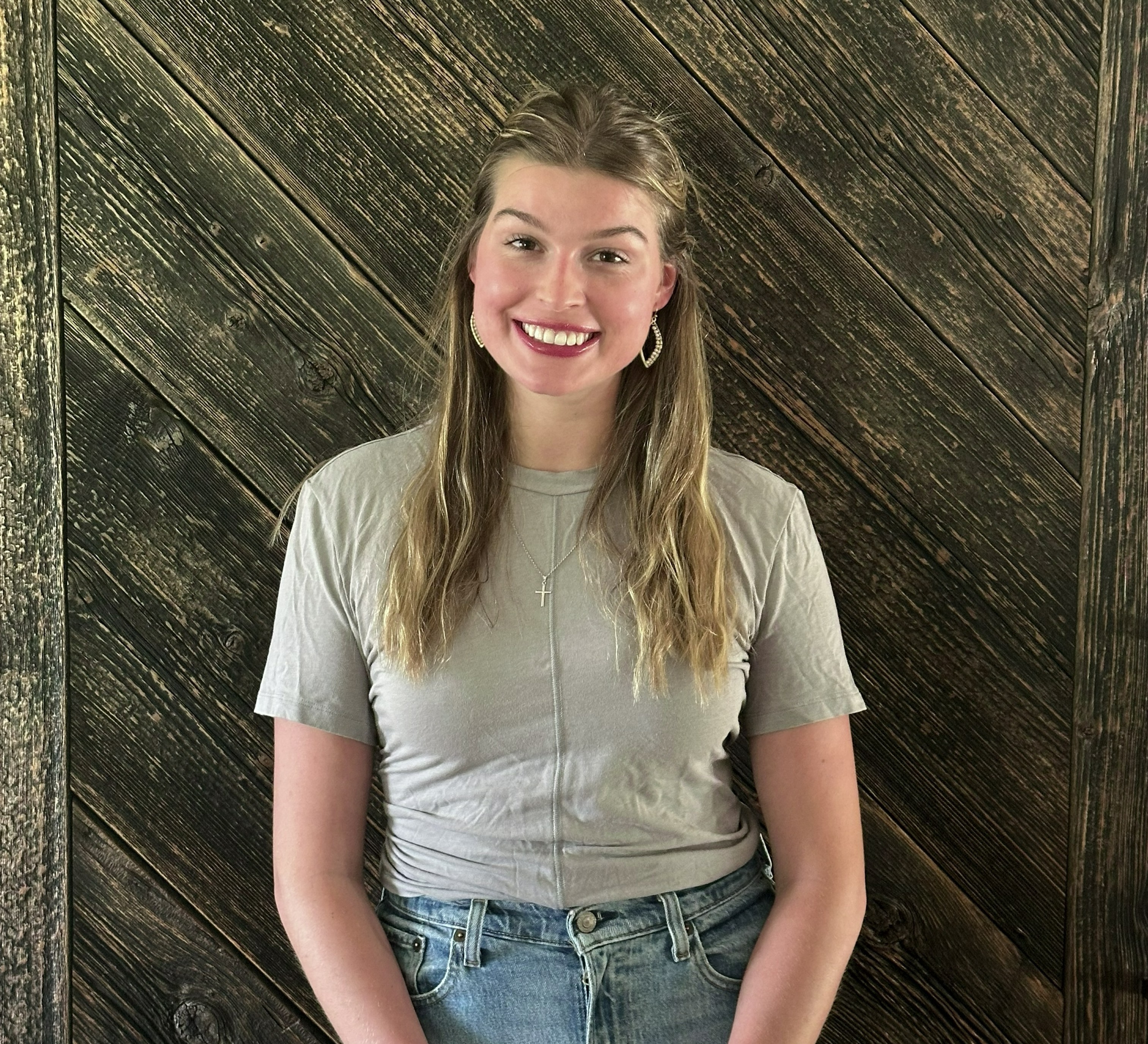
Hope Grootenboer stands in front of wooden plank wall

Hope earned an Honours Bachelor of Science in Biology in 2023 at Lakehead. “My professors were very supportive of everything I did—they remembered my name and I wasn’t just a number,” she says.

It helped that Hope has such a strong bond with these massive animals.

"I love cows! They have unique personalities, just like humans," she says. "I used to lay down in the barn by the calves whenever I was feeling overwhelmed. They helped me de-stress because they're just so happy."

By the time Hope was in grade five, she was already skilled at feeding calves, milking cows, and providing basic care. "That's when I started thinking about becoming a veterinarian," she says.

Then in 2020—while pursuing an Honours Bachelor of Science in Biology degree at Lakehead University in Thunder Bay—Hope was hired as a veterinary assistant at the Northwestern Veterinarian Hospital.

"I still work full time during the summers, and I also picked up hours during the school year when I was doing my Lakehead University degree," says Hope, who graduated in 2023.

"It's great to be able to watch surgeries and shadow both large and small-animal veterinarians. They're very excited when anyone wants to learn and they're happy to teach you."

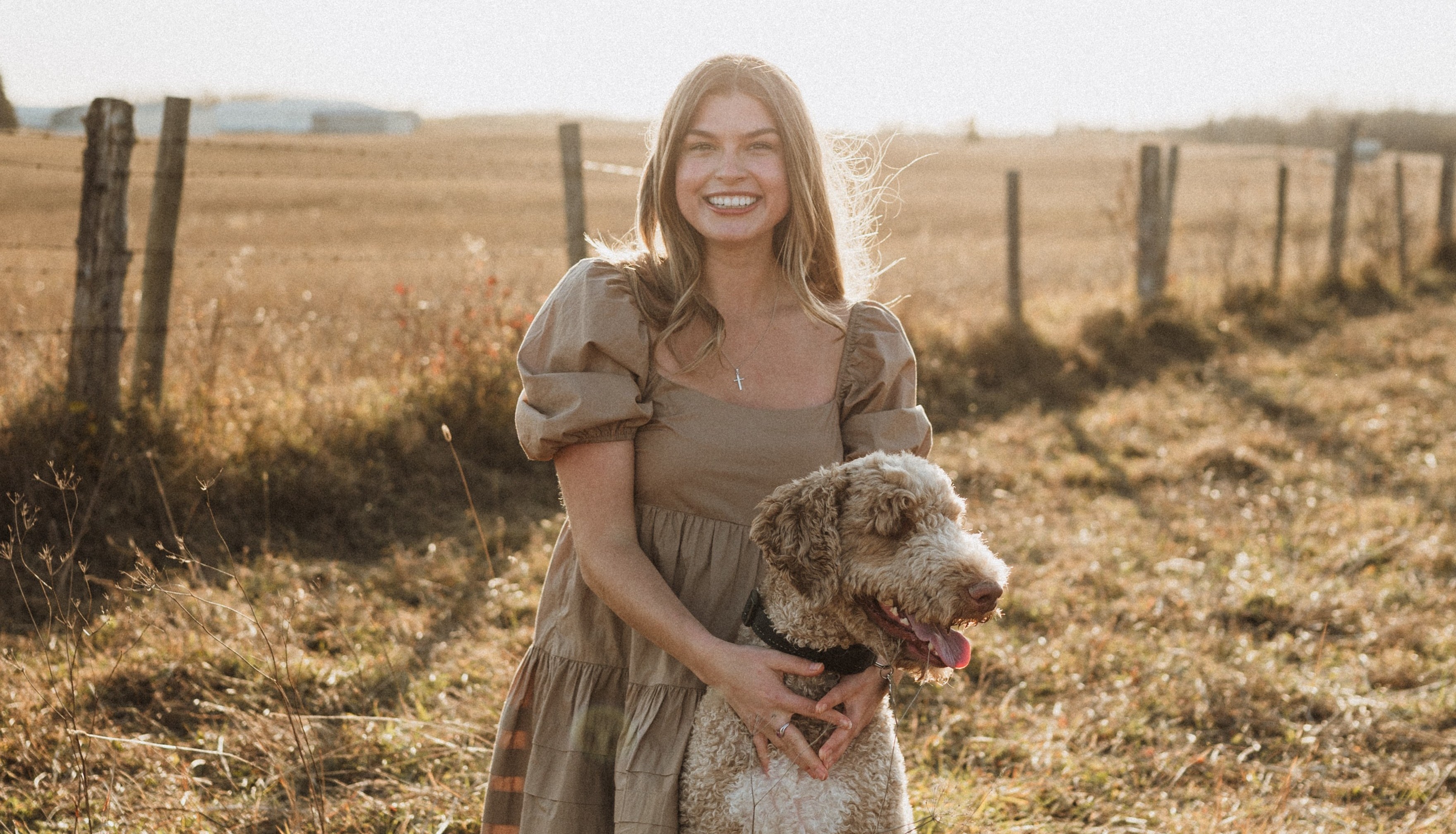
Hope Grootenboer, in a field during the autumn, puts her arms around a dog; a wire fence is behind her

Hope won a Beef Farmers of Ontario Veterinary Scholarship in 2025. "I was elated to be honoured and very surprised to win," she says. Above, Hope on her family farm with her brother's dog Elly.

Her time at Northwestern Veterinarian Hospital has opened Hope's eyes to the struggles veterinarians face due to the shortage of professionals in the north.

"They have to turn away clients because they want to provide the best care possible and there's only so many animals they can see in the day," she says.

"The situation is even worse for farmers whose horses and cattle need medical assistance. There are just two large animal veterinarians in the region—and both of them are on-call 24/7, 365 days a year."

The Busy and Rewarding Life of a CDVMP Student

As Hope embarks on her second year at the OVC campus at the University of Guelph, she's ready to tackle whatever is on the curriculum.

Hope Grootenboer sits on the ground in a barn pen and holds a sheep sitting on its haunches on the ground

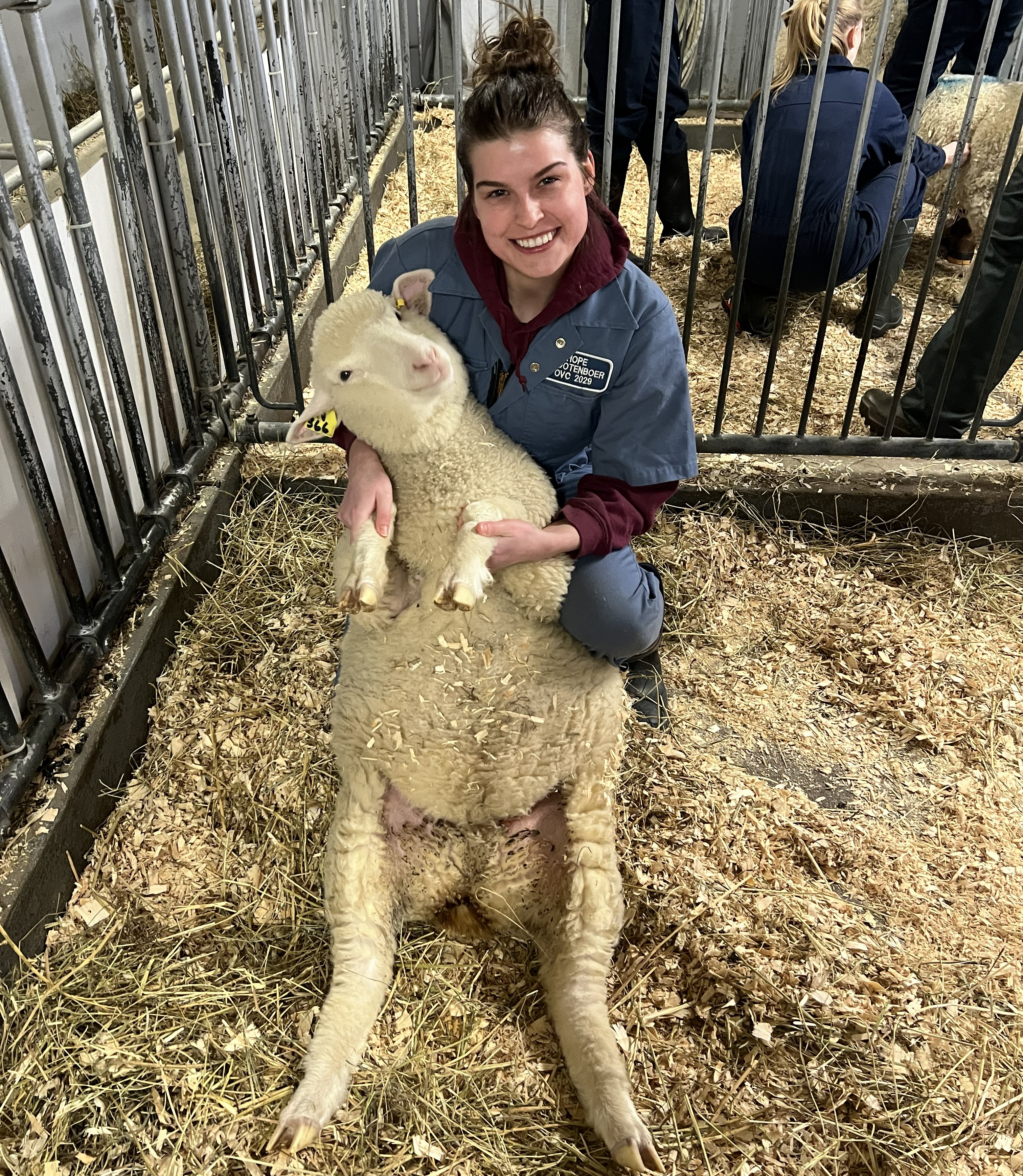
Above, Hope, in the OVC barn, takes part in a lab teaching students how to conduct physical exams of sheep. "We practice tipping the sheep to put them in the position that is most comfortable for them," she says. Hope discovered that she'd been accepted to the CDVMP while preparing to run a half marathon in Banff. "I woke up at 5 in the morning and looked at the Ontario Veterinary College student portal and it said I was accepted, a few hours later I got an official notification by email. I popped a bottle of champagne and celebrated with my mom, two of my sisters-in-law, and my sister, who were with me in Banff. It was a great day!"

"We're learning spaying, surgical techniques like suturing, and rectal palpation exams. These exams help you understand the anatomical structure of cows and horses and determine if an animal is pregnant or sick—it's the most effective way to check the health of herds."

Hope believes that enrolling in the CDVMP is one of the smartest educational decisions she's ever made.

"I've had an amazing experience at Guelph. We're like one big happy family and the students in my lab practice group have become my closest friends."

When Hope graduates in 2029, her plan is to establish a mixed practice in Thunder Bay that treats both large and small animals.

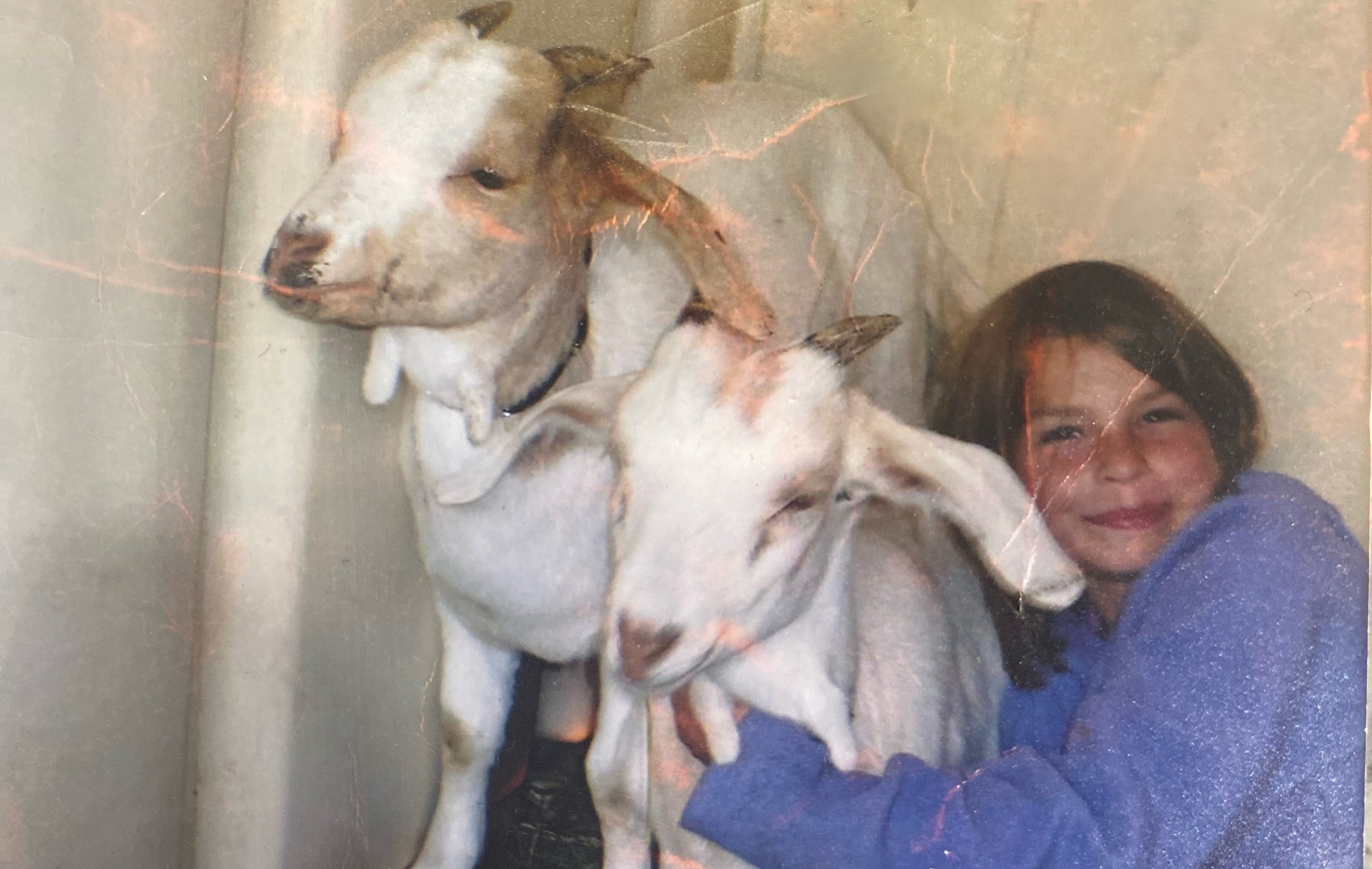
Hope Grootenboer, aged about 10, hugs a small white goat that is standing next another small white goat in a buiding

"Cows are great mothers and great protectors, and calves are super sweet," Hope says. She is also fond of goats. "When I was in grade three we got two goats, Autumn and Nutmeg (above). I was there when their mother gave birth and I helped feed them after they were born."

"I'd recommend that anyone from northern Ontario interested in a veterinary career look at the CDVMP option, talk to their local veterinarians, get some work experience, and then apply to the program," she says.

"My wish is that every student in my CDVMP cohort will see how fulfilling it is to work in the north," she adds.

Pages

Subscribe to Indigenous