Indigenous

(OR) Downtown Adventure

We invite ALL new students to join us for our Downtown Adventure in beautiful downtown Orillia. We’ll head downtown together from campus and show you just how easy it is to get there using your Lakehead Bus Pass—or bring some change if you don’t have one yet! Once downtown, you’ll be free to explore with friends or alongside our Orientation Leaders.

(OR) The First Howl Orientation Day

We invite ALL new students to join us for The First Howl: Orientation Day! This fun-filled day is all about showing your Thunderwolf spirit, connecting with fellow new students, meeting your future professors, getting a few important tasks checked off your to-do list, and having fun. You won’t want to miss it! Participating in Orientation Day also gives you the chance to earn ballots toward our grand prize draws, and yes—lunch is FREE for all students!

Schedule of the Day

(OR) Board Games & Indoor Movie

We invite ALL new students to our indoor movie and board game night! After a busy day of Orientation, kick back in your comfiest clothes with blankets and new friends for a fun evening of board games, snacks, and a movie! The movie selection will be announced soon—stay tuned for updates! Please note that this event use to be an outdoor event, but has been moved indoors due to weather.

(OR) Welcome Dinner

Join us for a free dinner in the dining hall and enjoy the opportunity to keep connecting with fellow new students! This event is free and open to both residence and commuter students. 

This event requires registration — don’t forget to register below!

(OR) Commuter House Meeting

Residence students have house meetings—why shouldn’t you? New commuter students, join us at your very own "house meeting" to get tips on winter driving, saving on gas, making friends while living off-campus, and more. Discover the ins and outs of commuting to Orillia!

Note: There's a super fun Commuter Social happening just before this. If you’re a commuter student, try to attend both events and kick off your Orientation on the right foot!

This event requires registration — don’t forget to register below!

Tackling northwestern Ontario’s labour market challenges by helping newcomers find a sense of belonging

By EMILY DONTSOS

Dr. Kathy Sanderson (headshot)

With an unemployment rate that’s significantly lower than the provincial average, Northwestern Ontario has a lot of jobs to offer.

The problem? With a population that isn’t growing fast enough, “we actually don’t have enough people to meet our job needs,” says Dr. Kathy Sanderson, an associate professor of human resources and organizational behaviour at Lakehead University. 

Dr. Sanderson says the key to closing that gap lies in attracting newcomers to northwestern Ontario. But many employers find it difficult to retain newcomer employees, leading to a cycle of instability and uncertainty. 

Several years ago, Dr. Sanderson—who also serves as the associate director of EPID@Work, a research institute at Lakehead focused on workplace wellness—decided to tackle this challenge. 

“We started with the question, ‘How can we make sure newcomers want to stay in northwestern Ontario?’ And from there, we asked: ‘How can we make newcomers feel more welcome?’” 


Opening Doors to Welcoming and Belonging

With funding from the Ontario Ministry of Labour, Immigration, Training, and Skills Development, Dr. Sanderson and an interdisciplinary team of researchers and graduate students launched a research project seeking to understand how newcomer men and women experience welcoming and belonging in the workplace. 

As a community-based study, the team worked closely with the Thunder Bay Multicultural Association and the Community Economic Development Corporation to recruit newcomer participants and receive ongoing guidance and support. 

The main finding from this study is striking. 

“We discovered that newcomers were looking for friendships within the community, to understand workplace culture and norms, and feel safe, while employers were more focused on cultural competence training and short-term integration,” Dr. Sanderson says. “This points to serious gaps that can cause newcomers to feel disconnected from their communities and workplaces.”  

Based on these initial findings, the team turned its attention to the experiences of newcomer women, who face unique barriers to labour participation and belonging. 

“Rates of labour participation and income for newcomer women lag behind both Canadian-born men and women as well as newcomer men,” Dr. Sanderson says. “We wanted to find out exactly what their experiences are and what supports they need to feel a higher degree of belonging and job security.” 

The team found that many newcomer women struggle with a lack of information—and they’re often unsure how to make lasting friendships in a Canadian context. 

“Many of their challenges relate to limited information on Canadian workplace norms and cultures, occupational health and safety standards, and human rights—many of the things that Canadian-born employees are familiar with and take for granted,” Dr. Sanderson says. 

When it comes to building relationships, newcomer women shared that while their Canadian colleagues are friendly towards them, those friendships often don’t extend beyond the workplace. 

“This can cause newcomer women to feel quite isolated,” Dr. Sanderson says. “They aren’t feeling that full sense of belonging in the community, which can make it really hard to adjust to their new life.”   

Now that this three-year study has wrapped up, the team is focused on harnessing its findings to change northwestern Ontario’s labour landscape—including the development of an online training program designed to introduce newcomer women to workplace norms and culture.

“This was one of the key recommendations that emerged from our research,” Dr. Sanderson says. “We are now seeking additional funding to create this program, which would be available to employees throughout northwestern Ontario. We’ll then evaluate its impact on workers’ sense of welcoming and belonging.” 


A New Area of Focus: The Impacts of Artificial Intelligence and Digitization 

In addition to ongoing studies related to welcoming and belonging, Dr. Sanderson has recently received funding to explore another area of critical concern for newcomer women and for the region: the emerging impacts of AI and digitization. 

“We’re already seeing that AI and digitization will first target the most precarious jobs, and most of those jobs are held by women—both newcomers and Canadian-born women alike,” she says. 

Dr. Sanderson’s new study will look at how technology is affecting employment in northwestern Ontario, and what these impacts mean for the future of the labour market and community well-being in the region. 

“Ultimately, this work relates to my original research interest—how are we going to retain people in northwestern Ontario? If technological advancement renders certain positions obsolete, our labour market will face substantial challenges.” 

Dr. Sanderson says her new project aims to identify the most vulnerable occupations and develop strategies that enable workers to enhance their adaptability. “This will help ensure they maintain viable employment alternatives in an evolving job market.” 


Building a Strong and Thriving Future 

Dr. Sanderson says that her research as a whole—which directly contributes to several United Nations Sustainable Development Goals, including gender equality, decent work and economic growth, and reduced inequalities—aims to help northwestern Ontario communities truly thrive, today and long into the future. 

“I hope that as we enhance our capacity to ensure all employees feel valued and develop a sense of belonging, we’ll see a more stable and flourishing labour market and stronger communities,” she says. “There are many areas of recruitment and retention where I think improved approaches to welcoming could be beneficial for our region.”

Research in Action highlights the work of Lakehead University in various fields of research.

Innovative First Nations-Led Project on Indigenous Arts and Wellbeing Secures Australian Research Council Grant

Dr. Pauline Sameshima (Professor, Faculty of Education) is part of an innovative, First Nations-led research initiative that aims to enhance health and wellbeing through arts integrated Indigenous research methods.

The five-year project, titled Dandhigu Yimbana: Listening on Country for Social and Emotional Wellbeing, has received a funding grant of $868,000 AUD through the Australian Research Council’s 2025 Discovery Indigenous grant scheme.

The research applies Arts-Informed Indigenist Research (AIIR) methods to explore how Indigenous arts and culturally grounded research practices can address epistemic violence, support healing, and foster culturally safe research environments that promote health equity. The team will work closely with communities engaged in Indigenous health and wellbeing research, aiming to shape how social and emotional wellbeing is understood and studied in Indigenous contexts.

The project is led by Dr. Vicki Saunders, a Gunggari researcher at CQUniversity’s Jawun Research Institute in Australia.Central to the research is the Gunggari concept of Dandhigu Yimbana that emphasizes deep listening with respect, on, for and with Country, a practice vital to both community and environmental wellbeing and to research integrity. 

This research is expected to contribute significantly to Indigenous scholarship and influence global conversations around arts, health, and decolonizing research practices.

Below:

The visual depiction of the research project is represented in the artwork called Idiwirra: nung Ulamai, which translates to Secret Business: Let us dance/do ceremony (Alngith language). The artwork was made by Dr. Fiona Wirrer-George Oochunyung. The artwork represents 5 different projects coming together, held by lore, symbolized by two green (new) quarter moon shapes. The work illustrates flow, interconnectedness and unfolding as offerings. 

Idiwirra: nung Ulamai (2025). Artist Fiona Wirrer-George Oochunyung

Research in Action: Protecting Workers

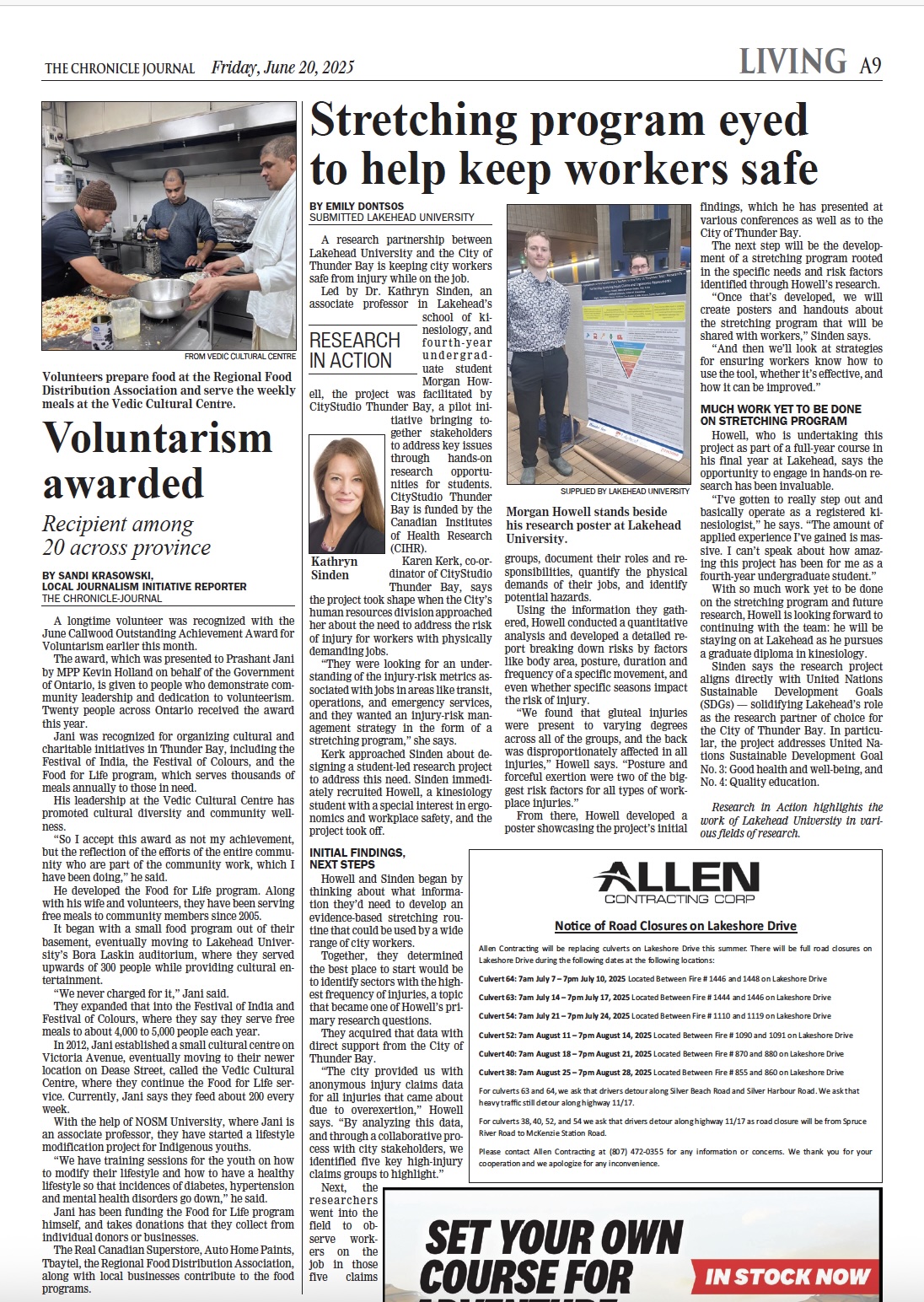
A version of this article was originally posted in The Chronicle Journal on June 20, 2025

By EMILY DONTSOS

Dr. Kathryn Sinden (headshot)

A unique research partnership between Lakehead University and the City of Thunder Bay is keeping city workers safe from injury while on the job. 

Led by Dr. Kathryn Sinden, an associate professor in Lakehead’s School of Kinesiology, and fourth-year undergraduate student Morgan Howell, the project was facilitated by CityStudio Thunder Bay—an innovative pilot initiative bringing together multiple stakeholders to address key issues through hands-on research opportunities for students. CityStudio Thunder Bay is funded by the Canadian Institutes of Health Research (CIHR).

Karen Kerk, coordinator of CityStudio Thunder Bay, says the project took shape when the city’s Human Resources Division approached her about the need to address the risk of injury for workers with physically demanding jobs. 

“They were looking for an understanding of the injury-risk metrics associated with jobs in areas like transit, operations, and emergency services, and they wanted an injury-risk management strategy in the form of a stretching program,” she says. 

Kerk approached Dr. Sinden about designing a student-led research project to address this need. Dr. Sinden immediately recruited Howell, a kinesiology student with a special interest in ergonomics and workplace safety, and the project took off. 

The Benefits of Stretching 

Howell and Dr. Sinden began by thinking about what information they’d need to develop an evidence-based stretching routine that could be used by a wide range of city workers. 

Together, they determined the best place to start would be to identify sectors with the highest frequency of injuries—a topic that became one of Howell’s primary research questions. 

They acquired that data with direct support from the City of Thunder Bay.

“The city provided us with anonymous injury claims data for all injuries that came about due to overexertion,” says Howell. “By analyzing this data, and through a collaborative process with city stakeholders, we identified five key high injury claims groups to highlight.” 

Next, the researchers went into the field to observe workers on the job in those five claims groups, document their roles and responsibilities, quantify the physical demands of their jobs, and identify potential hazards. 

Using the information they gathered, Howell conducted a quantitative analysis and developed a detailed report breaking down risks by factors like body area, posture, duration and frequency of a specific movement, and even whether specific seasons impact the risk of injury. 

“We found that gluteal injuries were present to varying degrees across all of the groups, and the back was disproportionately affected in all injuries,” Howell says. “Posture and forceful exertion were two of the biggest risk factors for all types of workplace injuries.” 

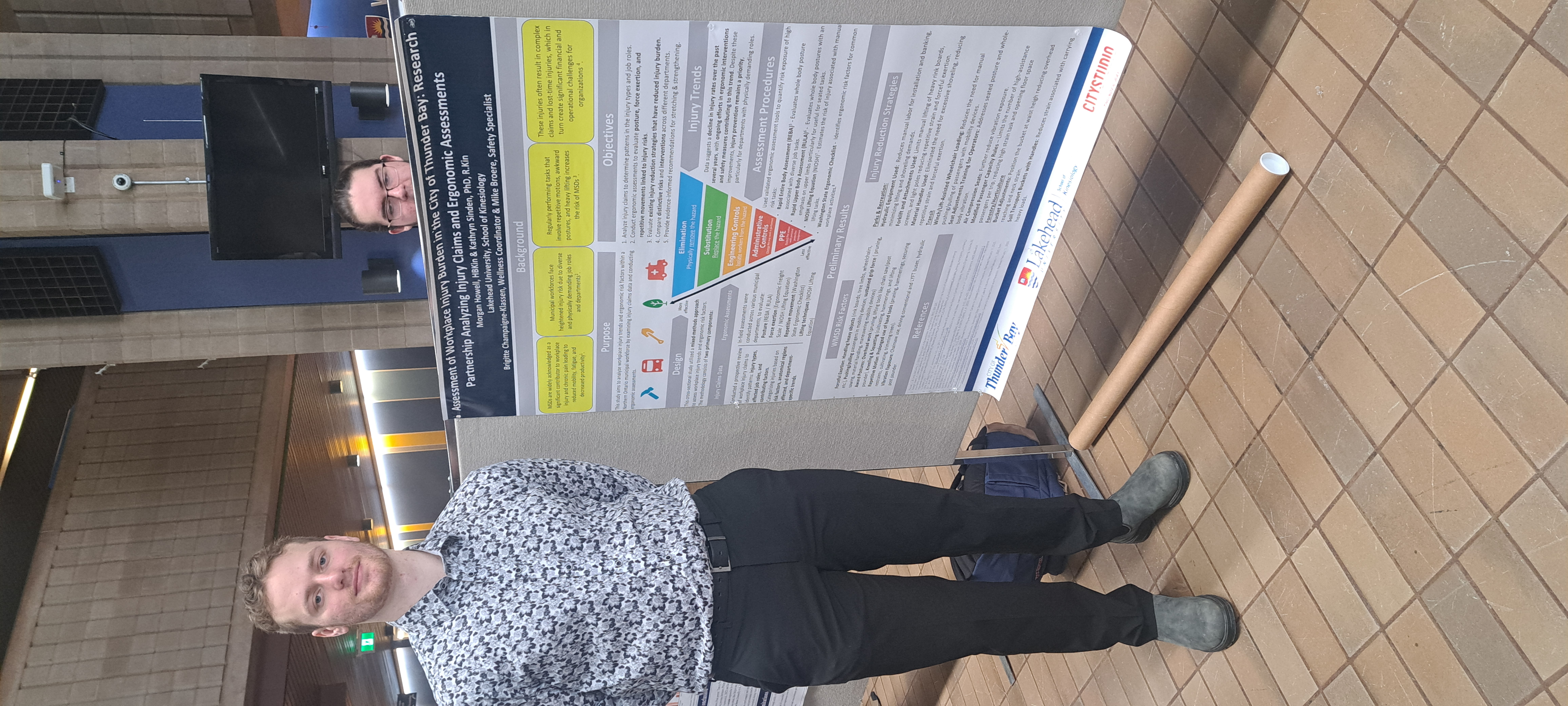
Morgan Howell standing beside his research poster at Lakehead UniversityFrom there, Howell developed a poster showcasing the project’s initial findings, which he has presented at various conferences as well as to the City of Thunder Bay. 

The next step will be the development of a stretching program rooted in the specific needs and risk factors identified through Howell’s research. 

“Once that’s developed, we will create posters and handouts about the stretching program that will be shared with workers,” Dr. Sinden says. “And then we’ll look at strategies for ensuring workers know how to use the tool, whether it’s effective, and how it can be improved.” 

An Invaluable Opportunity 

Howell, who is undertaking this project as part of a full-year course in his final year at Lakehead, says the opportunity to engage in hands-on research has been invaluable. 

“I’ve gotten to really step out and basically operate as a registered kinesiologist,” he says. “The amount of applied experience I’ve gained is massive. I can’t speak about how amazing this project has been for me as a fourth-year undergraduate student.” 

With so much work yet to be done on the stretching program and future research, Howell is looking forward to continuing with the team: he will be staying on at Lakehead as he pursues a graduate diploma in kinesiology.  

Dr. Sinden says the research project aligns directly with United Nations Sustainable Development Goals (SDGs)—solidifying Lakehead’s role as the research partner of choice for the City of Thunder Bay. In particular, the project addresses SDG #3: Good Health and Well-being and SDG #4: Quality Education.

Research in Action highlights the work of Lakehead University in various fields of research.

Picture of article that was published in The Chronicle Journal

Pages

Subscribe to Indigenous