

Psychology

Why do we sometimes ignore our gut instincts?

Dr. Beth Visser Wants to Help People Escape Dangerous Situations

Content Warning: This story includes references to sexual violence.

Dr. Beth Visser is an acclaimed forensic psychologist whose work has led her down some dark paths.

Her previous research investigated individuals with narcissistic, Machiavellian, psychopathic, and other socially malevolent traits who manipulate, deceive, and exploit others.

Dr. Visser, who's also a psychology and interdisciplinary studies associate professor at Lakehead's Orillia campus, has now turned her attention in a different direction.

She wants to understand why women-identified victims and survivors of crime may find it difficult to remove themselves from risky or dangerous situations.
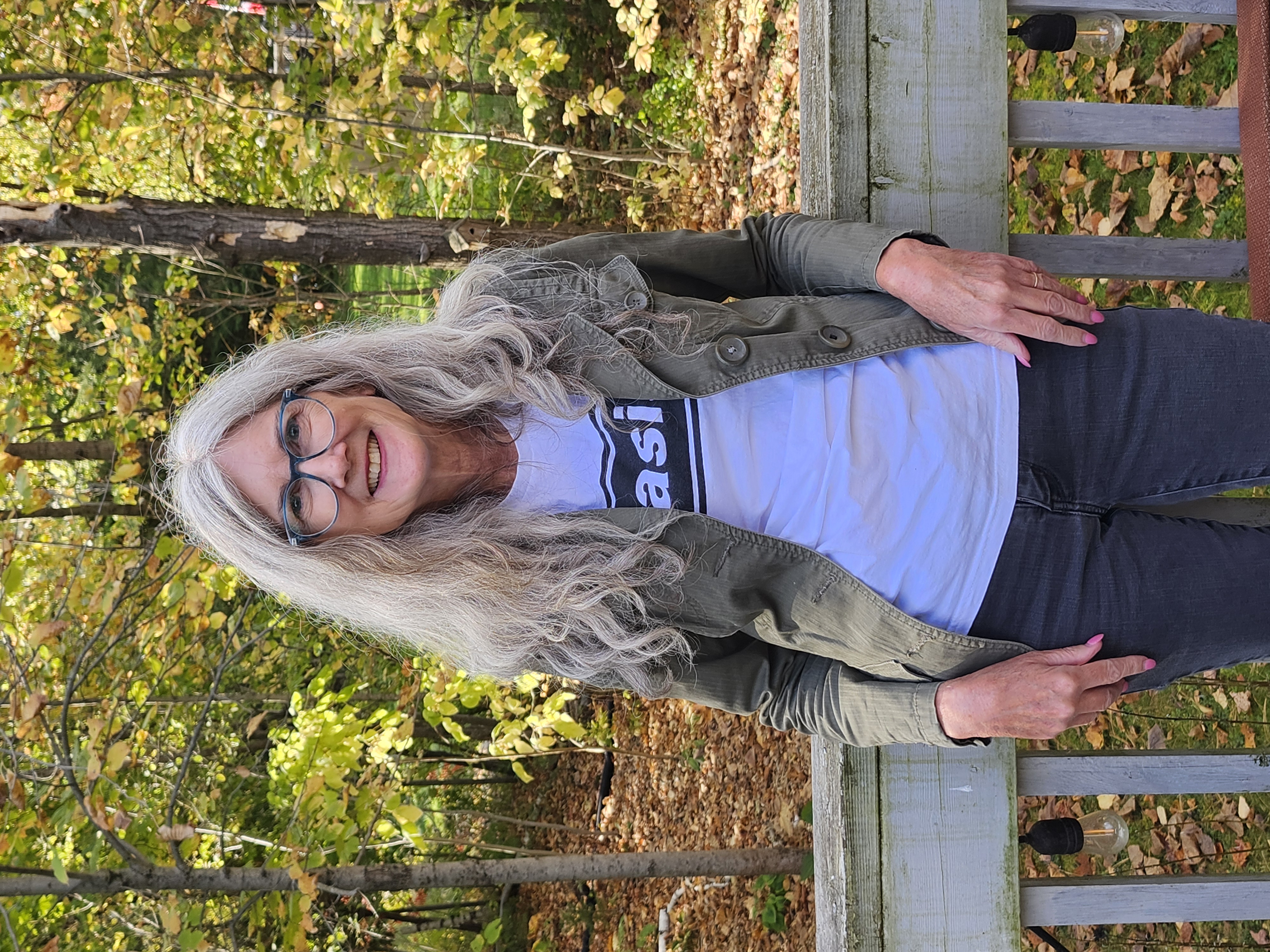
Dr. Beth Visser leans against a wooden deck railing in a yard with trees and fallen leaves

Dr. Visser is an associate editor of both the Journal of Research in Personality and Collabra: Psychology, as well as Lakehead's graduate program coordinator for psychological science. "I want to support talented junior researchers like Theresia Bedard who are doing important work that will have a positive impact on victims and survivors," she says.

Her work is timely, considering the disturbing headlines of the past few years—from the horrifying sexual assault case of Frenchwoman Gisèle Peliquot to the World Junior Hockey sexual abuse scandal to the ongoing Epstein files in the United States.

Dr. Visser's goal is to prevent people from being victimized by sharing her findings with the general public, organizations that support victims and survivors, and fellow researchers.

Victims Are Often Overlooked

"I would go to psychopathy conferences and meet with my peers every couple of years, and none of us were studying victims and survivors," she says.

After a victim's support group representative attended a recent conference and asked how this research relates to victims and survivors, Dr. Visser had an epiphany that has shifted the course of her work.

"I thought it might be more helpful to talk to people who've been exploited by somebody who's psychopathic because they'd probably have better insight into what happened than the psychopathic person," she explains.

"My collaborator Dr. Angela Book and I are exploring why people feel they can't leave a situation when they are afraid."
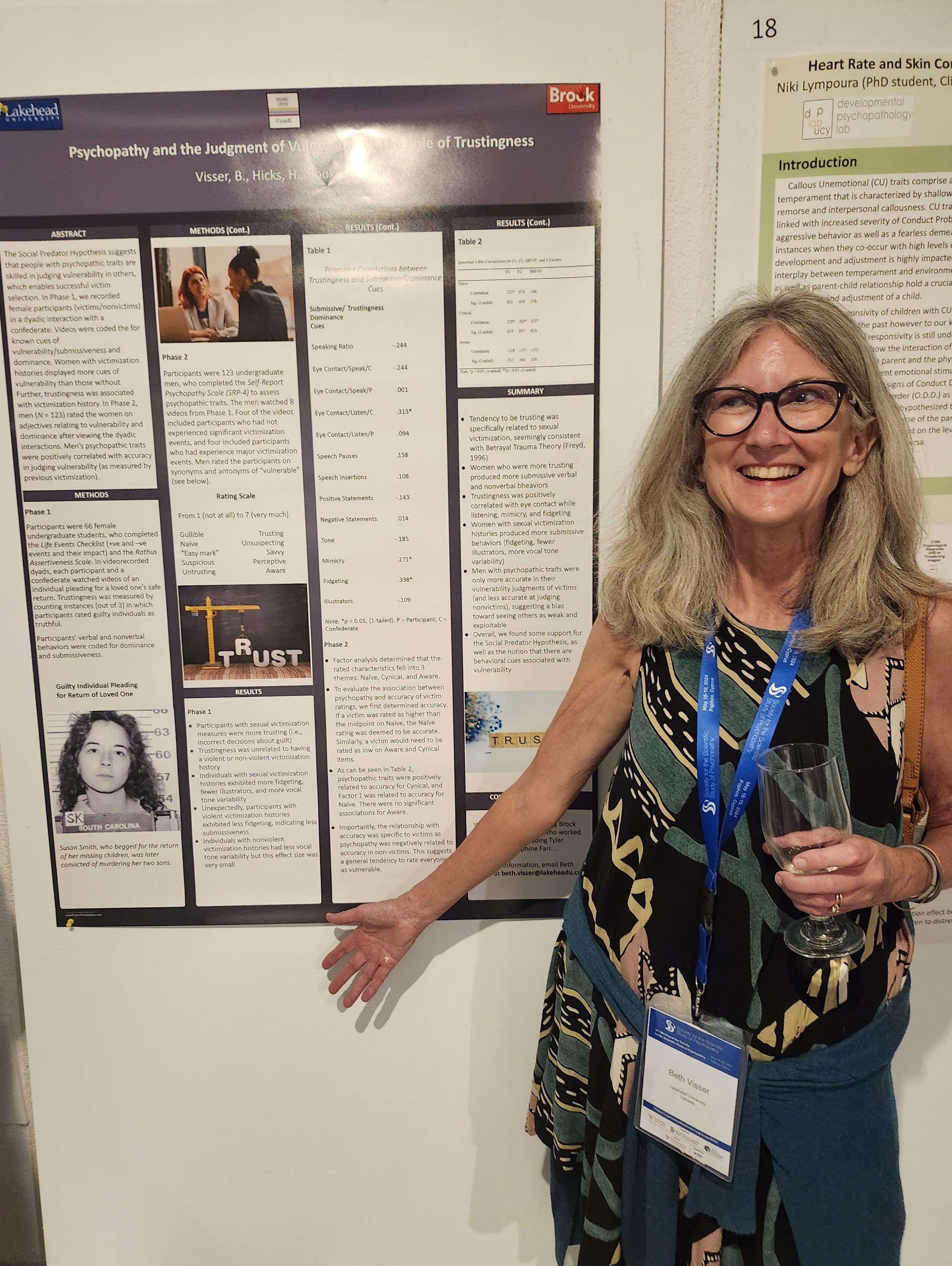
Dr. Beth Visser stands in front of a research poster about the social predator hypothesis Dr. Visser is a research volunteer with the Aftermath: Surviving Psychopathy Foundation, which supports victims and survivors. One of her contributions is to provide accessible translations of research articles, and she will be sharing her own research findings with Aftermath.

In their latest research study, Dr. Book, a professor in psychology at Brock University, recalls buying a used musical instrument for her son from a man who told her that the instrument was in his camper van.

"She's a very experienced forensic psychologist, but she got in the van," Dr. Visser says. "Fortunately, she came away with a well-priced musical instrument, but she knew that, objectively, it was a terrible decision.

As women, we're peacemakers. We might have been taught to avoid conflict. What we've found in our research is that, for women, there's this variable called 'silencing the self' that was the strongest predictor for complying in unsafe situations."

Being Polite Can Leave You Powerless

Whether they get goosebumps or some other physiological reaction, women often know in their gut when something is a bad idea or situation.

Yet Dr. Visser says that they may shut down these signals because they want to avoid anything that will cause a confrontation.

"If you can't bring yourself to be rude when you're concerned about your personal safety, it puts you at even greater risk," she says.

Another complication Dr. Visser notes is that although society has changed somewhat since the #MeToo movement, many of the underlying systemic issues remain the same.

"When you listen to women who've testified and gone through the court process, it's still pretty harrowing."

Dr. Visser and her PhD student, Theresia Bedard, are conducting studies with open-ended questions to learn why people stay in dangerous circumstances or appear compliant.

"When we asked people, 'Have you ever been in a situation that you felt like you couldn't get out of?' almost 50 per cent of the women spontaneously responded with a story about some creepy guy.

Theresia Bedard and Dr. Beth Visser stand on either side of an ISSID 2025 Conference banner

Dr. Visser (right) and her PhD student Theresia Bedard (left) present their research at the 2025 International Society for the Study of Individual Differences (ISSID) conference in Vienna. They also give public talks to spread awareness of their work. Recently, Dr. Visser spoke to the Psychological Association of Lakehead Students (PALS) and students in Lakehead's Humanities 101 program.

One thing we're learning is that as well as humans' fight, flight, and freeze responses, when faced with a threat, there's a fawning response.

People think, 'If I just make this person happy, they won't hurt me.'"

She's also looking at whether past childhood trauma makes an individual more likely to exhibit a fawning response.

"Maybe you're more likely to try and keep the peace," she says. "We know that previously victimized people are more likely to be victimized in the future."

This is exactly what Dr. Visser hopes her research can help change.

Dr. Visser's research is being made possible by a Social Sciences and Humanities Research Council (SSHRC) Insight grant.

Complexity

Complexity science is a collection of theories dealing with phenomena that emerge from the interactions of many interdependent agents. It is a multi-disciplinary meta-theory and includes concepts and theories from a range of disciplines including mathematics, information sciences, biology, physics, psychology, economics, and ecological sciences. 

Some fundamental properties of complex systems include: (a) that the coordination of many interdependent agents or parts produces a whole that is greater than the sum of these parts, (b) that the operation of positive and negative feedback loops between the system and its environments generates patterns of stability and change, and (c) that order or organization emerges or self-organizes in a complex system without external or internal direction or command. Systems concepts have been applied in numerous areas, most notably within the literature on organizational processes. 

Scholars in Psychology have employed systems theories and concepts from the beginning. Most recently, researchers in neuroscience, cognitive psychology, psycholinguistics, social psychology, and other areas have explored the application of concepts and methods from Nonlinear Dynamic Systems (NDS) Theory. NDS theory provides a means to explore systems that are not necessarily equilibrium seeking, or that are in a far-from-equilibrium state, in which unexpected and novel system states emerge. As such, NDS theory is well suited to the study of complex living systems. The Santa Fe Institute provides numerous resources relevant to the study of complex systems in general as well as nonlinear dynamic systems in particular. 

Complex Adaptive Systems (CAS) Theory is an area within NDS Theory focusing on the adaptation of individual and collective behaviour in correspondence with changes in the context or environment. The capacity of CAS to show emergence and adaptive capacity in the face of disturbance is of particular interest, leading to the study of resilience and adaptive cycles in linked social-ecological systems. The Stockholm Resilience Centre provides extensive resources regarding the study of resilience in complex adaptive systems.

Many of us in the CCR Lab explore the application of NDS and CAS Theory concepts and methods. For example, we are interested in how CAS Theory may help us understand interdependencies among psycho-social-ecological systems, with the goal of better understanding the emergence of environmentally destructive behaviour.  We are also interested in understanding both psychological and community resilience in light of CAS Theory. The interaction of cultural and psychological processes in place may also be understood in a perspective informed by complexity science concepts and theories. 

The CCR Lab is part of an interdisciplinary network of scholars interested in complexity science at Lakehead University. Dr. Stroink organizes and runs the Complexity Seminar in collaboration with this network every 2-3 years. The Complexity Seminar runs as a set of linked directed studies courses and provides an opportunity for in-depth study and discussion on complexity science with faculty and students from various disciplines. 

If you are interested in complexity science or its applications in Psychology, please contact Dr. Mirella Stroink.  


Selected References:

Eidelson, R.J. (1997). Complex adaptive systems in the behavioral and social sciences. Review of General Psychology, 1(1), 42-71.

Folke, C. (2006). Resilience: The emergence of a perspective for social-ecological systems analyses. Global Environmental Change, 16, 253-267. DOI:10.1016/j.gloenvcha.2006.04.002

Folke, C., Carpenter, S.R., Walker, B., Scheffer, M., Chapin, T. & Rockström, J. (2010). Resilience thinking: Integrating resilience, adaptability and transformability. Ecology and Society, 15(4), 20. http:// www.ecologyandsociety.org/vol15/iss4/art20/

Guastello, S.J., Koopmans, M., & Pincus, D. (Eds) (2011). Chaos and complexity in psychology: The theory of nonlinear dynamical systems. Cambridge University Press.

Gunderson, L. H., and Holling, C.S. (2002). Panarchy: Understanding transformations in human and natural systems. St. Louis, Missouri: Washington University Island Press.

Holland, J. H. (2000). Emergence: from chaos to order. Oxford University Press, Oxford, UK.

Holland, J. H. (2006). Studying complex adaptive systems. Journal of Systems Science and Complexity, 19, 1-8.

Holland, J.H. (1992). Complex adaptive systems. Daedalus,121(1), 17-30. 

Holling, C.S. (2001). Understanding the complexity of economic, ecological, and social systems. Ecosystems,4(5), 390–405.

Holling, C.S. (1973). Resilience and stability of ecological systems. Annual Review of Ecology and Systematic, 4,1-23. DOI: 10.1146/annurev.es.04.110173.000245

 Kauffman, S. (1993). The origins of order: Self organization and selection in evolution. Oxford University Press.

Piers, C., Muller, J.P., & Brent, J. (2007). Self-organizing complexity in psychological systems. Lanham, MD: Rowman & Littlefield Publishers.

Stacey, R. (2001). Complex responsive processes in organizations: Learning and knowledge creation. New York, NY: Routledge.

Uhl-Bien, M. & Marion, R. (2008). Complexity Leadership, Part 1: Conceptual Foundations. Charlotte, NC: Information Age Publishing, Inc.

Waldrop, M. M. (1992). Complexity: The emerging science at the edge of order and chaos. Toronto: Touchstone Book. 

Walker, B. & Salt, D. (2006). Resilience thinking: Sustaining ecosystems and people in a changing world. Washington: Island Press.

What is Psychology?

Psychology refers to both the science and profession concerned with understanding and influencing the thoughts, feelings, emotions and behaviour of individuals.

Different psychologists are often people with very different interests and abilities. For example, one particular psychologist may have been trained as a practitioner, work in a mental health clinic, and spend most of their time interpreting psychological tests and doing psychotherapy. Another psychologist may have been trained both as a scientist and a practitioner and work for a management consulting firm, consulting with clients in regard to organization development, executive selection, and career planning. A third psychologist may have been trained as a scientist and spend most of their working time in a research laboratory doing research with either humans or animals. This wide diversity among different psychologists is reflected by the fact that at Lakehead University students may begin their training as psychologists either with an Arts or Science Degree.

Psychologists are concerned with a multitude of questions. How do we perceive? How do we learn? How do we think? What motivates us? What developmental stages do we go through? How do individuals differ from one another? How is each and every individual unique? How are we influenced by our social and physical environments? How do biological factors influence us? How do drugs influence us? What abnormalities can occur in regard to thinking, feeling, emoting and behaving? And, what can we and what should we do about these abnormalities?

What virtually all psychologists have in common is that through their work, whatever it may be, they hope to make a positive contribution to human welfare. Studying psychology at Lakehead University, through either the introductory course or other courses, should prove to be a beneficial and satisfying experience for anyone. The more a person knows and understands about thinking, feeling, emoting and behaving, the better he or she will be able to appreciate and cope with the complex world in which we live!

Subscribe to Psychology