




Dennis Stauffer
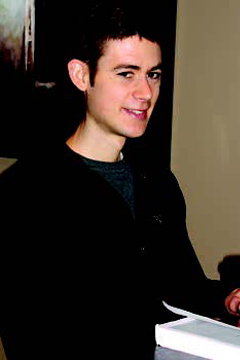
Mathematics / Concurrent Education
Classical probability is what we think of when we think about statistical chance. However, there are limitations to the theory, such as its inability to be able to deal with matrices and other non-commutive variables. Mathematics researcher Dennis Stauffer explains, “Commutation means that the order doesn’t matter – 3 times 5 is the same as 5 times 3. However, with matrices, the order does matter, you get a different answer if you multiply A times B than if you multiplied B times A. As a result, classical probability theory can’t be used.” He goes on to talk about the theory of free probability, which doesn’t have this limitation. “My project with [Mathematical Sciences] Prof. Viola was to understand the theory of free probability and a proof of its free central limit theorem,” he says. “This theory is not a traditional probabilistic/statistical field, so it’s not taught in traditional mathematics or statistics courses.”
When asked about his career goals, Dennis points out that he is in the Concurrent Education program, which allows students to work on bachelor’s degrees in science and education simultaneously. He credits his educational background for setting him on this career path. “All through high school I had math teachers that were excellent – who challenged me to find my own ways to solve problems,” he says. So why choose Lakehead? “I like the outdoors: fishing, hiking, etc. But mainly I’ve been really interested in education in First Nations, so Lakehead was a natural fit for me.” In September 2015, Dennis is furthering his studies in a Master of Science degree at University of Waterloo.