



Lakehead Student is One of Many Indigenous Veterans Who Served with Honour
Master Corporal (Retired) Kevin Wesley Shares His Military Journey
Content Warning: This story discusses war and its impacts.
Kevin Wesley is in his third year of Lakehead University's undergraduate anthropology program, but he has already contributed a lifetime of service to his country as a member of the Canadian Armed Forces (CAF).
Two weeks ago, in October 2026, Kevin retired from the CAF with the rank of Master Corporal, allowing him to fully focus on the next chapter of his career.

"Everything came together when I decided to take anthropology at Lakehead," Kevin says. "I took an archaeology course when I was younger and really enjoyed it. I was drawn to archaeology again because I wanted to learn more about where I came from." Kevin says he sees parallels between the ethnic cleansing in Bosnia and Canada's residential schools. "This became really clear to me after mass graves started to be imaged on the sites of former residential schools."
"I joined the CAF's Reserve Forces in 2001 at the suggestion of my father, and everything just clicked," Kevin says. "My great grandfather served in the Boer War and World War One and my grandfather served in the Second World War, so I have a strong connection with the military."
During his 25 years as a soldier, Kevin was honoured with a Canadian Forces' Decoration medal, a Canadian Peacekeeping Service Medal, and a Non-Article 5 NATO Medal for Operations in the Balkans.
His sacrifices, and those of his fellow servicemen and servicewomen, are uppermost in the minds of people across the country as we prepare to honour Indigenous Veterans Day on November 8.
Kevin's father's family is Moose Cree from the northeastern part of Ontario, while his mother's family is of European descent. His decision to study anthropology at Lakehead Thunder Bay is motivated by his wish to serve as a bridge between Indigenous and non-Indigenous people and to learn more about his Indigenous culture.
Peacekeeping in War-Ravaged Bosnia
Kevin enlisted in the CAF at a tumultuous moment in the world's history.
"I was a student at Lambton College in Sarnia, Ontario, and was completing my military training with the 1st Hussars reserve unit when the September 11 terrorist attacks happened. I thought: 'What is happening? Is Canada going to war?'"

To prepare for his deployment in Bosnia, Kevin did compressed infantry occupational training in Fort Knox, Kentucky, and final training exercises at the Shilo Canadian Forces Base in Manitoba. Above, Kevin in the back of a Grizzly AVGP (armoured vehicle general purpose) tank during a training exercise at Canadian Forces Base (CFB) Wainwright in Alberta. "The Grizzly has room for troops in the back and we were on our way to one of the attack points," Kevin says.
Instead, Kevin received word that his unit would be deployed to Bosnia as part of a NATO (North Atlantic Treaty Organization) peacekeeping mission. NATO, of which Canada is a member, was responsible for maintaining a ceasefire in Bosnia after the end of the Bosnian War in 1995.
Kevin was a good fit for this mission because he was trained in close quarters combat, hand-to-hand combat, and high-performance driving.
"I learned to drive a six-wheeled tank with a cannon in the turret called the Cougar and a Bombardier Iltis, which is a type of jeep," Kevin says. After six months of training in Winnipeg, his reserve unit was attached to the Second Battalion of the Princess Patricia Canadian Light Infantry unit and deployed to the town of Bihac in Bosnia on April 1, 2002.
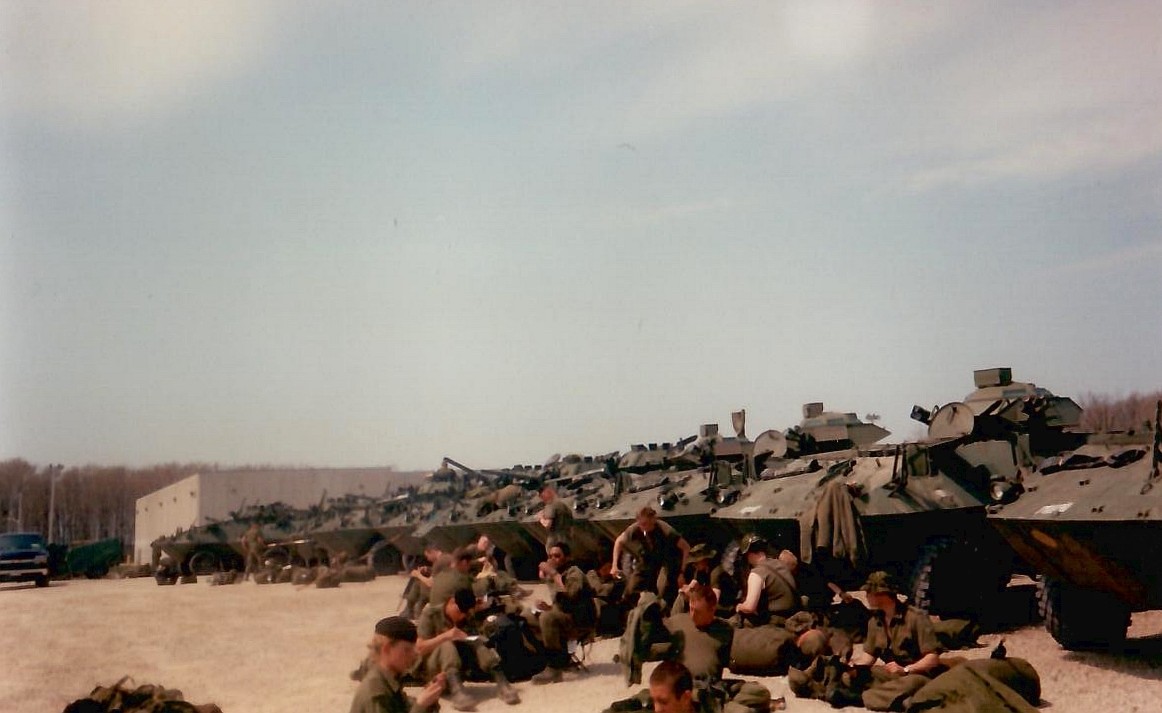
Kevin made lifelong friends in the military, and he fondly recalls his training as a reservist in Sarnia. "Part of learning how to drive a Cougar tank involved navigating through the Tim Horton's drive through to get coffees, which was a lot of fun," he says. Above, Kevin and his unit during a firing range training exercise at CFB Wainwright. Behind them is a row of Cougar armoured vehicle general purpose (AVGP) tanks.
"When we arrived, the war had been over for almost a decade and the younger generation wanted to leave the past behind," Kevin says.
Although it was peacetime, the threat of exploding mines was a constant danger on patrols. "Bosnia was the most heavily mined country in the world, so the rule was that you never went off the hard-packed roads."
As a peacekeeper, a significant amount of his time was consumed by going house to house to retrieve weapons that people had cached during the war. "We found machine guns and explosives," he says.
One memory that particularly stands out was being tasked with securing a mass grave. It was uncovered by a United Nations' humanitarian group attempting to identify the remains of individuals who had been killed in the war.
A Call to Remember Veterans
"I have complex PTSD from a combination of my deployment in Bosnia and my 18 years of policing, which eventually forced me to leave the OPP," Kevin says. He subsequently worked with the Workplace Safety and Insurance Board (WSIB) to begin retraining as an anthropologist.

After he graduates from Lakehead University, Kevin plans to work in the cultural resource management field doing assessments of Indigenous archaeological sites identified during the approval process for provincial infrastructure projects, such as roads and bridges. "I hope to serve as an interpreter between academics, government, and Indigenous communities," he says. "Making right what anthropology and colonialism got wrong in the past inspires me to keep going."
"The psychological impact of deployment is easy to dismiss because you can't see it, but it really changes how a person thinks," he says. "It's more like a brain injury than a traumatic event.
That's one of the reasons that I think that Indigenous Veterans Day and Remembrance Day should be statutory holidays. Veterans don't always come out and say it, but it's just as important to remember the living as it is to remember the service members we've lost."
Indigenous Veterans Day is observed in Canada on November 8. This holiday was established both to commemorate the service of Indigenous veterans and to acknowledge the historical injustices many faced during and after their military service.
Indigenous veterans who need support can contact the Indigenous Veterans Engagement Team (IVET).
