Indigenous

(OR) The First Howl Orientation Day

We invite ALL new students to join us for The First Howl: Orientation Day! This fun-filled day is all about showing your Thunderwolf spirit, connecting with fellow new students, meeting your future professors, getting a few important tasks checked off your to-do list, and having fun. You won’t want to miss it! Participating in Orientation Day also gives you the chance to earn ballots toward our grand prize draws, and yes—lunch is FREE for all students!

Schedule of the Day

(OR) Board Games & Indoor Movie

We invite ALL new students to our indoor movie and board game night! After a busy day of Orientation, kick back in your comfiest clothes with blankets and new friends for a fun evening of board games, snacks, and a movie! The movie selection will be announced soon—stay tuned for updates! Please note that this event use to be an outdoor event, but has been moved indoors due to weather.

(OR) Welcome Dinner

Join us for a free dinner in the dining hall and enjoy the opportunity to keep connecting with fellow new students! This event is free and open to both residence and commuter students. 

This event requires registration — don’t forget to register below!

(OR) Commuter House Meeting

Residence students have house meetings—why shouldn’t you? New commuter students, join us at your very own "house meeting" to get tips on winter driving, saving on gas, making friends while living off-campus, and more. Discover the ins and outs of commuting to Orillia!

Note: There's a super fun Commuter Social happening just before this. If you’re a commuter student, try to attend both events and kick off your Orientation on the right foot!

This event requires registration — don’t forget to register below!

Tackling northwestern Ontario’s labour market challenges by helping newcomers find a sense of belonging

By EMILY DONTSOS

Dr. Kathy Sanderson (headshot)

With an unemployment rate that’s significantly lower than the provincial average, Northwestern Ontario has a lot of jobs to offer.

The problem? With a population that isn’t growing fast enough, “we actually don’t have enough people to meet our job needs,” says Dr. Kathy Sanderson, an associate professor of human resources and organizational behaviour at Lakehead University. 

Dr. Sanderson says the key to closing that gap lies in attracting newcomers to northwestern Ontario. But many employers find it difficult to retain newcomer employees, leading to a cycle of instability and uncertainty. 

Several years ago, Dr. Sanderson—who also serves as the associate director of EPID@Work, a research institute at Lakehead focused on workplace wellness—decided to tackle this challenge. 

“We started with the question, ‘How can we make sure newcomers want to stay in northwestern Ontario?’ And from there, we asked: ‘How can we make newcomers feel more welcome?’” 


Opening Doors to Welcoming and Belonging

With funding from the Ontario Ministry of Labour, Immigration, Training, and Skills Development, Dr. Sanderson and an interdisciplinary team of researchers and graduate students launched a research project seeking to understand how newcomer men and women experience welcoming and belonging in the workplace. 

As a community-based study, the team worked closely with the Thunder Bay Multicultural Association and the Community Economic Development Corporation to recruit newcomer participants and receive ongoing guidance and support. 

The main finding from this study is striking. 

“We discovered that newcomers were looking for friendships within the community, to understand workplace culture and norms, and feel safe, while employers were more focused on cultural competence training and short-term integration,” Dr. Sanderson says. “This points to serious gaps that can cause newcomers to feel disconnected from their communities and workplaces.”  

Based on these initial findings, the team turned its attention to the experiences of newcomer women, who face unique barriers to labour participation and belonging. 

“Rates of labour participation and income for newcomer women lag behind both Canadian-born men and women as well as newcomer men,” Dr. Sanderson says. “We wanted to find out exactly what their experiences are and what supports they need to feel a higher degree of belonging and job security.” 

The team found that many newcomer women struggle with a lack of information—and they’re often unsure how to make lasting friendships in a Canadian context. 

“Many of their challenges relate to limited information on Canadian workplace norms and cultures, occupational health and safety standards, and human rights—many of the things that Canadian-born employees are familiar with and take for granted,” Dr. Sanderson says. 

When it comes to building relationships, newcomer women shared that while their Canadian colleagues are friendly towards them, those friendships often don’t extend beyond the workplace. 

“This can cause newcomer women to feel quite isolated,” Dr. Sanderson says. “They aren’t feeling that full sense of belonging in the community, which can make it really hard to adjust to their new life.”   

Now that this three-year study has wrapped up, the team is focused on harnessing its findings to change northwestern Ontario’s labour landscape—including the development of an online training program designed to introduce newcomer women to workplace norms and culture.

“This was one of the key recommendations that emerged from our research,” Dr. Sanderson says. “We are now seeking additional funding to create this program, which would be available to employees throughout northwestern Ontario. We’ll then evaluate its impact on workers’ sense of welcoming and belonging.” 


A New Area of Focus: The Impacts of Artificial Intelligence and Digitization 

In addition to ongoing studies related to welcoming and belonging, Dr. Sanderson has recently received funding to explore another area of critical concern for newcomer women and for the region: the emerging impacts of AI and digitization. 

“We’re already seeing that AI and digitization will first target the most precarious jobs, and most of those jobs are held by women—both newcomers and Canadian-born women alike,” she says. 

Dr. Sanderson’s new study will look at how technology is affecting employment in northwestern Ontario, and what these impacts mean for the future of the labour market and community well-being in the region. 

“Ultimately, this work relates to my original research interest—how are we going to retain people in northwestern Ontario? If technological advancement renders certain positions obsolete, our labour market will face substantial challenges.” 

Dr. Sanderson says her new project aims to identify the most vulnerable occupations and develop strategies that enable workers to enhance their adaptability. “This will help ensure they maintain viable employment alternatives in an evolving job market.” 


Building a Strong and Thriving Future 

Dr. Sanderson says that her research as a whole—which directly contributes to several United Nations Sustainable Development Goals, including gender equality, decent work and economic growth, and reduced inequalities—aims to help northwestern Ontario communities truly thrive, today and long into the future. 

“I hope that as we enhance our capacity to ensure all employees feel valued and develop a sense of belonging, we’ll see a more stable and flourishing labour market and stronger communities,” she says. “There are many areas of recruitment and retention where I think improved approaches to welcoming could be beneficial for our region.”

Research in Action highlights the work of Lakehead University in various fields of research.

Innovative First Nations-Led Project on Indigenous Arts and Wellbeing Secures Australian Research Council Grant

Dr. Pauline Sameshima (Professor, Faculty of Education) is part of an innovative, First Nations-led research initiative that aims to enhance health and wellbeing through arts integrated Indigenous research methods.

The five-year project, titled Dandhigu Yimbana: Listening on Country for Social and Emotional Wellbeing, has received a funding grant of $868,000 AUD through the Australian Research Council’s 2025 Discovery Indigenous grant scheme.

The research applies Arts-Informed Indigenist Research (AIIR) methods to explore how Indigenous arts and culturally grounded research practices can address epistemic violence, support healing, and foster culturally safe research environments that promote health equity. The team will work closely with communities engaged in Indigenous health and wellbeing research, aiming to shape how social and emotional wellbeing is understood and studied in Indigenous contexts.

The project is led by Dr. Vicki Saunders, a Gunggari researcher at CQUniversity’s Jawun Research Institute in Australia.Central to the research is the Gunggari concept of Dandhigu Yimbana that emphasizes deep listening with respect, on, for and with Country, a practice vital to both community and environmental wellbeing and to research integrity. 

This research is expected to contribute significantly to Indigenous scholarship and influence global conversations around arts, health, and decolonizing research practices.

Below:

The visual depiction of the research project is represented in the artwork called Idiwirra: nung Ulamai, which translates to Secret Business: Let us dance/do ceremony (Alngith language). The artwork was made by Dr. Fiona Wirrer-George Oochunyung. The artwork represents 5 different projects coming together, held by lore, symbolized by two green (new) quarter moon shapes. The work illustrates flow, interconnectedness and unfolding as offerings. 

Idiwirra: nung Ulamai (2025). Artist Fiona Wirrer-George Oochunyung

Research in Action: Protecting Workers

A version of this article was originally posted in The Chronicle Journal on June 20, 2025

By EMILY DONTSOS

Dr. Kathryn Sinden (headshot)

A unique research partnership between Lakehead University and the City of Thunder Bay is keeping city workers safe from injury while on the job. 

Led by Dr. Kathryn Sinden, an associate professor in Lakehead’s School of Kinesiology, and fourth-year undergraduate student Morgan Howell, the project was facilitated by CityStudio Thunder Bay—an innovative pilot initiative bringing together multiple stakeholders to address key issues through hands-on research opportunities for students. CityStudio Thunder Bay is funded by the Canadian Institutes of Health Research (CIHR).

Karen Kerk, coordinator of CityStudio Thunder Bay, says the project took shape when the city’s Human Resources Division approached her about the need to address the risk of injury for workers with physically demanding jobs. 

“They were looking for an understanding of the injury-risk metrics associated with jobs in areas like transit, operations, and emergency services, and they wanted an injury-risk management strategy in the form of a stretching program,” she says. 

Kerk approached Dr. Sinden about designing a student-led research project to address this need. Dr. Sinden immediately recruited Howell, a kinesiology student with a special interest in ergonomics and workplace safety, and the project took off. 

The Benefits of Stretching 

Howell and Dr. Sinden began by thinking about what information they’d need to develop an evidence-based stretching routine that could be used by a wide range of city workers. 

Together, they determined the best place to start would be to identify sectors with the highest frequency of injuries—a topic that became one of Howell’s primary research questions. 

They acquired that data with direct support from the City of Thunder Bay.

“The city provided us with anonymous injury claims data for all injuries that came about due to overexertion,” says Howell. “By analyzing this data, and through a collaborative process with city stakeholders, we identified five key high injury claims groups to highlight.” 

Next, the researchers went into the field to observe workers on the job in those five claims groups, document their roles and responsibilities, quantify the physical demands of their jobs, and identify potential hazards. 

Using the information they gathered, Howell conducted a quantitative analysis and developed a detailed report breaking down risks by factors like body area, posture, duration and frequency of a specific movement, and even whether specific seasons impact the risk of injury. 

“We found that gluteal injuries were present to varying degrees across all of the groups, and the back was disproportionately affected in all injuries,” Howell says. “Posture and forceful exertion were two of the biggest risk factors for all types of workplace injuries.” 

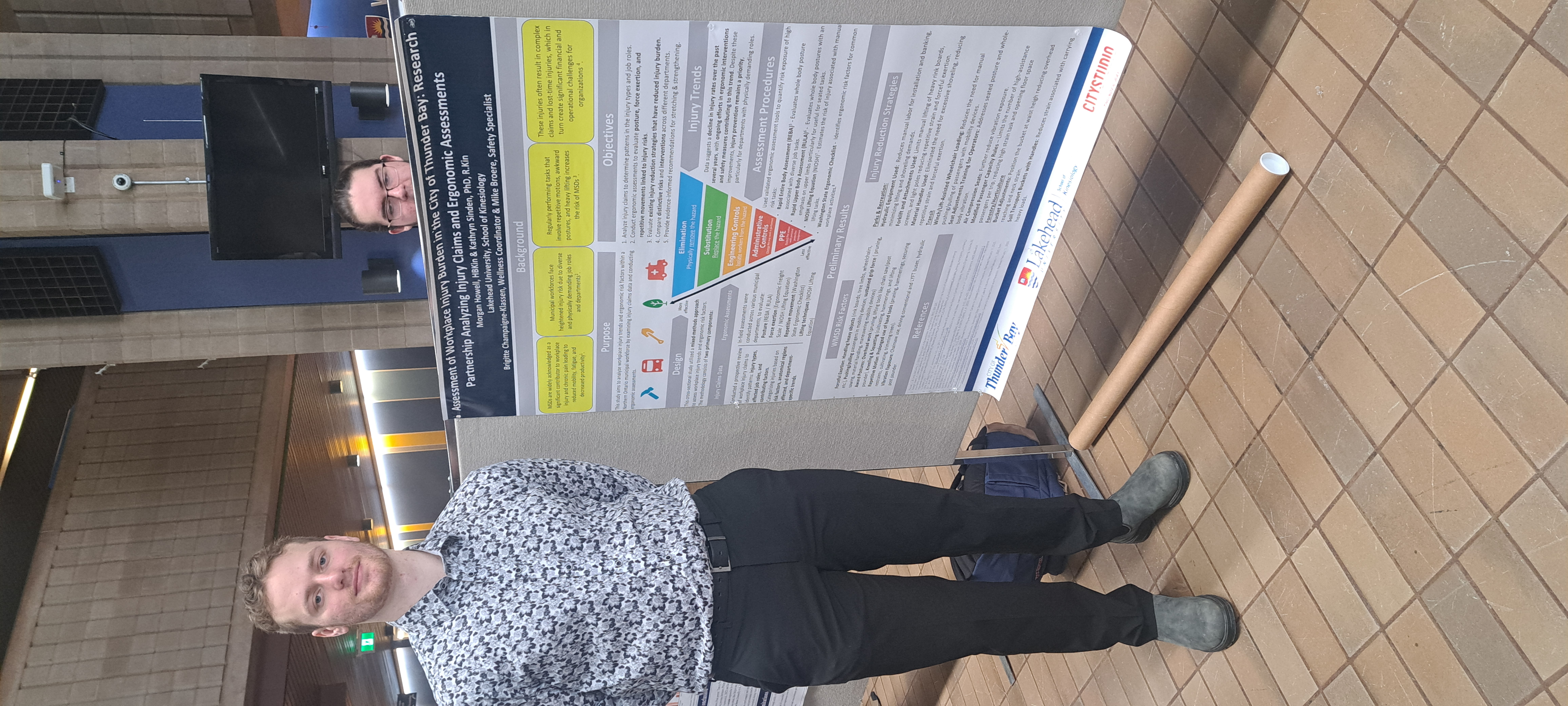
Morgan Howell standing beside his research poster at Lakehead UniversityFrom there, Howell developed a poster showcasing the project’s initial findings, which he has presented at various conferences as well as to the City of Thunder Bay. 

The next step will be the development of a stretching program rooted in the specific needs and risk factors identified through Howell’s research. 

“Once that’s developed, we will create posters and handouts about the stretching program that will be shared with workers,” Dr. Sinden says. “And then we’ll look at strategies for ensuring workers know how to use the tool, whether it’s effective, and how it can be improved.” 

An Invaluable Opportunity 

Howell, who is undertaking this project as part of a full-year course in his final year at Lakehead, says the opportunity to engage in hands-on research has been invaluable. 

“I’ve gotten to really step out and basically operate as a registered kinesiologist,” he says. “The amount of applied experience I’ve gained is massive. I can’t speak about how amazing this project has been for me as a fourth-year undergraduate student.” 

With so much work yet to be done on the stretching program and future research, Howell is looking forward to continuing with the team: he will be staying on at Lakehead as he pursues a graduate diploma in kinesiology.  

Dr. Sinden says the research project aligns directly with United Nations Sustainable Development Goals (SDGs)—solidifying Lakehead’s role as the research partner of choice for the City of Thunder Bay. In particular, the project addresses SDG #3: Good Health and Well-being and SDG #4: Quality Education.

Research in Action highlights the work of Lakehead University in various fields of research.

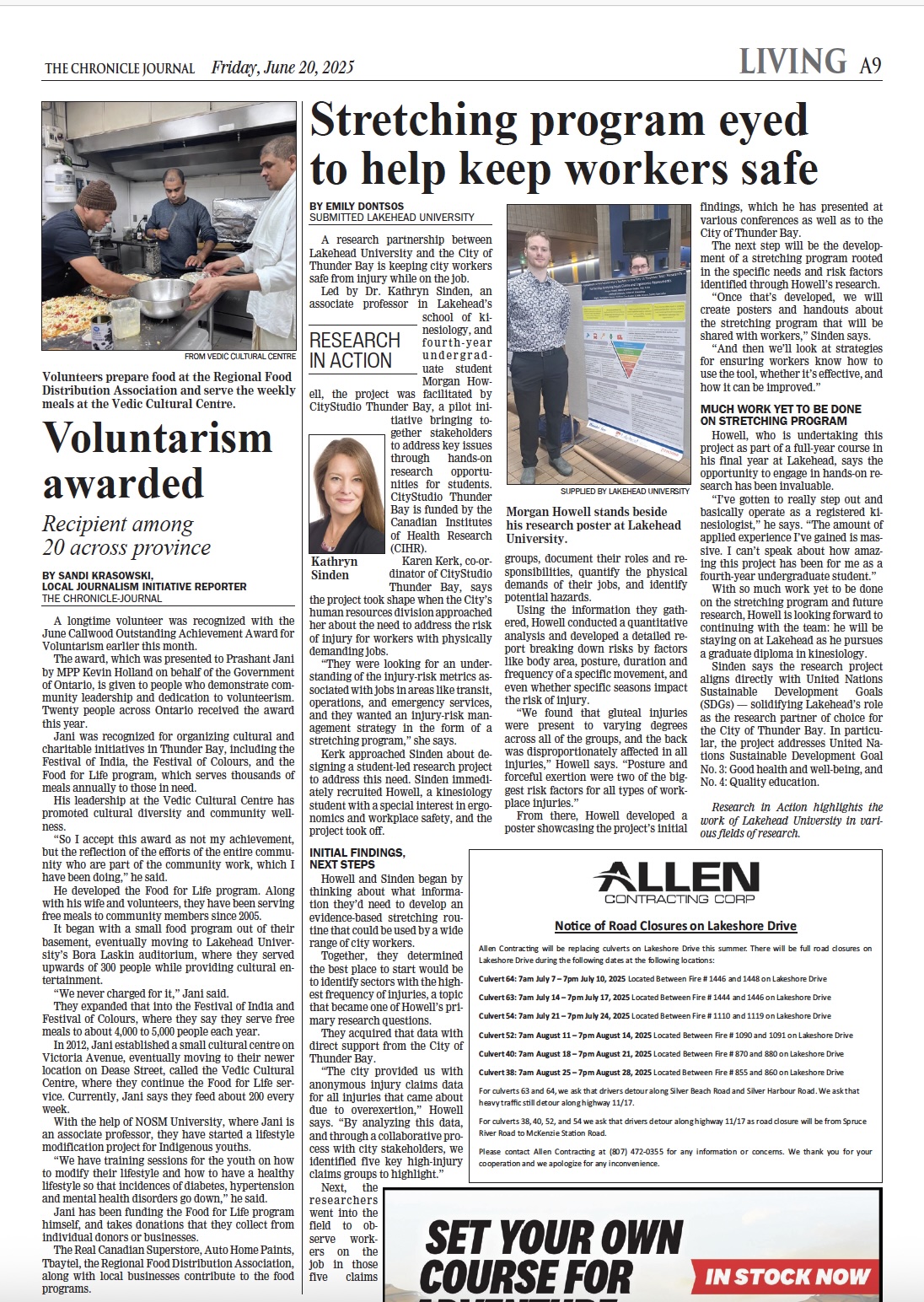
Picture of article that was published in The Chronicle Journal

Lakehead Marks Ground Blessing with $2M Provincial Boost for New Northern Veterinary Program

The ground blessing celebrated a wave of support for the project, recognizing the generosity of community partners, individual donors, and government funders.
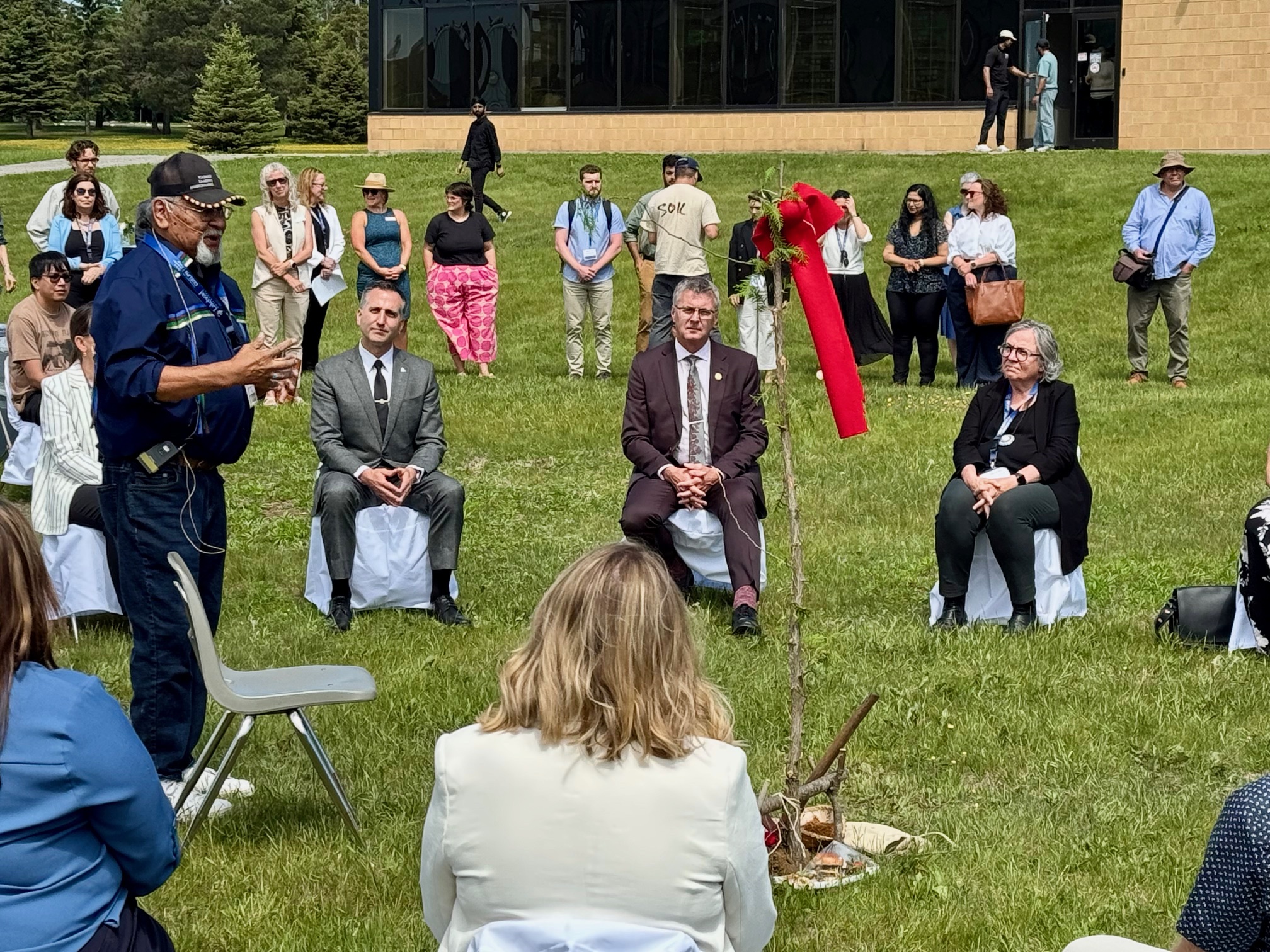
Lakehead University Ground Blessing of CDVMPThunder Bay, Ont. – Today’s ground blessing ceremony marks more than the beginning of construction—it symbolizes hope. In regions where farmers struggle to find veterinary care for their livestock and families drive hours to treat their pets, the Collaborative Doctor of Veterinary Medicine Program—delivered in partnership with the University of Guelph’s Ontario Veterinary College—provides a lasting solution to a critical need.

Building on the Government of Ontario’s previously announced investment of $14.78 million—of which $4.5 million will support Lakehead’s capital build requirements with the remaining amount going to the University of Guelph—today, the Hon. Trevor Jones, Minister of Agriculture, Food and Agribusiness on behalf of the Hon. George Pirie, Minister of Northern Economic Development and Growth, announced an additional $2 million from the The Northern Ontario Heritage Fund Corporation (NOHFC) to support Lakehead’s delivery of the program.

The event also welcomed supporters from across the province whose generous contributions have been vital to launching this much-needed program. Separate from government funding, Lakehead set a philanthropic fundraising goal of $12.9 million, and thanks to major gifts from individual donors, 95% of that goal has already been achieved. The final 5% will be raised through a public, community-driven campaign launching this fall, welcoming donations of all sizes to help bring veterinary care to northern Ontario.

“The Collaborative Doctor of Veterinary Medicine Program signifies something profoundly personal to northern communities—it’s about fairness, access, and addressing a critical issue,” said Dr. Gillian Siddall, President & Vice-Chancellor of Lakehead University. “We heard loud and clear from the north that more veterinarians should be trained where services are needed. Thanks to the Ontario Government, our partners, donors, and supporters, we’re answering that call—not with a temporary solution, but with a legacy that will serve generations of people and animals across northern Ontario.” 

A ground blessing ceremony led by Elder Gene Nowegejick and attended by university leadership, donors, and government partners on Lakehead's Thunder Bay campus signalled the ceremonial start of construction for a new animal education facility that will open in 2027. The event celebrated the newly confirmed Indigenous name for the future facility: Gakina Awesiinyag, from the Anishinaabemowin language, translating to All Animals (Place For).

The event emphasized the innovative vision behind the Collaborative Doctor of Veterinary Medicine Program: to train and retain veterinarians who understand and serve rural, remote, and northern communities' unique needs. The new animal education facility, as designed by mcCallumSather, will feature large and small animal housing and clinical skills training space. Renovations to existing buildings will include combined anatomy/pathology and clinical skills labs, and other relevant training spaces.
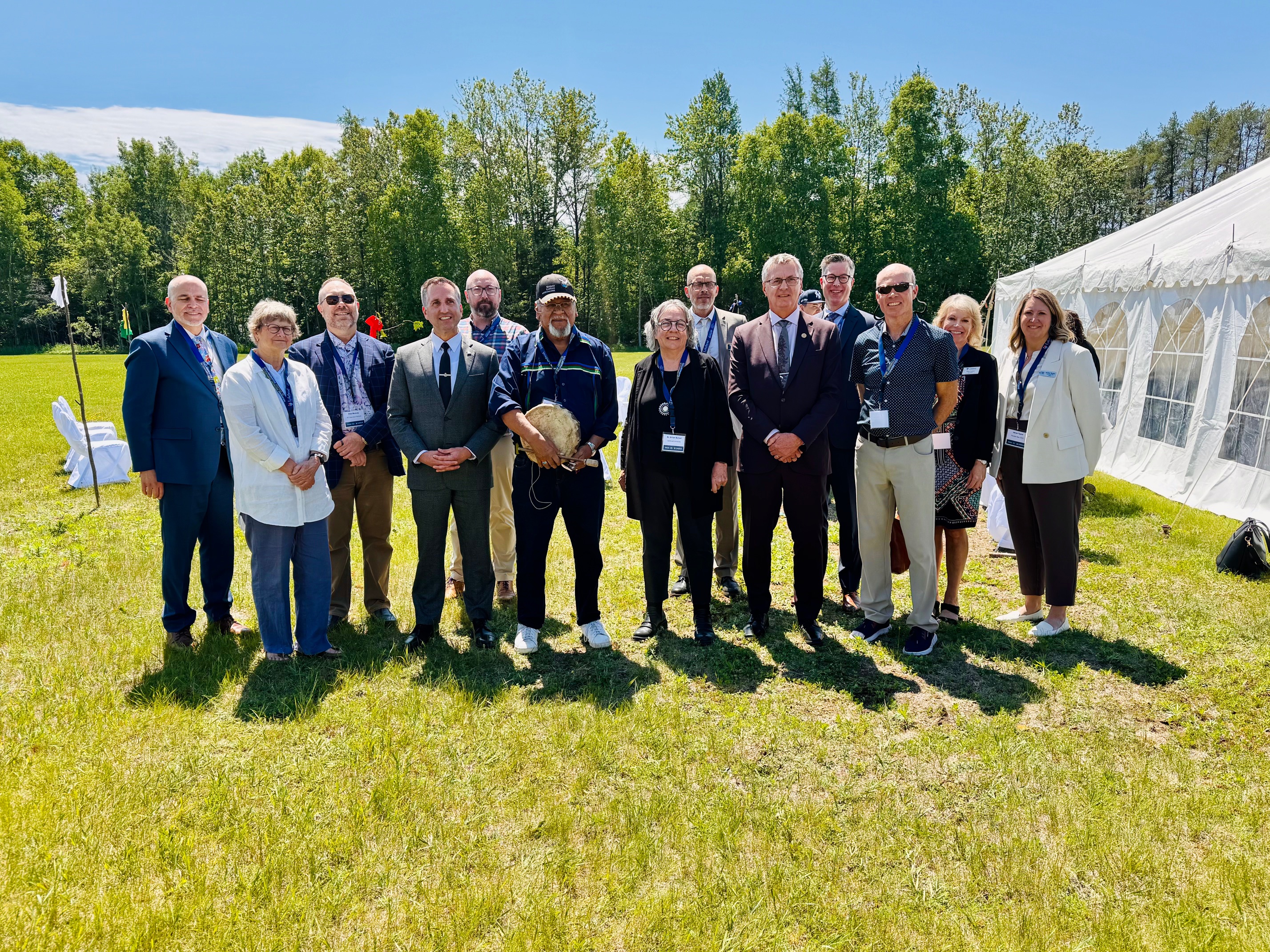
Lakehead University Ground Blessing of CDVMP“This milestone reflects a groundswell of support,” said Michael den Haan, Vice-President, University Advancement at Lakehead University. “Today, we celebrate and acknowledge the many philanthropic supporters, government funders, and community partners who have come together with a shared belief in this innovative solution to the complex challenge of veterinary access in northern Ontario. Their collective generosity is what makes this program possible. It’s more than funding—it’s a statement of confidence in Lakehead University, and the power of education to transform animal care and agriculture across northern Ontario.” 

The Collaborative Doctor of Veterinary Medicine Program will admit its first students in fall 2025, with the initial northern cohorts completing their studies at the Ontario Veterinary College in Guelph. Starting in 2027, the northern cohort will begin the program in Thunder Bay and complete the program in Guelph. This regionally distributed model will ensure that veterinary education is embedded in northern communities from day one.


Quotes:

Hon. Trevor Jones, Minister of Agriculture, Food and Agribusiness, Government of Ontario —
"Once completed, the animal education facility at Lakehead University will serve as a key hub to train future veterinarians serving northern Ontario,” said Trevor Jones, Minister of Agriculture, Food and Agribusiness. "By investing in this program, our government is helping address vet shortages across rural and remote communities while keeping the northern agri-food industry strong.”

Hon. George Pirie, Minister of Northern Economic Development and Growth, Government of Ontario —
"Lakehead University’s new program is a crucial step in expanding access to veterinary services in our northern communities," said George Pirie, Minister of Northern Economic Development and Growth. "This investment will bring more veterinary jobs close to home for Northerners and expand essential support for our agricultural producers." 

Hon. Nolan Quinn, Minister of Colleges, Universities, Research Excellence and Security, Government of Ontario —
“Veterinarians are paramount to the success of Ontario businesses’ and families’ wellbeing, and today marks a new milestone in building the veterinary workforce of tomorrow. This critical investment will ensure that students in Lakehead University’s Collaborative Doctor of Veterinary Medicine Program, delivered in partnership with the University of Guelph’s Ontario Veterinary College, gain the hands-on skills they need to thrive as veterinarians and meet the need for excellent animal care in Ontario’s north.” 

Hon. Kevin Holland, MPP - Thunder Bay–Atikokan, Associate Minister of Forestry and Forest Products, Government of Ontario —
“This groundbreaking project marks a transformative investment in the future of northern Ontario. By bringing veterinary education closer to home, we’re addressing critical gaps in care for livestock, pets, and wildlife needs that are essential to both our agricultural sector and the overall well-being of our communities,” said The Hon. Kevin Holland, MPP for Thunder Bay - Atikokan. “I’m proud that our government is supporting this first-of-its-kind program at Lakehead University, which will train skilled veterinarians and help strengthen the fabric of our rural and northern communities for generations to come.”

Dr. Jeffrey Wichtel, Dean, Ontario Veterinary College, University of Guelph —
“Every animal in Ontario deserves timely and accessible veterinary care,” said Dr. Jeffrey Wichtel, Dean of the Ontario Veterinary College. “Through U of G's partnership with Lakehead, we're responding to the urgent need for northern veterinary services by preparing the next generation of skilled veterinarians. This fall, we’re proud to welcome the first cohort of northern students into OVC’s Doctor of Veterinary Medicine program—future leaders who will help transform veterinary care across the province's rural, Indigenous, and agricultural communities.”

Doug Brooks, President and Chief Executive Officer, Ontario SPCA and Humane Society —
“The Ontario SPCA and Humane Society is proud to support this vital step forward for veterinary medicine in northern Ontario through this meaningful partnership with Lakehead University and our shared commitment to animal health and well-being,” said Doug Brooks, President and CEO of the Ontario SPCA and Humane Society. “By working together to help train more veterinarians, we’re investing in healthier communities, improved animal welfare, and greater access to care for animals and the people who love them.” 

The Tamblyn Family Foundation —
“The Tamblyn Family Foundation is proud to support the Collaborative Doctor of Veterinary Medicine Program at Lakehead University. This innovative partnership with the Ontario Veterinary College at the University of Guelph expands access to veterinary education in northern Ontario and supports the development of skilled veterinarians who will serve communities across the region and beyond.” 


Quick Facts:

  • Program Launch: Fall 2025 (at University of Guelph), Fall 2027 (at Lakehead University, Thunder Bay)

  • Annual Seats: 20 students from northern Ontario

  • Philanthropic Fundraising Goal: $12.9 million raised through individual donors/major gifts (separate from government funding)

  • Raised to Date: 95% of the philanthropic fundraising goal has been achieved through major gifts from individual donors

  • Remaining Fundraising Goal: A public, community-driven campaign will launch this fall, welcoming donations of all sizes to complete the campaign 

  • Project Features: Animal education facility, anatomy/clinical labs, culturally responsive learning spaces


About the Collaborative Doctor of Veterinary Medicine Program
The Collaborative Doctor of Veterinary Medicine Program is a partnership between Lakehead University and the University of Guelph’s Ontario Veterinary College. It is designed to help address the shortage of veterinarians in northern Ontario by providing location-based and culturally relevant education and training in the north, for the north.

About Lakehead University
Lakehead University is where ambition meets opportunity and where a degree leads to real-world impact. Known for small class sizes, hands-on learning, and unparalleled undergraduate research opportunities, Lakehead has earned national and international recognition for our student-focused approach–including being named Ontario’s #1 primarily undergraduate university by Maclean’s magazine in 2024, and ranked by Times Higher Education Impact Rankings as the top university in North America (under 10,000 students) for our commitment to sustainability and social justice.

With campuses in Thunder Bay and Orillia–and a new STEM Hub opening in Barrie in 2026–Lakehead offers a vibrant, close-knit, nature-rich environment for learning where students enjoy a uniquely balanced and enriching university experience. With more than 65 career-focused programs, Lakehead is a training ground for future leaders, entrepreneurs, and changemakers—graduates who think critically and drive meaningful impact in their communities and around the world.


Backgrounder

Lakehead University thanks its generous donors who are making this important initiative come to life. A public, community-driven campaign will launch this fall, welcoming donations of all sizes to help bring veterinary care to northern Ontario; however, those who wish to contribute now can do so by visiting Lakehead’s website at: https://ec.lakeheadu.ca/giving/fund-project

Acknowledging support from key contributors to the Collaborative Doctor of Veterinary Medicine Program at Lakehead University includes:

Kim & Stu Lang
$10,000,000

Government of Ontario
Ministry of Agriculture, Food and Agribusiness; Ministry of Colleges and Universities, Research Excellence and Security; $4,500,000 towards Lakehead University capital construction, as a part of a $14,780,000 provincial investment supporting infrastructure for the CDVMP at both Lakehead University and the University of Guelph

Northern Ontario Heritage Fund
$2,000,000

The Paterson Foundation
$750,000

Ontario SPCA and Humane Society
$500,000

Thunder Bay Community Economic Development Commission
$500,000 

John Andrews Foundation
$250,000

P3 Veterinary Partners
$100,000

Tamblyn Family Foundation
$100,000

Bruno's Contracting Ltd
$50,000

The Eric S. Margolis Foundation
$25,000



Pages

Subscribe to Indigenous