
Indigenous

Prime Minister Carney’s Visit to Mexico Shines a Light on Lakehead

Two Lakehead students are given a tour of the El Tahin PyramidsOVERVIEW:

  • Prime Minister Mark Carney and Mexican President Claudia Sheinbaum recently launched the inaugural Canada-Mexico Action Plan 2025-2028
  • The plan singles out the importance of a Lakehead University initiative—the Canada–Mexico Roundtable on Indigenous and Intercultural Higher Education
  • Lakehead University is playing a key role in promoting mobility, inclusivity, and well-being between our two countries

University Initiative is Highlighted in New International Agreement

Lakehead University is being applauded for its role in fostering cooperation between Canada and Mexico in a time of economic and political uncertainty.

During Prime Minister Mark Carney's September 18 visit to Mexico, he and Mexican President Claudia Sheinbaum launched the inaugural Canada-Mexico Action Plan 2025-2028 to strengthen ties between the two nations.

The plan singles out the importance of a Lakehead University initiative—the Canada–Mexico Roundtable on Indigenous and Intercultural Higher Education—as one of the ways to promote mobility, inclusivity, and well-being.

The 2024 Canada–Mexico Roundtable on Indigenous and Intercultural Higher Education at the Xalapa Campus of the Veracruzana University in Mexico

The 2024 Canada–Mexico Roundtable on Indigenous and Intercultural Higher Education (above) was held at the Xalapa Campus of the Veracruzana University in Mexico.

"I was contacted by the Canadian embassy in Mexico about Lakehead University's roundtables while the Canada-Mexico Action Plan was being finalized," says Pierre Sved, Lakehead's international relations manager for Latin America. "They wanted to highlight the roundtables as a model of success."

Canada-Mexico Roundtables on Indigenous/Intercultural Higher Education

Lakehead University is a leader in Indigenous postsecondary education with one of the largest Indigenous student populations of any Canadian university.

In 2012, Lakehead reached beyond its borders to establish the Canada-Mexico Roundtables on Indigenous/Intercultural Higher Education. The purpose was to connect Mexican intercultural universities with Canadian universities and colleges that support Indigenous education.

Intercultural universities are schools located in remote, mostly mountainous, areas of Mexico where the majority of students are Indigenous. The State of Puebla's intercultural university, for instance, is a five-hour drive from its capital city.

Lakehead University Indigenous Initiatives Vice-Provost Denise Baxter and two students at the Palacio de Bellas Artes cultural centre in Mexico City.

Indigenous Initiatives Vice-Provost Denise Baxter and Lakehead students Maya Oversby and Summer Lavellee visit the Palacio de Bellas Artes cultural centre in Mexico City in 2024. Lakehead is grateful for the support Canada-Mexico Roundtables receive from Canada's embassy in Mexico and Global Affairs Canada.

"We wanted to connect the heads of these postsecondary institutions to discuss shared challenges and solutions," Sved says. "Common issues faced by Indigenous Peoples in Canada and Mexico include discrimination and barriers to higher education, jobs, and health care."

The roundtables were created by Lakehead's sixth president and vice-chancellor, Dr. Brian Stevenson, together with the University of Lethbridge, Vancouver Island University, and the Mexican Education Ministry (SEP).

The Power of Working Together

Roundtables happen annually but were interrupted for several years by COVID. They are organized around specific themes chosen by the host school. Past themes have included Indigenous entrepreneurship, human rights, and maternal health for Indigenous Peoples.

Encouraging student and faculty mobility is one of the driving forces of the roundtables.

"Throughout the years, Indigenous students at Lakehead University have participated in outward mobility opportunities, visiting Intercultural universities in Mexico," says Indigenous Initiatives Vice-Provost Denise Baxter.

Summer Lavellee, Indigenous Initiatives VP Denise Baxter, and May Oversby attend Day of the Dead Celebrations in Mexico

Cultural activities help students better understand each other’s perspectives and heritage. Above, Summer Lavellee, Indigenous Initiatives Vice-Provost Denise Baxter, and Maya Oversby attend Day of the Dead celebrations in Mexico.

"The opportunity to meet with other Indigenous students and faculty members to engage in rich intercultural learning opportunities has been impactful. We have also been fortunate to host faculty and Indigenous students on our campus and in our region to engage in learning, sharing, and collaboration on future projects," explains Indigenous Initiatives Vice-Provost Baxter.

Today, over 500 Indigenous students from Mexico have studied in Canada as part of the roundtables. This includes 120 students who came to Lakehead, primarily for its language programs, while more than 10 Indigenous Lakehead students have travelled to Mexico. "Many of the students have told me that this was a life-changing experience," Sved says.

Equally important to the roundtables is forging joint research collaborations to solve social, environmental, and economic problems.

Lakehead Garners International Praise

"The influence of the roundtables has spread internationally, building connections in countries such as Ecuador, Chile, Brazil, and New Zealand," says Lakehead Vice-Provost International Dr. Aamir Taiyeb.

Mexican students, staff, and Stacey Pawluk visit the Thunder Bay marina


Above, Lakehead student Summer Lavellee, Mexican student Maria de Lourdes Ayala Mata, Marcos Juarez Martinez, Mexican student Adriana Eloisa Perez Esquivel, and Lakehead Indigenous Initiatives Administrative and Programs Officer Stacey Pawluk visit the Thunder Bay marina in June 2025.

The roundtables' transformative impact was recognized in the Canada-Mexico Action Plan 2025–2028, which states:

"The Canada-Mexico Roundtable on Indigenous Higher Education will serve as a key platform for deepening academic partnerships, advancing research collaboration, and strengthening institutional linkages in support of Indigenous post-secondary education."

Through these roundtables, Lakehead will continue to strengthen partnerships, advance Indigenous education, and celebrate the diversity of Indigenous peoples and cultures that enrich its campuses and communities.

As Prime Minister Carney said when he announced the new bilateral plan, "today, we're beginning a new era of elevated cooperation."

The University of Manitoba will host the next Canada–Mexico Roundtable on Indigenous and Intercultural Higher Education in June 2026.
Pipe Ceremony & Teachings

Pipe Ceremony & Teachings

Friday, October 24, 2025 12:00 pm to 1:00 pm

Gakina Nindinawemaaganag - UC1007

Indigenous Student Services Centre is pleased to provide students with the opportunity to attend a pipe ceremony and teachings. Elder Gene Nowegejick will conduct a pipe ceremony and share his knowledge.

Light refreshments will be available.

Everyone welcome.

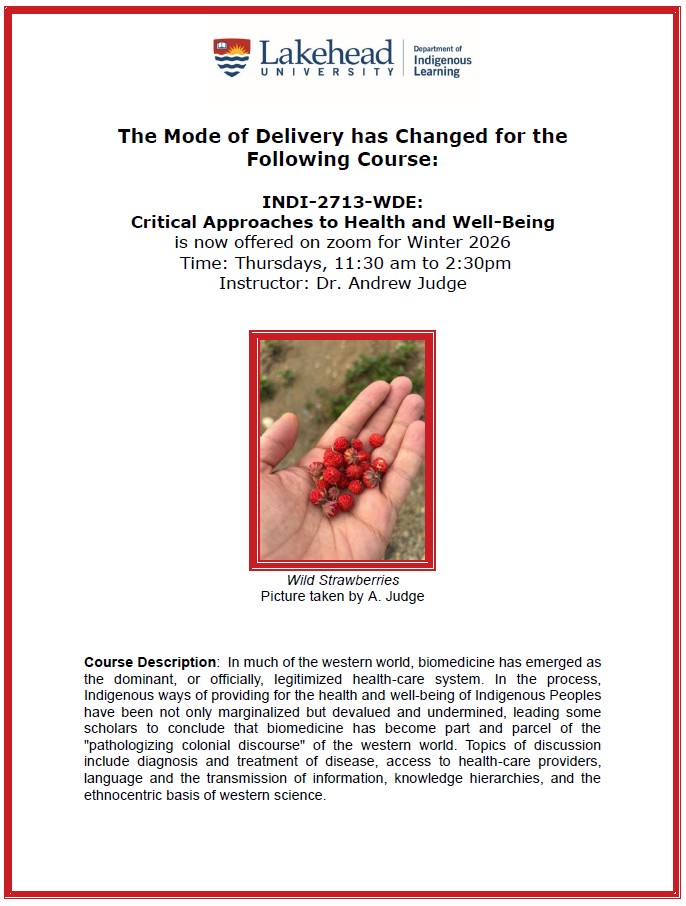
Critical Approaches to Health and Well-Being

The Mode of Delivery has Changed for the Following Course:

INDI-2713-WDE: Critical Approaches to Health and Well-Being is now offered on zoom for Winter 2026
 
Time: Thursdays, 11:30 am to 2:30pm
Instructor: Dr. Andrew Judge
 
Course Description: In much of the western world, biomedicine has emerged as the dominant, or officially, legitimized health-care system. In the process, Indigenous ways of providing for the health and well-being of Indigenous Peoples have been not only marginalized but devalued and undermined, leading some scholars to conclude that biomedicine has become part and parcel of the "pathologizing colonial discourse" of the western world. Topics of discussion include diagnosis and treatment of disease, access to health-care providers, language and the transmission of information, knowledge hierarchies, and the ethnocentric basis of western science.
 
A hand holding red, wild strawberries.

Dr. Jodie Murphy Helps People in Crisis

Content Warning: This story contains discussion of sexual violence.

OVERVIEW:

  • Social Work Professor Dr. Jodie Murphy's research is aimed at improving the treatment of sexual assault survivors in the aftermath of assaults
  • Dr. Murphy is one of the authors of the recent research paper, "Not Without Judgment," which explores how sociocultural barriers prevent survivors in northwestern Ontario from accessing sexual assault evidence kits (SAEKs)
  • A new five-year study is being launched to investigate the handling of sexual assault evidence kits across Ontario to understand how kits are being used and to address gaps in the health care and criminal justice systems

Sexual Assault Survivors Face Bias and Barriers to Accessing Care

Dr. Jodie Murphy's research team is helping sexual assault survivors receive better medical care and fairer treatment from the Canadian criminal justice system.

A social work professor, Dr. Murphy, and her research team began researching sexual violence in 2020 after being approached by the Ontario Provincial Police (OPP).

"They asked me to investigate high rates of 'unfounded sexual assaults,' hoping to better understand and address this serious issue," Dr. Murphy says.

"Sexual assault can happen to anyone, but if survivors don't fit the criteria of a perfect victim, their credibility is often questioned."

Dr. Murphy's initial contact with the OPP led to research with police organizations across Canada, as well as sexual assault survivors, to gain insight from both survivors and police regarding what happens in unfounded sexual assault cases.

Her research team includes Lakehead School of Nursing Professor Dr. Karen McQueen, Lakehead sessional lecturer and nurse Ainsley Miller, and Lakehead Women's Studies Professor Dr. Lori Chambers.

What is Unfounded Sexual Assault?

A sexual assault is deemed unfounded when a police investigation determines that a sexual assault allegation is false or baseless, and that the survivor is not being truthful.

"A large number of survivors, however, told us that their cases hadn't been fully investigated, yet they were still dismissed as unfounded. When this happens, there's no justice or recourse for survivors," Dr. Murphy says.
Dr. Jodie Murphy stands outside on Lakehead's Thunder Bay campus

Dr. Jodie Murphy completed bachelor's and master's social work degrees at Lakehead. She returned to Lakehead in 2015 when she was hired as a professor with the School of Social Work. "It feels like I've come full circle." Photo Credit: Dan Garrity Media

Survivors also frequently reported that the police investigation felt like a secondary victimization. In fact, Dr. Murphy's research with survivors found that police officers often believe in rape myths, resulting in sexual assaults being improperly investigated.

"Many officers, and the general public, still think that rapes are committed by strangers in dark alleys, but in most cases, assaults are committed in private spaces by someone the survivor knows," Dr. Murphy says.

"Sexual assault can happen to anyone, but if survivors don't fit the criteria of a perfect victim, their credibility is often questioned."

The team's research with police officers found that "many police officers wanted better sexual assault training and were passionate about fixing issues in the system," Dr. Murphy says. Organizational constraints in police organizations often create barriers to sexual assault investigations.

Not Without Judgment

Dr. Murphy is one of the authors of the newly released research paper, "Not Without Judgment," which looks at sociocultural barriers that prevent sexual assault victims in rural and remote northwestern Ontario from accessing sexual assault evidence kits (SAEKs).

Dr. Murphy worked with McGill Master of Science student Sydney Timmermans (the study's lead author) and McGill Family Medicine Research Director Dr. Kathleen Rice on this project.

"We investigated the kind of sexual-assault care that victims received when they went to hospital emergency rooms," Dr. Murphy explains.

View of the outside of a hospital emergency room
People who've been sexually assaulted once are more likely to be assaulted again, especially if they're vulnerable. "Survivors have also told us that they start to lose the ability to see red flags because of the trauma," Dr. Murphy says. Photo Credit: Pixabay from Pexels

The study found that hospital staff often weren't properly trained in administering SAEKs, which are used to collect DNA and forensic evidence to help prove assaults.

These intrusive examinations can take up to three hours to complete, but they're crucial because they can lead to sexual assault convictions. In addition, convicted offenders' DNA is entered into a national crime database, which helps identify serial offenders and prevent future assaults.

Inexperience in administering SAEKs was compounded by biases held by some healthcare professionals.

"The study found that Indigenous women were more likely to be disbelieved and denied access to SAEKs than non-Indigenous women," Dr. Murphy says. "Survivors who were intoxicated when they came to the emergency room and survivors who hadn't contacted the police were also less likely to receive a SAEK."

Major New Study into Sexual Assault Evidence Kits

Dr. Murphy and her research team are now embarking on a groundbreaking five-year study looking at how sexual assault evidence kits are used across Ontario.

"There's very little Canadian evidence about SAEKs," Dr. Murphy says.

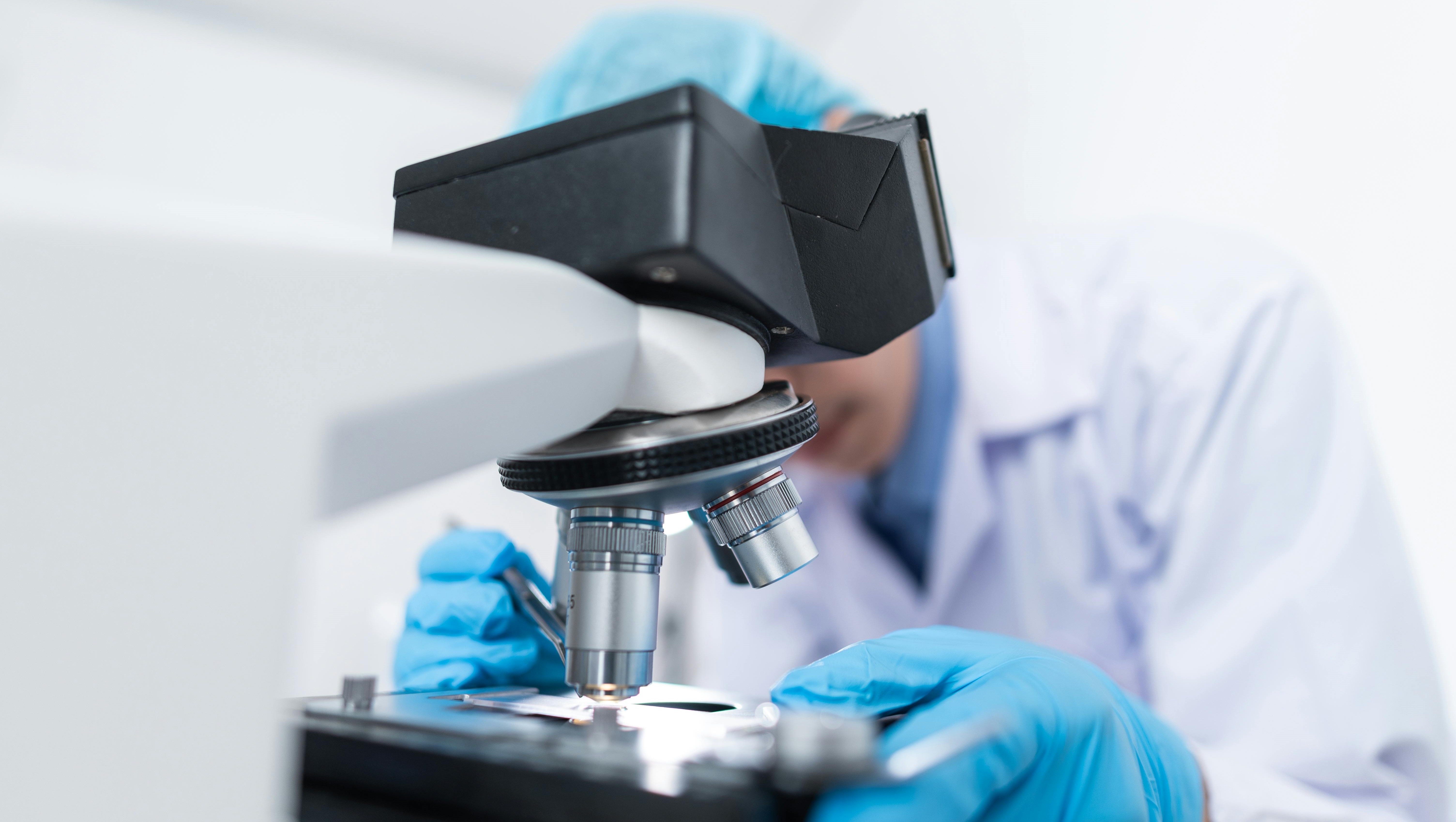
A lab technician wearing gloves and a lab coat uses a microscope

There's a network of Ontario sexual assault centres skilled in collecting sexual assault evidence kits. Many smaller and remote communities, however, don't have these centres, forcing survivors to go to emergency rooms to have testing done. Photo Credit: Pexels/Chokniti Khongchum

She and her research team will look at the processes and decisions of nurses, doctors, police, and prosecutors, who handle SAEKs.

They'll examine how kits are collected, processed, and used, as well as how healthcare and criminal justice professionals communicate with each other about these kits.

"Our research will identify gaps in systems so that survivors healing from the trauma of sexual assault can find justice," Dr. Murphy says.

Dr. Jodie Murphy's research is supported by the Social Sciences and Humanities Research Council of Canada.

Lakehead University Named Ontario’s Top Primarily Undergraduate University in 2026 Maclean’s Ranking

As Lakehead celebrates its 60th anniversary, the university continues to lead in student awards, student-to-faculty ratios, scholarships, and research excellence.

Lakehead University maintained its position as Ontario’s top primarily undergraduate university in the 2026 Maclean’s University Rankings. 

The university continues to be recognized for its exceptional education, research excellence, and outstanding student outcomes. Among Ontario universities in the primarily undergraduate category, Lakehead ranked first in student awards and student-to-faculty ratio, second in scholarships and bursaries, and third in total research dollars.

"Lakehead has always been a place where students achieve their full potential through transformative, world-class education," said Dr. Gillian Siddall, President and Vice-Chancellor. "Our rising rankings and the success of our graduates reflect the quality and impact of the learning experiences we offer. Equally important, we provide unique pathways and supports for students from diverse backgrounds, ensuring that everyone with potential has the opportunity to thrive. This recognition in Maclean's celebrates the dedication of our faculty, staff, and partners in creating an environment where excellence and inclusion go hand in hand."

As Lakehead marks its 60th anniversary, students continue to benefit from hands-on learning and collaborative research experiences that contribute to strong retention, high graduation rates, and employment outcomes that exceed the provincial average.

The annual Maclean’s rankings categorize Canada’s universities into three groups — primarily undergraduate, comprehensive, and medical/doctoral — and Lakehead stands out in its primarily undergraduate category, shining a light on its deep commitment to student success.

“This recognition also reflects the strength and scope of the research happening across Lakehead,” said Dr. Siddall. “Our researchers and students are tackling issues that matter — from sustainability and health to social equity and innovation — work that continues to raise the university’s national and global profile.” 

According to the Ontario University Graduate Survey (OUGS 2021), 93 per cent of Lakehead graduates find employment within six months of graduation. Within two years, that figure rises to 96 per cent, and 93 per cent report working in roles directly related to the skills gained through their undergraduate studies. These results demonstrate how Lakehead’s distinctive educational approach helps graduates transition successfully into the workforce.

Lakehead’s growing reputation for excellence continues to gain international attention. In the Times Higher Education World University Rankings 2026, released last week, Lakehead placed second in Ontario and second in Canada among primarily undergraduate universities. Together, the Maclean’s and Times Higher Education results reaffirm Lakehead’s position as one of Canada’s top primarily undergraduate universities.

Building on six decades of innovation and community engagement, Lakehead continues to shape the next generation of changemakers who will strengthen the north, Canada, and the world. Prospective students can learn more by joining one of our upcoming fall recruitment events, such as the Orillia Open House on Nov. 8, 2025, or the Explore the North VIP Experience in Thunder Bay on Nov. 14, 2025. Details are available at lakeheadu.ca/admissions/events

Lakehead Innovation Cuts Fertilizer Waste, Boosts Farm Profits, and Supports Climate Goals

At the Lakehead University Agricultural Research Station (LUARS), Dr. Gautam Das, professor in the department of physics, is developing a low-cost, high-tech device that will help farmers apply fertilizer more effectively. 

Dr. Gautam Das with prototype

Nitrogen is a crucial nutrient for healthy crops, which is contained in fertilizers. However, much of the available nitrogen is not absorbed by crops. It is instead lost to the atmosphere and waterways through various pathways, contributing to air and water pollution, climate change, and economic burden to farmers.

Currently, farmers lack a precise, real-time method to measure this nitrogen loss, making it a constant balancing act to apply enough fertilizer while minimizing environmental impact. To address this, Dr. Das's interdisciplinary team has developed a prototype device based on patented technology to accurately detect and measure gases such as nitrous oxide (N2O), carbon dioxide (CO2), ammonia (NH3), and oxides of nitrogen released from fertilized fields. With support from industry partner Nutrien, a PhD student in Dr. Das’s research group is developing a specialized laser to be integrated into the prototype, enhancing the device’s sensitivity and accuracy. 

This new technology will provide a clear, real-time picture of nitrogen loss, enabling farmers to make smarter decisions about fertilizer use. By incorporating readily available components from the telecommunications industry, the new device is more cost-effective than current systems, making this advanced technology widely accessible to farmers in Canada and around the world. 

Dr. Das's innovation offers multiple advantages: the technology will not only help farmers increase crop yields and profits while using less fertilizer and reducing pollution, but it could also set a new industry standard for nitrogen allocation in commercial crops, benefitting the entire agricultural supply chain from fertilizer producers to distributors and agribusinesses. Additionally, the technology will provide scientists, agronomists, and policymakers with data that will help them make informed decisions on the most effective fertilizers to use in specific climates to optimize plant growth and minimize nitrogen loss. 

Lakehead University provides a powerful tool for farming communities to protect the planet while securing a stable and secure food supply. This project is funded in part by the governments of Canada and Ontario under the Sustainable Canadian Agricultural Partnership (Sustainable CAP), a five-year, federal-provincial-territorial initiative.

Pages

Subscribe to Indigenous