Indigenous youth tackle Python
posted in the Chronicle Journal August 8, 2023
BY JULIO HELENO GOMES
A computer programming course developed by Lakehead University that introduces Indigenous students to the basics of computational thinking has been such a success that school boards across the region are looking to add it to their course load. But along with introducing pre-teens to the joys of coding, it could also be a springboard to encouraging critical thinkers and a career in the sciences.
“Our objective was to improve the computational thinking of students through coding,” states Dr. Vijay Mago.
The aim was also to build a sustainable learning culture and remove geographical barriers for Northwestern Ontario communities, adds graduate student Lakshmi Preethi Kamak.
“Long-term benefits include learning computational abilities and programming expertise at a young age, a critical 21st-century skill,” she says. “Computational thinking skills are not only limited to programming but also help develop well-rounded problem-solving skills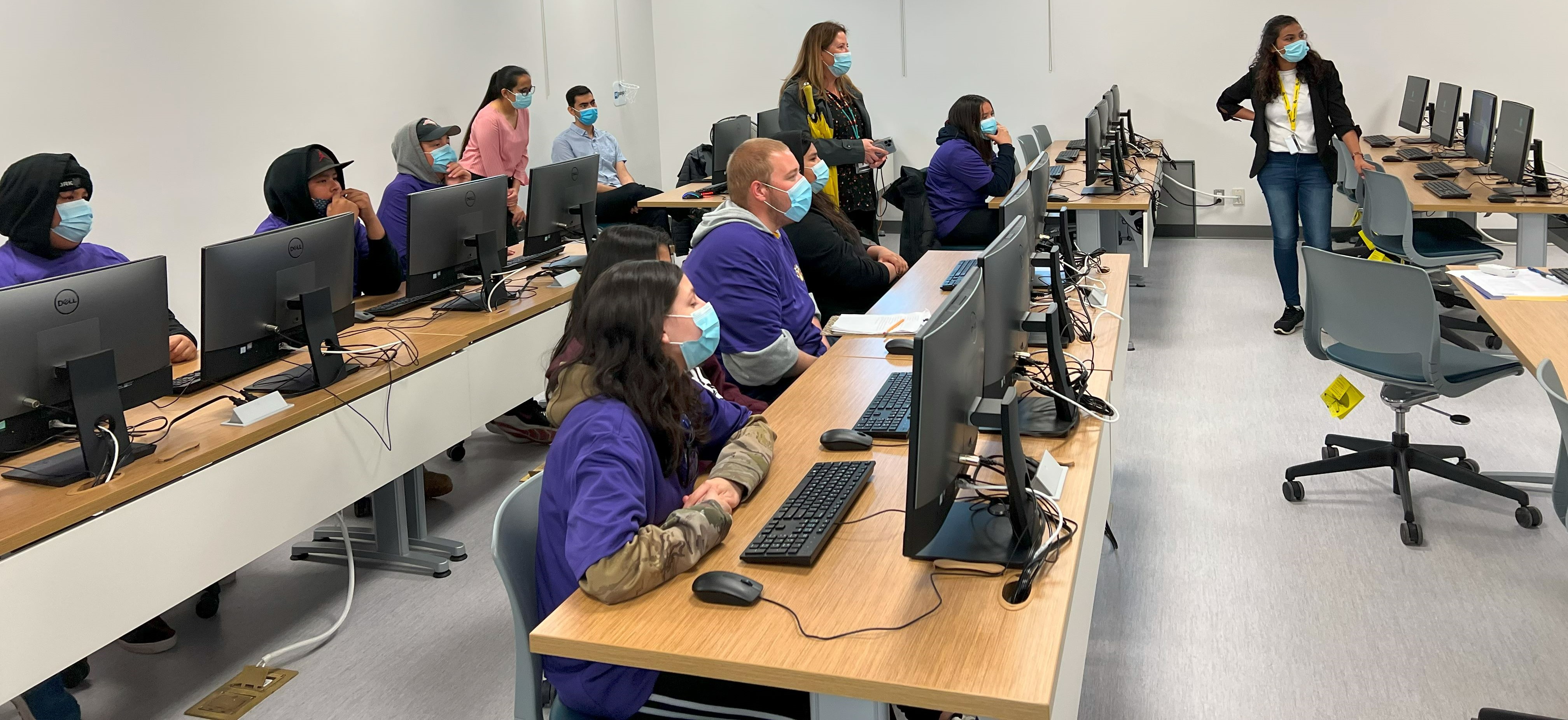 required in other fields. This will help the students to understand and equip themselves with in-demand skills and give them equal opportunities in the job market in the future.”
The task of creating a custom coding program was overseen by Mago, with support from Lakehead's Niijii Indigenous Mentorship Program, and a $36,000 PromoScience grant from the Natural Sciences and Engineering Research Council of Canada.
Mago, an associate professor in Computer Science, set out to improve computer skills in Indigenous youth by using Python programming language, and to compare the results with block-based programming (“Scratch”) with a drop-and-drag interface.
“With computational thinking we want to see whether the student can comprehend the problem and whether they are able to look at solutions, one at a time, step by step, in small segments. Then can they look at the full view of the problem and go deeper to try and find a solution on a smaller scale, then combine all those smaller sub-problems into a big solution,” Mago explains.
The program took two years to develop and was designed by Kamak. A native of India, she has an undergraduate degree in computer science and engineering as well as seven years' experience in the IT field as a data analyst. This project, part of her master's degree studies, involved developing coding appropriate for the grade 7 and 8 level. In the end, it was delivered to about 20 students at Armstrong Public School in a blended learning environment: Kamak conducted classes online as well as in-person, and hosted a visit to the Lakehead campus and the research lab.
It was a rewarding and fulfilling exercise for those students, says Armstrong school principal Corey Dagenais.
“What they really enjoyed was the hands-on experience working with the team from Lakehead University in person,” he says. “Not only the coding element, but also being involved in a program connecting them to future opportunities in post-secondary education.”
Dagenais praised Lakehead staff for engaging the students and working collaboratively with Armstrong school staff to provide a responsive and accessible course.
“Having this program in our school also allowed teachers and support staff to explore a new component of the Ontario mathematics curriculum, and develop their professional skills as educators,” Dagenais adds.
Mago is equally pleased with the outcome of the eight-month program.
“Our findings were quite encouraging,” he says. “We see that a lot of students were able to learn computational thinking and they enjoyed the blended learning environment as well.”
The program was so successful that Kamak was invited to bring it to Pickle Lake. That's all the proof Mago needs to advocate for its continued use.
“It should not be a one-time thing,” he says. “One needs to practice, one needs to improve coding skills over a period of time. Now they have the exposure. These students got their first taste of a text-based program like Python. If we have more funding and more resources, we can support those students. I have a strong belief that all students are equally competent.”
The issue is resources and overcoming the disadvantages that Indigenous students face, such as living in small, remote communities with limited Internet connection and access to qualified instructors. That's one of the reasons so few Indigenous students show an interest in the Science, Technology, Engineering and Mathematics field, the so-called STEM programs.
Kamak found the students were enthusiastic about learning computational thinking and coding syntax and were willing to learn in a non-traditional environment.
“I am overjoyed when students take the lead, complete a code and show me the output,” she says.
In fact, she adds, their data indicates some of these students did well enough that they could qualify to pursue advanced STEM-based education.
“Ultimately we made a significant contribution to the limited computational thinking teaching resources for the Ontario curriculum with a custom-designed curriculum and assessment tool,” she says.
Research in Action highlights the work of Lakehead University in various fields of research.
Submitted photo - Coding class
Armstrong Public School students participated in a course on computer coding skills using a blended learning environment, which included both online and in-person activities.