| What is a Temporary Position? |
A Temporary Position is a fixed-term, non-union role with a defined start and end date, created to address a specific operational, administrative, or project-based need. These roles are not part of the University’s continuing staffing complement, or roles that are established under another non-union employee group. |
| To whom does this Policy apply? |
This Policy applies to all positions in non-union, fixed-term roles paid through the University payroll who meet the definition of “employee” under the Employment Standards Act, 2000 It does not apply to: - Employees covered by a collective agreement
- Schedule II or Technical Staff
- Research-funded positions governed by Fund 50
- Post-doctoral fellows or Visiting Scholars
|
| When should a department use a Temporary Position? |
A department should use a Temporary Position when there is a short-term operational need. This may include addressing temporary increases in workload, supporting a time-limited project, responding to seasonal fluctuations, or managing peak periods where additional support is required for a limited duration. |
| How do Standardized Generic Job Descriptions work? |
Generic job descriptions offer a consistent, equitable framework for classifying and compensating positions. By focusing on the responsibilities, skills, and qualifications required, they ensure that all employees in similar roles receive fair compensation, regardless of where they are working. This approach prevents pay inequities and aligns with the university's commitment to equity, diversity, and inclusion. |
| How do the Standardized Generic Job Descriptions (JDs) impact the hiring process and wage class/band, especially when a candidate’s qualifications exceed the minimum requirements? |
The listed qualifications in a generic job description represent the minimum qualifications required to perform the job. The responsibilities outlined in the JD determine the job’s level, which in turn establishes the appropriate salary band. Even if the successful candidate has qualifications that exceed the minimum (e.g., a master's degree for a role requiring only a bachelor's degree), the level of the job and the assigned wage class/band will not change. The band/class of wages is based on the responsibilities of the role and the predefined JD, not on the individual’s higher qualifications. This ensures fairness and consistency in pay practices, preventing situations where more highly qualified candidates receive higher wages than others performing the same job with the same responsibilities. The JD, not the candidate’s individual qualifications, determines the salary class/band, ensuring that pay remains aligned with the role’s expectations. |
| What is required before recruiting for a Temporary Position? |
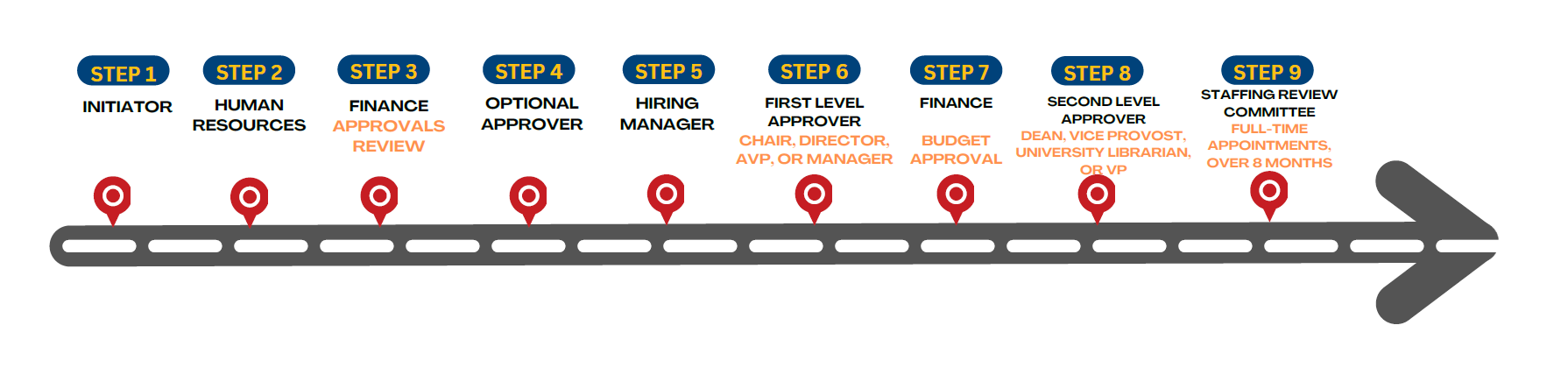
A fully approved Request to Hire (RTH) must be submitted and approved before posting or hiring. No recruitment activity may proceed without this approval. |
| How are Temporary Positions classified and paid? |
All Temporary Positions must align with an established Generic Job Description and be assigned to a class/band within the Temporary Positions Salary Grid (TP0–TP5). The rate of pay must fall within the approved departmental budget, and compensation is typically set between the minimum and mid-range of the applicable salary class/band. Any exceptions to this range require approval from Human Resources. |
| What are the standard hours of work? |
- Full-time Temporary Positions: 35 hours per week
- Part-time Temporary Positions: Less than 35 hours per week
Overtime and hours of work are governed by the Employment Standards Act and University procedures. |
| Are Employees in Temporary Positions eligible for paid vacation days? |
Employees receive vacation pay in accordance with the Employment Standards Act, 2000. |
| Are Employees in Temporary Positions eligible for paid sick days? |
Employees who receive vacation pay as per the answer above are not eligible for paid sick days. If a Temporary Employee is paid on the semi-monthly pay schedule (salary), a Leave of Absence form for unpaid sick time must be submitted for Human Resources to process accordingly. |
| Are Employees in Temporary Positions eligible for other group benefits (e.g., medical, dental, vision, LTD, life insurance, pension)? |
Eligibility for group benefits, if applicable, is determined by Human Resources based on contract duration and other factors. |
| How long does a Temporary Position last? |
Temporary Positions automatically end on the date specified in the employment contract unless renewed or extended in writing. A Request to Hire (RTH) must be submitted and approved prior to the current contract end date. |
| What are my responsibilities as a Hiring Manager in terms of statutory obligations? |
As a supervisor, you must ensure compliance with employment legislation, including payroll, employment standards, and workplace health and safety. Consult Human Resources for guidance on statutory requirements. |
| Are performance reviews/evaluations required? |
Supervisors are expected to provide regular feedback. If a Temporary Position extends beyond one year, at least one formal performance review/evaluation must be conducted. |
| What are the key responsibilities of Hiring Managers? |
Hiring Managers are responsible for identifying the operational need for a Temporary Position and ensuring the role is appropriately classified and placed within the correct salary class/band. They must follow established recruitment procedures, manage the position within the approved departmental budget, and provide ongoing supervision and performance feedback to the employee. Hiring Managers are also responsible for ensuring that all processes comply with applicable employment legislation and University policies. |
| What if I need to discipline or terminate an employee in a Temporary Position? |
Disciplinary or termination actions should be conducted in consultation with Human Resources to ensure adherence to University policies and applicable laws. |
| What happens if an employee in a Temporary Position resigns early? |
Supervisors must notify Human Resources promptly by emailing formsubmission.hr@lakeheadu.ca. The email should include the employee’s full name, employee ID, and a copy of their resignation notice, along with confirmation of the employee’s final date of employment. If the resignation was initially provided verbally, supervisors should request that the employee confirm their resignation in writing so it can be forwarded to Human Resources. |
| Why do I need to submit a Request to Hire (RTH) to fill a position? |
At a time when there is a need for strategic budget planning, and an extremely competitive market for talent, it is important that the University has clear and confident projections about available budget, open roles, and desired skill sets. Leadership needs access to accurate and complete information about the number of occupied and unoccupied budgeted positions. The RTH process provides clarity on budgeted positions and every employee associated with that position (every RTH is linked to an EIF) The permanence of the data aggregated from payroll and accounting, recruiting, and other systems across the university in a position-first approach to workforce planning brings greater visibility and ability to making insightful comparisons between budgeted Full Time Equivalents (FTE), headcount, compensation and actual spend to ensure that funding is identified and utilized in the most effective manner |
| Where can managers get support? |
Hiring Managers should initially consult the Temporary Positions Employment Policy and the Temporary Positions Employment Procedure. If something is still unclear, please contact the Office of Human Resources via email at humanres@lakeheadu.ca for guidance on classification, salary, recruitment, or contract matters. |