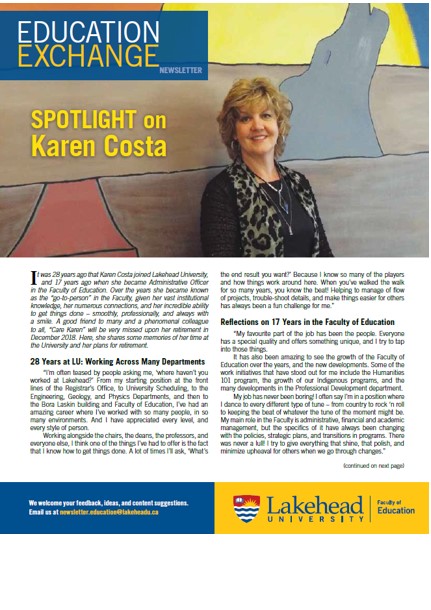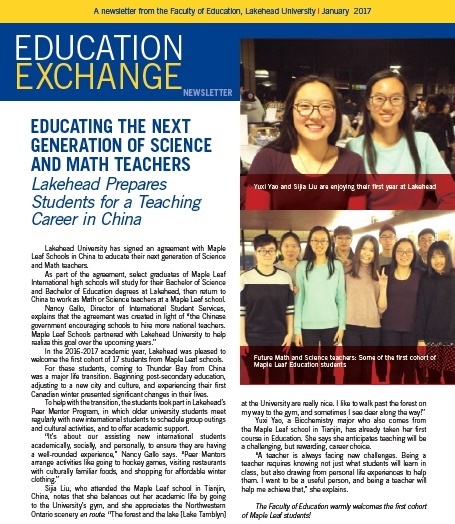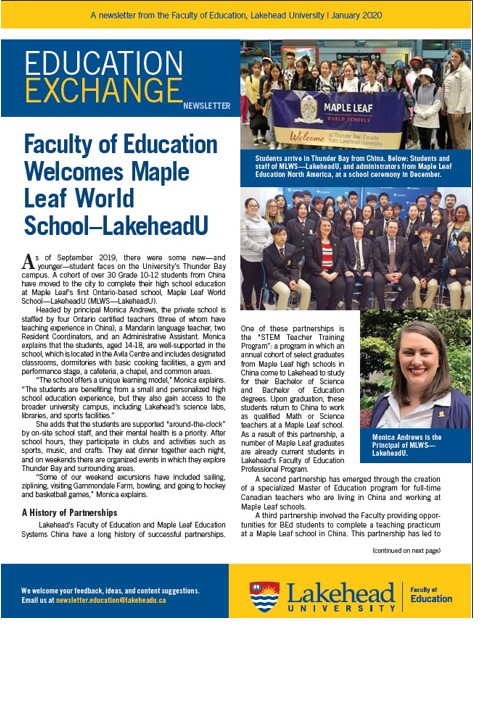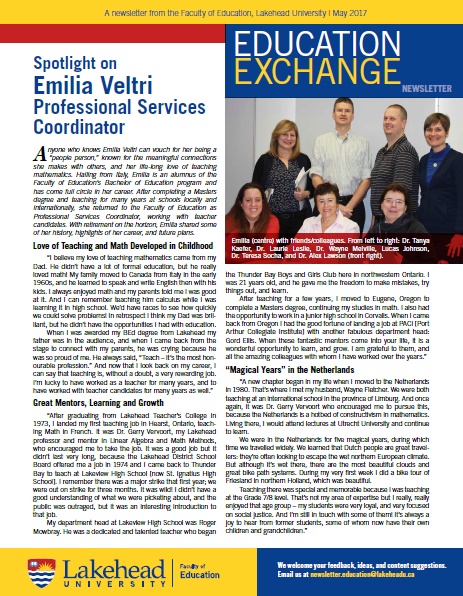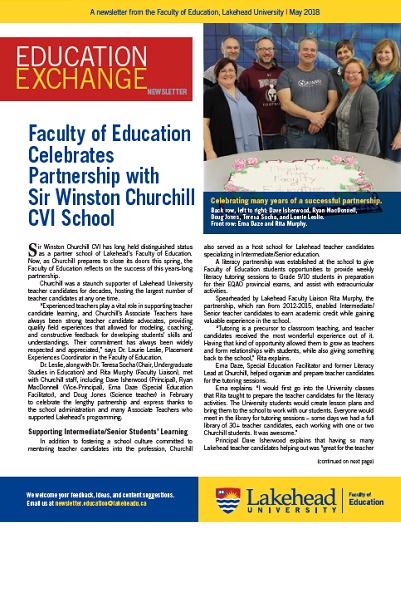
September Issue of Education Exchange Newsletter Published

We are pleased to announce that the September issue of our Education Exchange newsletter has been published. This newsletter brings our current and former students as well as our educational partners together to share news, successes, and innovations.

To access our Education Exchange newsletter, click the following link:

Education Exchange Newsletter (September 2019)

To see previous issues of the newsletter, visit the newsletter archives.


September Issue of Education Exchange Newsletter Published

The September issue of our Education Exchange newsletter has been published. This newsletter brings our current and former students as well as our educational partners together to share news, successes, and innovations.

To access our Education Exchange newsletter, click the following link:

Education Exchange Newsletter (September 2017)

To see previous issues of the newsletter, visit the newsletter archives.

September Issue of Education Exchange Newsletter Published

We are pleased to announce that the September issue of our Education Exchange newsletter has been published. This newsletter brings our current and former students as well as our educational partners together to share news, successes, and innovations.

To access our Education Exchange newsletter, click the following link:

Education Exchange Newsletter (September 2018)

To see previous issues of the newsletter, visit the newsletter archives.

January 2026 Education Exchange Newsletter Published

The January 2026 issue of Education Exchange, the Faculty of Education’s newsletter, is now available. This issue highlights Dr. Gerald Walton’s lecture from the President’s Public Lecture Series, “What’s the Deal with Bullying? Stories from a Target, Scholar, and Educator,” and features announcements of new staff members, student and alumni spotlights, faculty news and awards, and more.

To access this issue, click here.

Robyn Moffat Wins Esri Canada New Teacher Competition

Congratulations to Robyn Moffat (BEd, 2025), whose outstanding StoryMap project earned first place in the 2025 Esri Canada New Teacher Competition. Robyn received the competition’s grand prize in recognition of her creativity, innovation, and commitment to advancing geographic literacy through GIS technology.

Robyn created the award-winning StoryMap, “Canada’s Natural Wonders,” as part of an assignment in the Intermediate/Senior Geography course taught by Sarah Gallah. The resource Robyn created invites Grade 9 learners to virtually explore Canada while uncovering the Indigenous histories and geological processes behind some of the nation’s most remarkable landforms. Robyn’s work aligns closely with the newly updated Exploring Canadian Geography curriculum, released at the start of the 2024-2025 school year.

The Esri Canada New Teacher Competition highlights emerging educators who use ArcGIS to foster spatial awareness, critical thinking, and analytical skills in the classroom. Robyn’s StoryMap has now been added to the Esri Canada K–12 Resource Finder, making it accessible to teachers and students across the country.

Robyn’s work was additionally featured in the Esri Canada article GIS Day Spotlight: Teacher Wins, GIS Stories, and ArcGIS Resources.

Congratulations, Robyn, on creating an exceptional learning resource that will inspire students and educators alike!


Keith Ailey Named OAEA Post-Secondary Art Educator of the Year

Congratulations to Keith Ailey (Contract Lecturer, Thunder Bay), who has been named Post-Secondary Art Educator of the Year by the Ontario Art Education Association (OAEA).

Keith—an instructor of I/S and P/J Curriculum & Instruction in Visual Arts and a long-time Thunder Bay high school art teacher—will be formally celebrated at an online awards event in February 2026.

As noted by the OAEA adjudicators, “Keith exemplifies the qualities of an outstanding teacher who inspires and nurtures creativity, confidence, and excellence in his students. His distinguished career and exceptional contributions to art education at Lakehead Public Schools and his contributions at Lakehead University stand as an inspiring example celebrated by this award.”

This honour recognizes educators who demonstrate exceptional commitment to fostering creativity, critical thinking, and artistic skill in all learners.

Reflecting on the award, Keith shared: “I strongly believe that being an educator is the greatest job in the world. I am honoured and humbled with this award, but more importantly I am inspired to continue improving and refining my work in education. I strive to continuously explore new methods of instruction, assessment and classroom management, and I am always excited to share these with teacher candidates.”

Keith is widely recognized for creating engaging, inclusive, and empowering learning environments. Lakehead Teacher Candidate Gabrielle Rattray notes: “The dedication, effort, and passion he invests in his students is immediately apparent… Thanks to Keith, I now feel far more confident and prepared to step into a classroom of my own.”

Congratulations, Keith, on this well-deserved achievement!

Etuaptmumk bimoseng (Two-Eyed Seeing Walk) Invites Lakehead Community to Learn with the Land

A new land-based learning experience—now in its pilot phase—is inviting the Lakehead Thunder Bay community to walk, learn, and reflect together on the history and culture of Indigenous peoples on what is now considered campus lands.

Acting Sustainability Coordinator Rachel Portinga discusses one of archeological sites along the McIntyre River.  The Etuaptmumk bimoseng (Two-Eyed Seeing Walk) offers an experiential way to engage with land-based learning, truth and reconciliation. Developed and led by Joe Duncan (Indigenous Content Curriculum Specialist, Teaching Commons) and Rachel Portinga (Acting Sustainability Coordinator, Office of Sustainability; pictured left in teal jacket), the 90-minute campus walk is grounded in Etuaptmumk, or Two-Eyed Seeing, which weaves together Indigenous and Western ways of knowing.

“This walk brings Lakehead’s land acknowledgment to life in a new way,” explains Joe Duncan. “We are sharing about the deep cultural and historical significance of this land, including the presence and activities of Indigenous peoples dating back over 9,000 years.”

To date, more than 60 participants have taken part in the walk. Participants from the Faculty of Education included Wayne Melville, Kevin Dempsey, Gisella Scalese, Pauline Sameshima, Heather Moynihan, Lis Boileau, Sinead Huffman, and Jan Oakley.

Learning with the Land

The walk begins at Lake Tamblyn and moves along the pathway of the McIntyre River, concluding around a fire at the ceremonial sweat lodge site on campus.

Along the way, participants visit some of the 14 archaeological sites that have been identified on the land, iA copper piece excavated along the river.ncluding quarry sites of Jasper taconite. Copper (pictured right) is also abundant on the land. Artifacts such as arrowheads, spearheads, knives, fishhooks, and other copper tools dating back thousands of years have been uncovered, illustrating the long-standing Indigenous presence on the land.

As participants continue the walk along the river path, they learn about some of the local medicinal plants and their cultural significance. Traditional medicines exemplify Etuaptmumk in practice; for example, giizhik (cedar) has long been used by Indigenous peoples for detoxification, spiritual cleansing, and anti-inflammatory properties; more recently, Western science has also demonstrated the same benefits.

Acknowledging Difficult Histories

While the walk celebrates the richness and resilience of Indigenous cultures, it also addresses the ongoing impacts of colonization. Participants discuss the 1849 commissioners’ report that shaped the 1850 Robinson-Superior Treaty (under which the Lakehead Thunder Bay campus is covered), as well as the introduction of the Indian Act in 1873 and the subsequent residential school era and its devastating impacts. These historical events are connected to present-day realities, including the lasting intergenerational effects of settler colonialism.

This engagement with difficult histories opens space for conversations about the Truth and Reconciliation Commission’s Calls to Action and the shared responsibilities of all treaty people in moving reconciliation forward.

The walk concludes at the campus sweat lodge site, where participants gather to reflect, share giizhik tea, and discuss teachings from the walk.

Looking Ahead

Indigenous Curriculum Specialist Joe Duncan (in baseball cap) shares teachings around a campfire, while participants drink cedar tea. The Office of Sustainability and the Teaching Commons are currently gathering feedback from the pilot sessions to help shape the future of the walks. Planned steps include seasonal walks and a train-the-trainer model to broaden access to the walk across the university, and potentially the wider community.

At Lakehead University, sustainability is considered in a pluralistic and inclusive way, encompassing human and ecological health, social justice and equity, Indigenous rights, secure livelihoods, workplace wellbeing, and leadership for vibrant communities. Co-developing initiatives like the Etuaptmumk bimoseng (Two-Eyed Seeing walk) invite the Lakehead community to learn with the land and experience how sustainability is intersectional and multi-dimensional.

“Not all classrooms have four walls,” says Joe (pictured left, in baseball cap). “When we connect to the land and are listening and talking from the heart, that’s learning.”

Mohit Dudeja Receives Teaching Innovation Award

Mohit Dudeja, PhD student and Contract Lecturer (Thunder Bay campus), has been honoured with a Teaching Innovation Award for the 2024-2025 academic year. The Senate Teaching and Learning Committee recognized Mohit’s creative development and delivery of the graduate-level Activism in Education course, which blended theory with immersive, hands-on learning.

The course stood out for its dynamic mix of arts-based activities, outdoor experiential learning, multimedia, and imaginative exercises designed to create transformative learning experiences. A highlight noted by the committee was Mohit’s theatrical approach—most notably an in-class play on activism—which allowed the Master of Education students, many of whom are international students, to actively explore pressing issues in the Canadian context including gender equality, racism, and discrimination.

The award speaks to both the impact of the course and Mohit’s dedication to innovative, student-centered teaching.

Congratulations, Mohit!


Dr. Connie Russell’s Special Issue on Annette Gough’s Scholarly Contributions Released

Dr. Connie Russell (Professor, Faculty of Education) recently edited a Special Issue of the top-ranked journal, Environmental Education Research. It focuses on Professor Emeritus Annette Gough’s career retrospective book, Gender and Environmental Education: Feminist and Other(ed) Perspectives. The Selected Works of Annette Gough (Routledge).

Over the past 35 years, Dr. Gough, a Professor Emeritus (RMIT University, Australia), has made significant contributions to environmental education. This Special Issue was an opportunity to assess, applaud, and augment her body of work. The issue consists of an editorial, eight response papers by an international group of highly respected scholars, and two papers by Dr. Gough – one a summary of her book and the other her reflection on the responses. The issue highlights topics, theoretical perspectives, and methodological approaches that have been, and in some cases continue to be, marginalized in environmental education scholarship and identifies future research directions and strategies for countering erasures, revealing silences, and broadening horizons in the field.

The full issue is available here.

Honouring the Legacy of Jean Engholm: A Dedicated Supporter of Indigenous Education

It is with sadness that we share the passing of Jean Engholm in September 2025, at the age of 93.

The Faculty of Education extends its sincere gratitude for Jean’s enduring commitment to the Faculty and its mission. Jean’s generous support and belief in the transformative power of education have left a lasting legacy at Lakehead – particularly in her support of Keewatinase Indigenous Education and advancing Indigenous education.

Through her contributions, Jean helped strengthen Keewatinase’s capacity to carry forward its commitments to revitalizing Indigenous programming and responding meaningfully to the Truth and Reconciliation Commission’s Calls to Action. Her support reflected a deep respect for inclusive, community-based learning and a commitment to reconciliation. The Faculty is deeply grateful for her vision and generosity.

As noted in her obituary, Jean’s connection to Lakehead University extended beyond philanthropy. A lifelong learner, she earned her Bachelor of Arts in Economics from Lakehead in 1984, pursuing higher education later in life as part of her enduring intellectual curiosity.

Jean was born near Manchester, England, in 1932. She trained as a nurse at age 17 and later served as Nursing Sister in charge of Student Health Services at Makerere University College in Uganda. Though she did not practise nursing in Ontario, her career spanned a remarkable range of roles – from bookkeeper and research assistant to conference coordinator and volunteer.

Her volunteerism was inspiring. From assisting with evacuated children during WWII as a Red Cross Cadet, to supporting Save the Children in Uganda and Canada, and advocating for individuals with developmental challenges through Community Living Thunder Bay, Jean dedicated her life to helping others. In her later years, as she faced the challenge of vision loss and became deeply involved with the CNIB, continuing her lifelong example of community engagement.

The Faculty of Education remembers Jean Engholm with deep appreciation for her generosity, her spirit of service, and her lasting impact on education and reconciliation. 

Pages