| What is a Research Funded Position (RFP)? |
A Research Funded Position (RFP) is a position that is funded through research grants, agreements, or other research-related funding sources. These positions may be full-time or part-time and may be established as fixed-term or permanent/continuous, depending on the nature and duration of the funding. Where ongoing funding can be reasonably foreseen, a research-funded position may be established on a permanent or continuous basis to support longer-term research needs. |
| Why are we using generic job descriptions? |
Generic job descriptions offer a consistent, equitable framework for classifying and compensating research-funded positions. By focusing on the responsibilities, skills, and qualifications required, they ensure that all employees in similar roles receive fair compensation, regardless of the specific field of research. This approach prevents pay inequities and aligns with the university's commitment to equity, diversity, and inclusion. |
| How do Generic Job Descriptions work? |
Standardization Across Roles:
A Research Assistant in biology may work in a laboratory setting conducting experiments, while an RA in history may focus on literature reviews and archival research. Despite these differences in daily tasks, their job descriptions might focus on shared core elements, such as: - Assisting in data collection and analysis.
- Supporting the principal investigator in research tasks.
- Preparing reports or summaries of research findings.
Same Job Band for Similar Responsibilities and Qualifications:
Even though RAs in biology and history may work on vastly different types of projects, their qualifications (such as educational background) and the overall scope of their responsibilities (such as data handling, research support, and reporting) may be comparable. In this case, both would fall under the same salary band on the Research Funded Positions Salary Grid because the overall nature of the work is considered equivalent. |
| What’s the advantage of using Generic Job Descriptions? |
- Simplifies Hiring for Principal Investigators (PI): Using generic job descriptions means that the PI does not have to create a new job description every time they hire. These pre-set descriptions cover core responsibilities, qualifications, and skills, making the hiring process more efficient.
- Promotes Fairness Across Fields: By focusing on the required qualifications and responsibilities rather than the specific field of research, generic job descriptions ensure that employees in different disciplines (e.g., biology vs. history) receive fair and equal compensation if their roles are similar in scope and expertise.
- Consistency in Salary Bands: Generic descriptions allow PIs and HR to assign salary bands based on clearly defined criteria. This ensures employees with the same qualifications and responsibilities are compensated consistently, regardless of their specific research project.
- Mitigates Subjective Decision-Making: Without standard descriptions, PIs may assign salaries based on their project's perceived importance or available funding. Generic job descriptions ensure that salary decisions are objective and based on role requirements, not individual preferences.
- Supports Pay Equity Compliance: In line with Ontario’s Pay Equity Act, using generic job descriptions guarantees that employees in substantially similar roles are paid equally, regardless of their gender, department, or field, reducing the risk of pay equity challenges.
|
| With Generic Job Descriptions, how do I clarify specific tasks and expectations? |
Even with generic job descriptions (JDs), you can easily clarify specific tasks and expectations for employees by customizing certain aspects of their role based on the project’s needs. Here's how to ensure clarity while still adhering to the generic JD framework: - Tailored Onboarding and Orientation: During onboarding, go beyond the generic JD by clearly outlining the specific tasks the employee will handle within the research project. For example, while the generic JD may describe "data collection" as a responsibility, you can specify that the role involves collecting environmental data in field studies for a biology project or archival data for a history project.
- Set Clear, Project-Specific Goals: While the generic JD covers broad duties, set specific goals during the hiring or orientation process. Discuss with the employee what success looks like in their particular role and how it contributes to the larger research project. This helps them understand their exact responsibilities.
- Create a Task List or Work Plan: You can create a detailed work plan or task list based on the project timeline. For instance, provide a weekly or monthly breakdown of deliverables or milestones relevant to their role, such as deadlines for data collection, analysis, or report writing.
- Regular Check-ins and Feedback: To ensure expectations are clear, schedule regular check-ins (e.g., bi-weekly or monthly meetings) to discuss the employee's progress on project-specific tasks. This also allows you to provide feedback and adjust expectations as the project evolves.
- Performance Reviews Aligned to Specific Tasks: Though performance reviews will be tied to the broad duties outlined in the generic JD, you can tailor the review process by evaluating the employee’s performance on the specific tasks they’ve been assigned within the project.
All of the above will be different depending on the level and seniority of the role. |
| How do generic job descriptions (JDs) impact the hiring process and wage bands, especially when a candidate’s qualifications exceed the minimum requirements? |
When reviewing a generic JD, the listed qualifications represent the minimum qualifications required to perform the job. The responsibilities outlined in the JD determine the job’s level, which in turn establishes the appropriate salary band. Even if the successful candidate has qualifications that exceed the minimum (e.g., a master's degree for a role requiring only a bachelor's degree), the level of the job and the assigned wage band will not change. The band of wages is based on the responsibilities of the role and the predefined JD—not on the individual’s higher qualifications. This ensures fairness and consistency in pay practices, preventing situations where more highly qualified candidates receive higher wages than others performing the same job with the same responsibilities. The JD, not the candidate’s individual qualifications, determines the salary band, ensuring that pay remains aligned with the role’s expectations. |
| Who is responsible for hiring research-funded employees? |
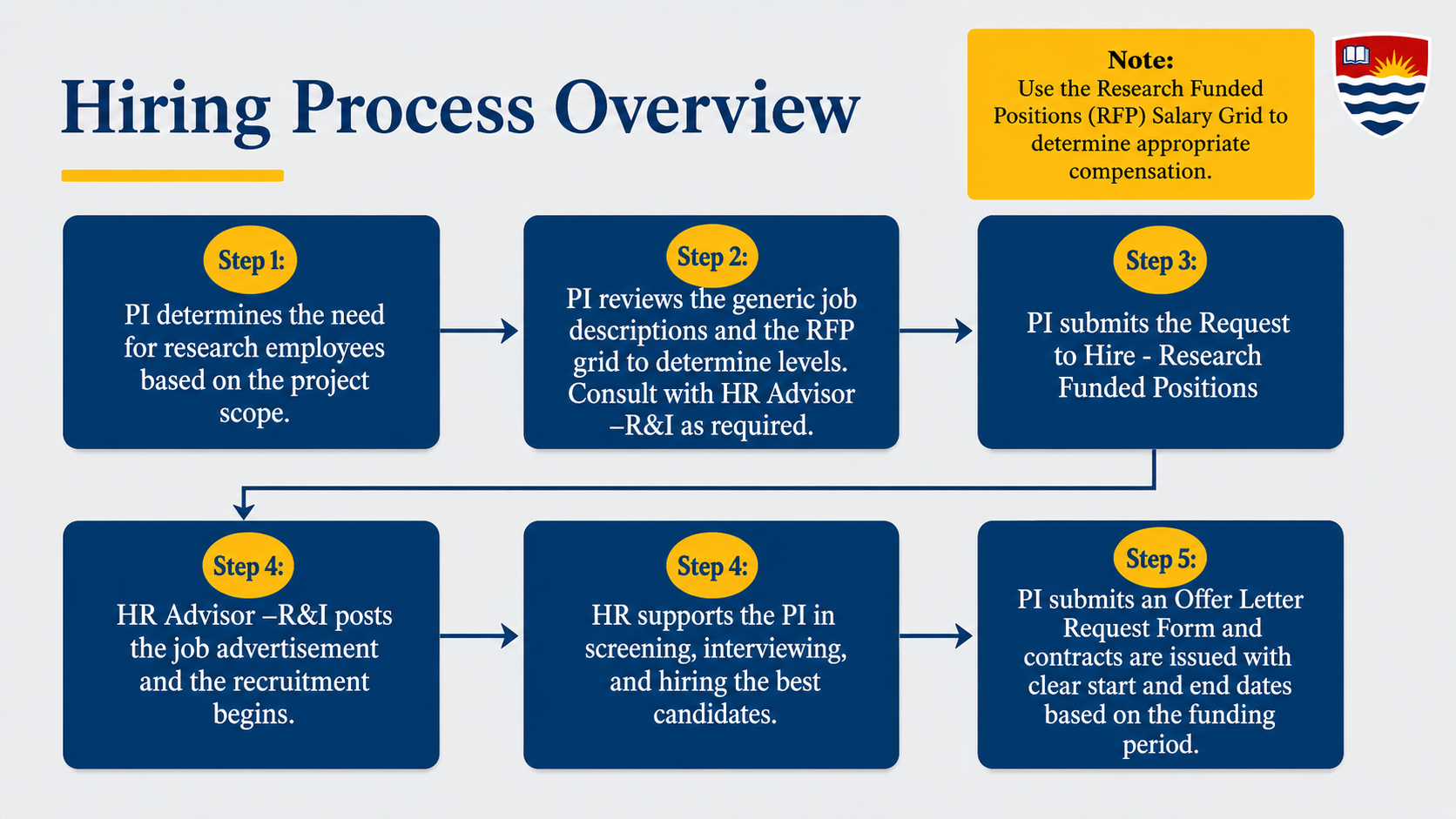
The Principal Investigator (PI) is responsible for hiring employees for research-funded positions. The PI works in collaboration with Human Resources to ensure compliance with employment policies and funding requirements. |
| How are salaries for RFPs determined? |
Salaries are based on the Research Funded Positions Salary Grid. The PI, with assistance from Human Resources, determines the salary band in line with the value of the position. Exceptions to the grid require approval from the Vice President of Research and Innovation. |
| Can an RFP employee receive salary increases? |
Yes, salary increases may be provided based on performance and available funding. Additionally, selective salary increases may be requested by the PI if salary inequities exist, or adjustments are required. |
| What is the standard workweek for full-time RFP employees? |
The standard workweek for full-time RFP employees is 35 hours. Part-time employees work fewer than 35 hours, with hours and compensation governed by the Ontario Employment Standards Act. |
| Are RFP employees eligible for benefits? |
Eligible RFP employees may be enrolled in non-statutory benefits programs, provided the employer’s share of the cost is covered by the research funds. The availability of benefits is also subject to the funding agreement. |
| How do I initiate the hiring process of an RFP employee? |
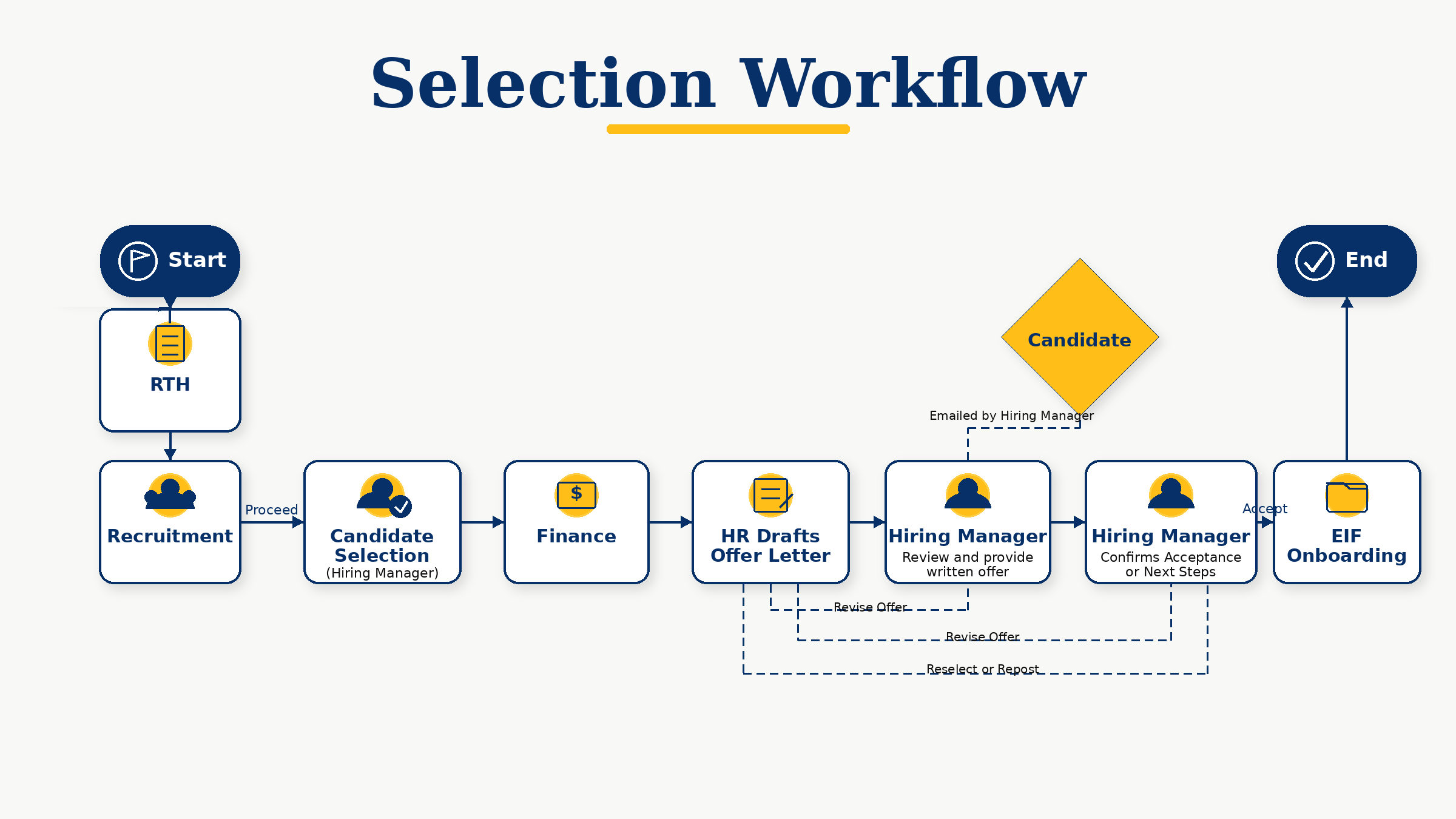
The recruitment procedure is outlined in the Research Funded Positions Employment Procedure. |
| What happens if an employee's contract is renewed beyond two years? |
If an RFP employee's contract is renewed multiple times and total employment with the University reaches 5 years, they may be considered to have continuous employment, which impacts entitlements such as notice of termination and severance pay. Hiring Managers should consult with Human Resources in such cases. It is important to note that the employment is continuous based on being with the University as an employer continuously even if the individual has only worked less number of years in a specific research contract. |
| What is the process for performance reviews for RFP employees? |
RFP employees are subject to regular performance assessments. Hiring managers (PI/Supervisors) are encouraged to hold annual performance goal setting and assessment meetings, aligning with the University’s performance management process. More information regarding the Annual Performance Evaluation can be found here. |
| How is vacation pay handled for RFP employees? |
Vacation pay is provided in accordance with the Ontario Employment Standards Act, unless otherwise specified in the employee’s contract. |
| What are my responsibilities as a Hiring Manager in terms of statutory obligations? |
As a supervisor, you must ensure compliance with employment legislation, including payroll, employment standards, and workplace health and safety. Consult with Human Resources for guidance on statutory requirements. |
| What if I need to discipline or terminate an RFP employee? |
Disciplinary or termination actions should be carried out in consultation with Human Resources to ensure adherence to University policies and applicable laws. |
| Why do I need to submit a Request to Hire (RTH) to fill a position? |
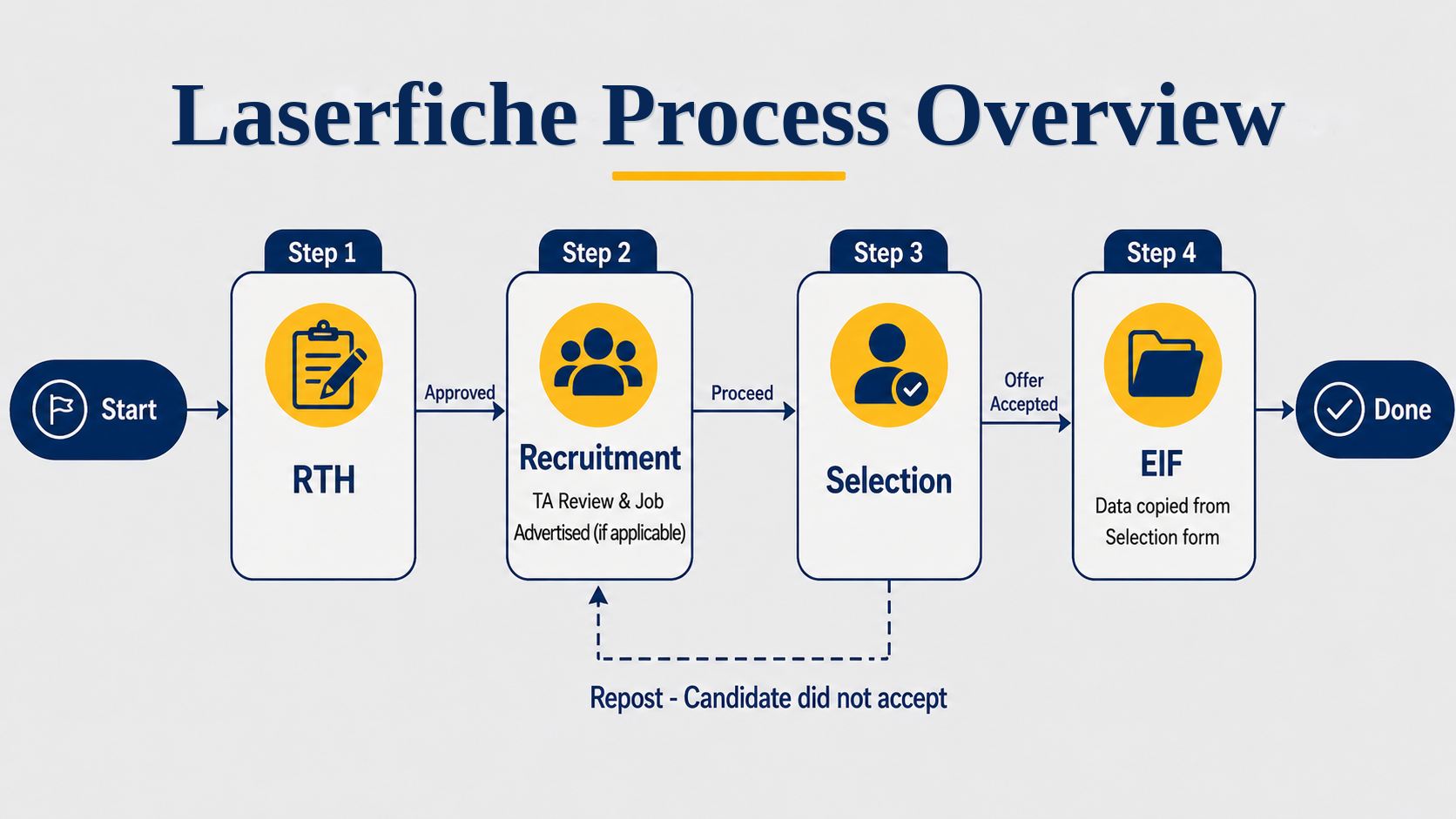
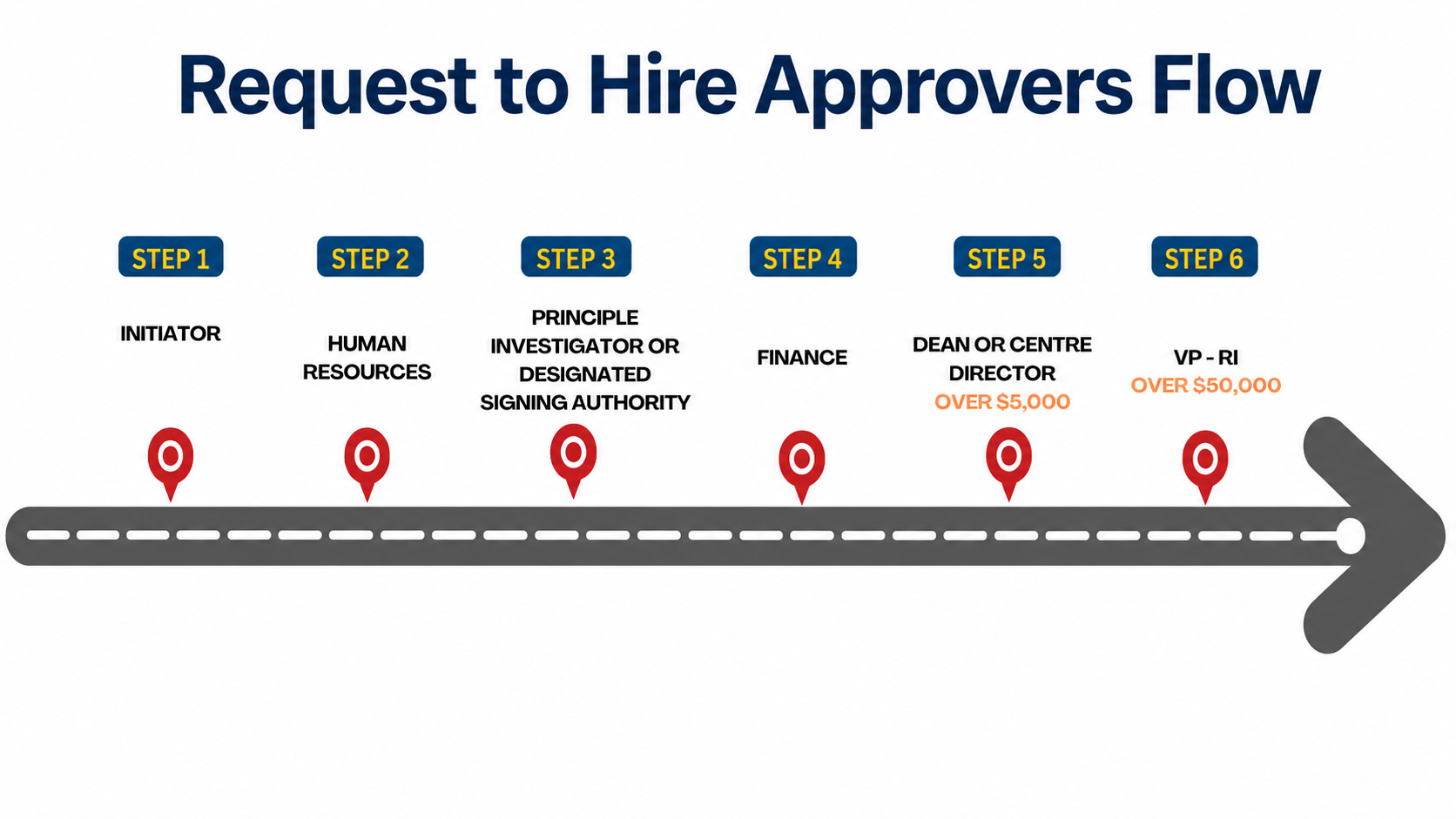
At a time when there is a need for strategic budget planning, and a very competitive market for talent, it is important that the University has clear and confident projections about available budget, open roles and desired skill sets. Leadership needs access to accurate and complete information about the number of occupied and unoccupied budgeted positions. The RTH process provides clarity on budgeted positions and every employee associated with that position (every RTH is linked to an EIF) The permanence of the data aggregated from payroll and accounting, recruiting, and other systems across the university in a position-first approach to workforce planning brings greater visibility and ability to making insightful comparisons between budgeted Full Time Equivalents (FTE), headcount, compensation and actual spend to ensure that funding is identified and utilized in the most effective manner |
| What do I do if my Request to Hire is declined? |
If your Request to Hire submission is declined you will be notified and able to see the comments provided. You can later resubmit a new request. |
| How long is the RTH Valid? |
The RTH for a full time position is valid for 6 months. For part time/fixed term contract positions an RTH only valid for until the budget year in which RTH has been approved. |
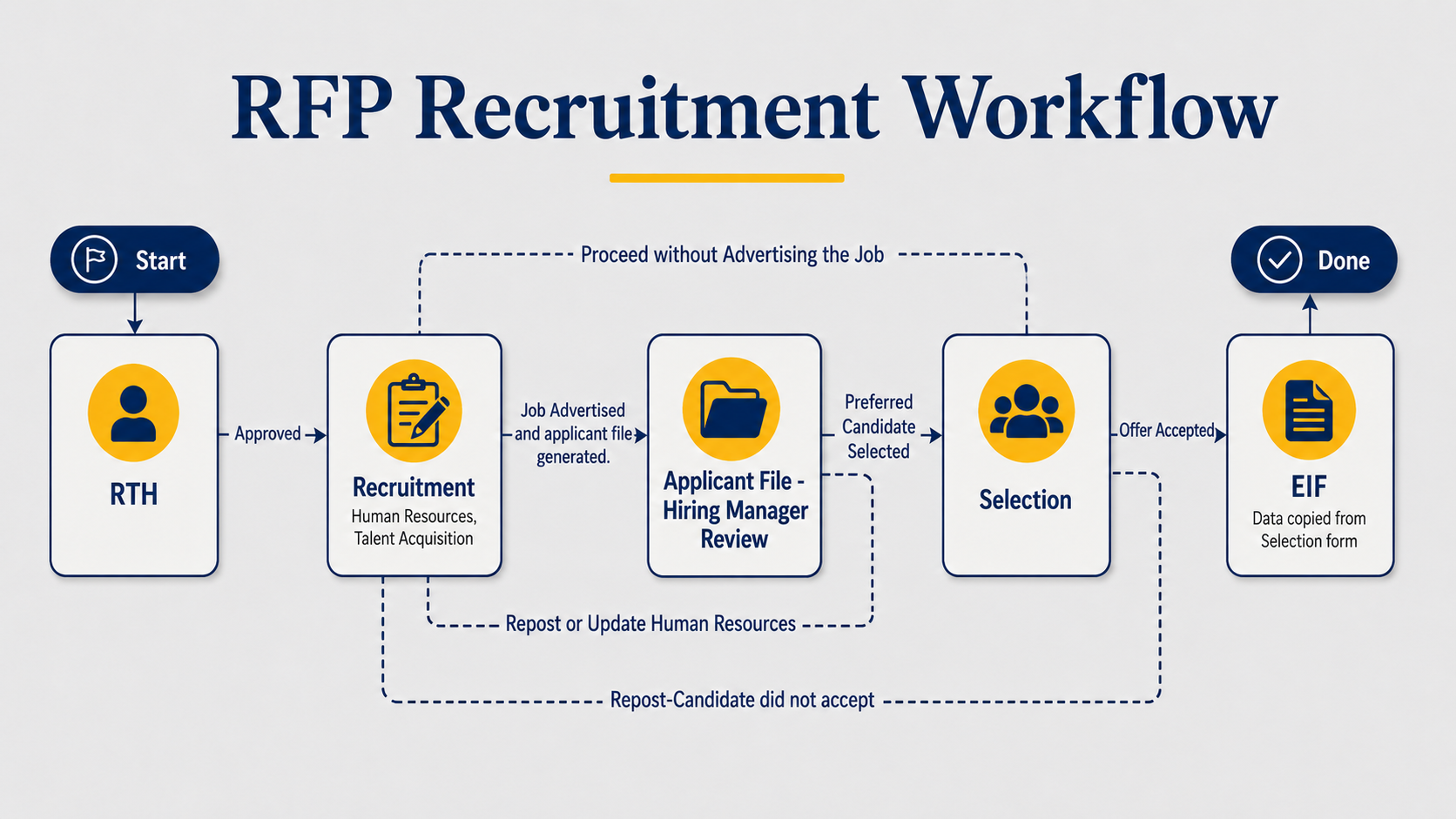
| I forgot to put in an RTH, and I have already offered a candidate the position. Can I complete an EIF instead? |
An EIF will not be processed unless there is a corresponding RTH. However, these errors are possible, and as long as there is a budget and all stakeholders are in agreement, through this workflow process, an RTH can be approved within a few hours. |