Lucas Johnson Receives Grant for Research Project on Educational Technology Decision-Making Influences

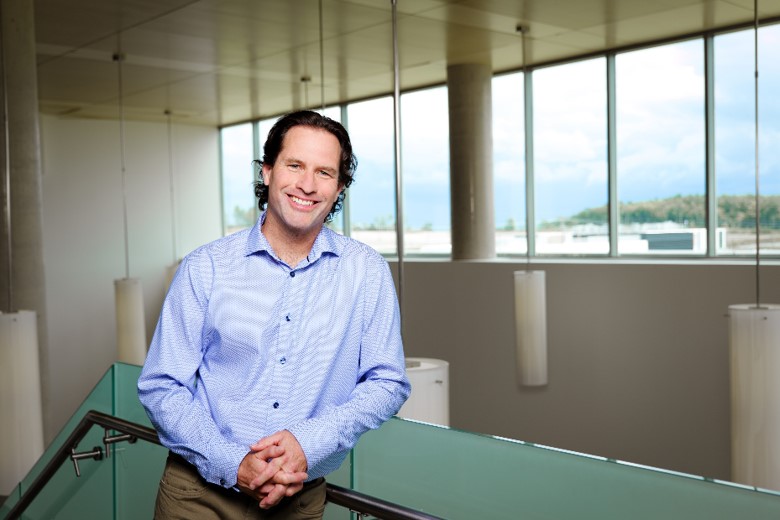
Lucas Johnson (Educational Technologies Facilitator, Contract Lecturer, and PhD student) has been awarded an AMTEC Trust research grant for his graduate research, titled “Educational Technology Implementation Influences in Ontario K-12 Schools.”

His research examines the decision-making processes and factors related to the selection and implementation of education technology in schools.

“It is important to critically examine the factors influencing decision-making, especially in a time when publicly-funded spending on educational technologies continues to increase and technology permeates our lives,” he explains.

He plans to collect data via by surveying boards of education and conducting interviews to garner a larger picture of the scope of the factors influencing technology acquisition and allocation.

With over 20 years’ experience in the educational technologies sector himself, Lucas is well-positioned to undertake this study.

The annual AMTEC Trust award is a $3000.00 research grant awarded to a graduate student whose research is focused on educational technology. Lucas will present his research at the Canadian Network for Innovation in Education conference next year.

BEd Student Samantha Clay Wins Panel Award for Storybook about “The Sustainable Squirrel”

As part of the undergraduate conference during this year’s Research and Innovation (R&I) week, Bachelor of Education student Samantha Clay (Orillia campus) won a “Special Category” award for participating on panel and sharing the storybook she created and illustrated, titled The Sustainable Squirrel.

Samantha explains that the storybook introduces young readers to the Sustainable Squirrel character, who provides lessons in sustainability to Fashionable Frog, New Toy Turtle, Art Ant, and Water Bottle Walrus.

“The storybook focuses on the idea of commercial over-consumption. The Sustainable Squirrel promotes the concepts of reducing, reusing, and recycling. I envisioned the story as one that could be shared with parents/guardians. Students could come up with their own characters with alliterative names, then follow the repetitive template of the book to identify more sustainable solutions to throwing an item away,” she says.

Samantha was selected by her instructor, Elizabeth Thomas (Curriculum & Instruction in Social Studies - Primary/Junior) to participate on a nine-student panel that focused on sustainability and growth. She adds that it was an honour to be selected and to be able to combine her interests in this project.

“I’ve always had a passion for the outdoors and the environment, and the ability to apply my artistic side to this project made it especially exciting.”

BEd Student Kari Clark Named Best Presenter on Sustainable Growth Panel

As part of an undergraduate conference during this year’s Research and Innovation (R&I) week, Bachelor of Education student Kari Clark (Orillia campus) was selected by her peers as best panelist on a nine-student panel that focused on sustainability and growth.

Her presentation, which she adapted from a Social Studies assignment, responded to the question: “How does the town of Collingwood’s potential water shortage affect the school system, infrastructure development, and growth and sustainability of the community as a whole?”

Kari notes that participating in the panel was an excellent opportunity to advocate for teachers using outdoor spaces to teach the Social Studies curriculum, as a means of promoting sustainability. This connected to the theme of this year’s R&I week: “Planetary Sustainability.”

As a reward for being selected as best panelist, Kari was asked to represent the Faculty of Education at a lunch with the University President and winners from other University faculties.

She explains that participating on the panel was “an amazing opportunity, especially from an educational perspective. Lakehead students have a wealth of knowledge, and to be able to witness this learning and growth in relation to planetary sustainability was nothing short of incredible!”

Connecting Indigenous Cultural Practices and Lynx Coding: Dr. Ruth Beatty and Colleagues Receive Grant

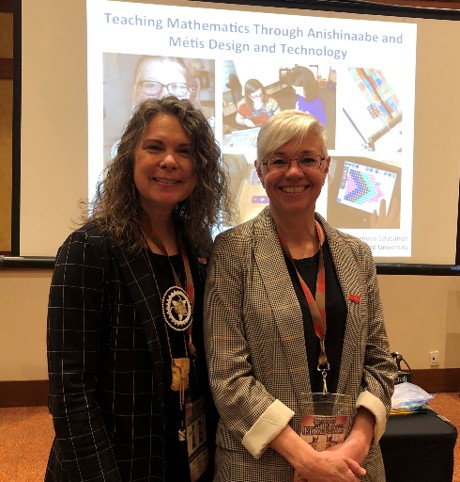
As part of a $3,000,000 CanCode grant awarded to TakingITGlobal, Dr. Ruth Beatty (Associate Professor, Orillia campus) and her Indigenous Knowledges and Mathematics research colleagues will receive $75,000 over the next 2.5 years to continue to explore connections among Indigenous cultural practices, mathematics, and Lynx coding.

Lynx is a text-based coding program available in many languages including Anishinaabe, Mi’kmaw, Kanien’kéha, and Oji-Cree. For this project, the research team will collaborate with community partners to continue to explore how incorporating coding can help us to further understand Anishinaabe and Métis ways of knowing mathematics that both align with, and are different from, a Western European conception of mathematics.

To date, they have used Lynx as a way to investigate the structure of loom beading, circular medallions, and Métis finger weaving. The dynamic nature of the software affords students an opportunity to explore different mathematical concepts inherent in beadwork or weaving such as computational thinking, patterning and algebraic reasoning, proportional reasoning, and geometric transformations. The current project will extend these previous explorations, and also include other technologies such as birchbark basket making.

Seven Faculty Instructors Nominated for Contribution to Teaching Awards

The Faculty of Education is fortunate to have many exemplary instructors whose work has been recognized in a number of different ways over the past years. In an impressive demonstration of the depth of teaching in the Faculty of Education, seven instructors have been nominated by their students for Contribution to Teaching Awards. Unfortunately, some of these outstanding educators are not eligible for the award, as one of the conditions for receiving the award is to have taught at Lakehead for four semesters. This does not detract, however, from the very real achievement of being nominated.

On behalf of the Faculty of Education, congratulations to the seven nominees!

  • Melanie Biesenthal - Curriculum & Instruction in Mathematics (Primary-Junior). Melanie recognizes that this nomination is the result of being part of a collaboration with Dr. Alex Lawson and the Primary/Junior Math Team with whom she learns and works so closely.
  • Tom Boland - Planning, Evaluation, and Classroom Management; Faculty Advisor
  • Jen Farrell-Cordon - Curriculum & Instruction in Social Studies (Primary-Junior)
  • Sarah Gibbon - Curriculum & Instruction in Language Arts (Primary-Junior)
  • Sherri Lankinen - Planning, Evaluation, and Classroom Management; Curriculum & Instruction in Language Arts (Primary-Junior); The Practice of Inclusive Education (Primary-Junior); Faculty Advisor
  • Steven Secord - Critical Digital Literacy; Online Teaching; Planning, Evaluation, and Classroom Management; Curriculum and Instruction in Science and Technology (Primary/Junior); Faculty Advisor
  • Brian Weishar - Planning, Evaluation, and Classroom Management; Literacy and Learning in the Intermediate-Senior Curriculum; Faculty Advisor

Dr. Gary Pluim’s Research Featured in OrilliaMatters News

Dr. Gary Pluim (Assistant Professor, Orillia campus) is leading a study that follows the transfer of curriculum between Commonwealth countries in the Caribbean, South Pacific, Eurasia, and sub-Saharan Africa.

His research was recently featured in OrilliaMatters News, as part of their “Research in Action” series.

As Gary notes in the write-up, “The research looks at the extent to which educational programming can be packaged and exported to different countries, the assumptions we make about the nature of knowledge, and the implications of sharing curriculum around the world. We draw on decolonial scholarship to critique a widespread perception that curriculum and knowledge are universal. In this vein we ask, ‘to what extent does place, culture, and nationality matter in education?’”

To read the story about Gary’s research, click here.

Dr. Sonia Mastrangelo’s Research Featured in OrilliaMatters News

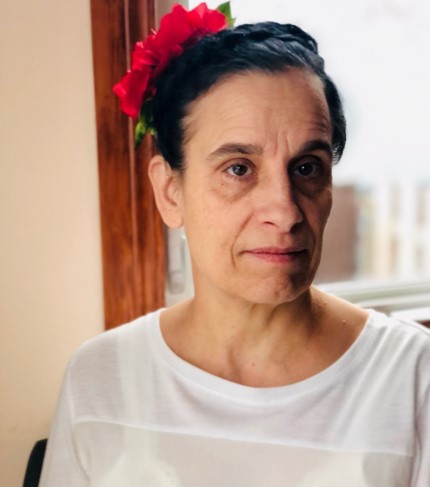
Dr. Sonia Mastrangelo (Associate Professor, Orillia campus) is conducting a qualitative study to explore the lived experiences of adults with developmental disabilities living in the care farm setting of Camphill Communities of Ontario.

Her research was recently featured in OrilliaMatters News, as part of their “Research in Action” series.

As Sonia explains in the article, the goal of the research project is to build “knowledge and understanding about the well-being of adults with developmental disabilities, and figuring out what they need. We’re going to explore their lived experiences at Camphill and what that looks like.”

To read the story about Sonia’s research, click here.

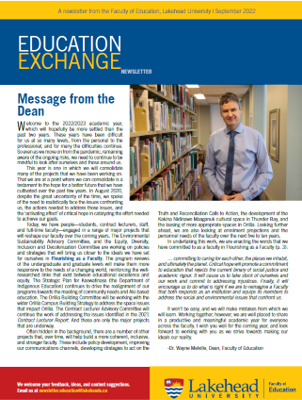
Faculty of Education Publishes Flourishing as a Faculty

Flourishing as a Faculty encapsulates the values of the Faculty of Education and will guide the Faculty’s program reviews and the next iteration of the Faculty Strategic Plan (2023-2028).

Developed collaboratively over 14 months of conversations, the Faculty of Education has identified and come to understand the values that will promote sustainability and human dignity such as equity, diversity, inclusion, reconciliation, and empowerment, both within the Faculty and in its relationships with the wider world. A diversity of issues and challenges, both tangible and intangible, are discussed in the document, alongside pathways for change at both the individual and Faculty level.

Developing an understanding of the values that the Faculty aspires to, and the work that will be required to realize those values, commits the Faculty of Education “to helping create the conditions by which all humans, all life, and the land can flourish. We strive to work and act in accordance with these values for the benefit of all.”

The document can be viewed here.

Flourishing as a Faculty document

Year of Climate Action Funding Awarded: “Benchmarking Climate Change Policies across Canadian School Boards”

Dr. Ellen Field (Assistant Professor, Education) is Principal Investigator on a research project that has been awarded funding from the Year of Climate Action fund. Ellen is working alongside co-investigator Dr. Muhammad Asaduzzaman (Assistant Professor, Computer Science) on this research project entitled Benchmarking Climate Change Policies across Canadian School Boards.

The research project, which will run from January-September 2022, will involve:

  • developing a web scraping protocol to collect data on climate change policies from school board websites across Canada;
  • quantifying the number of school boards that have developed climate change policies; and
  • publishing a report on climate change policies across Canadian school boards.

Currently, there is limited data as to how the formal education system is responding to climate change, and Ellen notes that this study will determine existing policies within school boards.

“After analysis, the findings will indicate where gaps in policy exist both quantitatively, in terms of number of school boards with policies, and qualitatively, in terms of content in climate change policies for ensuring education systems are responsive to preparing young people for the rapid change and uncertainty they will face in the next 30-70+ years,” she explains.

The research will culminate in a report that outlines recommendations for Ministries and school boards on administrative leadership on climate change. 

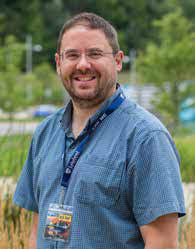
Pictured below: Dr. Ellen Field (Principal Investigator) and Dr. Muhammad Asaduzzaman (Co-Investigator)

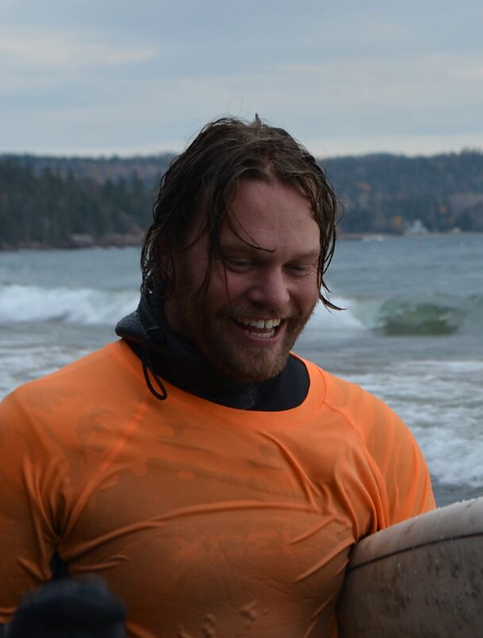
Professional Sports Photographer/Education Alumnus Mike Carlson says Lakehead University Changed His Life

Mike Carlson (BEd, 1993) knows firsthand some of the challenges faced by reporters today, especially with many people believing that the news is fake. 

Mike earned a Bachelor of Arts in English and a Bachelor of Education – both at Lakehead University. He is a professional sports photographer who has covered the National Hockey League, the National Basketball Association, the National Football League, and Major League Baseball. 

His advice to prospective journalists is that they must have persistence. 

“Journalism/photojournalism is a truly rewarding career, but with the recent developments in calling everything ‘fake news’ and disdain for the job by many – it does make it more difficult. 

“No one I know, and no one I’ve trained ever goes into it with an ‘agenda.’ I believe in presenting the truth without bias, and it’s an important trait for successful journalists,” he says, adding that it is also important for journalists to be multifaceted – so they can contribute in many different ways.

“I have the rare opportunity in professional sports to work with teams who have writers, videographers, and photographers – in many instances in journalism today one person should be prepared to do all of that,” he says. 

Based in Tampa, Fla., Mike also teaches digital multimedia courses at River Ridge High School. His students learn photography, illustration, graphic design, and video – skills they can eventually use in journalism. The school displays their work on its website and social media pages, among other places.  

It has been an interesting journey since he graduated from Lakehead University in the 1990s. In 1997, he moved to Istanbul to teach and bought a new printer that included a 35 mm film camera. 

“I figured since I was seeing a whole new world I may as well take some photos – and that’s when I became hooked,” he says. 

When Mike moved to Cairo, he would often visit a photography store owned by an Egyptian man who had lived in the US. That man soon recognized Mike had an eye for photography. 

“He gifted me an old Canon T50 – a fully manual film camera, which forced me to slow down and concentrate on all of the settings. This allowed me to really learn how all settings combined in a photo.” 

When his wife was diagnosed with terminal cancer, photography gave Mike a brief break from reality – and photography has continued to do that in the years since her passing.   

Mike, who grew up in Thunder Bay, says his favourite sport to photograph is either football or hockey. 

“I love the challenge of football because so much is potentially happening on every play. It means balancing three cameras and choosing a position carefully while at the same time reacting to the plays and fakes at NFL speed. It moves a lot faster down on field level. 

“But, I also love hockey – it’s the Canadian in me. It’s a different challenge shooting through a small hole in the glass and reacting at NHL speed . . . plus it’s a lot more comfortable in an arena than a 110 degree field in the Florida sunshine,” he says. 

Mike says the introduction of digital photography changed the game for professional sports photographers. 

“The challenge with digital in today’s world is the expectation that the results are delivered instantaneously, especially in sports. There is a constant race to have the photo out first. For most NFL games and big events, we all have internet-connected cameras that transfer photos of big plays to an editor, with the goal to have images available to post within a minute or less of them happening.” 

One of the highlights of Mike’s career occurred in 2013 when his photo of Alex Rodriguez ran on the cover of Sports Illustrated.

When he isn’t photographing winning touch downs or goals, Mike looks back fondly on the years he spent at Lakehead University, which he says changed his life.

“Being able to get into the concurrent education program allowed me to follow my passion at the time and get into education – both of my parents were long-time teachers in Thunder Bay,” he says. 

“It was also at Lakehead where I met and made connections to other teacher grads who headed out on the international school circuit and who introduced it to me.” 

While at Lakehead, he often frequented the Outpost Campus Pub. 

“I lived five minutes from campus, so the Outpost was where I spent time on campus with friends from out of town or who lived on campus. Studying, socializing, it gave me the chance to meet and get to know people who became life-long friends,” he says. 

Not only did Mike love attending school, he also enjoys teaching. Since graduating, Mike has taught in Canada, the United States, Turkey, Egypt, and Tanzania. 

“Through all of the diversity in schools/curricula/countries, the one thing that hasn’t changed is the students. Working with them on projects, on the fields, in the gym, in my studios, I just enjoy the energy and creativity (and chaos) of the teenage mind.

“It’s hard to truly explain, but a teacher will understand,” Mike says. 

Mike would love to hear from friends and former classmates. He is on Instagram (@carlsonphotos) and his website is mcarlson.photoshelter.com.

Pages