
Like Father, Like Son and Daughter

Monday, September 5, 2016 /

Dr. Somashekhar (Som) Naimpally, Lakehead University Professor Emeritus of Mathematics, published close to a dozen books and over 100 research papers in his lifetime.

His daughter Anuradha (Anu) and sons Shivshanker (Shiv) and Ravi were born in India. Som moved his family to several cities in the United States, Canada, and India before coming to Lakehead University as a mathematics teacher and researcher in 1971.

Their father was, his children say, endlessly passionate about math.

His success and passion for his work strongly influenced his children, as Anu and Shiv, both Lakehead alums, are deeply committed to their professions as well.

Anu is enjoying her 25th year as a dance professional. Both a performer and a teacher, Anu runs her own classical Indian dance school, Austin Dance India, in Texas.

After one year as a psychology major at Lakehead, Anu moved to India to study professional dance.  Three years later, she returned knowing she wanted to be a dancer and teacher. “I then took courses at Lakehead that I thought would benefit this role,” she says. “This was a great decision because some of the human development courses I took have been especially relevant to my work with children.”

Anu received her Honours Bachelor of Philosophy from Lakehead in 1986, then a Master of Fine Arts in Dance Ethnology from York University in ’88.

Shiv (BSc’79 in Mathematics/HBSc’85 in Computer Science) also took a roundabout path to his current profession. After many successful years with Nortel in software design, technical training, and marketing, he was laid off during the massive tech downturn in the early 2000s.

Having moved from Ottawa to Texas for a promotion, Shiv found himself starting over. While on contract with a local firm writing patent applications, he quickly became intrigued with the work and enrolled in law school to become a patent lawyer.

“Going to law school at the age of 45 seemed crazy at the time,” says Shiv, “but it worked out.”  He has written patent applications for many tech firms including IBM, AT&T, Microsoft, Amazon, Intel, and Dell.

“Having been a software designer, I have a deep understanding of the subject and am better able to grasp and explain the inventive concepts,” he says. “Working as a patent attorney is never boring because I get to learn new technology every week.”

Som and his wife Sudha were great lovers of the arts, particularly Indian classical music and dance – another passion passed down to their children. For this reason, both parents were very active in the community, bringing cultural and artistic events to the Thunder Bay area.

Anu teaches Bharata Natyam-style dance, which is the most popular of Indian dances, and shares this part of her culture with her community by participating in local festivals, events, arts education, and non-profit fundraising.

In 2015, she planned and conducted a performance tour for 36 people, including 18
of her dance students, to southern India. There, they performed at six historic temple heritage sites, honoured, she says, to share their art with local communities. “It was an unforgettable trip,” says Anu, “and I was humbled to travel as an official Cultural Ambassador for the City of Austin.”

Shiv, meanwhile, has developed his musical talents. He plays the tabla, a type of Indian hand percussion instrument. His father gave him lessons when he was 10, after which he pursued more serious training in India with his uncle, an accomplished tabla player.

“There were not many tabla players in Canada, so I was able to accompany many famous Indian musicians.” He performed in two concerts that the CBC broadcasted nationally. “I still remember what a thrill it was to get in my car and listen to my performance in Montreal on the radio!”

Shiv also played the tabla with the Ottawa-based Celtic folk band Imaginary Heaven, which has recorded several CDs. One of the songs he played on, Taken to Silence, was picked up by a major label for a compilation album called The Faire Celts. “It was so cool to discover the song while listening to the album at a Virgin records store in Texas!”

”Shiv still regularly performs with various artists and at fundraising concerts for causes like the India disaster relief and the Sankara Foundation (which provides free cataract surgeries in India).

Though Som passed away in 2014, his love of Indian art and strong belief in philanthropy live on. Anu and Shiv have made sure of that.

Tommy Sullivan Finds his Calling in Small-Town Alberta

Thursday, March 16, 2017 /

May 3, 2016, started out as an ordinary morning for Tommy Sullivan (BEd’13). He had no inkling that the wildfire roaring through northern Alberta would reach Fort McMurray that day.

The teacher and hockey coach left the Fort McMurray condo he shared with his wife Anna to drive to work at his school in nearby Fort McKay – a First Nation community of about 400. By lunchtime, smoke was rolling into the schoolyard, and at three o’clock, Anna sent him a photo of the fire nearing their condo building.

In a panic, Tommy rushed back to Fort McMurray. “Luckily a great friend got Anna out,” he says, “because when I got there, they were calling for a full evacuation.
Smoke was covering the city and the fire
was burning on both sides of the road.” Tommy headed back to Fort McKay – where the couple had an apartment – and Anna did the same. “Because Anna was stuck near the heart of ‘The Beast,’” Tommy says, “a journey north that normally takes 45 minutes, took
her four hours – the highway was jam packed with vehicles.”

The couple’s apartment quickly became a refuge. “At one point, there were about a dozen people staying there with us – friends, cousins, anyone who needed a spot. My school also became a shelter.”
Tommy and Anna were among the more fortunate survivors – when they returned to the devastated city, their condo was smoke damaged but still standing. Shortly after the fire, Tommy’s teaching contract ended and he was hired as the principal of the Sunchild First Nation’s K-12 school in the Rocky Mountain Foothills.

Teaching in Alberta is just the latest adventure in Tommy’s life. He grew up on a dairy farm in Earnscliffe, Prince Edward Island, and started playing hockey at the age of four – a sport that would shape his future. While studying international business at Saint Mary’s University in Halifax, he played Tier II junior hockey and became a Certified Hockey Canada Coach and International Ice Hockey Federation Coach.

After earning his Bachelor of Commerce in 2000, Tommy lived in Korea where he coached hockey at the international level and worked in the regular school system. He also helped open a private Korean kindergarten and started a soccer club that still exists today. After three years in the after school private sector, Tommy landed a teaching position at an international school in Taiwan.

Then in 2012, Tommy found himself at a crossroads. His Taiwanese school couldn’t rehire him because he didn’t have a teaching degree. Undaunted, he returned to Canada and was accepted into the one-year education program at Lakehead University’s Orillia campus. “I loved the community feeling in Orillia,” he says. It was a whirlwind year – in between studying, Tommy met and married Anna, a fitness trainer and dog groomer.

Today, Tommy and Anna are taking on new challenges. Anna works as an education assistant at Sunchild School and the couple runs a personal growth through hockey program in the summers.

“Sunchild is a really big hockey community,” Tommy says. “They’re excited because I’ve been taught by the coaches of NHL players Sidney Crosby, Connor McDavid, and Alexander Ovechkin.” In 2017, Tommy is embarking on the next chapter of his life – starting a master of education degree and, more importantly, he and Anna are adopting a child.

A Dedicated and Dynamic Public Servant

Monday, May 15, 2017 /

Annette Butikofer has always been a self starter who jumps in with both feet. Currently, she’s responsible for about 4,000 IT professionals in her role as information technology branch assistant commissioner and CIO with the Canada Revenue Agency (CRA). “My team provides IT development and support services to the CRA, as well as to the Canada Border Services Agency (CBSA),” she explains.

Annette’s willingness to challenge herself was apparent even during her undergrad days. The Thunder Bay native studied business administration, majoring in management systems. “In my third year, I was asked to lead the development of a cost accounting program on behalf of the School of Business,” she says, “an opportunity I probably wouldn’t have had at a larger university.”

Annette is a first-generation Canadian (her mother was from Finland and her father from Switzerland) who grew up in a family of five. “Finances were limited and I wasn’t able to go away to university like so many kids do these days,” she says. By chance, Annette had a Lakehead connection before she enrolled as a student. Her father 
had worked in the University’s maintenance department until he passed away in 1977 and was responsible for painting the original abstract designs in the underground tunnel. Annette describes her Lakehead years as wonderful. “Remaining in Thunder Bay to attend university was not just the only option, but history shows it was the best option!”

Annette graduated in 1985 with her bachelor’s degree and immediately started a one-year work exchange with Telecom Australia in Melbourne, Australia. She was able to participate in this adventure through AIESEC, an organization that describes itself as “the world’s largest youth-led network creating positive impact through personal development and shared global experiences.”

Annette trained as a programmer/analyst and worked with four different project teams. “I gained analysis and programming experience across different technology platforms which made me very marketable.” When she returned to Canada in 1986, she was quickly hired by Woods Gordon Consulting and the Hudson’s Bay Company in Toronto.

Her switch to the public sector happened in 1991 when Annette joined the Canada Revenue Agency in Ottawa. She also continued her educational journey. In 1992, she became a Certified Management Accountant (CPA, CMA) and in 2013, she obtained a certificate in Public Sector Leadership and Governance from the University of Ottawa. Her leadership skills and work ethic have been noticed. In 1996 when Annette was a team leader, she was selected to represent the Information Technology Branch in the CRA’s executive development program. In 2009, she led the CRA team that won the gold medal for the Managed Distributed Environment (MDE) program in the IT Operations category and in 2014-15, she led the team that was given the CRA Award of Excellence in the Connie Roveto Governance Award category for Local Solutions Governance.

Despite all the accolades, she counts her family as her greatest joy. “I have two daughters, Véronique and Geneviève, and each and every day, they remind Paul and me of the importance of family.” Annette tries to spend as much time as possible with her children and when they were younger, she was an enthusiastic volunteer with their dance school and soccer associations.

Annette is a strong believer in “being open to opportunity, even if it scares you, because not only will you develop on a personal level, it will lead to new paths on a professional level.” She also encourages Lakehead University students and alumni to consider the diverse, and rewarding, government careers that are available to them. “Your public service needs you!”


An Ironman with a Giant Heart

Monday, October 7, 2019 /

Brent running

One winter, former Thunder Bay deejay Brent Hawley (BA’01) packed up his belongings, sold off most of his real estate holdings, and moved to Hawaii.

After two decades in Northwestern Ontario, Brent had landed a job as a media management consultant for the largest group of radio stations in the Hawaiian Islands – the Pacific Media Group (PMG) in Kailua-Kona.

The position fit perfectly with Brent’s experience in the music industry and meant that he was in a place where he could “swim with turtles and manta rays and watch dolphins glide by my office window.”

Now, Brent has embarked on another major career shift. In December 2018, he relocated to Tampa, Florida, to become the IRONMAN Foundation Director of Development and Marketing – the charitable arm of the IRONMAN triathlon.

“Our athletes have built orphanages in South Africa, purchased lifesaving equipment for hospitals, and provided clean water in Puerto Rico in the aftermath of Hurricane Maria,” Brent says. “This job combines my passion for sport, my entrepreneurial spirit, and my legacy of leaving something positive in racing communities. It’s everything I’ve ever wanted all in one.”

Brent’s interest in endurance sports began after a serious motorcycle accident put him in a brace for eight months and left him barely able to walk. When his doctor recommended exercise as part of his rehabilitation, Brent made a snap decision. “I’ve always an extreme person, so I registered for a Team Diabetes marathon in Honolulu.” His father had type 2 diabetes and the idea of raising money to fight the disease was appealing. “It’s a global pandemic,” Brent explains, “more people die of complications from diabetes than cancer.”

Since his first marathon in 2009, Brent has generated over $150,000 for diabetes research for the Canadian Diabetes Association (CDA) and raced in Antarctica, Rome, Iceland, Peru, Honolulu, and Edinburgh. Initially, Brent’s embrace of athletics was a surprise to his friends and colleagues – his focus had always been music, not health and fitness. Not long after he moved from southern Ontario to attend Lakehead University, he established a successful DJ business, 2-Tone Music. The company was a regular fixture at Thunder Bay weddings and special occasions, including major charity events where Brent volunteered the company’s services. As well as running 2-Tone and taking classes, he was active in the Lakehead University Student Union during his undergraduate days.

Brent stayed in Thunder Bay after he’d earned his BA and was hired by Dougall Media – which owns several local radio and TV stations – and hosted a morning radio show for 15 years. It was on a dare from his co-host that Brent became a triathlete.

“We were chatting on air,” Brent recalls, “when he said to me, ‘You did that marathon, but if you want to be a real legend, you need to do an Ironman.’ By the end of the show, I’d registered for the 2011 triathlon in South Africa.” Since then Brent has competed in triathlons in Austria, Switzerland, Italy, Australia, and in Kona, Hawaii, at the IRONMAN World Championship. So when the opportunity to work for the IRONMAN Foundation opened up, Brent jumped at the chance. He also continues to compete in triathlons.

“Races are mentally tough and you’re in pain,” he says, “but nothing is more gratifying than finishing. The hardest part, really, is tying up your shoes every morning.”

Giving Kids Someone to Lean On

Monday, November 4, 2019 /

Matthew at Big Brothers Big Sisters Conference  (Photo courtesy of BBBS)

Being a kid isn’t easy, and when everyday struggles are combined with challenging situations, a child’s self-esteem can plummet.

Matthew Chater, the President & CEO of Big Brothers Big Sisters of Canada, believes that having a mentor can help turn things around for young people.

“I lived through bullying and isolation myself,” he says. “As a gay youth, I was targeted as different.”

Instead of letting this experience make him retreat from the world – Matthew who grew up in London, Ontario – became a champion for other children facing hardships. As a high school student, he did co-op placements as an elementary school education assistant and he volunteered with Big Brothers Big Sisters (BBBS).

“Through my volunteer work I was able to share tools to navigate adversity with my ‘Little Brother,’” Matthew says. “When pro-social adults mentor young people, it builds up their confidence. They have to see it to be it.”

In university, Matthew studied psychology and education at Lakehead’s Thunder Bay campus and every summer he worked as a camp director with the YMCA of Western Ontario. His goal was to build a career focused on helping young people thrive and excel.

After graduating from Lakehead, Matthew returned to London to do a master’s degree in educational policy at Western University. It was also an opportunity to begin volunteering with Big Brothers Big Sisters again. While he was in the London BBBS office, a job posting for a mentoring coordinator caught his eye. “I’d been looking for part-time work while I was doing my master’s,” he explains.

It soon became a full-time role and Matthew rapidly worked his way up the ranks, eventually becoming the CEO of Big Brothers Big Sisters of London and Area. Then, in May 2018, Matthew was chosen as the President and CEO of Big Brothers Big Sisters of Canada, headquartered in Toronto.

Big Brothers Big Sisters of Canada is a federated organization comprised of 102 member agencies serving more than 1,100 communities across the country. Participation in BBBS programs supports social emotional competence, mental health and wellbeing, and educational and employment readiness.

“In the past,” Matthew says, “Big Brothers Big Sisters has been seen as a nice service, but not an essential service. This needs to change.”

Well-established brain science has found that childhood adversities can create toxic stress that negatively affects brain development. Fortunately, these effects aren’t irreversible.

“Research demonstrates that relationships and mentorship can help build the brain back up,” Matthew says. “Mentored youth and children are two times more likely to stay in school, more likely to get a higher paying job, and give back to their community.”

Matthew prides himself on the fact that BBBS is there to ensure that all young people realize their full potential – newcomers, Indigenous people, individuals with disabilities, children in care, children from single-parent homes, and urban, rural, and LGBTQ youth. He recognizes that young people’s needs are complex and that developmental relationships are crucial to their wellbeing and future success.

“When I was a kid and I was facing a tough moral or ethical dilemma,” Matthew says, “I would always ask my grandmother for guidance and advice. I want all young people to have opportunities to build networks of support through intentional mentorship.”

An Inspirational Student

Wednesday, April 19, 2017 /

Lakehead’s Thunder Bay campus was the last place that fine arts student Vanessa Magee thought she’d end up. “I didn’t enjoy high school and I didn’t think I was smart enough for university,” she explains.

As soon as she finished grade 12, Vanessa entered the labour force. She worked in the retail and service sectors before landing a job in the housekeeping department of Thunder Bay’s regional hospital.

Things were running pretty smoothly until April 2008 when Vanessa was struck by a mysterious fever. Her immune system began attacking her nervous system, resulting in a loss of physical mobility. Even with rehabilitation, Vanessa could no longer do her job.

Three years later, she was still battling health problems and trying to figure out how to turn her life around. She happened to pour out her troubles to a man sitting next to her on a flight to Toronto.

He listened and then asked, “Have you ever thought of going back to school?” before rummaging around for a piece of paper. On it, he scrawled the name “Humanities 101,” his name and email, and a colleague’s name and email.

Humanities 101 is Lakehead’s free semester-long, non-credit program that introduces community members to the university experience – in particular, people facing social or economic barriers to postsecondary education.

When Vanessa got home, she Googled her seatmate’s name and discovered it was none other than the current principal of Lakehead’s Orillia campus, Dr. Kim Fedderson. The first Humanities 101 class was the next evening so “I became a Lakehead student 14 hours after my fateful flight,” Vanessa says. It was a step she would have been terrified to take before her chance encounter. “When you look at Lakehead from the outside, it’s like this monster,” she says.

This perception soon changed and at the end of the course, she was chosen as class valedictorian. At the graduation ceremony, Vanessa said: “Every lecture was stimulating and there was something to learn from each one, and more important, something to learn about yourself in the process.”

After completing Humanities 101, Vanessa immediately enrolled in Lakehead’s Fine Arts program as a part-time student and found that she had a special talent for ceramics and sculpture.

She's now won multiple awards in Lakehead’s annual Juried Student Art Exhibition, including an Alumni Association Award for a ceramic piece called “Doggy Bag.” The artwork is a commentary on how some people treat animals like trophies. It’s a ceramic purse in the shape of a dog triggered by what Vanessa describes as ‘the Paris Hilton effect.’ The celebrity socialite was constantly photographed carrying her pet Chihuahua around in her purse. She spawned a legion of copycats who “bought baby Chihuahuas and then abandoned them,” Vanessa says. “They’ve had to start Chihuahua farms to try to rehabilitate these dogs who can’t walk because they’ve been carried their whole life.”

Although Vanessa has a job she enjoys at Lakehead Ironworks Inc., earning her degree is opening doors. She’s considering a career in art therapy – a field she’s drawn to because the act of creating has had such a powerful effect on her life. “Art changed the way I dealt with my illness. When I was struggling, it shone a little light.”


If you'd like to help other students like Vanessa continue their journey to life-long learning, please consider donating to the Lakehead Annual Fund.

Teaching, Technology, and the Tragically Hip

Monday, June 19, 2017 /

Lyrics made popular by classic rock band The Tragically Hip wafted through the door of a tenth-grade classroom this past autumn.


“Wheat kings and pretty things
Let’s just see what the morning brings
Wheat kings and pretty things
Oh, that’s what tomorrow brings…”


Inside, an unconventional history class was taking place at Thunder Bay’s Superior Collegiate and Vocational Institute.

The teacher – Lakehead alumna and Tragically Hip fan Vicky Walker (BA’96/BEd’96) – used the songs of the iconic band as a pathway into exploring Canadian history and identity. Her ambitious pilot project was designed with the support of TeachOntario. TeachOntario is an initiative to help educators to stay up-to-date on 21st-century teaching and learning pedagogy, digital tools, and collaborative professional development. Improving student outcomes is another key goal of TeachOntario, which was developed by TVO in partnership with the Ontario Teachers’ Federation, its affiliates, and the Ministry of Education.

In Vicky’s class, music was the jumping off point for students to create online blogs, videos, and artistic endeavours related to their topic. Cameron Padovese, for example, says that the themes explored in Tragically Hip frontman Gord Downie’s lyrics sparked his imagination: “I tried to formulate some ideas and I converted them all to paintings that I’m really excited about.”

“It’s a different way to engage,” Vicky says. “It allows students the freedom to really explore Canadian history and identity in a way that appeals to them.” She describes Superior Collegiate as a small, safe, and accepting school. “Both of my daughters go there. It’s a hidden gem – it’s high tech and modern for those students that want to explore technology in ways not available in other schools.”

Vicky, who grew up in Orillia, hadn’t planned on a career in education – many in her family were teachers and she wanted to set her own course. But she changed her mind after becoming a swimming instructor while attending Western University. Realizing that teaching was a natural fit, Vicky enrolled at Lakehead to finish her undergrad studies and to get her education degree. The appeal of Lakehead was, like Superior CVI, its small size and welcoming atmosphere.

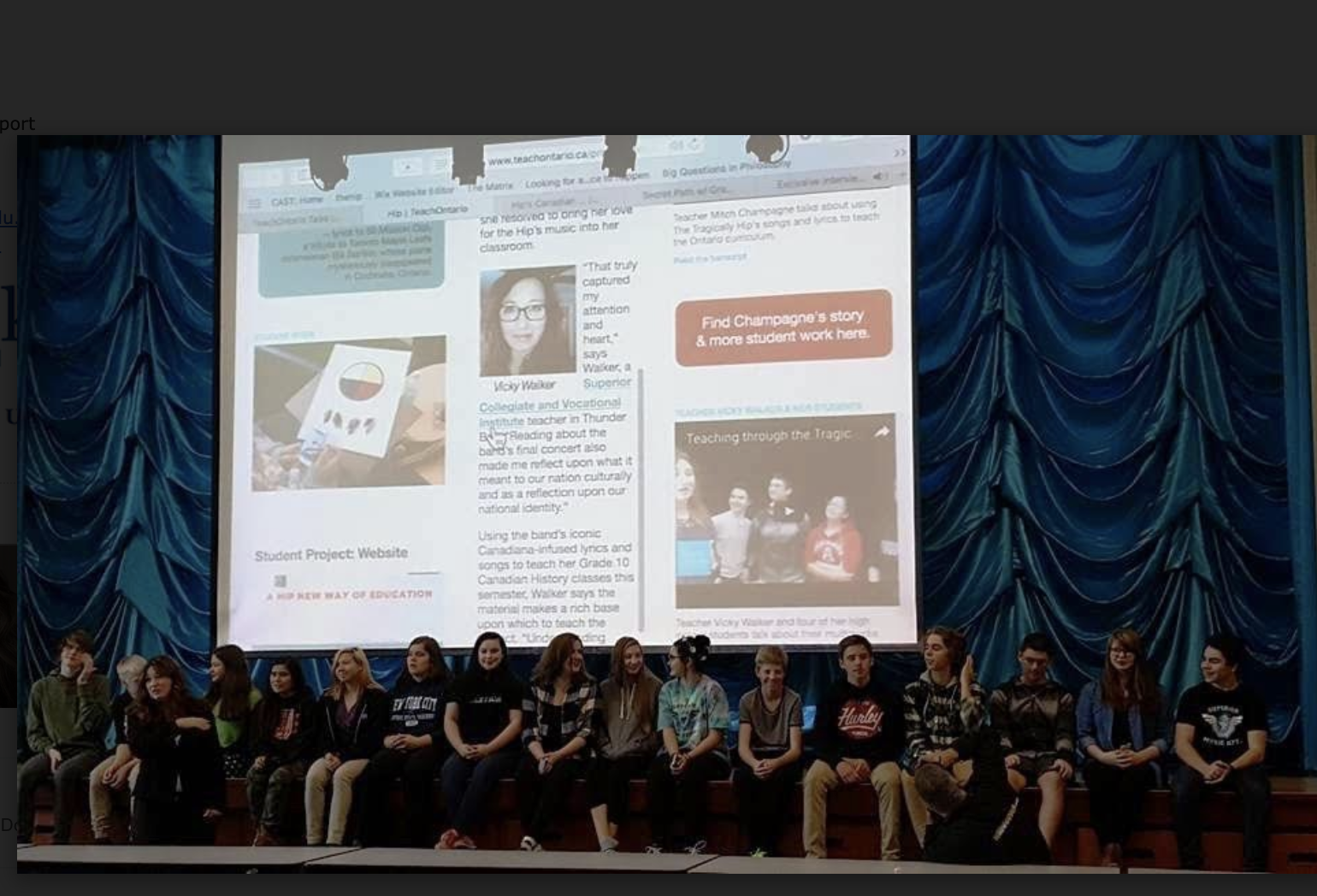
Pictured right: Vicky and her grade 10 history students share their thoughts about school, music, and technology at a media conference for the TeachOntario Talks series. The students discussed learning about Canadian identity through the songs of the Tragically Hip and Gord Downie’s latest album “The Secret Path.”

Now Vicky is at the forefront of a movement to change traditional teaching methods. Instead of fighting today’s technology-driven reality, she’s embracing it and using it to its fullest potential. “We don’t just read out of textbooks anymore,” she says. “Everything is filtered through the technology students have in their hands. If you don’t use the technology, they’ll be sitting staring under their desks, texting.”

Digital games, iPads, and Google searches are just a few of the ways she integrates technology into her classroom. Her students use group chat apps to share notes and information. Her classroom website contains every resource a student needs – from worksheets to PowerPoint presentation to videos.

Vicky believes her approach to teaching requires her students to take more responsibility for their education. “School is a lot more inquiry-based now. We teach kids how to research and think critically rather than focusing on memorization and rote learning.”

As well as teaching high school law, history, and philosophy, Vicky is a sessional lecturer with Lakehead’s Faculty of Education where she has taught Indigenous Curriculum and Literacy Instruction courses. She is also doing a master’s in Instructional Design and Technology at the American College of Education.

“I’d like to continue pushing the boundaries of 21st-century learning and make students lifelong learners.”


Check out this video interview with Vicky’s students and discover how they immersed themselves in Canadian history through music:

https://www.teachontario.ca/videos/4681

Launching NASA Telescopes on Outer Space Odysseys

Monday, November 6, 2017 /

Colette Lepage (BEng’99) woke up with a sense of dread on the morning of May 11, 2009. The Space Shuttle Atlantis was preparing to blast into space for the final servicing of the Hubble Space Telescope and Colette – a National Aeronautics and Space Administration (NASA) engineer – would be there for the launch at the Kennedy Space Center.

“We’d lost two shuttles already,” she says, “so we could have lost all of our hardware and watched seven people die.” The Lakehead chemical engineering grad had been in the shuttle bay with the astronauts in the days leading up to the countdown “inspecting practically every centimetre of the hardware for contamination.”

Colette’s path to joining NASA’s team wasn’t the usual one. She is a small-town Canadian girl whose curiosity about the universe was sparked by the clear night skies over the outskirts of Sudbury, Ontario, where she grew up.

Pictured right:  Colette near Shuttle Atlantis during roll out to launch pad

After getting a Chemical Engineering Technology diploma from Cambrian College, she worked for several years before applying to Lakehead’s faculty of engineering – afraid she wasn’t smart enough, but knowing she’d never forgive herself if she didn’t try.

Not only did she finish her degree, Colette soon landed a job as a control contamination engineer at NASA’s Goddard Space Flight Center in Greenbelt, Maryland. By the time of the Hubble mission, she was managing one of the largest clean rooms in the world – the Spacecraft Systems Development and Integration Facility (SSDIF) – which keeps airborne and molecular contaminants away from aerospace components during assembly and testing.

Then from 2009 to 2017, Colette was part of a team of international scientists constructing the largest telescope ever built – the James Webb Space Telescope. “It will look back in time to capture the first light after the Big Bang 13.8 billion years ago.” Colette, who’s now working as a NASA consultant, may be travelling to South America to support the telescope launch in 2019.

The James Webb will change how we understand the universe. Reflecting on her own experiences, Colette says, “Nothing about my life is what you would expect. I’ve learned that you never know how things will turn out, so just keep trying.”


View the Webb Telescope Milestone: Completion of Telescope Element Video

https://www.youtube.com/watch?v=r1ybe4yr2no

Into The Deep

Monday, August 7, 2017 /

Last summer, Jason Epp (BEng’15, Electrical) descended 700 feet into the Atlantic Ocean to document a World War II battlefield that had never been seen by the human eye.

An embedded systems developer at 2G Robotics in Waterloo, Ontario, the Lakehead alumnus was part of a team of scientists and explorers assembled by the National Oceanic and Atmospheric Administration (NOAA). Together, they embarked on a 15-day expedition surveying WWII shipwrecks lost in the Battle of the Atlantic. Watch the expedition highlights (2:02 runtime)

“It was the first time I’d physically gone underwater in a submersible,” Jason says. “Generally our underwater laser scanner systems integrate with remotely operated vehicles (ROVs) or autonomous underwater vehicles (AUVs) and we’re in a command centre running our instruments from the surface – you aren’t actually sitting in a submarine exploring the ocean floor.”

The Battle of the Atlantic was a protracted naval campaign that changed the course of the war. The Allies blockaded Germany and the Germans retaliated by blockading Europe. One skirmish in the six-year battle took place in July 1942 when a convoy of Allied merchant ships bringing supplies to England was targeted by a German submarine off the coast of North Carolina. It torpedoed the freighter SS Bluefields before being destroyed by a depth charge.

Pictured right:  the two-person submersible that alum Jason Epp boarded last summer to survey shipwrecks can travel up to 20 km per hour and can stay underwater for 10 hours.

“Seeing the battlefield was surreal,” Jason says. “Because of the Gulf Stream, we had to descend in the submersible several hundred metres from the site. As we made our way closer to the wreck, we started seeing more and more fish, and then all of a sudden the U-576 submarine came into view. It was covered in barnacles and stood five metres off the bottom and you could see the whole hull from bow to stern.” Although weather challenges cut the mission short, it was an exhilarating experience for the amateur scuba diver.

Documenting the historic and ecological significance of the wrecks is just one highlight in Jason’s career. His job with 2G Robotics has taken him around the world, operating equipment on projects in Finland, the Netherlands, the United States, Norway, and even the Baltic Sea.

Originally from Ayr, Ontario, Jason enrolled in Lakehead’s electrical engineering program in September 2013. He’d already earned a diploma in electronics engineering technology from Conestoga College and was employed as an engineering technician at BlackBerry.

“I’d heard that Lakehead’s engineering faculty offered a college transfer option as part of their degree program,” Jason says. “Much of the department I was working in at Blackberry was disappearing, so it seemed like the right time to challenge myself further.”

The control systems engineering classes taught by Professor Abdelhamid Tayebi piqued his interest in robotics and within months of graduating with first class standing, Jason was hired by 2G Robotics. “No two days are ever the same,” he says. “The work never gets stale.”

For more details on the expedition click here.

Adventures in Forestry

Monday, February 5, 2018 /

Stephanie Seymour’s (MSCF'16) mother likes to tell her, “We gave you roots but we also gave you wings.” It’s advice that’s served Stephanie well. In July 2017, the Lakehead PhD student embarked on a career in natural resources. She now works for the Toronto branch of Ontario Power Generation (OPG) as a management and professional trainee in the Indigenous Relations Department.

Stephanie’s affinity for the outdoors emerged early in her life. A member of the Garden River First Nation, she grew up on St. Joseph Island – a small community about a 45-minute drive from Sault Ste. Marie, Ontario. “I spent most of my time in the bush hiking, camping, and hunting,” she says.

When Stephanie finished high school, she had some clear ideas about her future. “I knew that I wanted to work with Indigenous communities – especially in forestry.” In 2007, she took field naturalist courses at Sault College and completed a Forestry Technician diploma at Fleming College, but this would be just the first leg of her educational journey.

Stephanie then went to the University of New Brunswick and earned a Bachelor of Science in Forestry in 2013 before enrolling in Lakehead University’s Master of Science in Forestry program. She was attracted to Lakehead by the reputation of Professor Peggy Smith, who would become Stephanie’s thesis supervisor. “Peggy took me under her wing and encouraged me to persevere and grow as a young Indigenous professional,” she explains.

In December 2015, Stephanie received her master’s degree and entered Lakehead’s natural resources management PhD program. “Everywhere I went, I found a friendly face and support when I needed it. My Lakehead experience was exceptional!”

For her master’s thesis, Stephanie took the lead on a green energy research project, specifically, ways to reduce diesel consumption in small northern communities. “These places still rely on diesel-generated electricity to power their homes and offices,” she says, “which is a costly energy source that pollutes the environment.” Stephanie explored the feasibility of switching to biomass fuel – wood waste left over from the processing of pulp and paper products. Her work would garner her the 2016 Student Researcher of the Year award from the Biomass North Development Centre.

Stephanie combined her challenging academic schedule with volunteer work. One of the highlights was reaching out to young people through Lakehead’s Aboriginal Mentorship Program (AMP). “AMP increases Northwestern Ontario high school students’ interest in science and exposes them to educational and career paths,” she says. “I enjoyed watching students tackle science experiments and motivational challenges and seeing all the ideas they came up with – ideas I hadn’t even thought about!”

Now that Stephanie has launched her OPG career, she is excited to have an active role in stewarding Ontario’s resources and promoting sustainable energy solutions. “As a society, our values are constantly shifting and evolving. It can make managing natural resources and planning for future resource use a fascinating and dynamic landscape.”

Stephanie also has ambitions in the realm of policymaking. “I’d like to be the first Indigenous minister of natural resources and forests – we haven’t had one yet.”

In 2015, Stephanie was a speaker at an international conference hosted by Escuela Superior Politécnica de Chimborazo (ESPOCH) - a public university in Riobamba, Ecuador. The conference focused on resource development and the challenges and opportunities it presents for communities across the globe. This photo was taken on "The Devil's Nose" train trip - a stretch of the Trans-Andean rail line that climbs more than 500 meters in less than 12 km with steep ascents and descents. The excursion gave Stephanie a hands-on experience of responsible tourism that supports local communities and showcases local culture.

In 2015, Stephanie was a speaker at an international conference hosted by Escuela Superior Politécnica de Chimborazo (ESPOCH) – a public university in Riobamba, Ecuador. The conference focused on resource development and the challenges and opportunities it presents for communities across the globe. This photo was taken on “The Devil’s Nose” train trip – a stretch of the Trans-Andean rail line that climbs more than 500 meters in less than 12 km. The excursion gave Stephanie a hands-on experience of responsible tourism that supports local communities and showcases local culture. 

To find out more about Stephanie, check out this video interview:

https://www.youtube.com/watch?time_continue=344&v=eVc7fVej7d0

Pages