Insect Husks, Old Tires, and Biodegradable Mulch
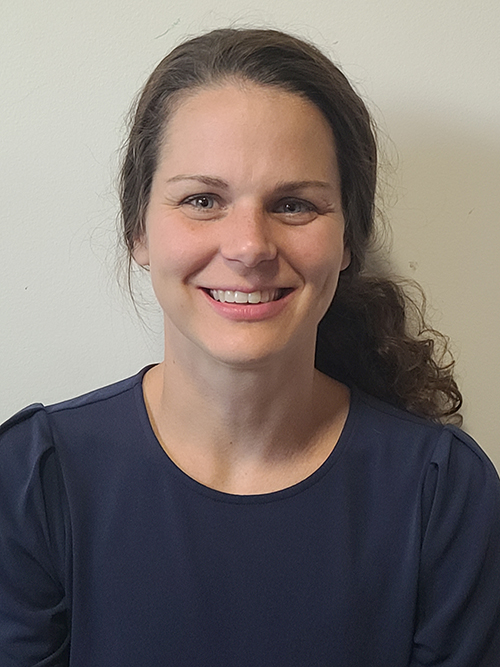
Dr. Snyder is a Georgian College health and wellness science professor who teaches chemistry, physics, and mathematics in addition to conducting research.
Have you ever given much thought to the discarded shells left behind by bugs when they molt and grow larger?
Lakehead alum and Georgian College professor Dr. Kayla Snyder (HBASc’13, BEd’13, MSc’15) certainly has.
She’s collaborating with Lakehead physics professor Dr. Chris Murray—her former mentor—to convert this bug molt into sustainably-made agricultural and medical products.
“Anything that has an environmental impact interests me as a researcher,” Dr. Snyder says.
The Benefits of Bugs
Bug shells are made of a polysaccharide called chitin that makes them hard and waterproof.
Dr. Snyder and Dr. Murray are experimenting with new ways to convert this bug molt into a polymer that’s currently used in a multitude of products—including hand sanitizers, wound dressings, protein powders, and fertilizers.
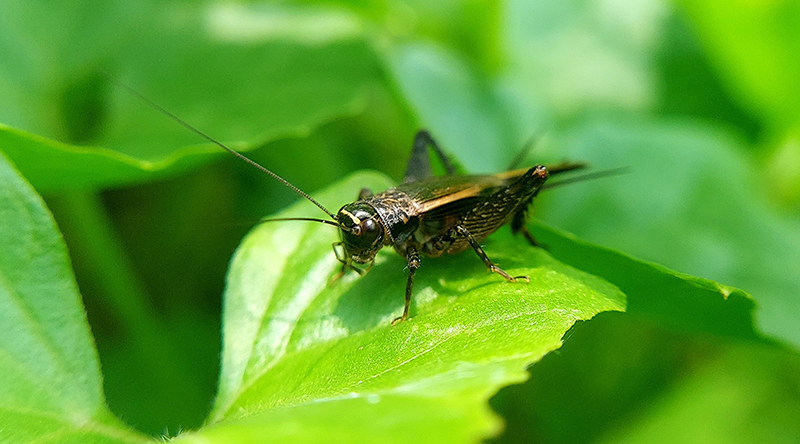
Dr. Snyder’s research into bug molt is being supported by Georgian College’s Department of Research and Innovation. “I don’t think I could eat a whole cricket, but I’d be willing to try cricket protein powder,” she says. Photo Credit: Pexels/Marshall Hembram
“We’re focused on the cricket and mealworm industries,” she says. “They grow insects commercially as food for pets, zoo animals, livestock, and even humans. But bug molt is often treated as a waste byproduct. We want to change that.”
An Environmentalist in the Making
Dr. Snyder’s love of tackling complex socio-ecological challenges began at Lakehead.
As an undergraduate student in the fledgling Honours Bachelor of Arts and Science program, she became one of Dr. Murray’s research assistants.
“His enthusiasm for science and environmental sustainability is contagious,” she says.
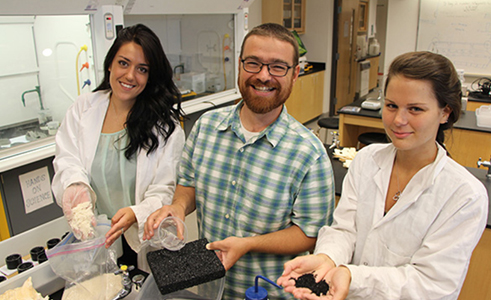
“For one project, we investigated how to turn old rubber tires into filters for water treatment plants. Since filters can be expensive, we wanted a common waste product capable of removing pollutants.”
Similarly, they developed prototypes for rubber filters that farmers could install at the edge of fields to stop phosphorus, a fertilizer ingredient, from draining into streams and rivers.
“Phosphorus is a big problem in agriculture,” Dr. Snyder explains. “It leads to excessive nutrients in water systems that cause toxic algae blooms. These blooms choke out plant life and kill off fish.
We also wanted to lower farmers’ operating costs by helping them capture and reuse phosphorus.”
A Researcher for the Real World
Dr. Snyder pursued a Master of Science in Chemistry at Lakehead after receiving Bachelor of Education and Honours Bachelor of Arts and Science degrees.
It gave her the opportunity to dive into another pressing agricultural problem—figuring out why a biodegradable plastic mulch film wasn’t breaking down the way it was designed to.

As a Lakehead master’s student, Dr. Snyder evaluated the effectiveness of a biodegradable mulch film at the Orillia Campus Research Garden. “Biodegradable mulch film breaks down into hydrogen and carbon, making it less harmful to the environment,” Dr. Snyder says. Photo Credit: Pexels/Jonathan David
Farmers use plastic mulch films to cover plants because they lengthen growing seasons, prevent soil erosion, stop weeds from growing, and protect crops from rotting.
The mulch manufacturer whose products Dr. Snyder was testing had been selling their products in Europe without any issues. “It saved time and money because farmers didn’t have to remove and dispose of the films every year.”
Through her research she discovered that the pesticides being sprayed on crops interfered with the decaying process. “Farmers had to stop using either the pesticides or the biodegradable film.”
Junk Drawer Genius
Since 2021, after earning a PhD in Chemistry at the University of Guelph, Dr. Snyder has been a Georgian College faculty member where her time is split between research and teaching.
She’s also recently begun tapping into her entrepreneurial talents.
“Having daughters in grade 1 and grade 3 made me realize that elementary schools often don’t have enough resources for science classes.”
This led to the idea for a unique hands-on science company called Junk Drawer Genius.
Dr. Snyder’s company will show teachers how to do curriculum-related experiments without purchasing expensive equipment. Instead, they’ll use commonplace items they already have.
She describes Junk Drawer Genius as a passion project that she hopes will foster young scientists and environmentalists.
“Everything on our planet is a limited resource. We need to take care of it so that future generations actually have an Earth.”