
Fighting for Justice
Cora McGuire-Cyrette was born into advocacy. “My grandparents Annie and Patrick McGuire were founding members of the Métis movement in Ontario and I’m a proud member of Bingwi Neyaashi Anishinaabek First Nation.”
Cora is the Chief Executive Officer of the Ontario Native Women’s Association (ONWA)—the largest and oldest Indigenous women’s organization in Canada. Her leadership of ONWA has been remarkable. She has doubled ONWA’s programs, boosted its size by 400 per cent, and increased its services to over 30,000 people across Ontario.
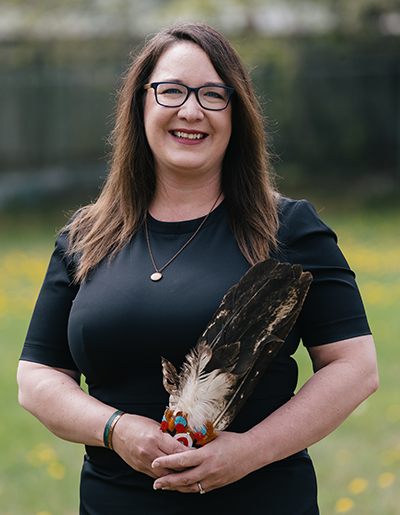
Cora believes that it’s important to be a role model because representation matters. “I see Indigenous women leading every single day and they should be recognized every single day.”
“ONWA is the result of Indigenous women mobilizing to solve the issues they face collectively,” Cora says. “We are an advocacy and a research agency as well as a charity and a frontline service provider—it’s a unique approach.”
Some of ONWA’s essential services include anti-human trafficking support, diabetes education, housing services, suicide-prevention support, help escaping family violence, and land-based healing camps.
Cora’s rise as an activist can also be traced to her mother, sociologist Dr. Patricia McGuire.
“My mom really pushed me to go back to school,” Cora says, “and I wanted to help Indigenous people by learning how Canada’s political system operates so that I could challenge that system.” This desire for change spurred Cora to complete a Bachelor of Arts specializing in sociology and Indigenous learning at Lakehead University in 2004.
“As an Indigenous woman, it felt like there were barriers around every single corner—daily racism, unaffordable housing, the high cost of food. This laid the foundation for my advocacy work, as did the murder of my cousin, Jamie McGuire, who visited Winnipeg over 30 years ago and never came home.”
“I’ve talked to many women and girls and they’re facing very similar barriers to what I faced decades ago,” Cora continues, “which speaks to the persistence of the systemic racism we see manifested in the high rates of imprisonment and high rates of violence against Indigenous women.”
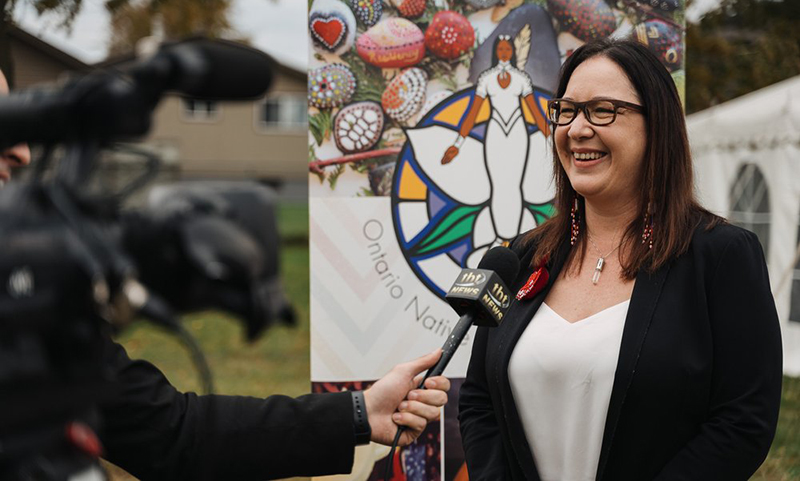
Cora speaks at the 2022 Sisters in Spirit Vigil event, which honours the lives of missing and murdered Indigenous women and girls.
Indigenous women, though, are resilient. They are doing everything from raising awareness of violence in their communities to fighting for clean waterways. “Without their tireless grassroots work, the National Inquiry into Missing and Murdered Indigenous Women and Girls (MMIWG) would never have happened,” Cora says.
Persistence is a crucial part of being an advocate—Cora says it usually takes about 10 years before they see an initiative come to fruition.
“In 2007, I coordinated a summit to end violence against women. As a direct consequence of this summit, the Ontario government announced its $100-million Walking Together strategy in 2016.”
Cora’s advocacy extends to the world stage as a member of the United Nations’ Permanent Forum on Indigenous Issues and the Committee for the Status of Women. And in 2021, she was named one of Canada’s Most Powerful Women by the Women’s Executive Network.
“To Indigenous women I’d like to affirm: Our communities need you—your leadership is required in all spaces, from your families to elected positions,” Cora says. “To our allies, I urge you to take one of the Truth and Reconciliation Commission’s calls to action and push it forward.”
